AI For Company
146 min read10 views

How to Learn AI for Developers: A Complete Guide

By TechPratham TeamPublished August 18, 2026Updated August 18, 2026

Artificial intelligence is changing the way software is designed, developed, tested, deployed, and maintained. Developers are no longer limited to traditional programming workflows. They can now use Generative AI, Large Language Models (LLMs), AI APIs, Retrieval-Augmented Generation (RAG), AI agents, and automation tools to build intelligent applications and improve software development processes.
However, learning AI as a developer is different from learning AI purely from an academic or theoretical perspective. Developers need to understand how AI technologies work and how to integrate them into real software applications.
This guide explains how developers can learn AI step by step, which skills matter, which technologies to focus on, what projects to build, and how AI development skills can support long-term career growth.

What Is AI for Developers?

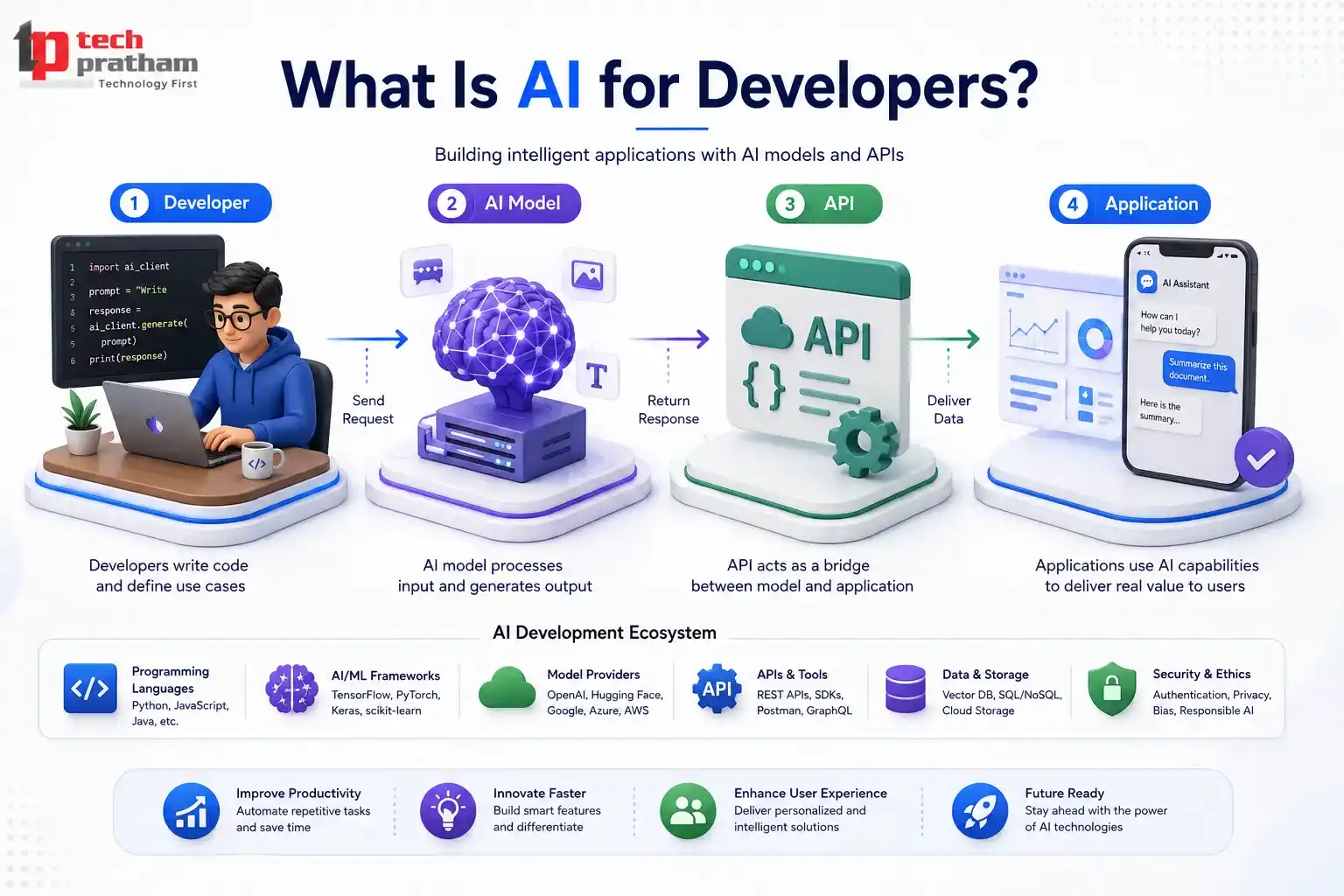
What Is AI for Developers?

AI for Developers refers to the skills, technologies, tools, and development practices used to build software applications that incorporate artificial intelligence.
Instead of treating AI as a separate field, developers can combine their existing programming knowledge with AI capabilities to create applications such as:

  • AI-powered chatbots
  • Intelligent search systems
  • Recommendation engines
  • Document analysis applications
  • AI assistants
  • Automated workflows
  • Content generation applications
  • Code-generation tools
  • Customer-support solutions
  • AI-powered business applications
Modern AI development can involve programming, APIs, machine learning concepts, LLMs, prompt engineering, RAG, vector databases, AI agents, and cloud-based AI services.

Why Should Developers Learn AI?

AI is becoming part of mainstream software development. Developers who understand how to integrate AI into applications can work across traditional software engineering as well as emerging AI-powered development roles.

Learning AI can help developers:
  • Build intelligent software applications
  • Integrate LLMs into existing applications
  • Automate repetitive development tasks
  • Work with AI APIs and models
  • Develop AI-powered business solutions
  • Understand Generative AI workflows
  • Create AI agents and automated systems
  • Improve productivity with AI coding tools
  • Expand their software development skill set

The goal is not necessarily to become a machine learning researcher. For many software developers, the more practical objective is to learn how to use AI technologies to solve real development problems.

What Skills Do Developers Need to Learn AI?

AI developer skills learning roadmap
There is no single skill that makes someone an AI developer. A strong learning path combines software development fundamentals with AI-specific technologies.

1. Programming Fundamentals

A solid programming foundation is still essential.

Developers should be comfortable with concepts such as:

  • Variables and data structures
  • Functions and classes
  • APIs
  • Object-oriented programming
  • Databases
  • Version control
  • Debugging
  • Testing
  • Software architecture
Python is particularly useful because of its extensive AI and machine learning ecosystem, although developers can use other programming languages depending on the application and technology stack.

2. Understand Machine Learning Fundamentals

Developers working with modern AI do not always need to become machine learning specialists, but understanding basic concepts can make AI implementation easier.

Important concepts include:
  • Training and inference
  • Supervised and unsupervised learning
  • Classification
  • Regression
  • Model evaluation
  • Features and datasets
  • Overfitting
  • Model performance

These fundamentals provide useful context before moving into modern Generative AI technologies.

3. Learn Generative AI

Generative AI has become an important part of modern application development.
Generative AI systems can generate text, code, images, audio, and other forms of content based on user instructions and contextual information.
For developers, the important question is not only what Generative AI is, but

How can Generative AI be integrated into a real application?

Developers can use Generative AI to build:
  • AI assistants
  • Code-generation applications
  • Content-generation systems
  • Document summarization tools
  • Question-answering applications
  • Intelligent search
  • Automated customer support
  • Knowledge-management systems

4. Learn Large Language Models (LLMs)

Large Language Models, commonly called LLMs, are central to many modern Generative AI applications.

Developers should understand concepts such as:
  • Tokens
  • Context windows
  • Model inference
  • Embeddings
  • Model APIs
  • System and user instructions
  • Structured outputs
  • Model limitations
  • Evaluation

The practical objective is to understand how an LLM can become part of a larger software architecture.
For example, a typical AI application may include:

User → Application → AI API → LLM → Application Response


Once developers understand this architecture, they can move toward more advanced AI application development.

5.Learn Prompt Engineering

Prompt engineering involves designing effective instructions and context for AI models.

Developers can use prompt engineering to improve:
  • Response quality
  • Output consistency
  • Task accuracy
  • Structured responses
  • Context handling
  • AI workflow performance

However, prompt engineering should not be treated as the entire AI development process.
Production AI applications often require a combination of:

Prompt + Model + Context + Data + Application Logic + Evaluation


This broader understanding is more valuable for developers building real-world AI systems.

6. Learn AI APIs

One of the easiest ways for developers to start building AI applications is through APIs.
AI APIs allow software applications to communicate with AI models and services.

Developers can use APIs for tasks such as:

  • Text generation
  • Summarization
  • Classification
  • Embeddings
  • Image generation
  • Speech processing
  • Information extraction

Understanding authentication, API requests, responses, error handling, rate limits, and application security is important when integrating AI into production systems.

7. Learn Retrieval-Augmented Generation (RAG)

Retrieval-Augmented Generation (RAG) is an important concept for developers building AI applications that need access to external or private information.
Instead of relying only on information contained within a model, a RAG application can retrieve relevant information from a knowledge source and provide that context to the model.

A simplified workflow looks like:

User Query → Retrieval → Relevant Information → LLM → Response

RAG applications commonly involve technologies such as:

  • Embeddings
  • Vector databases
  • Document processing
  • Retrieval systems
  • LLMs
  • Semantic search

This makes RAG particularly relevant for enterprise applications such as internal knowledge assistants, document search, support systems, and organizational knowledge bases.

8. Understand Vector Databases

When developers work with semantic search and RAG systems, they may need to understand vector databases.
Vector databases store numerical representations, often called embeddings, that can be used to identify semantically similar information.

Developers should understand:

  • Embeddings
  • Similarity search
  • Vector storage
  • Metadata
  • Retrieval
  • Semantic search

This knowledge helps developers build AI applications that can work with large collections of documents and knowledge sources.

9. Learn AI Agents and Automation

The next step beyond basic AI applications is understanding AI agents and AI-powered automation.
AI agents can be designed to perform multiple steps toward a goal, interact with tools, retrieve information, and execute workflows depending on the system architecture.

Developers can explore:

  • Tool calling
  • Agent workflows
  • Multi-step reasoning patterns
  • API integration
  • Workflow automation
  • Multi-agent systems
  • Human-in-the-loop processes

AI agent development is particularly relevant for applications that need more than a simple question-and-answer interaction.

AI Tools for Developers

Developers now have access to a growing ecosystem of AI development tools.

Depending on their goals, developers may explore:
  • AI coding assistants
  • LLM APIs
  • AI development frameworks
  • Vector databases
  • Prompt management tools
  • Model evaluation tools
  • Cloud AI platforms
  • AI agent frameworks
  • Machine learning libraries
The right tool depends on the application, technology stack, data requirements, security needs, and deployment environment.
Rather than trying to learn every AI tool available, developers should focus on understanding core concepts that transfer across tools and platforms.

A Practical AI Learning Roadmap for Developers

A structured learning path can make AI development easier to approach.

Step 1: Strengthen Programming

Build confidence in programming, APIs, databases, Git, testing, and application architecture.

Step 2: Learn AI Fundamentals

Understand machine learning, model training, inference, datasets, and evaluation at a practical level.

Step 3: Learn Generative AI

Understand how modern Generative AI systems work and where they can be used.

Step 4: Work With LLMs

Learn model APIs, prompting, context, embeddings, structured outputs, and application integration.

Step 5: Build RAG Applications

Learn document processing, embeddings, vector databases, retrieval, and LLM integration.

Step 6: Explore AI Agents

Move into tool calling, workflow automation, AI agents, and multi-step application architectures.

Step 7: Build Real Projects

Apply your knowledge to practical applications rather than learning concepts in isolation.

Step 8: Learn Deployment and Evaluation

Understand how AI applications are tested, monitored, secured, and deployed in real environments.

What Projects Should Developers Build?
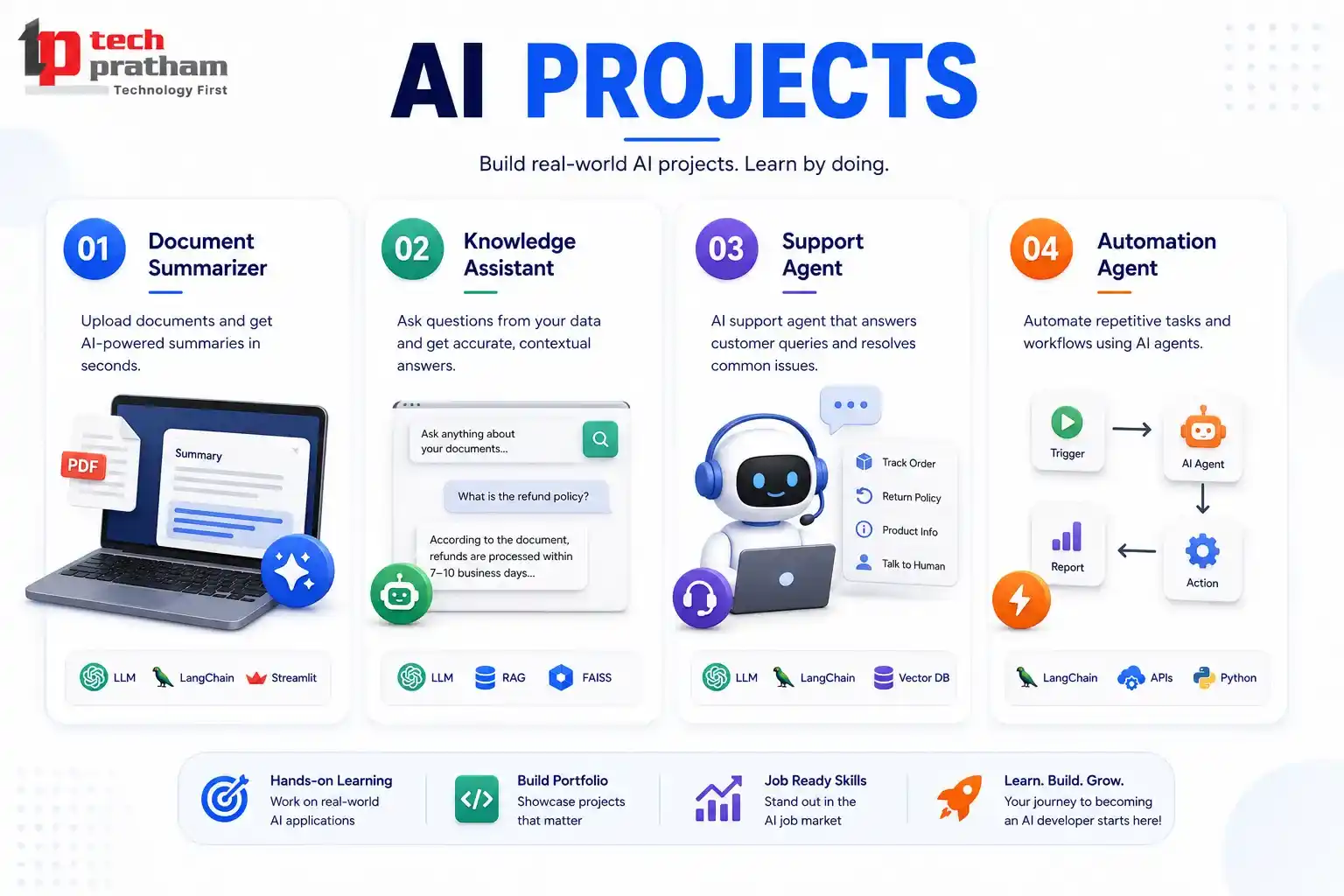
What Projects Should Developers Build?

Projects are one of the best ways to demonstrate practical AI development skills.

Beginner Project

AI Document Summarizer
Build an application that accepts documents and generates concise summaries.

Intermediate Project

Company Knowledge Assistant
Create a RAG-based assistant that retrieves information from organizational documents and generates contextual responses.

Advanced Project

AI Customer Support Agent
Build an AI-powered support system that understands customer queries, retrieves relevant information, and performs selected actions through APIs.

Advanced Agentic Project

AI Task Automation Agent
Create an agent-based workflow that can interpret a task, retrieve information, use tools, and execute multiple steps.
These projects help developers understand the complete journey from AI model integration to application development.

How to Choose AI Training for Developers

Developers considering an AI for Developers Training program should evaluate more than the course title.
Look for a program that includes:

  • Programming foundations
  • Generative AI
  • LLMs
  • AI APIs
  • Prompt engineering
  • RAG
  • Vector databases
  • AI agents
  • Practical projects
  • Application development
  • Deployment concepts
  • Interview preparation
A strong AI Developer Course should focus on practical implementation rather than only theoretical explanations.

If you want structured learning with hands-on exposure to these technologies, you can explore the AI for Developers Training course offered by TechPratham.

Career Opportunities in AI Development

AI development skills can complement traditional software engineering experience and open opportunities across different technology roles.

Depending on their skills and experience, developers can explore roles such as:
  • AI Developer
  • AI Application Developer
  • Generative AI Developer
  • LLM Application Developer
  • AI Engineer
  • Machine Learning Engineer
  • AI Solutions Developer
  • AI Automation Developer
  • AI Software Engineer
  • AI Agent Developer
Career requirements vary by organization. Some roles emphasize software engineering and AI integration, while others require deeper knowledge of machine learning, mathematics, model development, or MLOps.

AI for Developers: What Should You Learn First?

If you are a software developer starting your AI journey, you do not need to learn everything at once.

A practical sequence is:

Programming → AI Fundamentals → Generative AI → LLMs → APIs → Prompt Engineering → RAG → Vector Databases → AI Agents → Deployment → Real Projects

The most important principle is to build while learning.
Instead of spending months studying AI theory without implementation, combine each concept with a practical development exercise.

Common Mistakes Developers Make While Learning AI

Common Mistakes Developers Make While Learning AI

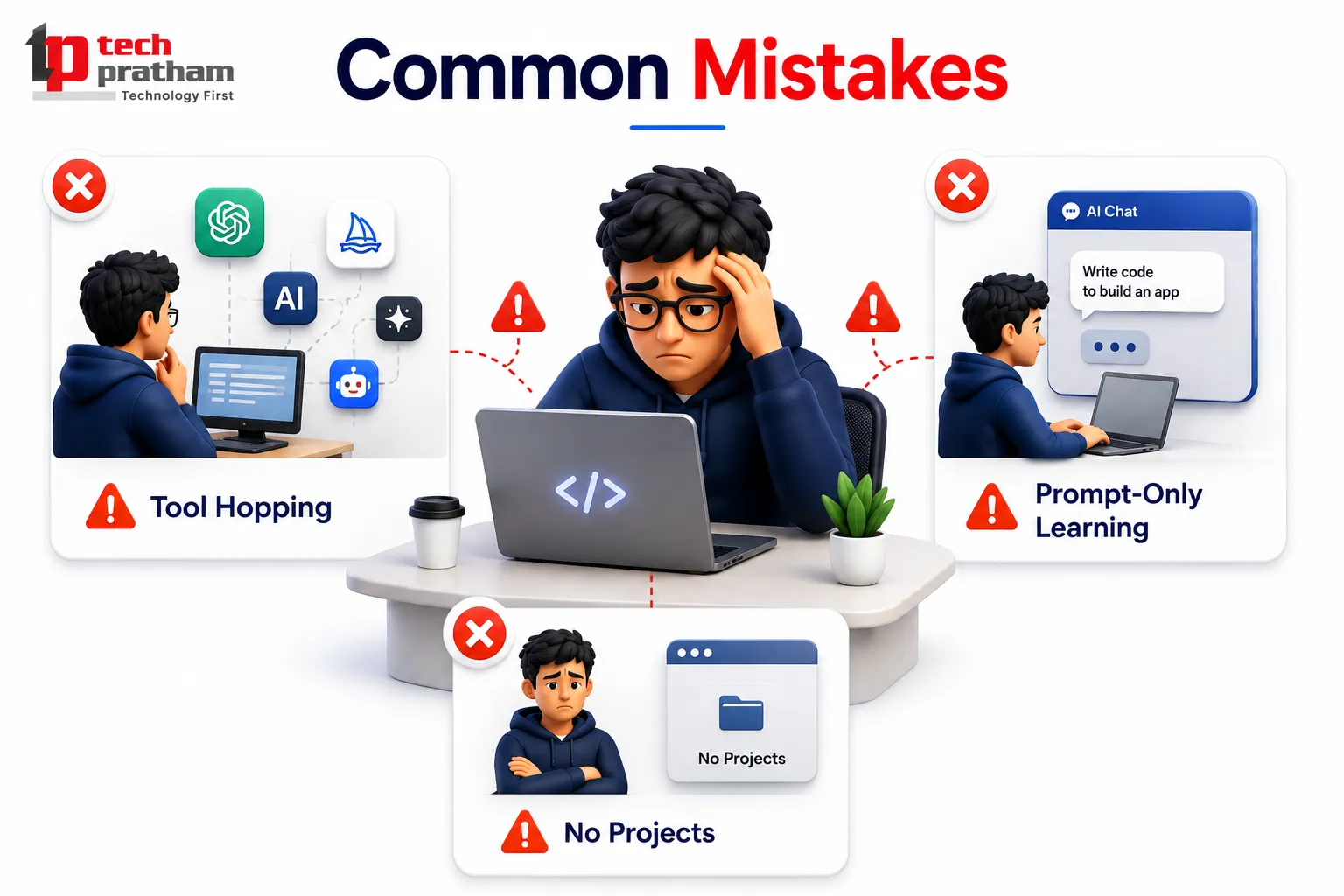
Trying to Learn Every AI Tool

AI tools change quickly. Focus on transferable concepts rather than memorizing every platform.

Focusing Only on Prompt Engineering

Prompting is useful, but production AI development requires application architecture, APIs, data, retrieval, security, testing, and evaluation.

Ignoring Software Engineering Fundamentals

AI applications are still software applications. Clean architecture, testing, version control, security, and maintainability remain important.

Building Only Simple Chatbots

Chatbots are a useful starting point, but developers should gradually explore RAG, tool integration, workflows, and AI agents.

Avoiding Real Projects

Reading documentation is useful, but building applications provides practical understanding that theory alone cannot provide.

Final Thoughts

Learning AI as a developer is not about replacing traditional software engineering skills. It is about combining software development expertise with modern AI capabilities to create more intelligent, useful, and automated applications.
Developers who understand programming, Generative AI, LLMs, AI APIs, RAG, vector databases, prompt engineering, and AI agents can build a strong foundation for modern AI application development.
The best approach is to learn progressively, build practical projects, understand the limitations of AI systems, and keep developing skills that remain valuable even as individual AI tools evolve.
For developers looking for a structured way to build these capabilities, an AI for Developers Training program can provide a guided learning path combining concepts, tools, projects, and practical application development.

Frequently Asked Questions

1. How can developers learn AI?

Developers can learn AI by starting with programming and AI fundamentals, then progressing to Generative AI, LLMs, AI APIs, prompt engineering, RAG, vector databases, and AI agents. Building practical projects alongside learning is highly recommended.

2. Do developers need to learn Python for AI?

Python is highly useful for AI development because of its extensive ecosystem of AI and machine learning libraries. However, the required programming language depends on the application and technology stack.

3. What is the best AI skill for developers?

There is no single best skill. A combination of software development, LLM integration, Generative AI, RAG, AI APIs, prompt engineering, AI agents, and AI application architecture provides a strong foundation.

4. Is Generative AI useful for software developers?

Yes. Developers can use Generative AI to build AI-powered applications, assistants, document processing systems, intelligent search, automation workflows, and other software solutions.

5. Should developers learn RAG?

RAG is valuable for developers building applications that need to retrieve information from external or private knowledge sources. It is especially useful for enterprise search, document assistants, and knowledge-based AI applications.

6. What should developers learn after LLMs?

After understanding LLM fundamentals, developers can explore AI APIs, structured outputs, embeddings, RAG, vector databases, tool calling, AI agents, evaluation, and deployment.