
Data Engineering
319 min read6 viewsWhat Is Data Engineering and How Can You Build a Career in It?
By TechPratham TeamPublished September 25, 2026Updated September 25, 2026

Data Engineering is becoming an important part of modern businesses as organizations rely on data to understand customers, improve operations, develop AI applications, and make informed decisions. But what exactly is Data Engineering, what does a Data Engineer do, and how can a beginner build a career in this field?
Whether you are a fresher, a working professional, or someone planning to switch from a non-IT background, understanding Data Engineering can help you decide whether this career path matches your interests and goals.
In this guide, we will explore Data Engineering fundamentals, career opportunities, essential skills, tools, AI's impact, a practical learning roadmap, projects, certifications, and how to prepare for Data Engineering roles.
What Is Data Engineering?
Data Engineering is the process of designing, building, and maintaining systems that collect, process, transform, and deliver data in a reliable and usable format.
Businesses generate data from websites, applications, customer transactions, business software, sensors, and many other sources. However, raw data is often incomplete, inconsistent, duplicated, or stored across different systems.
Data Engineers build the infrastructure and pipelines that make this data accessible, organized, and ready for analytics, reporting, and machine learning. For example, an e-commerce company may collect millions of customer interactions, orders, payments, and product views. A Data Engineer develops pipelines to bring this information together, clean and transform it, and store it in a data warehouse where analysts and business teams can use it. In simple terms, Data Engineering makes data available, trustworthy, and useful for the people and systems that depend on it.
What Does a Data Engineer Do?
A Data Engineer focuses on the technical systems that move data from its original source to its destination. The exact responsibilities depend on the organization, technology stack, and business requirements.
Common responsibilities include:
- Building data pipelines: Developing automated workflows that extract, process, and deliver data from multiple sources.
- Data integration: Combining information from databases, applications, APIs, and other systems.
- Data transformation: Cleaning, validating, standardizing, and structuring data for downstream use.
- Database and warehouse management: Organizing data for efficient storage, querying, and reporting.
- Data quality and reliability: Identifying missing values, duplicate records, pipeline failures, and inconsistent information.
- Performance optimization: Improving pipeline execution, query performance, storage efficiency, and processing costs.
- Supporting analytics and AI: Preparing reliable datasets for business intelligence, machine learning, and AI applications.
A Data Engineer also works with Data Analysts, Data Scientists, software developers, and business teams to understand data requirements and deliver systems that meet those needs.
How Does Data Engineering Work?
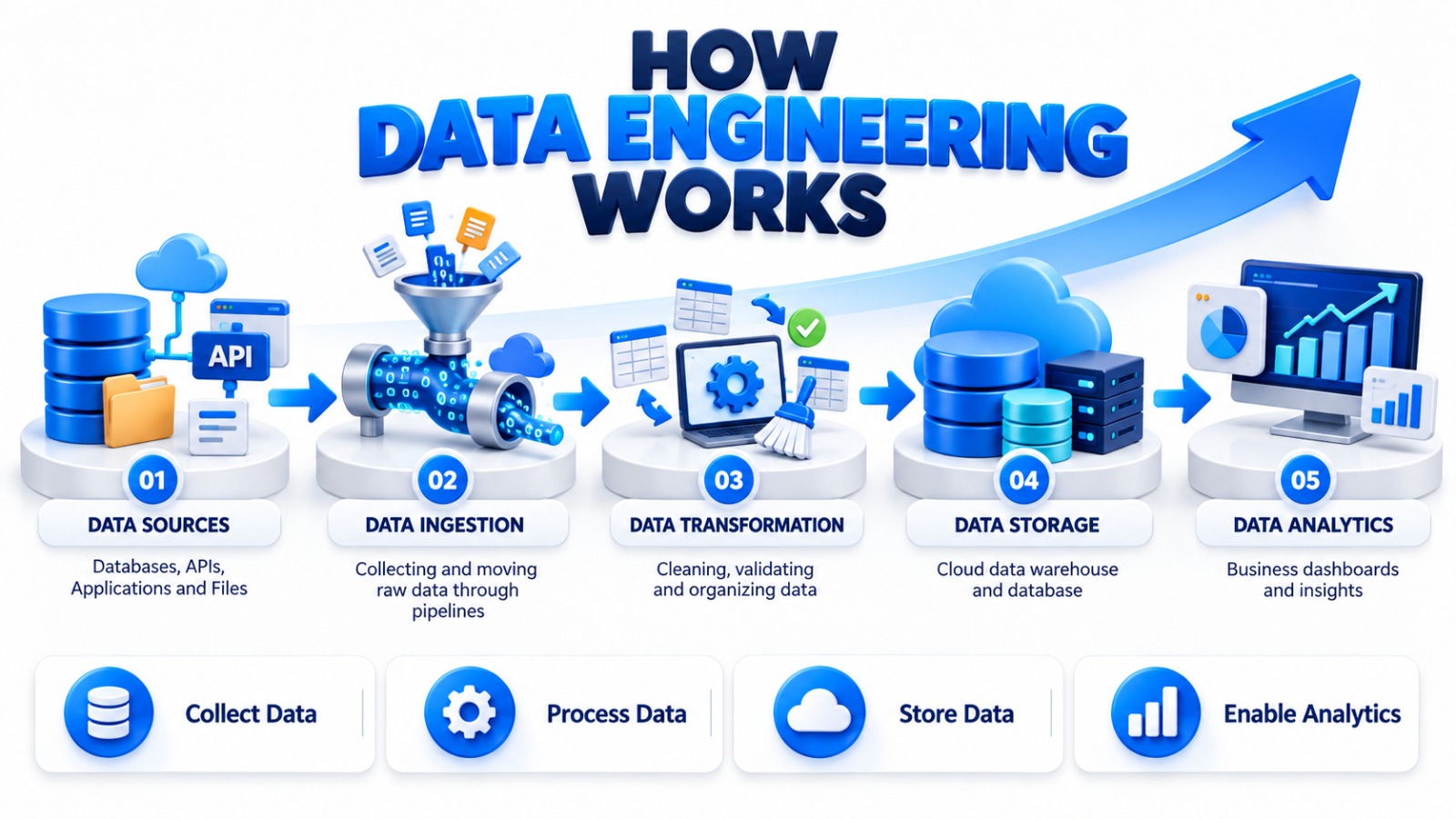
A typical Data Engineering workflow moves data through several stages, from collection to consumption.
1. Data Sources
Data is generated from databases, websites, applications, business software, APIs, sensors, and transaction systems.
2. Data Ingestion
Data is collected and transferred from its source into a processing or storage environment. Depending on the requirement, ingestion may happen in batches or continuously through streaming.
3. Data Processing and Transformation
Raw data is cleaned, validated, joined, standardized, and transformed into a suitable format. This stage helps address missing values, inconsistent records, and differences in data structures.
4. Data Storage
Processed data is stored in databases, data warehouses, data lakes, or lakehouses, depending on its intended use and the organization's architecture.
5. Data Consumption
The processed data becomes available for dashboards, business reports, analytics, machine learning models, and AI applications.
Two common approaches to processing data are batch processing and stream processing.
Many organizations use a combination of both approaches, depending on how quickly the data needs to be available.
Why Is Data Engineering Important for Businesses?
Data is valuable only when organizations can access and use it reliably. Data Engineering helps turn scattered information into a structured foundation for business decisions.
Retail and E-commerce
Retail businesses use data from customer purchases, inventory, website interactions, and orders. Data Engineering helps combine these sources to support demand forecasting, personalized experiences, sales reporting, and inventory planning.
Banking and Finance
Financial organizations process large volumes of transactions and customer information. Data Engineering supports reporting, risk analysis, fraud detection systems, and regulatory reporting by making data available in a structured and reliable format.
Healthcare
Healthcare organizations generate data from patient management systems, medical records, and operational applications. Data pipelines help prepare this information for reporting, research, and data-driven applications, subject to privacy and security requirements.
Manufacturing and Logistics
Manufacturing and logistics businesses generate data from equipment, sensors, supply chains, and operational systems. Data Engineering helps integrate this information for monitoring, planning, and predictive maintenance.
As organizations adopt cloud platforms, advanced analytics, and AI applications, dependable data infrastructure becomes an important part of their technology environment.
Is Data Engineering a Good Career Choice?
Data Engineering may be suitable for people who enjoy problem-solving, working with databases, writing code, and building systems that support business applications. It combines software development, data management, cloud technologies, and analytical thinking. Before choosing this career, consider the following aspects.
Career Opportunities Across Industries
Data Engineers can work in technology companies, financial services, consulting, retail, healthcare, manufacturing, and other sectors that use data-intensive systems. The opportunities available to an individual depend on their technical skills, experience, location, and the requirements of employers.
A Mix of Programming and System Design
Unlike roles that primarily focus on interpreting data, Data Engineering involves building and maintaining the systems that process it. People who enjoy understanding how applications communicate, how databases work, and how software systems can be made reliable may find the work interesting.
Continuous Learning
Data platforms and cloud technologies evolve over time. Professionals need to keep learning about new tools, architectures, security requirements, and engineering practices. This makes continuous skill development an important part of a Data Engineering career.
Is Data Engineering Suitable for Beginners?
Yes, beginners can learn Data Engineering by building a foundation in programming, SQL, databases, and data processing before progressing to advanced tools.
However, learning the concepts and becoming ready for a professional role are different stages. Practical projects, debugging experience, and the ability to explain technical decisions are important parts of career preparation.
Data Engineering vs Data Science vs Data Analytics
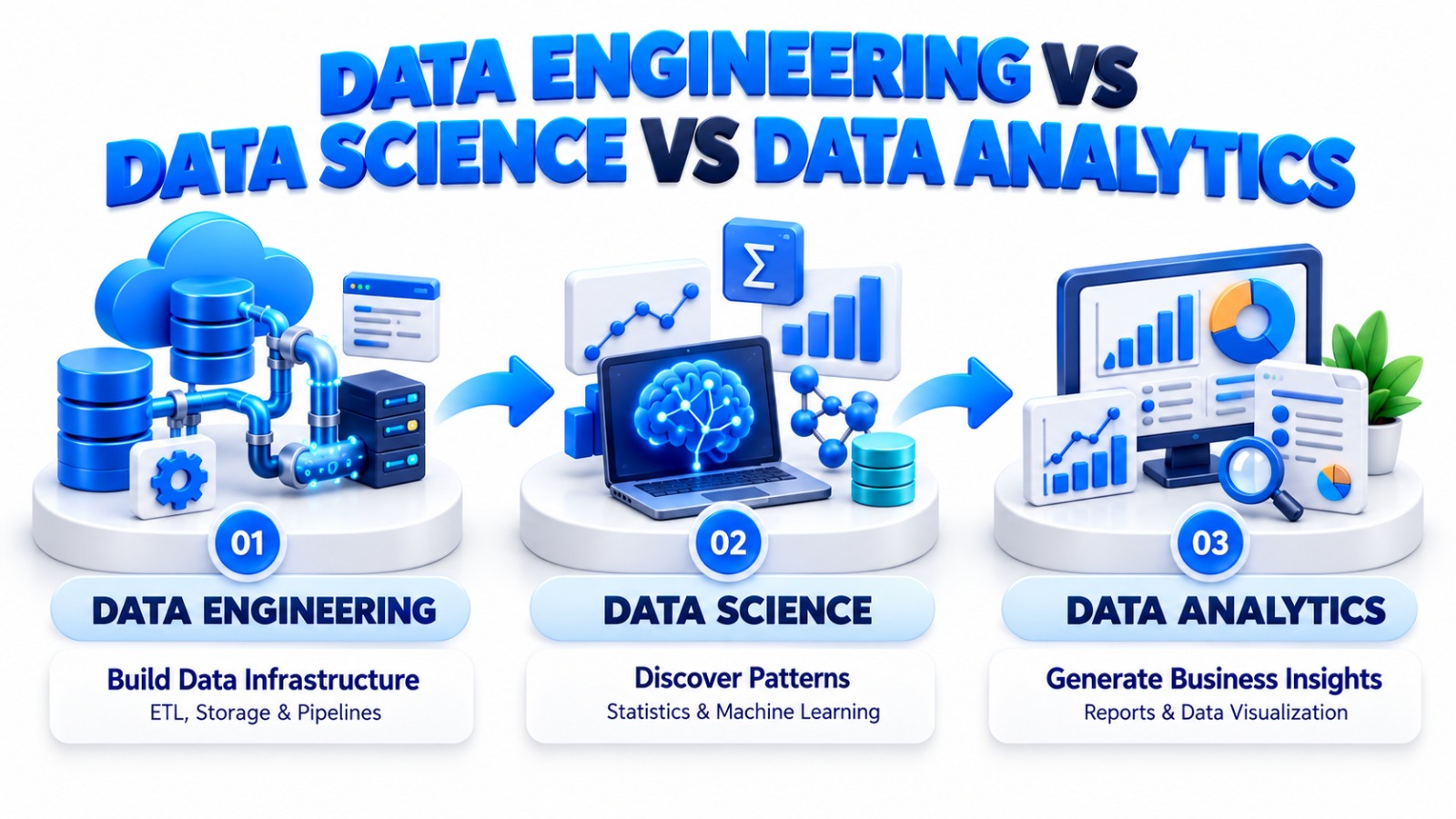
Data Engineering, Data Science, and Data Analytics work together, but each has a different primary responsibility.
For example, a Data Engineer may build the pipeline that collects customer transactions. A Data Analyst may use the resulting data to understand purchasing patterns, while a Data Scientist may develop a model to predict customer behavior.
These roles often collaborate, and responsibilities can overlap depending on the organization.
Essential Data Engineering Skills You Need to Learn
A structured skill set is more useful than trying to learn every available tool at once. Beginners should first understand the fundamentals and then apply them through practical work.
1. SQL and Database Fundamentals
SQL is one of the most important skills for Data Engineering. It is used to retrieve, transform, validate, and organize data stored in relational databases.
Learn:
- SELECT statements, filtering, sorting, and aggregations.
- Joins, subqueries, common table expressions, and window functions.
- Primary keys, foreign keys, indexes, and database normalization.
- Query performance and basic optimization.
- Transactions and database design fundamentals.
Practice with a relational database such as PostgreSQL or MySQL.
2. Python Programming
Python is widely used to automate data workflows, process files, interact with APIs, and develop data processing applications. Focus on variables, data types, conditions, loops, functions, modules, exception handling, and file operations. As you progress, learn how to work with JSON, CSV, APIs, and libraries such as Pandas. Understanding Python fundamentals is more important than memorizing libraries without knowing how the code works.
3. Data Warehousing and Data Modeling
Data warehouses organize data for reporting, analytics, and business intelligence.
Learn the differences between operational databases and analytical systems, along with:
- Fact and dimension tables.
- Star and snowflake schemas.
- Data normalization and denormalization.
- Data lakes, data warehouses, and lakehouses.
- Data partitioning and storage formats.
These concepts help you understand how to design data systems around actual business requirements.
4. ETL and ELT Pipelines
ETL stands for Extract, Transform, Load. Data is extracted from its source, transformed, and then loaded into the destination. ELT stands for Extract, Load, Transform. Data is loaded into the destination before transformation, often using the processing capabilities of modern data platforms. Understand how to create repeatable workflows, handle failures, validate data, and make pipelines reliable. Tools such as Apache Airflow and dbt can help with orchestration and transformation, respectively.
5. Cloud Computing
Cloud platforms provide storage, computing, databases, and managed data services. Start with the fundamentals of one cloud ecosystem rather than trying to learn every platform simultaneously.
Amazon Web Services (AWS) : Learn cloud storage, compute, permissions, and services such as Amazon S3 and AWS Glue.
Microsoft Azure: Understand cloud storage, data integration, and services such as Azure Data Factory and Azure Databricks.
Google Cloud: Explore cloud storage, data processing, and services such as BigQuery and Dataflow. Cloud services differ in architecture, terminology, and pricing. Build a working understanding of one platform first, then learn how similar concepts are implemented elsewhere.
6. Big Data and Distributed Processing
When datasets become too large or complex for conventional processing, distributed computing allows workloads to run across multiple machines.
Important concepts and tools include:
- Apache Spark for distributed data processing.
- Hadoop ecosystem fundamentals and distributed storage concepts.
- Apache Kafka for event streaming and data integration.
- Batch and streaming architectures.
- Data partitioning, parallelism, and fault tolerance.
Beginners do not need to master all these technologies immediately. Learn them after becoming comfortable with SQL, Python, and basic pipeline development.
7. Data Quality, Security, and Governance
Data systems must be accurate, secure, and maintainable. Learn how to validate schemas, identify missing or duplicate records, manage access permissions, protect sensitive information, and maintain documentation. Also understand basic version control with Git, testing, logging, monitoring, and troubleshooting.
These practices help distinguish a working demonstration from a reliable engineering solution.
How Is AI Changing Data Engineering?
AI is changing how technical teams write code, investigate problems, document systems, and automate repetitive tasks. Data Engineering is also being influenced by these developments.
AI-assisted tools can help engineers:
- Draft SQL queries and Python code.
- Explain unfamiliar code and error messages.
- Generate documentation and test-case ideas.
- Assist with data transformation and pipeline development.
- Explore data patterns and support troubleshooting.
However, AI-generated code still needs to be reviewed, tested, and validated. Data quality, security, system architecture, performance, and business requirements cannot be ignored simply because a tool generates code quickly.
Will AI Replace Data Engineers?
AI can automate or assist with specific engineering tasks, but this does not mean that every Data Engineering responsibility can be automated. Building reliable data infrastructure involves understanding business requirements, choosing appropriate architectures, managing access and security, handling failures, validating data, and making trade-offs around cost and performance.
These responsibilities require technical judgment and accountability. For aspiring Data Engineers, the practical approach is to learn programming, SQL, databases, and pipeline fundamentals first, then use AI tools to improve productivity and learn modern workflows. AI awareness should complement engineering knowledge rather than replace it.
How to Become a Data Engineer: A Step-by-Step Roadmap
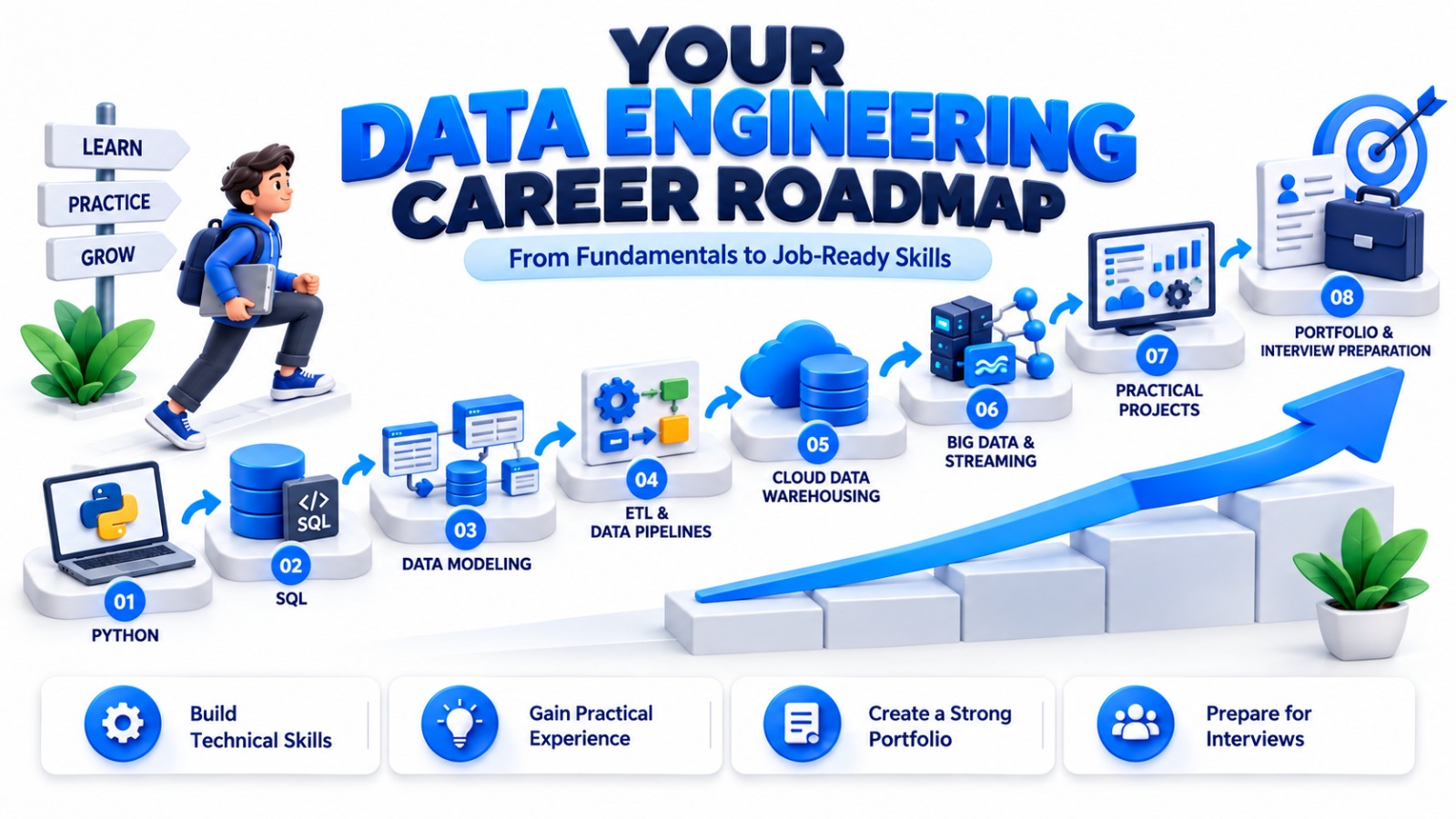
A structured roadmap helps beginners avoid jumping between tools without understanding the underlying concepts.
Step 1: Learn Programming and SQL
Build a foundation in Python, relational databases, SQL queries, and basic programming logic. Practice solving problems using real datasets.
Step 2: Understand Databases and Data Modeling
Learn how data is stored, organized, related, queried, and optimized. Practice designing tables and analytical data models.
Step 3: Build ETL and ELT Pipelines
Extract data from files, APIs, and databases. Clean and transform it, load it into a destination, and automate recurring workflows.
Step 4: Learn Cloud and Modern Data Tools
Choose one cloud platform and understand its storage, compute, data integration, and security services. Progress to orchestration and distributed processing.
Step 5: Complete End-to-End Projects
Build pipelines that include ingestion, transformation, storage, validation, monitoring, and documentation.
Step 6: Prepare a Portfolio and Interviews
Publish project documentation, explain design decisions, revise SQL and Python, and practice troubleshooting and technical interviews. The time required depends on your starting knowledge, available study time, learning approach, and the complexity of the projects you complete. Focus on demonstrating skills rather than following an arbitrary timeline.
Practical Data Engineering Projects for Your Portfolio
Projects allow you to apply concepts to realistic problems and demonstrate how you approach engineering challenges.
1. End-to-End ETL Pipeline
Extract data from a CSV file or public API, clean and transform it with Python, and load it into PostgreSQL. Add validation checks and document the workflow.
2. Sales Data Warehouse
Design fact and dimension tables, load transactional data, and create SQL queries that answer business questions such as revenue by product or monthly sales trends.
3. Automated Data Pipeline
Use an orchestration tool such as Apache Airflow to schedule tasks, manage dependencies, handle failures, and monitor pipeline execution.
4. Streaming Data Project
Build a basic event-processing pipeline using a streaming platform such as Apache Kafka. Process incoming events and store the results for analysis. For each project, include the problem statement, architecture, technologies used, setup instructions, sample data, data quality checks, and lessons learned. A well-documented project that you can explain clearly is more useful than a collection of copied projects that you cannot discuss during an interview.
What Career Opportunities Are Available in Data Engineering?
Data Engineering skills can support different career paths depending on technical expertise and experience.
These titles are not standardized across all employers. Some organizations combine responsibilities, while others maintain separate teams for data platforms, analytics engineering, and cloud infrastructure. Beginners should focus on developing the fundamentals and applying for roles that match their demonstrated skills and experience.
Can Non-IT Professionals and Working Professionals Become Data Engineers?
A non-IT background does not automatically prevent someone from learning Data Engineering. However, career transition requires a realistic assessment of the technical skills involved. Professionals from finance, operations, manufacturing, sales, business analysis, and other fields may already understand business processes and domain-specific data.
For example, someone with finance experience may understand transactions, reconciliation, and reporting. That knowledge can help when building financial data pipelines, but SQL, Python, databases, and engineering practices still need to be learned.
For Non-IT Learners
Start with computer and programming fundamentals, then progress to SQL, Python, databases, and practical data projects. Avoid beginning with advanced distributed systems before understanding the basics.
For Working Professionals
A structured learning schedule can help balance study with existing responsibilities. Focus on consistent practice and projects that connect your previous industry knowledge with technical skills.
For Freshers
Build a foundation in programming, databases, and data structures, then demonstrate your skills through end-to-end projects, internships, or suitable entry-level opportunities. A degree, certificate, or previous job title alone does not establish readiness for a Data Engineering role. Employers may assess technical knowledge, problem-solving, practical work, and communication.
Is a Data Engineering Certification Enough to Get a Job?
A Data Engineering certification can help organize learning, demonstrate exposure to a particular platform, and provide a structured way to study technical concepts. However, certification alone does not guarantee employment or prove that someone can design and maintain production data systems.
A well-rounded learning plan should include:
- Strong SQL and Python fundamentals.
- Practical experience with databases and data pipelines.
- Projects that demonstrate data processing and problem-solving.
- Familiarity with cloud services and relevant engineering tools.
- Interview preparation and the ability to explain technical decisions.
When selecting a certification or training program, review the syllabus, practical assignments, technologies covered, instructor experience, and how the program supports hands-on learning. Choose a learning path that matches your current knowledge and the type of Data Engineering role you want to pursue.
How to Choose the Right Data Engineering Training
Structured training may help learners who need guidance, practical exercises, and a clear progression from fundamentals to advanced concepts. Before enrolling, consider whether the program covers SQL, Python, databases, data modeling, ETL/ELT, cloud platforms, and end-to-end projects. Also review the learning format, assessment approach, practical lab access, and opportunities to clarify technical questions. TechPratham provides Data Engineering training options for learners exploring this field in India and specific locations.
Explore the relevant course pages to review the available program information:
Review the current syllabus and course details to determine whether the training matches your learning goals and technical starting point.
Frequently Asked Questions About Data Engineering
1. What is Data Engineering in simple words?
Data Engineering is the process of building systems that collect, clean, transform, store, and deliver data so that businesses and applications can use it reliably.
2. Is Data Engineering suitable for beginners?
Yes. Beginners can start with SQL, Python, and database fundamentals before learning data pipelines, cloud platforms, and advanced processing tools. Practical projects are important for developing job-related skills.
3. Do I need coding to become a Data Engineer?
Yes, programming is an important part of most Data Engineering roles. SQL is essential for working with data, while Python and other programming tools are commonly used to automate and build data workflows.
4. Can a non-IT professional become a Data Engineer?
A non-IT professional can transition into Data Engineering by learning the required technical fundamentals and developing practical experience. Previous industry knowledge may help with understanding business data, but it does not replace technical preparation.
5. Is Python or SQL more important for Data Engineering?
Both are important. SQL is used extensively for querying, transforming, and managing structured data, while Python supports automation, data processing, API integration, and pipeline development. Learn both and practice using them together.
6. Which cloud platform should I learn for Data Engineering?
AWS, Microsoft Azure, and Google Cloud all provide services for data storage, processing, integration, and analytics. Start with one platform based on your learning goals and the technologies relevant to your target roles.
7. Will AI replace Data Engineers?
AI can assist with coding, documentation, testing, and troubleshooting, but reliable data infrastructure also requires system design, validation, security, and engineering judgment. Learning AI-assisted workflows alongside core engineering skills can help professionals adapt to changing tools.
8. What projects should a beginner Data Engineer build?
Start with an ETL pipeline using Python and SQL, then build a data warehouse project. Progress to automated pipelines, cloud-based projects, and streaming systems as your skills develop.
9. Is Data Engineering different from Data Science?
Yes. Data Engineering primarily focuses on building and maintaining data infrastructure and pipelines. Data Science focuses on statistical analysis, experimentation, and machine learning. Both roles often work together.
10. How do I choose a Data Engineering course?
Compare the curriculum, SQL and Python coverage, practical projects, cloud technologies, instructor expertise, and learning support. Choose a program that matches your current skills and gives you opportunities to apply what you learn.
Final Thoughts
Data Engineering combines programming, databases, data processing, cloud technologies, and system design to help organizations turn raw data into reliable information. For beginners and career switchers, the journey starts with fundamentals and progresses through practical pipelines, cloud tools, and end-to-end projects. AI tools can support this process, but understanding the underlying engineering concepts remains essential.
If you are considering this career, begin by strengthening SQL and Python, build projects that demonstrate your skills, and explore a structured learning path that fits your goals.





 +91-8882178896
 +1 (343) 477-0926