
Agentic AI
200 min read24 viewsAI Agents vs Chatbots: What’s the Difference and How Are AI Agents Changing Work?
By TechPratham TeamPublished October 1, 2026Updated October 1, 2026
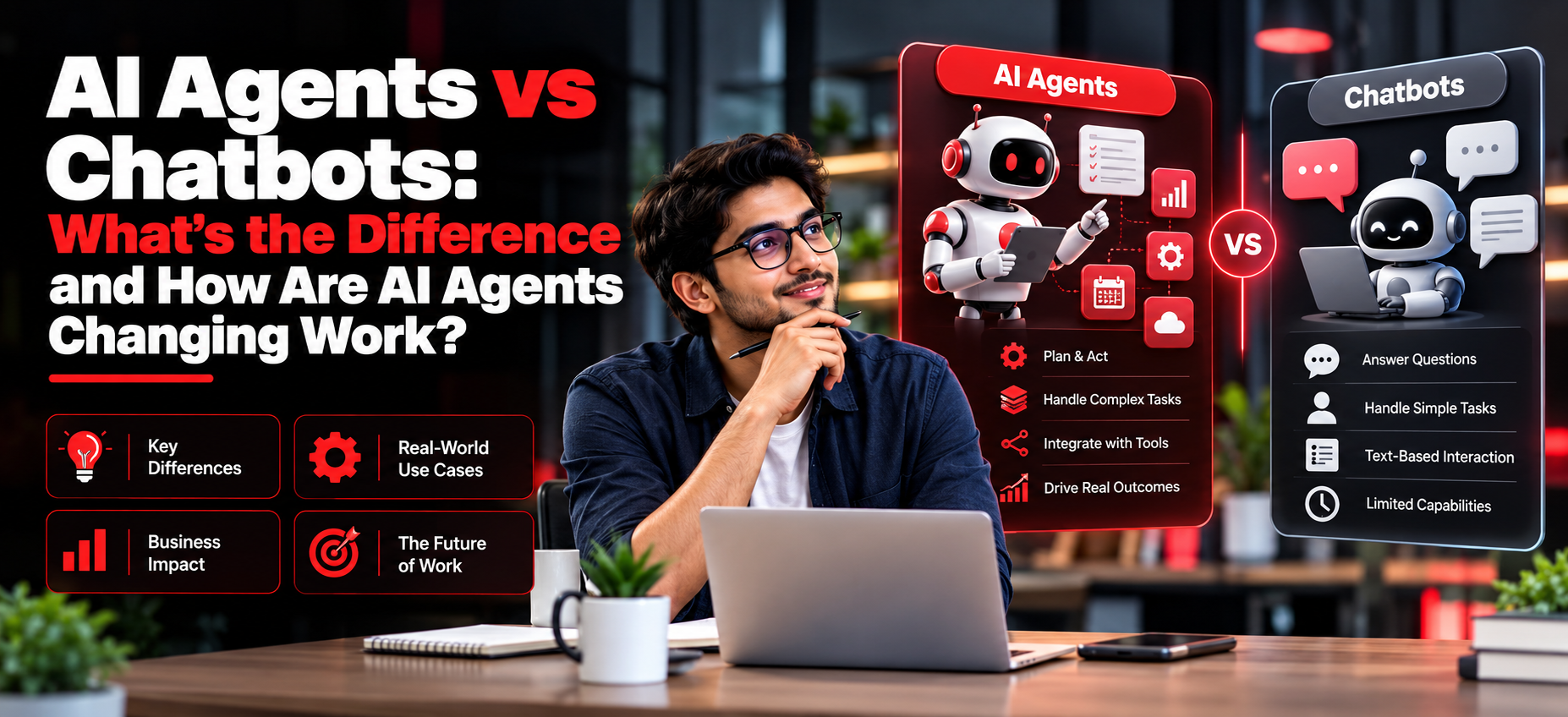
Artificial Intelligence is moving beyond systems that simply respond to questions. Traditional chatbots helped businesses automate conversations, while Generative AI made it easier to create text, code, images, and other content. The next step is increasingly focused on AI systems that can work toward a goal, use tools, interact with external systems, and complete multiple steps. This is where AI agents come into the picture.
But what exactly is the difference between an AI agent and a chatbot? Are AI agents simply more advanced chatbots? How do they work, and what skills are required to build them?
But what exactly is the difference between an AI agent and a chatbot? Are AI agents simply more advanced chatbots? How do they work, and what skills are required to build them?
Understanding these differences can help students, developers, working professionals, and businesses understand where AI is heading and what skills are becoming important.
What Is a Chatbot?
A chatbot is a software system designed to communicate with users through a conversational interface. Traditional chatbots generally rely on predefined rules, while modern AI chatbots can use machine learning and large language models to understand natural-language questions and generate responses.
Common chatbot applications include:
- Answering frequently asked questions
- Customer support
- Product recommendations
- Appointment assistance
- Information retrieval
- Basic troubleshooting
- Conversational assistance
For example, a customer might ask a chatbot, “Where is my order?” The chatbot can retrieve the relevant information and provide the status.
Modern chatbots can be highly capable, but their primary purpose remains conversation and assistance.
What Is an AI Agent?
An AI agent is an AI-powered system designed to work toward a specific goal by understanding a task, deciding what actions may be required, using available tools, and executing a workflow.
Instead of only responding to a question, an AI agent can potentially perform multiple steps.
For example, consider a user asking:
“Find a suitable meeting time, check the participants’ calendars, send an invitation, and schedule the meeting.”
A conversational chatbot may explain how to schedule the meeting. An AI agent connected to calendars, email, and scheduling systems could potentially perform those steps.
Depending on its architecture, an AI agent may use:
- Large language models
- Context
- Tools and APIs
- Function calling
- Memory
- Planning
- External data
- Workflow orchestration
- Human approval
- Monitoring and evaluation
The exact capabilities depend on the tools, permissions, integrations, and controls provided to the agent.
AI Agents vs Chatbots: What's the Difference?
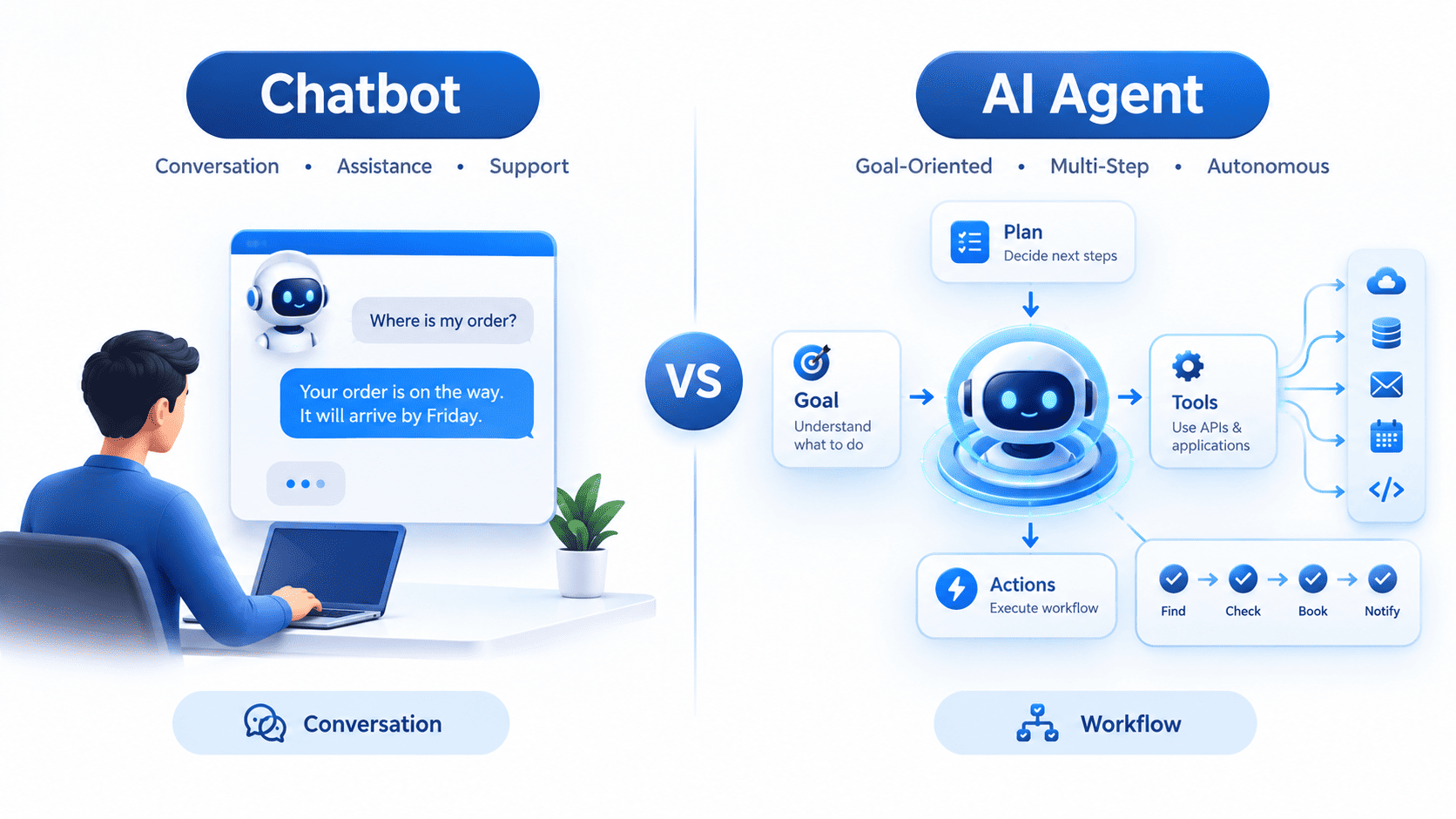
The key difference is not simply that one is “smarter” than the other.
A chatbot is primarily designed around interaction, while an AI agent is designed around accomplishing a goal or task.
Are AI Agents Just Advanced Chatbots?
Not necessarily, A chatbot can provide the conversational interface through which a user interacts with an AI agent. In other words, the two concepts can work together.
For example:
User → Chat Interface → AI Agent → Tools/APIs → Business Systems
The chatbot handles the conversation, while the agent can manage the underlying task workflow. This distinction becomes especially important in enterprise applications where AI needs to work with databases, CRMs, documents, APIs, internal knowledge bases, or business applications.
How Do AI Agents Work?
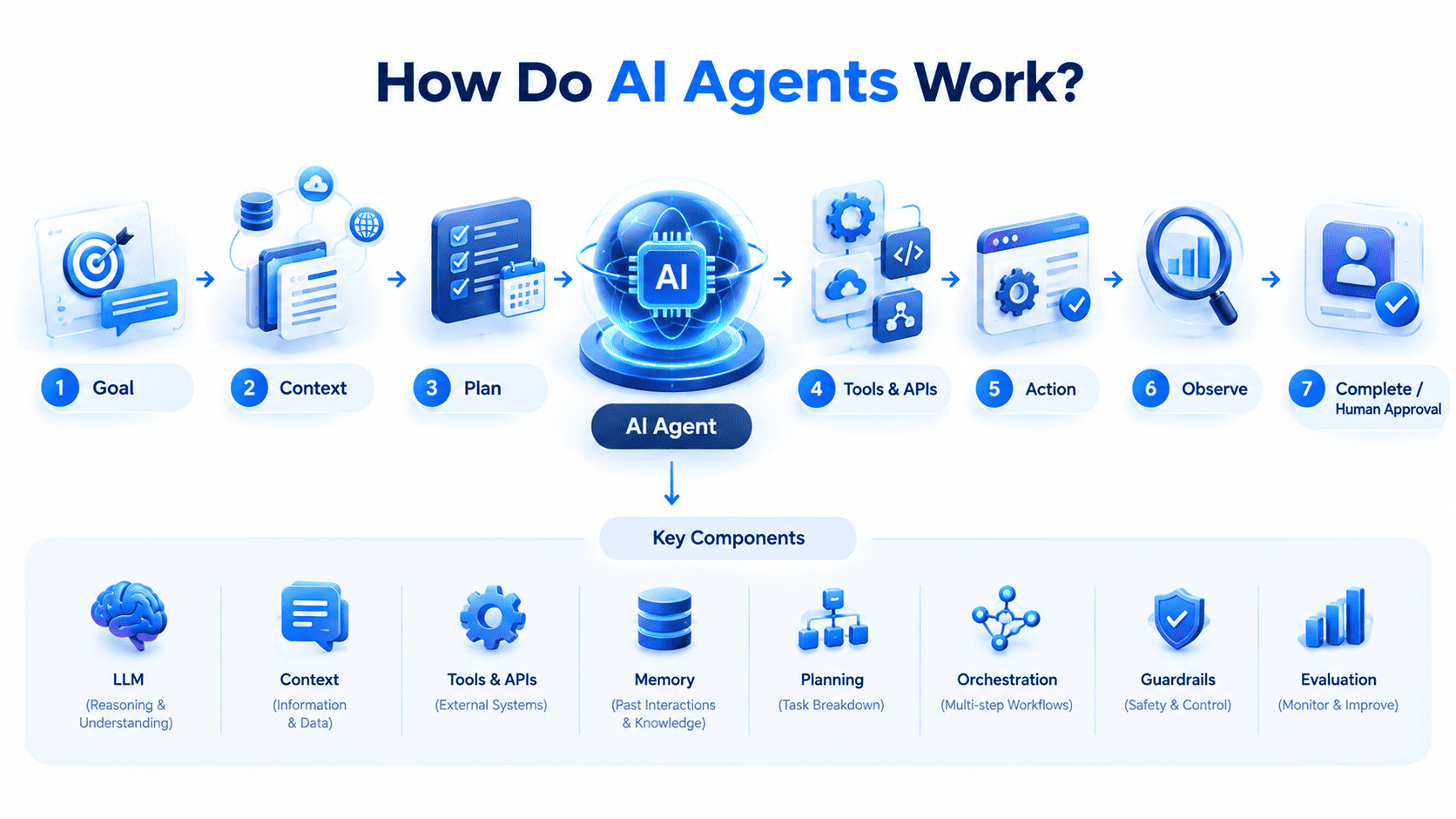
A typical AI agent workflow can involve several stages.
1. Understand the Goal
The agent first interprets what the user wants to accomplish.
2. Gather Context
It identifies relevant information from the conversation, knowledge base, database, or connected systems.
3. Plan the Task
For a complex request, the agent can determine which steps may be required.
4. Select Tools
The agent can choose appropriate tools, APIs, functions, or data sources based on the task.
5. Execute Actions
It performs the required actions through those tools.
6. Observe the Result
The agent evaluates the result and determines whether another action is required.
7. Complete or Escalate
The task can be completed, or the system can request human intervention when approval or additional information is needed. This combination of reasoning, tools, workflows, memory, and actions is what makes agent-based systems different from simple conversational systems.
A Real-World Example: Customer Support
Imagine a customer says:
“My order is late. Please check what happened and help resolve the issue.”
A chatbot might retrieve the order status and tell the customer that the shipment is delayed.
An AI agent connected to the relevant systems could potentially:
- Identify the order
- Check the order management system
- Check shipment information
- Identify the reason for the delay
- Review applicable policies
- Create or update a support ticket
- Recommend the next action
- Ask for human approval where necessary
The important point is that an agent can be designed around completing a workflow, rather than only generating a response.
How Are AI Agents Changing Work?
AI agents can affect different parts of business workflows, although the level of automation depends on the task and system design.
Customer Service
Agents can assist with information retrieval, ticket workflows, customer queries, and repetitive support processes.
Software Development
AI systems can assist with coding, testing, debugging, documentation, and development workflows.
Sales
Agents can support lead research, information gathering, CRM-related workflows, and follow-up processes.
Marketing
AI agents can assist with research, content workflows, campaign analysis, and repetitive marketing tasks.
Operations
Agents can help coordinate processes, generate reports, retrieve information, and automate repetitive workflows.
Research
AI agents can gather information, compare sources, organize findings, and produce structured outputs. The broader shift is from AI that provides assistance to AI that can participate in workflows.
AI Agents vs Generative AI vs Agentic AI
These terms are often used interchangeably, but they describe different concepts.
Generative AI focuses primarily on generating content such as text, code, images, audio, or other outputs.
Chatbots are conversational systems that allow users to interact with an application through natural language.
AI agents are systems designed to pursue goals and perform tasks using available capabilities such as tools, APIs, memory, and workflows.
Agentic AI refers more broadly to AI systems and architectures that exhibit goal-oriented, autonomous or semi-autonomous behavior.
A Generative AI model can therefore become one component of an AI agent rather than being the entire agent itself.
What Skills Do You Need to Build AI Agents?
Anyone planning to enter AI agent development should build skills progressively.
Technical Foundation
- Python
- APIs and REST
- JSON
- Git
- Databases
- Basic software development
AI Foundation
- Large Language Models
- Prompt engineering
- Embeddings
- RAG
- Context management
Agent Development
- Tool calling
- Function calling
- Agent workflows
- Memory
- Planning
- Orchestration
- Multi-agent systems
Frameworks and Tools
Depending on the project, learners may encounter technologies such as LangChain, LangGraph, CrewAI, AutoGen, and OpenAI-based agent development tools.
The goal should not be to collect a long list of frameworks. It is more important to understand why an agent needs a particular tool, workflow, memory architecture, or integration.
AI Agent Development Roadmap for Beginners
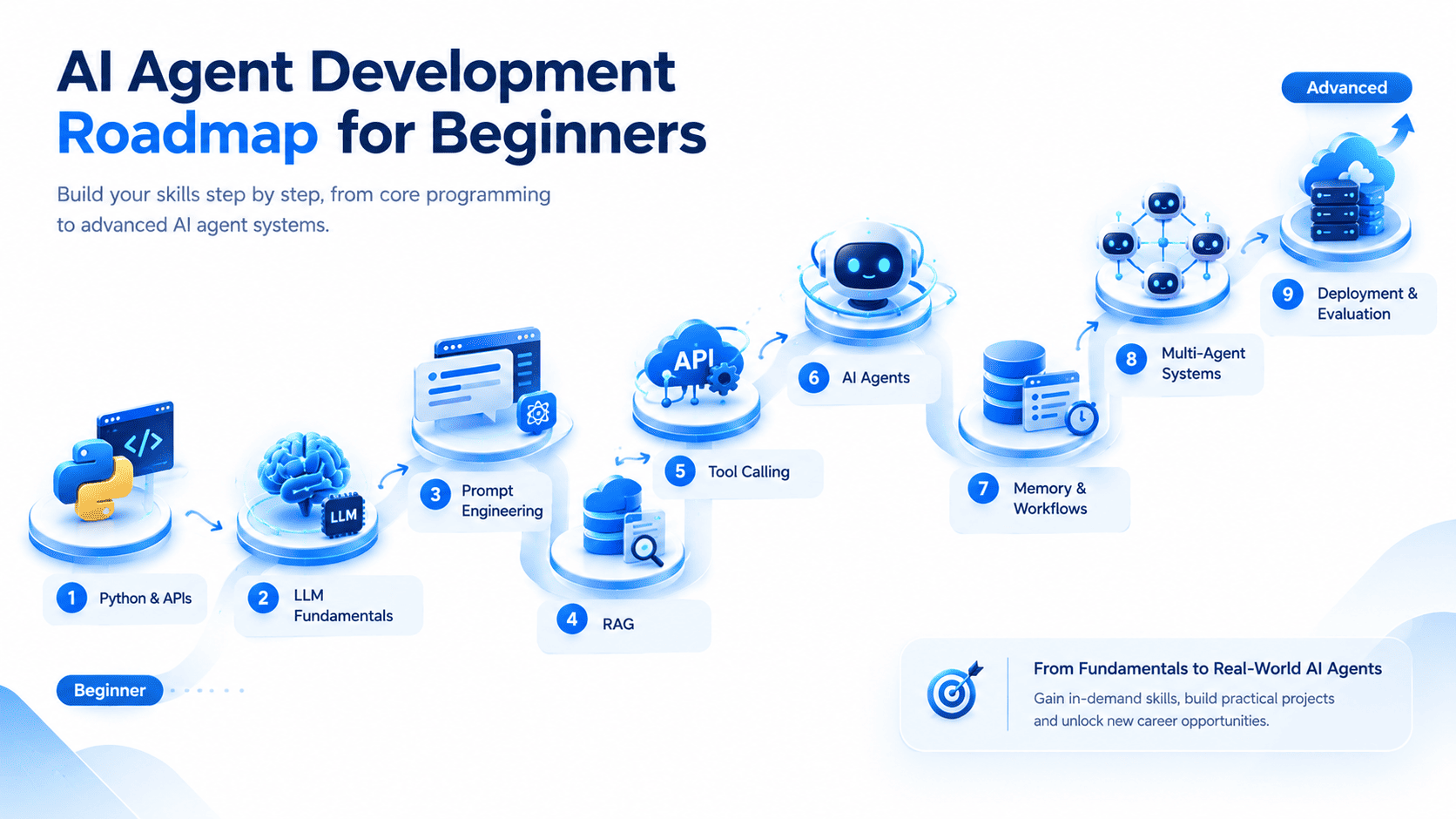
A practical learning path can look like this:
Learners who want a structured path can explore AI Agent Development as the next step after understanding the fundamentals.
Python & APIs → LLM Fundamentals → Prompt Engineering → RAG → Tool Calling → Single AI Agents → Memory & Workflows → Multi-Agent Systems → Deployment & Evaluation
Start with the fundamentals before moving into increasingly complex agent architectures.
Learners who want a structured path can explore AI Agent Development as the next step after understanding the fundamentals.
AI Agent Career Opportunities
As AI systems become more integrated into applications and workflows, learners can build skills relevant to roles such as:
- AI Agent Developer
- AI Engineer
- Generative AI Engineer
- LLM Engineer
- AI Automation Engineer
- AI Application Developer
- Agentic AI Developer
- AI Solutions Engineer
The specific responsibilities vary by organization, but strong candidates generally need more than prompt-writing skills. Understanding software development, APIs, LLMs, data, workflows, and deployment can provide a stronger technical foundation.
How to Choose an AI Agent Course or Training Program
Before choosing a course, check whether it provides practical coverage of:
- LLM fundamentals
- Prompt engineering
- RAG
- Tool and API integration
- AI agent development
- Memory
- Agent workflows
- Multi-agent systems
- Practical projects
- Deployment
- Evaluation and monitoring
A course should ideally help you understand how these technologies work together rather than simply providing a list of tools.
Why Choose TechPratham for AI Training?
For learners looking for structured AI and Agentic AI learning, TechPratham offers training programs covering areas such as LLMs, RAG, AI agents, multi-agent systems, AI automation, tools, workflows, and application deployment. Its AI Training in India program also combines instructor-led learning, hands-on projects, industry-relevant tools, assignments, recordings, resume support, and interview preparation.
For learners specifically interested in agentic systems, TechPratham's Agentic AI Training in India covers AI agent development, planning, memory, tool calling, workflow automation, multi-agent systems, MCP, deployment, and practical projects.
The right choice ultimately depends on whether you need a broad AI foundation or want to specialize more deeply in agentic systems.
Frequently Asked Questions
1. What is the main difference between AI agents and chatbots?
Chatbots primarily focus on conversation and assistance, while AI agents can be designed to pursue goals, use tools, and execute multi-step workflows.
2. Are AI agents better than chatbots?
They serve different purposes. Chatbots are useful for conversational interactions, while AI agents can be useful for more complex, goal-oriented workflows.
3. Are AI agents just advanced chatbots?
No. A chatbot can be the interface for an AI agent, but an agent's defining capability is its ability to work toward a goal using available tools, workflows, and actions.
4. How do AI agents work?
AI agents can understand a goal, gather context, plan steps, use tools, execute actions, evaluate results, and complete or escalate a task.
5. Can AI agents use APIs?
Yes. APIs can allow agents to interact with external applications, databases, business systems, and other software.
6. What is the difference between AI agents and Generative AI?
Generative AI primarily generates content or responses. AI agents can use generative AI as one component while adding tools, workflows, memory, and task execution.
7. What is Agentic AI?
Agentic AI broadly refers to AI systems designed to perform goal-oriented actions with varying degrees of autonomy or human oversight.
8. What programming language is commonly used for AI agents?
Python is widely used for AI application and agent development, although the appropriate technology depends on the application and development environment.
9. Can beginners learn AI agent development?
Yes. Beginners can start with programming and AI fundamentals before progressing to LLMs, APIs, RAG, tool calling, workflows, and agent development.
10. Will AI agents replace jobs?
AI agents can automate or assist with parts of workflows, but their impact varies by task, industry, system design, and level of human oversight. Many implementations focus on augmenting people rather than fully replacing entire occupations.
Final Thoughts
AI agents and chatbots are not necessarily competing technologies. Chatbots are primarily designed for conversation and assistance, while AI agents can extend AI capabilities into goal-oriented tasks, tool usage, workflows, and automation.
As AI continues to become part of modern business workflows, learning how LLMs, RAG, APIs, tool calling, memory, and agentic systems work together can help learners build practical AI skills.
For beginners who want to develop a broader foundation across Artificial Intelligence, Generative AI, LLMs, AI agents, and related technologies, AI Training in India can provide a structured path before moving into more specialized AI agent development.
The key is to focus not just on individual AI tools, but on understanding how to build useful, reliable, and practical AI applications that can solve real-world problems.
Related Articles

Agentic AI
Agentic AI Architecture: Components, Workflow & Use Cases
Explore Agentic AI architecture, workflows, RAG, memory, tools, MCP, multi-agent systems, security, and enterprise AI use cases.

Agentic AI
How to Become an Agentic AI Expert: Complete Learning Path, Essential Skills & Career Guide
Learn Agentic AI from scratch with this complete guide covering skills, certifications, career paths, and the best Agentic AI course in India.





 +91-8882178896
 +1 (343) 477-0926