Data Analytics and BI Training
301 min read16 viewsHow to Switch Your Career to Data Science: A Pathway to a New Career
By TechPratham TeamPublished September 16, 2026Updated September 16, 2026
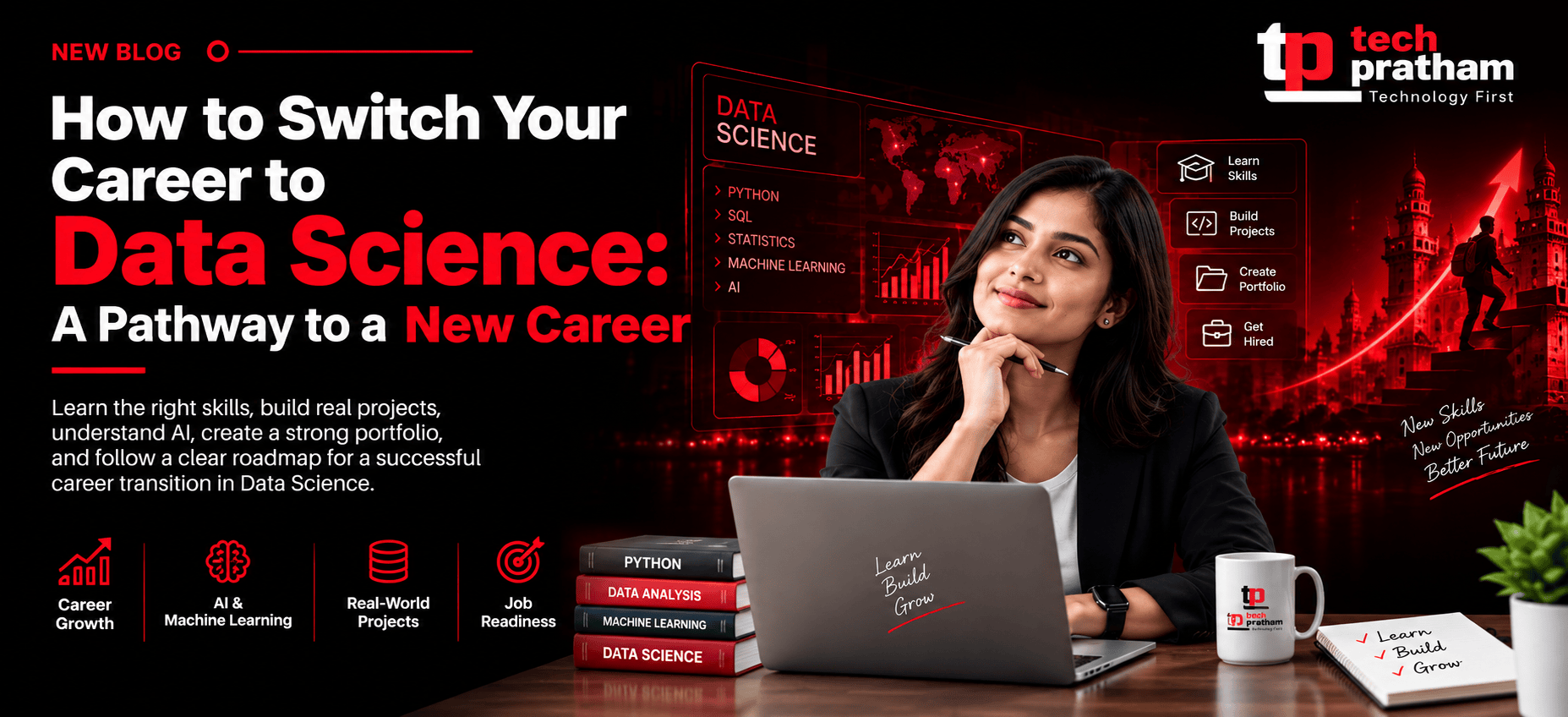
Changing careers can feel difficult when the new field requires technical skills, a different way of working, and a new approach to problem-solving. Data Science is one such career path that attracts professionals from IT, finance, operations, marketing, analytics, engineering, and other backgrounds. But switching to Data Science does not mean starting your professional life from zero.
Your previous experience, industry knowledge, communication skills, analytical thinking, and understanding of business problems can continue to be valuable. What changes is the technical foundation you need to build around that experience.If you are wondering how to switch your career to Data Science, whether you need coding or mathematics, how AI is changing the field, what projects you should build, and how to prepare for Data Science jobs, this guide explains the complete career transition process.
Why Are Professionals Considering a Career Switch to Data Science?
Data is now involved in almost every business function. Companies use data to understand customers, improve operations, forecast demand, identify risks, optimize products, and support business decisions.
This has created opportunities for professionals who can work with data and convert it into useful insights. For someone considering a career change, Data Science can also provide a way to combine previous professional experience with new technical capabilities.
For example:
- An IT professional can combine software knowledge with Machine Learning.
- A Data Analyst can move toward predictive modeling and advanced analytics.
- A finance professional can apply Data Science to forecasting, risk analysis, or fraud detection.
- A marketing professional can work with customer segmentation and recommendation systems.
- An operations professional can apply predictive analytics to demand and process optimization.
The important point is that a career switch should be treated as a skill transition, not simply as changing one job title to another.
Can You Switch to Data Science From Another Career?
Yes, professionals from different backgrounds can move into Data Science, provided they are willing to build the required technical and analytical skills.
However, the transition is not the same for everyone.
Someone with programming experience may find Python easier to learn, while someone from a business background may already understand business problems and stakeholder requirements but need more time to develop coding and statistical skills.
The starting point can be different, but the destination is similar: building the ability to work with data, develop analytical solutions, understand Machine Learning models, and communicate results effectively. The most useful approach is to identify your existing strengths first and then determine which Data Science skills you need to add.
Will Your Previous Career Experience Still Matter?
One of the biggest misconceptions about career switching is that previous experience becomes useless. In reality, your previous domain knowledge can become an advantage. A Data Scientist does not work only with algorithms. Data Science projects usually begin with a business or operational problem.
Understanding that problem can require knowledge of:
- Business processes
- Customer behavior
- Industry terminology
- Financial concepts
- Marketing activities
- Technology systems
- Operations
- Communication with stakeholders
For example, someone with experience in finance may understand financial data and business risks better than a complete beginner. After developing Data Science skills, that experience can become useful in areas such as risk analytics, forecasting, and fraud detection. Your goal should therefore be to combine your previous experience with Data Science rather than completely discard it.
Is Data Science Suitable for Non-Technical Professionals?
Data Science can be learned by non-technical professionals, but it is important to have realistic expectations. You do not need to be an advanced programmer before starting.
However, you will need to become comfortable with technical concepts such as:
However, you will need to become comfortable with technical concepts such as:
- Python programming
- SQL
- Statistics
- Data analysis
- Data visualization
- Machine Learning
- Model evaluation
The learning curve may be different depending on your background. Someone from a non-technical field may need additional time to become comfortable with programming, while someone from a technical background may need more focus on statistics or business interpretation. The key is consistency rather than trying to learn everything at once.
What Makes a Data Science Career Switch Difficult?
A career switch becomes challenging when learners underestimate the depth of the field. Data Science is not simply about learning Python or using a Machine Learning library. A job-ready learner needs to understand how different skills connect.
Learning Programming
Python is widely used in Data Science, so beginners need to become comfortable writing and understanding code.
Understanding Statistics
Statistics helps you understand data, relationships, distributions, uncertainty, and model results.
Learning Machine Learning
Machine Learning requires more than knowing how to call a library. You should understand why a particular approach is being used and how to evaluate the result.
Building Projects
Watching tutorials is different from solving a problem independently. Projects help you develop the ability to work with imperfect data, make decisions, troubleshoot problems, and explain your results.
Building a Portfolio
Career switchers often need evidence that they can perform Data Science work. A portfolio gives recruiters and interviewers something concrete to evaluate.
Preparing for Interviews
Technical interviews can cover Python, SQL, statistics, Machine Learning, projects, and problem-solving. You need to prepare across these areas rather than focusing only on certificates.
Will AI Replace Data Scientists?
AI is changing the way Data Science work is performed, but the impact is more nuanced than simply replacing Data Scientists. Modern AI tools can help automate parts of coding, data exploration, documentation, model development, and repetitive analytical tasks. At the same time, Data Science still involves activities that require context and judgment.
A professional may need to determine:
- Which business problem should be solved?
- Which data should be trusted?
- Is the data suitable for the problem?
- Which approach makes sense?
- Are the model's results reliable?
- What does the result actually mean for the business?
- How should the findings be communicated?
AI can assist with many parts of this process, but professionals still need to understand the fundamentals to validate and use AI-generated outputs responsibly.
For career switchers, this means learning Data Science fundamentals and AI-assisted ways of working together.
How Is AI Changing Data Science?
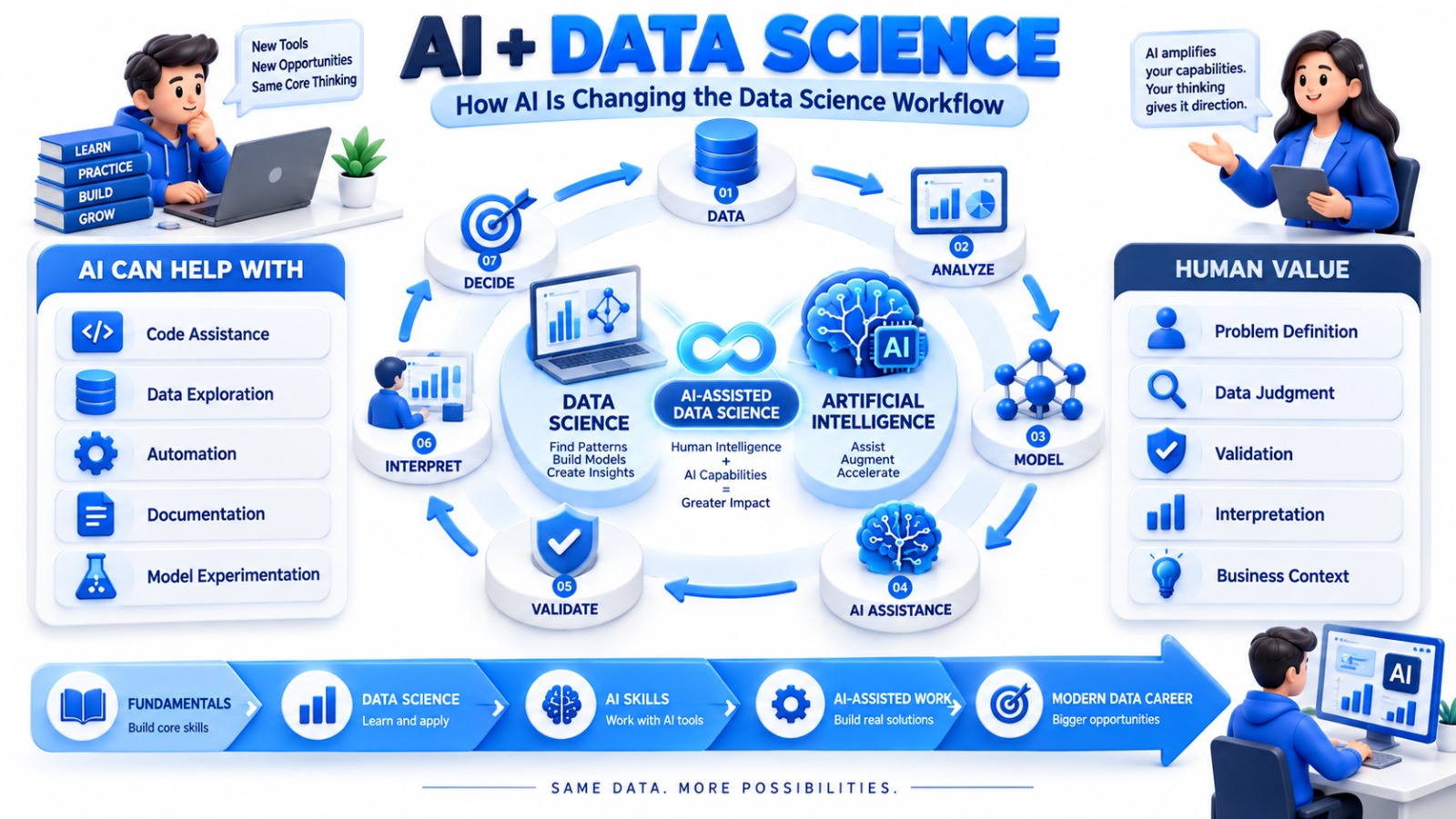
AI is becoming part of the Data Science workflow. A modern learning path can gradually move from traditional foundations toward AI-assisted Data Science.
A useful progression is:
Python → SQL → Statistics → Data Analysis → Machine Learning → AI → Generative AI → AI-Assisted Data Science
This does not mean every learner needs to become an AI researcher.
Instead, Data Science professionals should understand how AI can support tasks such as:
Instead, Data Science professionals should understand how AI can support tasks such as:
- Code generation
- Data exploration
- Feature engineering assistance
- Model experimentation
- Documentation
- Data interpretation
- Automation
- Natural-language interaction with data
The stronger your fundamentals are, the easier it becomes to evaluate and use these tools effectively.
How Important Is AI for Someone Switching to Data Science?
AI knowledge is becoming increasingly useful, but it should not replace the fundamentals. A beginner should not try to skip Python, SQL, statistics, and Machine Learning simply because AI tools can generate code.
For example, if an AI tool produces a model, you should still understand:
- What the model is doing
- What data it is using
- Which metrics are appropriate
- Whether the results make sense
- What limitations the model has
This is why a career switch into Data Science should be built around strong fundamentals plus modern AI capabilities.
Do You Need Coding Experience to Switch to Data Science?
You do not necessarily need previous professional programming experience. However, you should be prepared to learn coding.
Python is one of the most important programming languages for Data Science, and you should become comfortable with:
- Variables and data types
- Conditions and loops
- Functions
- Lists and dictionaries
- File handling
- Error handling
- Object-oriented programming basics
- Libraries used for data analysis
You will also need to work with libraries and tools commonly used for Data Science, such as Pandas, NumPy, Matplotlib, and Scikit-learn. The goal is not to become a software engineer. The goal is to become capable of using code to work with data and build analytical solutions.
How Much Mathematics and Statistics Do You Need?
You do not need advanced mathematics before beginning your Data Science journey. However, statistics is an important part of the field.
You should gradually understand concepts such as:
- Mean, median, and mode
- Variance and standard deviation
- Probability
- Distributions
- Correlation
- Hypothesis testing
- Regression concepts
- Sampling
- Statistical interpretation
As you progress into Machine Learning, mathematical concepts become more useful for understanding how algorithms work. A practical approach is to learn mathematics and statistics alongside Data Science rather than trying to master every mathematical topic beforehand.
What Skills Do You Need for a Data Science Career Switch?
A career switcher should focus on building skills across several areas.
Technical Skills
- Python
- SQL
- Pandas
- NumPy
- Data visualization
- Machine Learning
- Model evaluation
- Feature engineering
- Deep Learning fundamentals
- AI and Generative AI concepts
- Deployment fundamentals
Analytical Skills
You should be able to examine data, identify patterns, ask meaningful questions, and determine whether the results support a particular conclusion.
Business Understanding
A strong Data Science professional needs to understand why a problem matters to the business.
Communication Skills
You may need to explain technical findings to people who do not have a technical background.
Problem-Solving
Data Science projects rarely come with perfectly prepared datasets and clearly defined answers. You need to be comfortable investigating problems and making informed decisions.
What Skills Do You Need for a Data Science Career Switch?
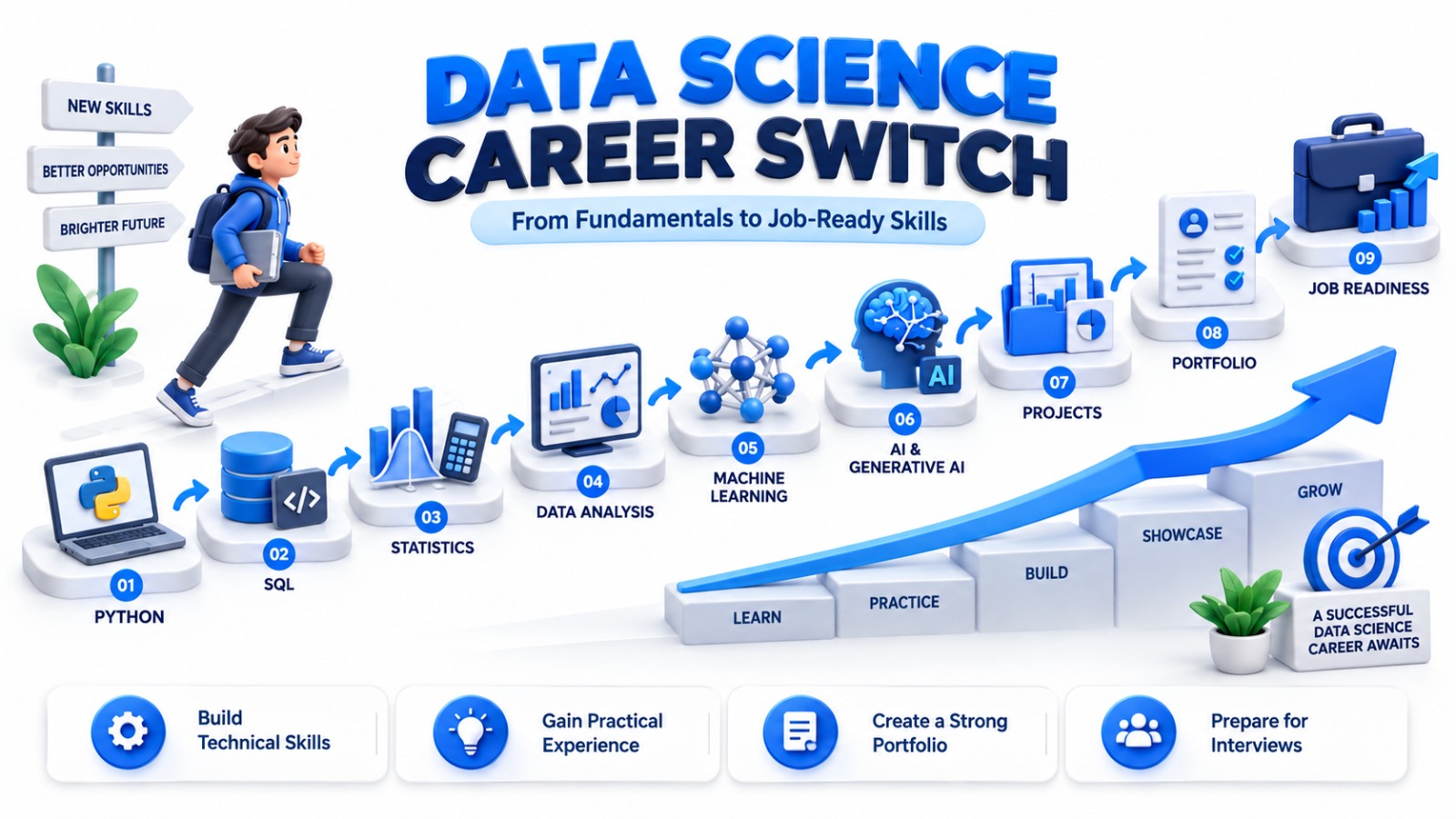
Trying to learn every Data Science technology simultaneously can make the transition confusing. A better approach is to build your skills progressively.
Stage 1: Learn the Fundamentals
Start with:
- Python
- SQL
- Basic statistics
- Data handling
Stage 2: Learn Data Analysis
Move into:
- Pandas
- NumPy
- Data cleaning
- Exploratory Data Analysis
- Data visualization
Stage 3: Learn Machine Learning
Understand:
- Supervised learning
- Unsupervised learning
- Regression
- Classification
- Clustering
- Feature engineering
- Model evaluation
Stage 4: Explore AI
After establishing the fundamentals, move toward:
- Artificial Intelligence
- Deep Learning fundamentals
- Generative AI
- AI-assisted Data Science
Stage 5: Apply Your Knowledge
Build projects that require you to work through the complete process from data preparation to insights and model evaluation. This progression helps prevent the common mistake of jumping directly into advanced AI tools without understanding the underlying concepts.
How to Build Practical Data Science Experience
Career switchers often face one major problem:
How do I show experience when I am trying to enter a new field?
Projects can help bridge that gap. Instead of building projects that only demonstrate that you followed a tutorial, try solving problems from beginning to end.
A project should ideally involve:
- Defining the problem
- Collecting or understanding the data
- Cleaning the data
- Exploring the data
- Creating useful features
- Selecting an appropriate approach
- Training a model where applicable
- Evaluating the results
- Interpreting the findings
- Explaining the business value
This gives you a much stronger story to discuss during interviews.
What Projects Should Career Switchers Build?
Your projects should demonstrate different Data Science capabilities.
Customer Churn Prediction
Analyze customer behavior and develop a model to identify customers who may leave.
Sales Forecasting
Use historical sales information to identify trends and forecast future demand.
Customer Segmentation
Group customers based on behavioral or transactional characteristics.
Fraud Detection
Analyze transaction patterns and identify potentially suspicious activities.
Recommendation System
Build a system that recommends products, content, or services based on user behavior.
Demand Forecasting
Use historical information to help businesses understand future demand. The project topic is important, but how you approach the problem matters even more.
How to Build a Data Science Portfolio
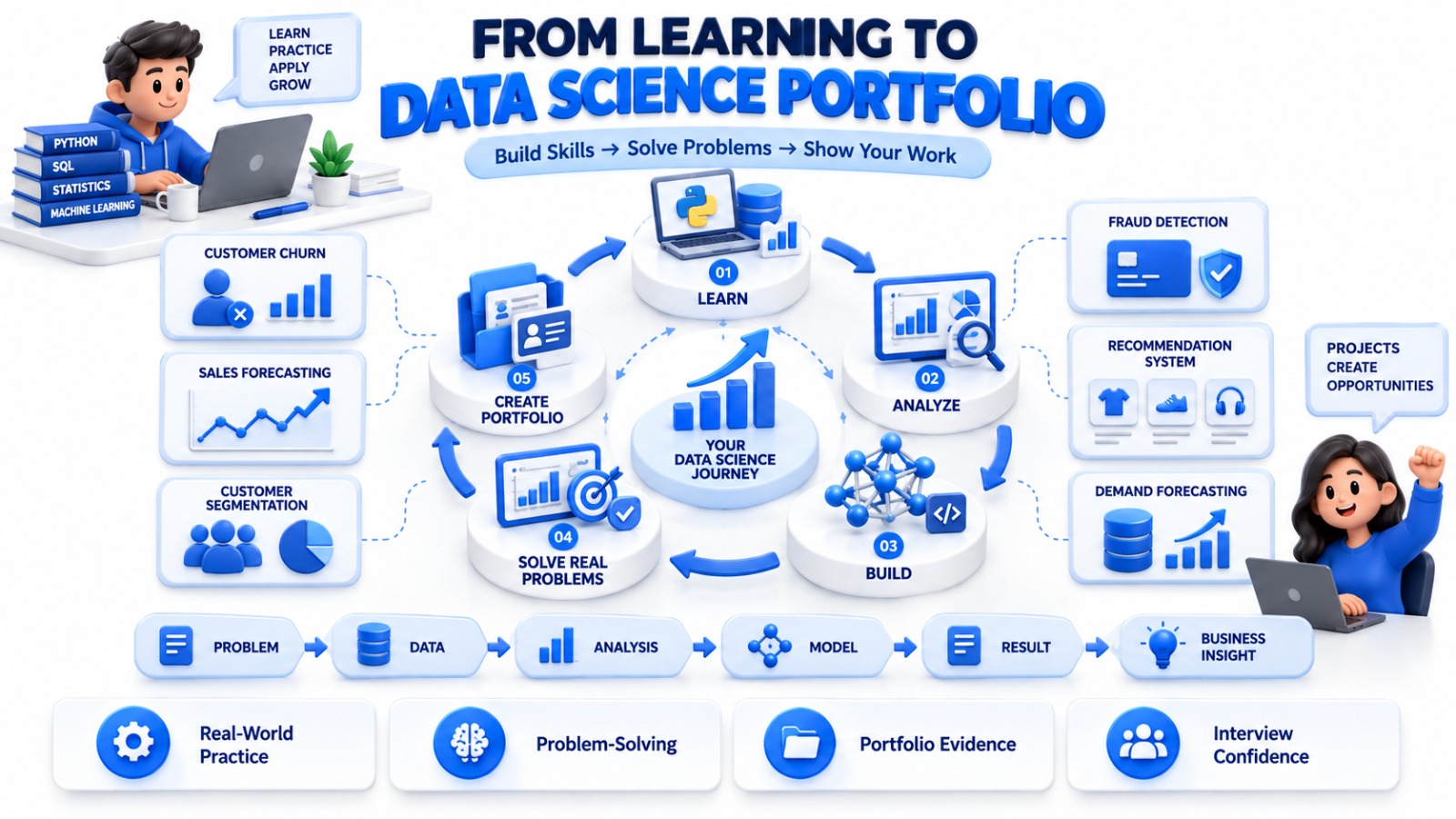
A portfolio should demonstrate how you think, not simply display a collection of notebooks.
For each project, explain:
- What problem were you solving?
- What data did you use?
- What challenges did you encounter?
- How did you clean the data?
- Which approach did you choose?
- Why did you choose it?
- How did you evaluate the result?
- What did you learn?
- What business decision could the analysis support?
A smaller number of well-explained projects can be more useful than a large collection of unfinished projects. Your portfolio can include projects using Python, SQL, Machine Learning, visualization, and AI depending on the role you want to pursue.
Can Working Professionals Learn Data Science?
Yes, working professionals can learn Data Science while continuing their current careers. The main challenge is consistency. Instead of trying to complete everything in a short period, create a sustainable learning routine.
For example, your learning time can be divided between:
- Concept learning
- Coding practice
- SQL practice
- Statistics
- Projects
- Revision
- Interview preparation
Working professionals can also use their current industry experience to select projects related to their domain. Someone working in operations might explore forecasting or optimization problems, while someone from finance might focus on risk or financial analytics. This can make the transition more relevant to their existing experience.
How Long Does a Data Science Career Switch Take?
There is no single timeline that applies to everyone.
The time required depends on factors such as:
- Your current technical knowledge
- Previous programming experience
- Educational background
- Learning consistency
- Time available each week
- Depth of skills you want to develop
- Amount of project practice
- Interview preparation
A career switch should therefore not be measured only by how quickly you finish a course.
A better question is:
Can I independently work on a Data Science problem and explain my approach?
When you can demonstrate your skills through projects, portfolio work, technical discussions, and interviews, you are moving closer to being job-ready.
Do You Need a Data Science Certification?
A certification can demonstrate that you completed a structured learning program, but certification alone does not make someone job-ready.
Recruiters and interviewers may also want to understand your:
- Technical skills
- Projects
- Problem-solving ability
- SQL knowledge
- Python knowledge
- Machine Learning understanding
- Communication skills
- Ability to explain your work
Therefore, use certification as one part of your career transition rather than treating it as the final goal.
How to Choose Data Science Training
If you are planning a career switch, the training program you choose should help you develop skills in a logical sequence.
Before enrolling, check whether the program covers:
- Python
- SQL
- Statistics
- Data Analysis
- Machine Learning
- Data Visualization
- AI
- Practical projects
- Assignments
- Portfolio development
- Interview preparation
Also look at whether the course is suitable for your current level. A beginner needs a different starting point from someone who already works with Python or analytics. Most importantly, evaluate the actual curriculum and learning outcomes rather than choosing a program only because of its title or certification.
How to Prepare for Data Science Interviews
Once you have developed your technical foundation and projects, interview preparation becomes important. Start by revising the fundamentals.
Python
Be prepared to explain and solve basic programming problems and work with data using Python.
SQL
Practice queries involving:
- SELECT
- WHERE
- GROUP BY
- JOIN
- Subqueries
- Aggregations
- Window functions
Statistics
Be comfortable explaining fundamental statistical concepts and their practical applications.
Machine Learning
Understand:
- Regression
- Classification
- Clustering
- Overfitting
- Underfitting
- Feature engineering
- Model evaluation
- Model selection
Projects
Your projects may become one of the most important parts of the discussion. Be ready to explain the problem, dataset, methodology, challenges, model selection, evaluation, and results. Do not memorize project explanations. Understand what you actually built.
When Are You Ready to Make the Career Switch?
You do not need to know every Data Science concept before applying for opportunities. However, you should be able to demonstrate a solid foundation.
You can use the following checklist:
- Can you write basic Python code?
- Can you work with SQL?
- Can you clean and analyze datasets?
- Can you explain basic statistics?
- Can you build and evaluate Machine Learning models?
- Can you explain why you selected a particular approach?
- Have you completed meaningful projects?
- Can you explain your projects without depending on a tutorial?
- Do you have a portfolio?
- Can you explain how your previous experience adds value?
- Are you comfortable discussing your technical skills in an interview?
If several of these areas are still unfamiliar, continue strengthening your foundation before making the transition.
Common Mistakes Career Switchers Should Avoid
Trying to Learn Everything at Once
Data Science includes many technologies. Trying to learn all of them simultaneously can create confusion. Build your foundation first.
Focusing Only on Certificates
A certificate can document learning, but it cannot replace practical knowledge.
Avoiding Coding
If you want to work in Data Science, you should become comfortable with programming rather than trying to avoid it completely.
Ignoring Statistics
Statistics helps you understand data and evaluate analytical results.
Building Only Tutorial Projects
Projects should demonstrate your own problem-solving ability.
Jumping Directly Into Generative AI
AI tools are useful, but they should complement your fundamentals rather than replace them.
Ignoring Your Previous Experience
Your previous career may provide valuable domain knowledge. Use it as part of your transition story.
Applying Without Interview Preparation
Technical skills and job-search preparation should develop together.
What Data Science Roles Can You Explore?
Data Science is a broad field, and career opportunities can vary depending on your skills and previous experience.
Depending on your background and specialization, you may explore roles such as:
- Data Scientist
- Junior Data Scientist
- Machine Learning Engineer
- Data Analyst
- Business Analyst
- Machine Learning Analyst
- AI-focused roles
- Predictive Analytics roles
The exact role you target should depend on your existing experience, technical skills, portfolio, and career goals. For some professionals, moving first into a Data Analyst or analytics-focused position may be a practical transition before moving toward more advanced Data Science responsibilities.
Is Data Science the Right Career Switch for You?
Data Science can be a suitable career direction for people who enjoy working with data, solving problems, learning technical concepts, and understanding how information can support decisions. But it is not the right choice simply because it is a popular technology field.
Before making the switch, ask yourself:
- Do I enjoy analytical problem-solving?
- Am I willing to learn programming?
- Am I comfortable working with numbers and data?
- Can I commit time to continuous learning?
- Am I willing to build projects instead of relying only on courses?
- Can I learn from mistakes and work through technical problems?
- How can my previous professional experience complement Data Science?
If your answers indicate that you are comfortable with this learning process, Data Science may be worth exploring as your next career direction.
Frequently Asked Questions
Q:1 Can I switch to Data Science without a Computer Science degree?
Ans: Yes. A Computer Science degree is not the only possible starting point. Learners from different educational and professional backgrounds can build Data Science skills by developing programming, statistics, analytics, and Machine Learning knowledge.
Q:2 Can a non-technical person become a Data Scientist?
Ans: Yes, but non-technical learners need to be prepared to develop technical skills such as Python, SQL, statistics, data analysis, and Machine Learning.
Q:3 How can I switch my career to Data Science?
Ans: Start by understanding your current skill set, identify the Data Science skills you need, learn Python and SQL, build statistical and Machine Learning knowledge, complete practical projects, create a portfolio, and prepare for interviews.
Q:4 Do I need to know Python before learning Data Science?
Ans: Previous Python experience is helpful but not mandatory for beginners. You can learn Python as part of your Data Science learning journey.
Q:5 Is mathematics necessary for Data Science?
Ans: You do not need advanced mathematics to begin. However, statistics and relevant mathematical concepts become important as you progress into Data Science and Machine Learning.
Q:6 Can working professionals switch to Data Science?
Ans: Yes. Working professionals can develop Data Science skills alongside their existing careers by following a consistent learning schedule and building projects relevant to their experience.
Q:7 Can an IT professional switch to Data Science?
Ans: Yes. IT professionals may already have useful technical experience and can build additional skills in Python, statistics, analytics, Machine Learning, and AI.
Q:8 Can a Data Analyst become a Data Scientist?
Ans: Yes. Data Analysts already work with data, which can provide a useful foundation. They can expand their skills into statistics, Machine Learning, predictive modeling, and advanced analytics.
Q:9 Is certification enough to get a Data Science job?
Ans: No. Certification can demonstrate structured learning, but practical skills, projects, technical understanding, communication, and interview performance are also important.
Q:10 Will AI replace Data Science jobs?
Ans: AI is automating and assisting with parts of Data Science work, but Data Science still requires problem definition, data understanding, validation, interpretation, and business context. Professionals will increasingly need to know how to work effectively with AI tools.
Q:11 Should I learn AI before Machine Learning?
Ans: For most beginners, building fundamentals in Python, SQL, statistics, data analysis, and Machine Learning first provides a stronger foundation before moving into advanced AI concepts.
Q:12 How many projects should I build for a Data Science portfolio?
Ans: There is no fixed number. Focus on building a small set of meaningful projects that demonstrate different skills and that you can explain confidently.
Q:13 Can my previous career experience help me in Data Science?
Ans: Yes. Domain knowledge from areas such as finance, marketing, operations, IT, engineering, or other industries can help you understand business problems and interpret data in context.
Q:14 What skills should I learn for a Data Science career switch?
Important skills include Python, SQL, statistics, data analysis, visualization, Machine Learning, model evaluation, feature engineering, AI fundamentals, and practical problem-solving.
Q:15 Is Data Science a good career for beginners?
Ans: Data Science can be a suitable career direction for beginners who are willing to develop technical and analytical skills and continuously practice through real projects.
Why Choose TechPratham for Your Data Science Career Switch?
Choosing the right training partner is an important part of a career transition. For professionals moving into Data Science, the focus should be on developing relevant technical skills, gaining practical exposure, and preparing to apply those skills in real-world scenarios.
TechPratham's Data Science training brings these elements together through a curriculum that covers the core technologies and concepts needed to build a strong foundation in Data Science.
Comprehensive Data Science Curriculum
The course covers key areas including Python, SQL, Statistics, Data Analysis, Data Visualization, Predictive Modeling, Machine Learning, Deep Learning, Artificial Intelligence, Feature Engineering, Model Evaluation, and Deployment Fundamentals. This gives learners a connected learning path instead of focusing on individual tools in isolation.
Practical Learning and Projects
Practical exposure is particularly important for career switchers. TechPratham's Data Science course includes assignments, recordings, and live project-based learning, helping learners apply concepts while developing hands-on experience. These projects can also provide useful material for building a portfolio and preparing for technical interviews.
Suitable for IT and Non-IT Backgrounds
Data Science career transitions can begin from different professional backgrounds. TechPratham's Data Science training is designed for learners from both IT and non-IT backgrounds who want to develop the technical and analytical skills required for a move into Data Science. Your existing professional experience can also be combined with your new Data Science skills to create a stronger career profile.
Resume and Interview Preparation
Learning technical concepts is only one part of changing careers. You also need to present your projects, skills, and previous experience effectively during the hiring process. TechPratham includes resume and interview preparation support to help learners prepare for this stage of their career transition.
A Career-Focused Learning Approach
The objective of Data Science training should go beyond completing lessons or earning a certificate.It should help you develop the ability to work with data, understand Machine Learning concepts, build projects, explain your approach, and prepare for Data Science opportunities. If you are planning a career switch to Data Science, explore the TechPratham Data Science Course to review the curriculum, skills covered, and learning approach.
Final Thoughts
A career switch to Data Science does not happen simply by completing a course or earning a certificate. It requires a combination of technical skills, analytical thinking, practical projects, portfolio development, and interview preparation. The good news is that you do not necessarily have to throw away everything you have learned in your current career.
Related Data Science Blogs
Related Articles
Data Analytics and BI Training
Is Data Science a Good Career? A Complete Guide for Beginners
Is Data Science a good career? Explore career opportunities, skills, roadmap, AI impact, and practical guidance for beginners.

Data Analytics and BI Training
Best Data Science Courses in India: A Complete Guide
Explore the Best Data Science Courses in India and build in-demand skills with industry-focused training and certification.