Data Analytics and BI Training
315 min read281 viewsIs Data Science a Good Career? A Complete Guide for Beginners
By TechPratham TeamPublished September 11, 2026Updated September 11, 2026

Choosing a career in technology can be difficult when the industry is changing so quickly. New tools appear regularly, artificial intelligence is changing the way people work, and many traditional job responsibilities are becoming automated.
This naturally leads to an important question:
Q: Is Data Science still a good career choice?
A: For beginners, the answer is not simply yes or no.
Data Science can be a strong career path for people who enjoy working with data, solving problems, understanding patterns, using technology, and making decisions based on evidence. At the same time, it is not a shortcut to a high-paying job. Building a career in Data Science requires programming, statistics, analytical thinking, practical projects, continuous learning, and the ability to solve real business problems.
The good news is that you do not necessarily need to start as an expert programmer or mathematician.
With a structured learning path, consistent practice, and real-world project experience, students, fresh graduates, working professionals, and career switchers can gradually build the skills required for data-related roles.
This guide explains what Data Science really involves, who should consider it, whether AI will replace Data Scientists, what skills you need, what career opportunities exist, and how to start learning Data Science in a practical way.
What Is Data Science?
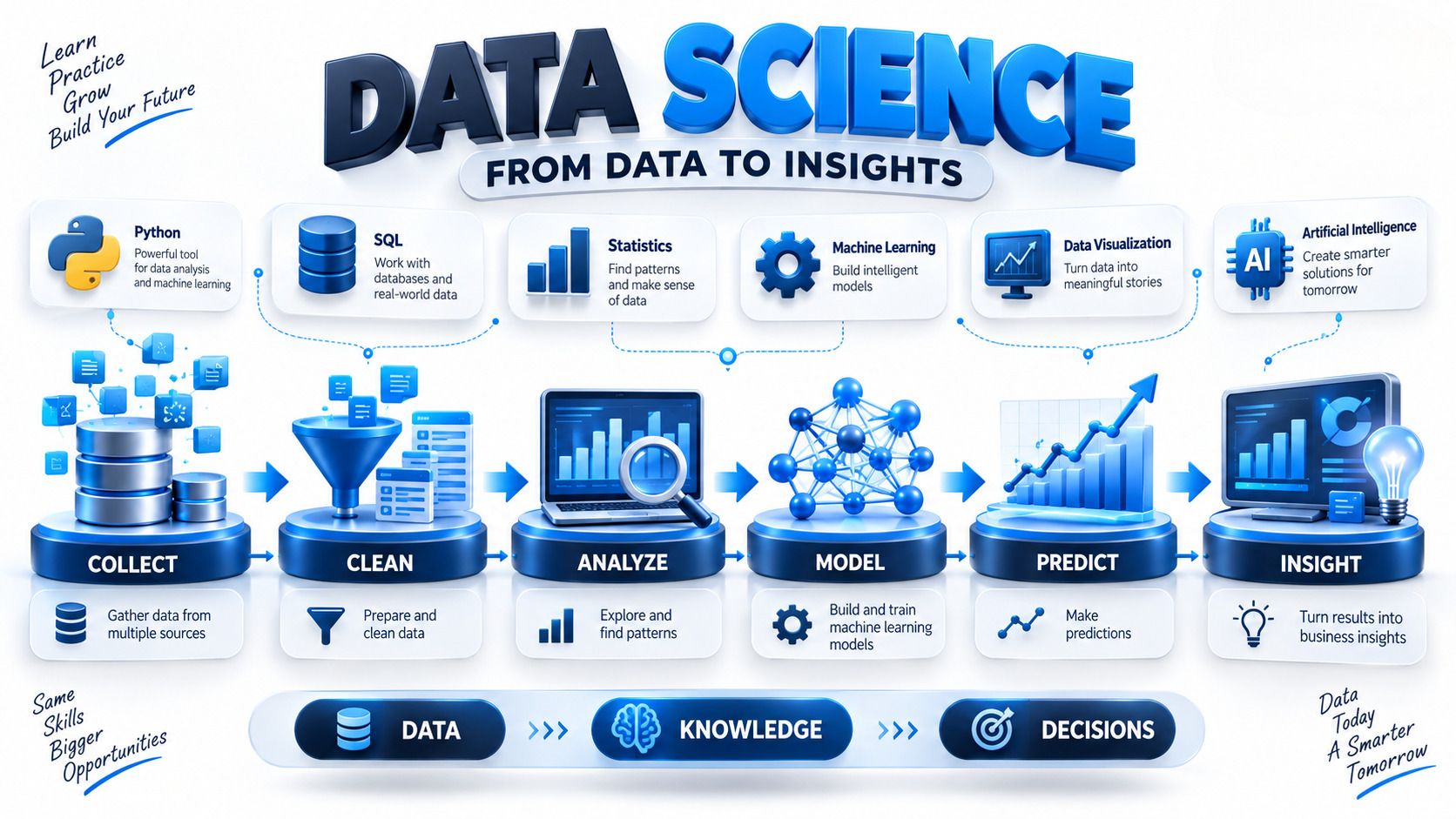
Data Science is a multidisciplinary field that combines data, statistics, programming, machine learning, analytical thinking, and domain knowledge to solve problems and generate useful insights.
In simple terms, Data Science helps organizations answer questions such as:
- What happened?
- Why did it happen?
- What is likely to happen next?
- What should the business do about it?
For example, an e-commerce company may use Data Science to predict customer demand, recommend products, identify unusual transactions, and improve pricing decisions. A financial organization may use data to evaluate credit risk or detect potentially fraudulent transactions. A manufacturing company can use predictive models to identify patterns associated with equipment failure. A healthcare organization can use data to identify trends and improve operational decision-making. This is why Data Science is not limited to one industry. The underlying skills can be applied wherever organizations collect and use data.
What Does a Data Scientist Actually Do?
The term "Data Scientist" can sound highly technical, but the actual job involves much more than writing machine learning code.
A Data Scientist may be responsible for:
- Understanding a business problem
- Collecting relevant data
- Cleaning and preparing data
- Exploring datasets
- Identifying patterns and relationships
- Applying statistical techniques
- Building machine learning models
- Evaluating model performance
- Communicating findings
- Helping organizations make better decisions
One of the most important skills is therefore not simply knowing Python or machine learning. It is understanding what problem you are trying to solve and whether the analysis actually answers that problem. A technically impressive model is not useful if it does not solve a meaningful business problem.
Is Data Science a Good Career?
Data Science can be a good career for people who are interested in technology, analytical problem-solving, statistics, programming, and working with data.
The field also connects with several growing areas of technology, including artificial intelligence, machine learning, predictive analytics, automation, and generative AI. However, it is important to have realistic expectations. Learning a few Python libraries or completing an online certificate does not automatically make someone job-ready.
A strong Data Science career usually requires a combination of:
- Programming skills
- Statistics
- SQL
- Data analysis
- Machine learning
- Data visualization
- Problem-solving
- Business understanding
- Communication
- Practical project experience
- Continuous learning
The strongest candidates are often those who can combine technical knowledge with the ability to understand and communicate business problems.
Why Is Data Science Important for Businesses?
Modern organizations generate enormous amounts of data from websites, applications, transactions, customer interactions, sensors, enterprise systems, and digital platforms. But raw data has limited value if a business cannot interpret it. Data Science helps organizations turn data into decisions.
It can support:
- Customer segmentation
- Demand forecasting
- Fraud detection
- Risk analysis
- Recommendation systems
- Predictive maintenance
- Marketing optimization
- Supply chain planning
- Customer behavior analysis
- Financial forecasting
- Operational optimization
This broad business applicability is one reason data-related skills continue to be relevant across industries.
Will AI Replace Data Scientists?
.jpg)
This is one of the biggest concerns among beginners.
The short answer is:
AI is more likely to change the work of Data Scientists than simply eliminate the profession.
AI tools can already help with many activities that previously required more manual effort. For example, AI can assist with:
- Writing code
- Generating SQL queries
- Explaining datasets
- Creating documentation
- Exploring patterns
- Generating visualizations
- Debugging code
- Building initial model pipelines
- Summarizing analytical results
This means some repetitive tasks are becoming faster. But Data Science involves much more than producing code.
Someone still needs to determine:
- Which problem should be solved?
- Which data is relevant?
- Is the data reliable?
- Is there bias in the data?
- Is the model appropriate?
- Are the results statistically meaningful?
- Does the model actually solve the business problem?
- Can the results be trusted?
- How should the findings be communicated?
These require judgment, context, analytical thinking, and domain understanding. The future therefore belongs increasingly to professionals who know how to use AI as a productivity tool while still understanding the fundamentals behind the work.
How AI Is Changing Data Science
Instead of thinking only about whether AI will replace Data Scientists, beginners should ask a better question:
How can a Data Scientist become more effective with AI?
AI can help professionals accelerate routine tasks, but fundamentals remain important. For example, if an AI tool generates a machine learning model, the Data Scientist still needs to understand:
- What data was used?
- Why was the algorithm selected?
- How was the model evaluated?
- What assumptions were made?
- What does the output mean?
- What could cause the model to fail?
Without these fundamentals, blindly accepting AI-generated results can create serious analytical mistakes. This makes AI literacy an increasingly useful complement to Data Science skills.
Who Should Consider a Career in Data Science?
Data Science may be suitable if you enjoy:
- Solving analytical problems
- Working with numbers and data
- Learning technology
- Finding patterns
- Experimenting with different approaches
- Understanding why something happened
- Building predictive solutions
- Learning continuously
You do not need to know everything before starting. Curiosity and willingness to learn are often more important at the beginning.
Can Freshers Learn Data Science?
Yes, Fresh graduates can start learning Data Science, but they should understand that the learning journey is broader than learning a few machine learning algorithms.
A fresher should gradually develop:
Programming → Data Handling → SQL → Statistics → Data Analysis → Machine Learning → Projects → Deployment Fundamentals → Interview Preparation
The biggest mistake beginners make is jumping directly into advanced AI or machine learning without understanding the basics. Strong foundations make advanced topics much easier to understand.
Can Non-CS Students Learn Data Science?
Yes, A Computer Science degree can provide useful technical foundations, but Data Science is not exclusively limited to Computer Science graduates.
People from backgrounds such as:
- Mathematics
- Statistics
- Economics
- Finance
- Engineering
- Business
- Operations
- Commerce
- Other analytical disciplines
may also find Data Science relevant. The important consideration is whether the learner is willing to develop the required technical foundation.
A non-technical learner may need more time initially to become comfortable with programming, databases, and statistics.
That is normal. The goal should not be to compare yourself with someone who has been coding for years. The goal should be to build your skills progressively.
Do You Need Coding for Data Science?
Yes, programming is an important part of Data Science. Python is particularly valuable because of its extensive ecosystem for data analysis and machine learning.
Beginners commonly learn tools and libraries such as:
- Python
- NumPy
- Pandas
- Matplotlib
- Scikit-learn
- SQL
The important point is that you do not need to become a software engineer before beginning Data Science.
You need enough programming knowledge to:
- Manipulate data
- Clean datasets
- Perform analysis
- Build models
- Automate repetitive tasks
- Understand and modify analytical code
With practice, programming becomes a tool for solving problems rather than something to fear.
How Much Mathematics Is Required for Data Science?
Mathematics is useful in Data Science, but beginners often make the mistake of assuming that they need advanced mathematics before they can start.
A practical foundation includes concepts from:
- Statistics
- Probability
- Descriptive statistics
- Distributions
- Correlation
- Regression
- Hypothesis testing
- Basic linear algebra
- Basic calculus concepts for advanced machine learning
The amount of mathematics you need depends on your career direction. Someone working primarily in business analytics may need a different mathematical depth from someone developing advanced machine learning models. The better approach is to learn mathematics alongside practical applications.
What Skills Do You Need to Become a Data Scientist?
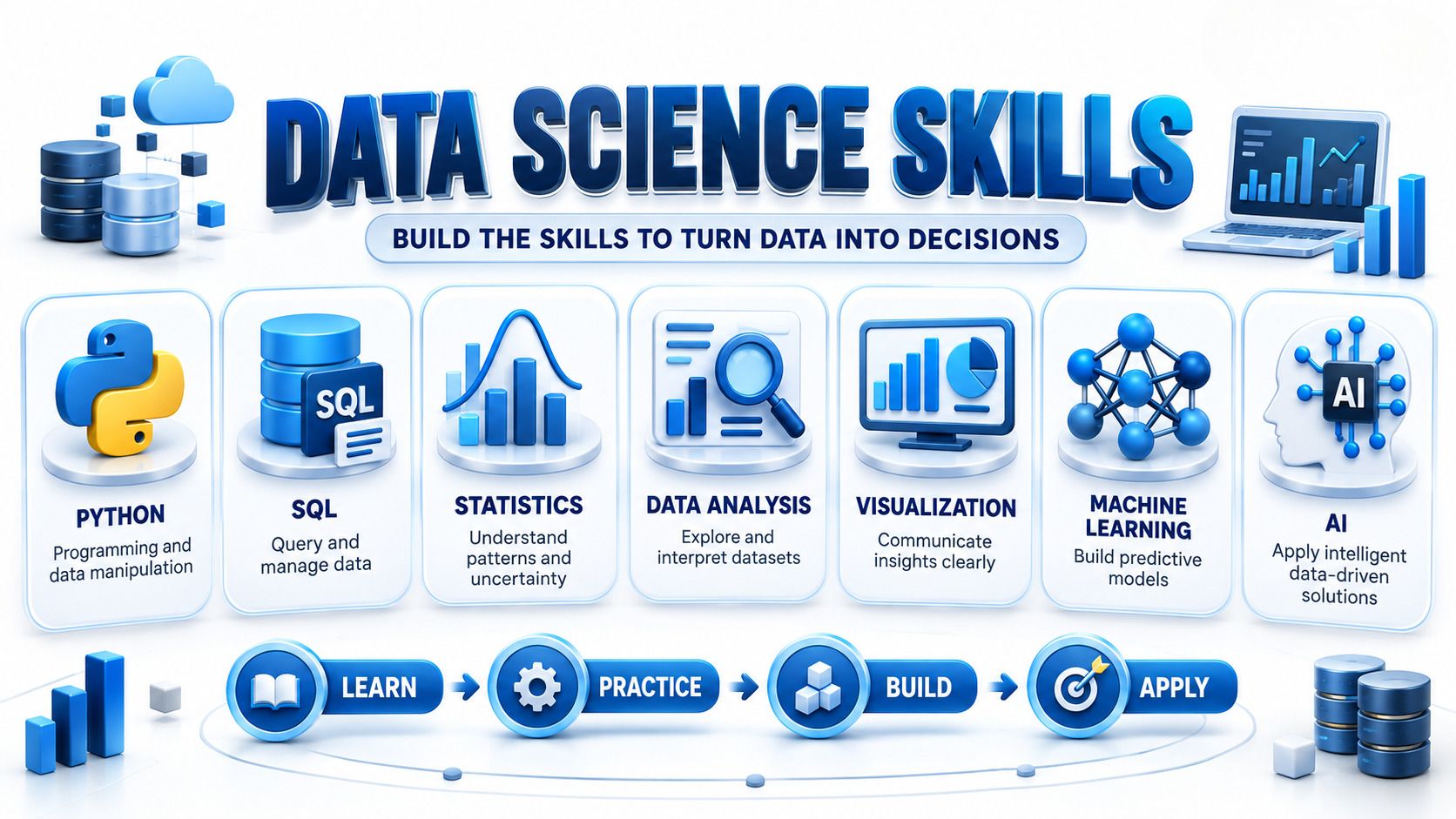
A strong Data Science skill set can be divided into several layers.
1. Python Programming
Python is widely used for data manipulation, analysis, automation, and machine learning.
2. SQL
SQL is essential for working with structured data stored in databases.
3. Statistics
Statistics helps you understand data, identify relationships, measure uncertainty, and evaluate results.
4. Data Cleaning
Real-world datasets are rarely perfect.
You need to know how to handle:
- Missing values
- Duplicate records
- Incorrect formats
- Outliers
- Inconsistent data
- Invalid values
5. Exploratory Data Analysis
EDA helps you understand a dataset before building models.
6. Data Visualization
Visualization helps communicate patterns and findings clearly.
7. Machine Learning
Machine learning allows systems to learn patterns from data and make predictions or classifications.
8. Model Evaluation
Building a model is only one part of the process. You must also understand whether the model performs reliably.
9. Business Understanding
A Data Scientist needs to understand why an analysis matters.
10. Communication
A technically correct result has limited value if stakeholders cannot understand it.
What Are the Career Options After Learning Data Science?
Data Science skills can lead to several related career paths.
Data Scientist
Focuses on advanced data analysis, statistical modelling, machine learning, and predictive solutions.
Machine Learning Engineer
Focuses more heavily on building, integrating, deploying, and maintaining machine learning systems.
Data Analyst
Works primarily with data preparation, reporting, visualization, business analysis, and insights.
Business Analyst
Uses analytical and business knowledge to help organizations understand requirements and make decisions.
AI/ML Specialist
With additional specialization, Data Science learners can move toward artificial intelligence and machine learning roles.
Data Science Consultant
Experienced professionals may work with organizations to design analytical solutions and solve business problems. The exact responsibilities and requirements vary between companies.
Data Science vs Data Analytics: Which Is Better?
There is no universal answer. Data Analytics and Data Science overlap, but their typical focus can be different.
For someone who is completely new to data, Data Analytics can sometimes provide a gentler entry point. For someone interested in programming, statistics, machine learning, and AI, Data Science may be a better long-term direction. The right choice depends on your background and career goal.
What Does a Data Science Learning Roadmap Look Like?
A practical beginner roadmap can look like this:
Stage 1: Understand Data Fundamentals
Start with:
- Data concepts
- Types of data
- Basic statistics
- Analytical thinking
Stage 2: Learn Python
Focus on:
- Variables
- Data types
- Conditions
- Loops
- Functions
- Lists and dictionaries
- File handling
- Basic object-oriented concepts
Stage 3: Learn SQL
Understand:
- SELECT
- WHERE
- GROUP BY
- JOIN
- Subqueries
- Aggregations
- Window functions
Stage 4: Learn Data Analysis
Work with:
- NumPy
- Pandas
- Data cleaning
- Exploratory analysis
- Data transformation
Stage 5: Learn Data Visualization
Build charts and communicate insights using appropriate visualization techniques.
Stage 6: Learn Machine Learning
Understand:
- Supervised learning
- Unsupervised learning
- Regression
- Classification
- Clustering
- Feature engineering
- Model evaluation
Stage 7: Build Real Projects
This is where theoretical knowledge becomes practical experience.
Stage 8: Learn Advanced Topics
Depending on your career goals, you can move toward:
- Deep learning
- Natural language processing
- Computer vision
- Generative AI
- MLOps
- Cloud-based machine learning
You do not need to learn every advanced technology at once.
Why Real Projects Matter in Data Science
One of the biggest differences between learning Data Science and becoming job-ready is practical experience. A portfolio project should demonstrate more than a model.
It should show that you can:
- Understand a problem
- Find or work with appropriate data
- Clean the data
- Explore the dataset
- Select an approach
- Build an analytical solution
- Evaluate the results
- Explain what the results mean
For example, instead of simply creating a machine learning notebook, you could build a project around:
- Sales forecasting
- Customer churn prediction
- Credit risk analysis
- Demand forecasting
- Customer segmentation
- Recommendation systems
Projects like these help demonstrate how technical skills can be applied to business problems.
How Long Does It Take to Learn Data Science?
There is no fixed timeline because learning speed depends on your background, available study time, technical foundation, and practice.
Someone with programming and statistics experience may progress faster than someone starting from zero.
A more useful way to think about the journey is by milestones:
Foundation → Practical Skills → Projects → Advanced Skills → Job Preparation
Rather than trying to finish Data Science as quickly as possible, focus on becoming capable of solving progressively more difficult problems. Consistency is usually more valuable than rushing through a syllabus.
Is Data Science Certification Enough to Get a Job?
No, A certification can demonstrate that you completed a structured learning program, but employers may evaluate a much broader set of capabilities.
These can include:
- Python
- SQL
- Statistics
- Machine learning
- Data analysis
- Projects
- Problem-solving
- Communication
- Business understanding
- Interview performance
This is why learners should evaluate a Data Science certification program based on its curriculum, practical exposure, projects, mentorship, and career preparation rather than focusing only on the certificate.
How to Choose Data Science Training in India
If you decide to pursue structured learning, choosing the right Data Science Training in India becomes an important decision. Do not choose a program only because it has a long list of technologies. Instead, evaluate the complete learning experience.
1. Check the Curriculum
A comprehensive program should cover the fundamentals before advanced concepts.
Look for areas such as:
- Python
- Statistics
- SQL
- Data Analysis
- Machine Learning
- Data Visualization
- Model Evaluation
- Projects
- Advanced AI topics where relevant
2. Look for Practical Projects
Ask whether you will actually work with datasets and business problems.
3. Check Mentor Experience
Industry exposure can help learners understand how concepts are applied beyond textbooks.
4. Understand Career Support
Depending on the provider, this may include:
- Resume preparation
- Interview preparation
- Mock interviews
- Career guidance
- Project discussions
5. Check Whether Beginners Are Supported
If you are starting from zero, a course designed only for experienced professionals may not be suitable.
6. Avoid Guaranteed-Job Claims
No training provider can honestly guarantee that learning a course automatically results in employment. Your outcome depends on your skills, effort, projects, communication, interview performance, experience, and the opportunities available to you.
Why Structured Data Science Training Can Help Beginners
Self-learning gives you flexibility, but it can also create problems. Beginners often jump between YouTube videos, courses, documentation, AI tools, and tutorials without following a logical sequence.
Structured training can provide:
- A defined curriculum
- Learning progression
- Instructor guidance
- Assignments
- Practical projects
- Feedback
- Interview preparation
- A consistent learning routine
The objective should not be to replace self-learning. Instead, structured training can provide the foundation while independent practice helps you become stronger.
Why Consider TechPratham for Data Science Training?
If you are evaluating Data Science Training in India, TechPratham provides a structured Data Science learning path covering important areas such as Python, statistics, machine learning, SQL, data visualization, predictive modelling, and related data technologies. The program is designed to combine technical learning with practical exposure, assignments, projects, interview preparation, and career-oriented development.
It can be relevant for:
- Fresh graduates
- IT professionals
- Working professionals
- Career switchers
- Developers
- Business analysts
- QA professionals
- Operations professionals
- Professionals from non-technical backgrounds who want to develop data skills
The right course still depends on your background and career goals. If you want to explore the curriculum in detail, you can review the Data Science course at TechPratham.
Who Should Not Choose Data Science?
Data Science is not the right career for everyone.
You may want to reconsider this path if:
You may want to reconsider this path if:
- You strongly dislike working with data
- You have no interest in learning programming
- You do not want to practice regularly
- You expect a job immediately after completing a certificate
- You dislike analytical problem-solving
- You are unwilling to keep learning new technologies
Choosing a career simply because it is considered "high paying" can lead to frustration. A better decision comes from matching your interests, strengths, and career goals with the actual work involved.
Common Mistakes Beginners Make
Trying to Learn Everything
Data Science is a huge field. Trying to learn every framework and AI tool at once can create confusion.
Ignoring SQL
Many beginners focus heavily on machine learning while neglecting data extraction and database skills.
Focusing Only on Certificates
A certificate is not a substitute for practical capability.
Avoiding Statistics
You do not need to become a mathematician, but understanding statistics is important for responsible data analysis.
Building Only Tutorial Projects
Following a tutorial is useful for learning, but eventually you need to solve problems independently.
Depending Completely on AI
AI can help you learn and work faster, but you should understand the code, assumptions, and results you use.
Ignoring Communication
Data professionals need to explain what their analysis means to people who may not have a technical background.
A Practical Beginner Strategy for Learning Data Science
If you are starting from scratch, follow a simple principle:
Learn → Practice → Build → Explain → Improve
For every major concept you learn:
- Understand the concept.
- Practice it with data.
- Build something small.
- Explain what you did.
- Identify what went wrong.
- Improve the solution.
This approach creates deeper understanding than simply completing video lessons.
Frequently Asked Questions About Data Science Careers
Q: Is Data Science a good career for beginners?
Ans : Yes, Data Science can be a strong career option for beginners who are willing to develop programming, statistics, analytical, and problem-solving skills gradually.
Q: Can I learn Data Science without a Computer Science degree?
Ans : Yes. People from different educational backgrounds can learn Data Science, although learners without technical experience may need additional time to build programming and mathematical foundations.
Q: Is Python mandatory for Data Science?
Ans : Python is not the only Ansprogramming language used in Data Science, but it is one of the most useful and widely adopted languages for data analysis and machine learning.
Q: Is mathematics difficult in Data Science?
Ans: Data Science uses mathematics and statistics, but beginners can learn the required concepts progressively. The mathematical depth depends on the role and specialization you pursue.
Q: Will AI replace Data Scientists?
Ans: AI is changing many Data Science tasks, particularly repetitive activities, but human judgment, problem framing, data quality assessment, model evaluation, business understanding, and communication remain important.
Q: Can freshers get Data Science jobs?
Ans: Freshers can pursue Data Science roles, but they should build practical skills, projects, strong fundamentals, and interview readiness rather than relying only on a certificate.
Q: Is Data Science better than Data Analytics?
Ans : Neither is universally better. Data Analytics can be a more accessible starting point for some beginners, while Data Science may be more suitable for learners interested in programming, statistics, machine learning, and predictive modelling.
Q: How should I start learning Data Science?
Ans: Start with Python and basic statistics, then learn SQL, data analysis, visualization, machine learning, and practical projects in a structured sequence.
Q: Are Data Science certifications worth it?
Ans: A certification can be useful as part of a structured learning journey, but it should be supported by practical skills, projects, problem-solving ability, and interview preparation.
Q: What should I look for in Data Science Training in India?
Ans: Look for a practical curriculum, experienced mentors, hands-on projects, foundational learning, advanced topics where appropriate, career guidance, and interview preparation.
Q: Can working professionals learn Data Science?
Ans: Yes. Working professionals can learn Data Science through structured programs and consistent practice. The learning format should fit their available time and existing technical background.
Q: What projects should a Data Science beginner build?
Ans: Beginners can build projects involving sales forecasting, customer segmentation, churn prediction, credit risk, demand forecasting, recommendation systems, or other real-world business problems.
Final Thoughts
So, is Data Science a good career?
It can be—but the value comes from the skills you build, not simply from the title of the course or certificate you complete.
Data Science combines programming, statistics, analytical thinking, machine learning, business understanding, and problem-solving. Artificial intelligence is changing the way these skills are used, but it is also creating new expectations for professionals who can work effectively with data and AI tools.
For beginners, the best approach is not to chase every new technology. Build strong fundamentals first. Learn Python. Understand SQL. Develop statistical thinking. Practice data analysis. Learn machine learning. Build meaningful projects. Learn to communicate your findings. Then gradually expand into advanced AI and machine learning areas.
If your interests match the work and you are prepared to keep learning, Data Science can become a valuable long-term career path. And if you are looking for structured Data Science Training in India, evaluate programs based on the quality of their curriculum, practical experience, mentorship, projects, and career preparation—not simply the promises made in their advertisements.
Related Articles

Data Analytics and BI Training
How to Switch Your Career to Data Science: A Pathway to a New Career
Learn how to switch your career to Data Science with the right skills, projects, AI knowledge, portfolio and career guidance.

Data Analytics and BI Training
Best Data Science Courses in India: A Complete Guide
Explore the Best Data Science Courses in India and build in-demand skills with industry-focused training and certification.





 +91-8882178896
 +1 (343) 477-0926