
Data Engineering
173 min read36 viewsEverything You Need to Know About Data Engineering: A Complete Guide
By TechPratham TeamPublished November 27, 2026Updated November 27, 2026

Data has become one of the most valuable resources for modern organizations. Businesses collect information from websites, applications, customer transactions, mobile devices, enterprise software, APIs, IoT devices, and many other sources. However, collecting data is only the beginning. Organizations need reliable systems to organize, process, transform, store, and deliver that data so it can support analytics, reporting, artificial intelligence, machine learning, and business decision-making.
This is where data engineering becomes important. Data engineers build and maintain the infrastructure and pipelines that move data from different sources into usable and trustworthy systems. Their work connects raw information with analysts, data scientists, applications, and business teams that depend on accurate and accessible data.
For learners considering a career in this field, understanding the fundamentals is essential before choosing technologies, courses, or certifications. This guide explains what data engineering is, what data engineers do, important technologies, required skills, career opportunities, practical projects, and the learning path beginners can follow to build a career in this growing technology field.
What Is Data Engineering?
Data engineering is the process of designing, developing, and maintaining systems that collect, process, transform, store, and deliver data. In simple terms, a data engineer creates the infrastructure that allows information to move from its original source to the people and systems that need it. This may involve databases, APIs, cloud platforms, data warehouses, data lakes, processing frameworks, and automated pipelines.
For example, consider an e-commerce company. Every day, customers may browse products, add items to their carts, place orders, make payments, and leave reviews. This information can come from multiple applications and databases. A data engineer can create pipelines that collect this information, clean and transform it, store it in an appropriate data platform, and make it available for dashboards, business reports, analytics, or machine learning systems. The objective is not simply to move data from one location to another. A well-designed data engineering environment should make information reliable, scalable, accessible, secure, and useful.
Why Is Data Engineering Important?
Modern organizations generate enormous amounts of information every day. However, raw data is often inconsistent, duplicated, incomplete, or distributed across multiple systems. Without a reliable data engineering foundation, organizations may experience problems such as disconnected data sources, poor data quality, slow reporting, manual data processing, pipeline failures, difficult data access, and scalability challenges. Data engineers address these problems by creating automated workflows that collect, process, organize, and deliver information efficiently.
Data engineering is also important because analytics and artificial intelligence depend on high-quality data. Business intelligence dashboards, machine learning models, customer analytics, financial reports, recommendation systems, and AI applications all require reliable data that can be accessed and processed efficiently. As organizations continue adopting cloud platforms and AI technologies, the ability to build dependable data infrastructure has become increasingly important.
What Does a Data Engineer Do?
A data engineer's responsibilities can vary depending on the organization, industry, and technology stack. However, several responsibilities are common across many data engineering roles.
Data Collection
Data engineers work with different data sources, including relational databases, APIs, enterprise applications, CSV and JSON files, CRM systems, ERP platforms, IoT devices, and event-streaming systems. The first challenge is often determining how data should be collected efficiently without affecting the performance of the source system.
Data Ingestion
Once data sources are identified, engineers create processes that move information into a centralized or distributed data environment. Data ingestion can happen through batch processing or real-time streaming. Batch processing handles information at scheduled intervals, while streaming allows data to be processed continuously or with very low latency.
Data Transformation
Raw information usually requires cleaning and restructuring before it can be used for analytics. Data engineers may remove duplicate records, handle missing values, standardize formats, validate fields, combine datasets, and apply business rules during transformation.
Data Storage
Processed and raw information needs to be stored in suitable systems. Depending on the use case, engineers may work with relational databases, data warehouses, data lakes, cloud storage, or lakehouse platforms.
Pipeline Monitoring
Data pipelines need continuous monitoring to identify failures, delays, unexpected changes, and performance problems. Engineers may implement logging, alerts, automated retries, and monitoring systems to ensure that important workflows continue operating reliably.
Data Quality
Reliable analytics depends on reliable data. Data engineers therefore implement validation and testing processes to detect incorrect, incomplete, duplicated, or unexpected information before it affects downstream users.
How Does a Data Engineering Pipeline Work?
A typical data engineering workflow can be represented as:
Data Sources → Ingestion → Processing → Transformation → Storage → Analytics/AI
Consider a company that receives customer orders through an online application.
The workflow could look like:
Application → API → Data Ingestion → Transformation → Data Warehouse → Dashboard
The application generates the original information. An ingestion process collects the data and transfers it into a processing environment. Transformation logic then cleans and structures the information before it is stored in a data warehouse. Once the data is prepared, analysts and business users can access it through reporting and business intelligence tools.
In larger environments, the architecture may also include cloud storage, distributed processing engines, streaming platforms, workflow orchestration, data quality tools, monitoring systems, security controls, and governance processes.
ETL vs ELT in Data Engineering
ETL and ELT are two important approaches used to move and transform data.
ETL: Extract, Transform, Load
ETL stands for Extract, Transform, Load. In this approach, data is extracted from a source, transformed before being loaded into the target system, and then stored. The transformation stage may include cleaning data, changing formats, combining datasets, applying business rules, and removing unwanted records.
ELT: Extract, Load, Transform
ELT stands for Extract, Load, Transform. In this approach, data is first extracted from the source and loaded into the target platform. Transformation is performed after the data has been loaded. Cloud-based data warehouses and modern data platforms have made ELT increasingly practical because these systems can perform large-scale transformations efficiently. Both approaches are important for learners to understand. The right choice depends on factors such as data volume, architecture, processing requirements, technology stack, and business needs.
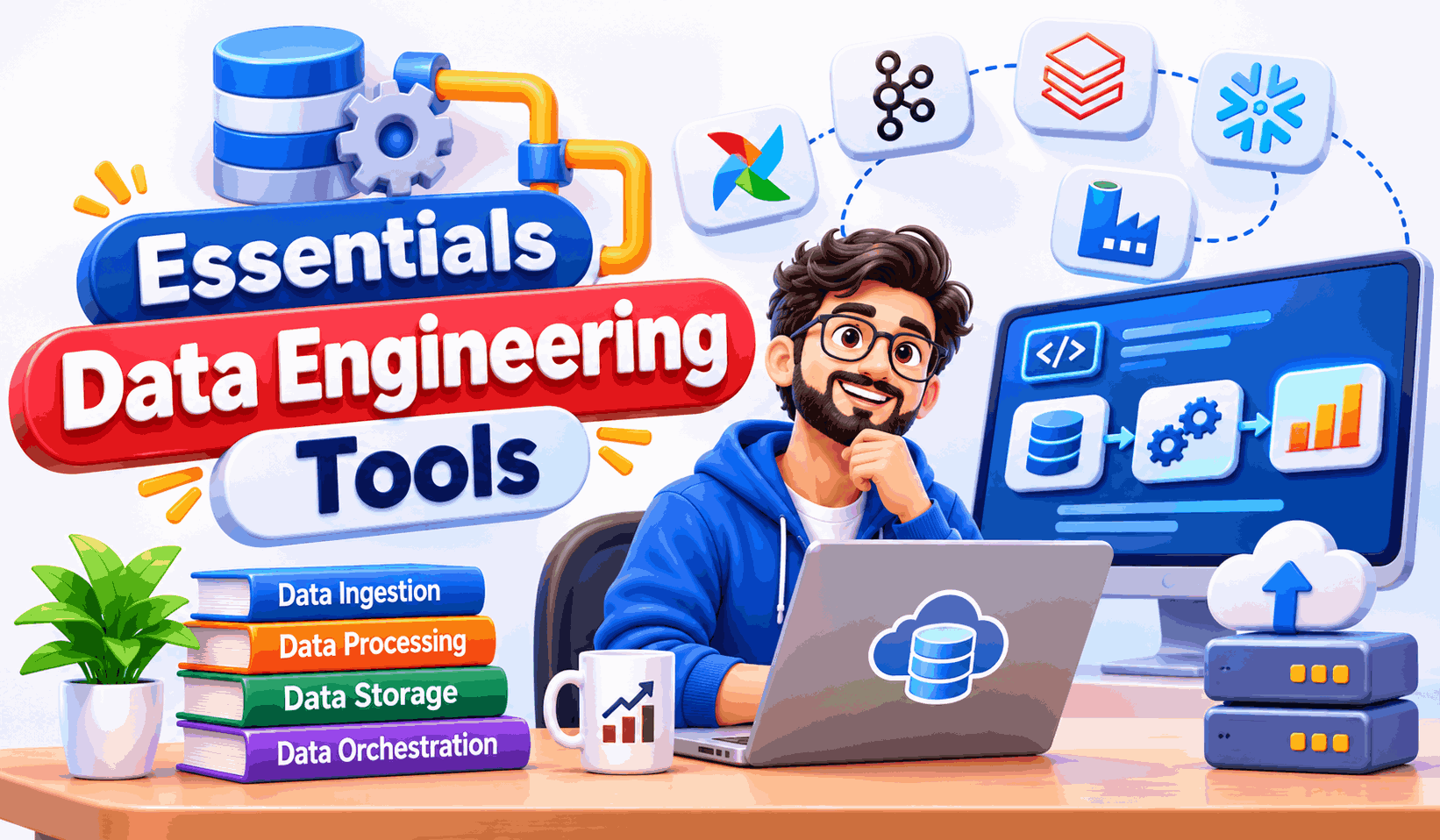
Essential Data Engineering Tools
Data engineering includes a large ecosystem of technologies. Beginners do not need to master every available tool. Instead, they should build strong fundamentals and then develop expertise in technologies relevant to their career goals.
SQL
SQL is one of the most important skills for data engineers. It is used to query databases, filter records, join tables, aggregate information, transform datasets, and support analytical workloads.
Important SQL concepts include SELECT and filtering, JOIN operations, GROUP BY, subqueries, Common Table Expressions, window functions, indexing, and query optimization. Strong SQL knowledge provides a foundation for working with structured data and relational databases.
Python
Python is widely used for automation, pipeline development, API integration, data processing, scripting, and custom transformation logic. A data engineer may use Python to extract information from APIs, process files, automate repetitive tasks, manipulate datasets, and develop components for data pipelines.
Apache Spark
Apache Spark is a distributed processing framework used for large-scale data workloads. It is useful when organizations need to process datasets that are too large or computationally intensive for a single machine. Spark can support batch processing, data transformation, data preparation, and other distributed workloads.
Apache Airflow
Apache Airflow is a workflow orchestration platform used to schedule, manage, and monitor workflows. It allows engineers to define dependencies between tasks, schedule jobs, manage retries, and monitor pipeline execution.
Apache Kafka
Apache Kafka is commonly used for event streaming and real-time data pipelines. It is useful for applications where information needs to be processed continuously instead of waiting for scheduled batch jobs.
Cloud Platforms
Modern data engineering frequently involves cloud environments such as AWS, Microsoft Azure, and Google Cloud. Cloud data engineering can include object storage, managed databases, data warehouses, processing services, identity management, monitoring, security, and governance.
Data Engineering and Cloud Computing
Cloud technology has significantly influenced modern data architectures. Instead of purchasing and maintaining all infrastructure themselves, organizations can use cloud services to store and process information at different scales.
A simplified cloud data architecture may look like:
Cloud Storage → Data Processing → Data Warehouse → BI/Analytics
For example, an organization may store raw files in cloud object storage, process those files using a managed processing service, and then load transformed information into a cloud data warehouse.
Beginners do not need to learn every cloud provider simultaneously. A more practical approach is to select one ecosystem and understand its storage, compute, database, security, networking, and data services before expanding to other platforms.
Data Lake vs Data Warehouse vs Data Lakehouse
Data lakes, data warehouses, and lakehouses are important concepts in modern data architecture.
Data Lake
A data lake is designed to store large amounts of raw or semi-structured information. It provides flexible storage for different types of data and can serve as an important foundation for large-scale data processing.
Data Warehouse
A data warehouse stores structured and organized information that is optimized for analytics and reporting. It is commonly used for business intelligence, dashboards, historical analysis, and structured analytical workloads.
Data Lakehouse
A data lakehouse combines characteristics associated with data lakes and data warehouses. It aims to provide flexible data storage while also supporting structured analytics and data management capabilities. Understanding these concepts helps learners understand why different organizations select different data architectures.
Skills Required to Become a Data Engineer
A successful data engineer needs more than knowledge of individual software tools.
Technical Skills
Important technical areas include:
- SQL
- Python
- Database concepts
- Data modeling
- ETL and ELT
- Data pipelines
- Cloud computing
- Data warehousing
- Data lakes
- Distributed processing
- Workflow orchestration
- Data quality
- Version control
Problem-Solving Skills
Data engineers frequently investigate technical problems. A pipeline may fail because of a source-system change, missing records, incorrect configurations, network problems, or unexpected data formats. Strong logical thinking and troubleshooting abilities help engineers identify the cause and develop reliable solutions.
Communication Skills
Data engineers often work with software developers, data analysts, data scientists, product teams, and business stakeholders. Being able to explain technical problems clearly and understand business requirements is therefore an important professional skill.
Data Engineering Career Roadmap
For beginners, trying to learn dozens of technologies simultaneously can create unnecessary confusion.
A practical learning path can be:
Step 1: Learn SQL
Step 2: Learn Python
Step 3: Understand databases
Step 4: Learn data modeling
Step 5: Understand ETL and ELT
Step 6: Build data pipelines
Step 7: Learn a workflow orchestration tool
Step 8: Learn Apache Spark
Step 9: Choose a cloud platform
Step 10: Build end-to-end projects
Step 11: Learn testing, monitoring, and data quality
Step 12: Prepare for technical interviews and relevant certifications
This approach helps learners understand why technologies are used instead of simply memorizing tool names.
How Can Data Engineering Training Help?
Self-learning can be useful, but beginners often find it difficult to determine what to study first and how different technologies connect. A structured learning program can provide a logical sequence covering programming, databases, data pipelines, cloud technologies, data processing, and practical projects. When evaluating a Data Engineering Course in India, learners should look beyond the course title. The curriculum should ideally include hands-on exercises and practical exposure to technologies and concepts such as SQL, Python, ETL, data modeling, cloud platforms, orchestration, and distributed processing.
Practical learning is particularly important because data engineering is an implementation-oriented field. Learners should understand how to build, test, troubleshoot, monitor, and optimize pipelines rather than only memorize definitions. A good learning experience should gradually move from fundamentals to practical implementation so that learners can understand how individual technologies work together in a complete data architecture.
Data Engineering Certification Training in India
Certification can be useful for learners who want structured learning or a credential that demonstrates knowledge of a particular technology ecosystem. However, certification should not be considered a replacement for practical experience.
A stronger combination is:
Technical Skills + Practical Projects + Certification + Portfolio
For example, a learner could build an end-to-end project that extracts data from an API, processes it using Python, stores it in a database or warehouse, schedules the workflow, performs quality checks, and creates analytics-ready tables.
Such a project demonstrates how multiple data engineering concepts work together in a practical environment. When selecting certification-focused learning, students should also consider whether the program provides hands-on exercises and whether the certification aligns with their desired technology or career path.
How to Choose the Best Data Engineering Training in India
The phrase Best Data Engineering Training in India can mean different things to different learners. Instead of selecting a program only because of its title, learners should compare the actual curriculum, practical exposure, learning support, and career relevance.
A useful program should ideally provide:
- Strong SQL and Python fundamentals
- ETL and ELT concepts
- Data pipeline development
- Data modeling and data warehousing
- Cloud data engineering
- Distributed processing
- Workflow orchestration
- Real-world projects
- Data quality and testing
- Interview preparation
- Practical demonstrations
Learners should also consider trainer experience, project depth, assignments, learning resources, doubt support, and how closely the curriculum matches current job requirements.
The right training program is not necessarily the one with the longest list of tools. It is the one that helps learners understand fundamental concepts and apply them to realistic data engineering problems.
Data Engineering Projects for Beginners
Projects help learners convert theoretical knowledge into practical ability.
Project 1: Sales Data Pipeline
Build a pipeline that extracts sales records, cleans the information, applies transformations, and loads the results into an analytics database. The project can include data validation, transformation, scheduled execution, error handling, and reporting.
Project 2: API Data Pipeline
Collect information from a public API, process the response using Python, and store the results for analysis. This project can help learners understand API integration, JSON processing, error handling, data transformation, and database storage.
Project 3: Cloud Data Warehouse
Build a pipeline that moves raw files into cloud storage, transforms them, and loads analytics-ready information into a data warehouse. This provides practical exposure to cloud storage, transformation, data modeling, and warehouse concepts.
Project 4: Real-Time Streaming Pipeline
Use a streaming platform such as Kafka to process continuously generated events. This project can help learners understand event-driven architectures, message processing, streaming data, and real-time analytics.
Data Engineering Career Opportunities
Data engineering can lead to several technical career paths, including:
- Junior Data Engineer
- Data Engineer
- Cloud Data Engineer
- Big Data Engineer
- ETL Developer
- Data Platform Engineer
- Analytics Engineer
- Data Warehouse Developer
- Streaming Data Engineer
- Data Engineering Architect
Responsibilities vary between organizations, so learners should review job descriptions carefully and identify the skills most frequently requested for their target roles. Career progression can also involve moving from implementation-focused responsibilities toward architecture, platform engineering, technical leadership, or specialized cloud and big data roles.
Data Engineering for AI and Machine Learning
Data engineering is becoming increasingly important as organizations adopt artificial intelligence and machine learning. AI systems depend heavily on data. Before a machine learning model or AI application can produce useful results, organizations need reliable processes for collecting, cleaning, storing, transforming, and delivering information.
A simplified AI data workflow looks like:
Data Sources → Data Pipeline → Clean Data → Data Platform → AI/ML System
This means data engineers increasingly contribute to AI-ready infrastructure, feature pipelines, large-scale processing, data quality, and systems that support machine learning applications.
For generative AI and modern AI applications, reliable data pipelines can also support document processing, knowledge retrieval, data preparation, evaluation workflows, and other data-intensive processes.
This connection between data engineering and AI makes foundational data skills increasingly valuable for professionals who want to work with modern intelligent applications.
Challenges in Data Engineering
Data engineering is rewarding, but it also involves complex technical and operational problems.
Common challenges include:
- Handling large data volumes
- Maintaining data quality
- Integrating multiple data sources
- Managing pipeline failures
- Controlling cloud costs
- Protecting sensitive information
- Maintaining data consistency
- Supporting real-time workloads
- Scaling infrastructure
- Monitoring data pipelines
Good engineering practices such as testing, logging, monitoring, documentation, version control, access management, and automated validation can help address these challenges. As data environments grow, engineers must also think about maintainability and scalability rather than focusing only on whether a pipeline works today.
Data Engineering Best Practices
Successful data engineering is not only about selecting the right tools. It also requires disciplined engineering practices.
Build Scalable Pipelines
Design pipelines so they can handle increasing data volumes without requiring a complete redesign.
Implement Data Quality Checks
Validate important fields, record counts, formats, duplicates, relationships, and business rules.
Monitor Pipeline Performance
Use monitoring and logging to identify failures, unusual processing times, missing data, and unexpected changes.
Document Data Workflows
Clear documentation helps engineers and business teams understand how data moves through the system and where important datasets originate.
Use Version Control
Store code and configuration in a version-control system so changes can be tracked, reviewed, and managed.
Protect Data
Apply appropriate access controls, authentication, encryption, and governance practices when working with sensitive information. These practices help make data platforms more reliable and easier to maintain as organizations grow.
Future of Data Engineering
The future of data engineering is closely connected with cloud computing, real-time analytics, artificial intelligence, and modern data platforms. Organizations increasingly need data systems that are scalable, automated, observable, secure, and capable of supporting both traditional analytics and AI workloads.
Important areas to watch include:
- AI-ready data infrastructure
- Real-time data processing
- Lakehouse architectures
- Data observability
- Automated data quality
- Data products
- Data mesh architectures
- Generative AI data pipelines
- Machine learning infrastructure
- Intelligent pipeline automation
For learners, this means foundational knowledge remains important even as tools continue to change. Strong SQL, Python, data modeling, pipeline concepts, database knowledge, and cloud fundamentals provide a foundation that can be adapted to new technologies.
Frequently Asked Questions About Data Engineering
Is data engineering a good career option?
Yes. Data engineering can be a strong technology career for people who enjoy programming, databases, problem-solving, and working with large datasets. The field also provides opportunities to specialize in cloud platforms, big data, streaming, analytics infrastructure, and AI-related systems.
Is Python necessary for data engineering?
Python is highly useful because it can be used for pipeline logic, automation, API integration, data processing, and scripting. SQL is equally important because many data engineering tasks involve querying, joining, transforming, and analyzing structured data.
How long does it take to learn data engineering?
The timeline depends on your previous experience, technical background, and learning schedule. Beginners should first build strong foundations in SQL, Python, databases, and data modeling before progressing to pipelines, cloud platforms, Spark, and orchestration.
Is certification enough to become a data engineer?
Certification can demonstrate structured knowledge, but practical skills are essential. Employers benefit from seeing evidence that candidates can build, troubleshoot, and maintain real data pipelines. Projects, technical skills, and relevant certification work best together.
What should beginners learn first?
A sensible starting sequence is SQL → Python → databases → data modeling → ETL/ELT → pipelines → cloud → Spark → orchestration. Learners can then expand into streaming, data quality, observability, and AI-related infrastructure.
Is data engineering difficult to learn?
Data engineering can seem challenging initially because it combines programming, databases, cloud platforms, data architecture, and problem-solving. However, learning these concepts step by step makes the subject easier to understand. Beginners should focus on fundamentals first and gradually introduce advanced technologies.
What is the difference between a data engineer and a data scientist?
A data engineer primarily builds the systems and pipelines required to collect, process, store, and deliver data. A data scientist typically uses prepared data for statistical analysis, machine learning, experimentation, and predictive modeling. Both roles work together, but their responsibilities are different.
Conclusion
Data engineering is the foundation behind many modern data-driven applications. It connects raw information from multiple sources with the analytical and AI systems that organizations use to make decisions. For beginners, the field can initially appear overwhelming because it includes programming, databases, cloud computing, distributed processing, data modeling, ETL, orchestration, and many specialized technologies. The best approach is to learn these concepts progressively instead of attempting to master everything at once.
A structured learning program can help learners follow a logical path from fundamentals to practical implementation. Whether you choose Data Engineering Training in India, enroll in a Data Engineering Course in India, pursue certification-focused learning, or build your skills independently, the primary objective should remain the same: learning how to create reliable, scalable, and useful data systems.
The strongest learners are not necessarily those who know the largest number of tools. They are the ones who understand how data moves, how it should be transformed, how quality can be maintained, and how the resulting information can support analytics and AI. With the right combination of foundational knowledge, practical projects, cloud skills, problem-solving ability, and continuous learning, aspiring professionals can build a strong foundation for a long-term career in data engineering.