
How to Become a Guidewire Business Analyst: Skills and Learning Path

The insurance industry is increasingly adopting technology to improve policy administration, claims processing, billing, and customer service. As insurers modernize their operations, professionals who understand both insurance processes and software systems play an important role in project delivery. A Guidewire Business Analyst helps bridge the gap between business requirements and technical implementation.
If you are interested in business analysis and insurance technology, this career path can help you explore opportunities in insurance software projects. You need to understand insurance fundamentals, develop requirement-gathering skills, and learn how Guidewire applications support different business processes.
What Does a Guidewire Business Analyst Do?
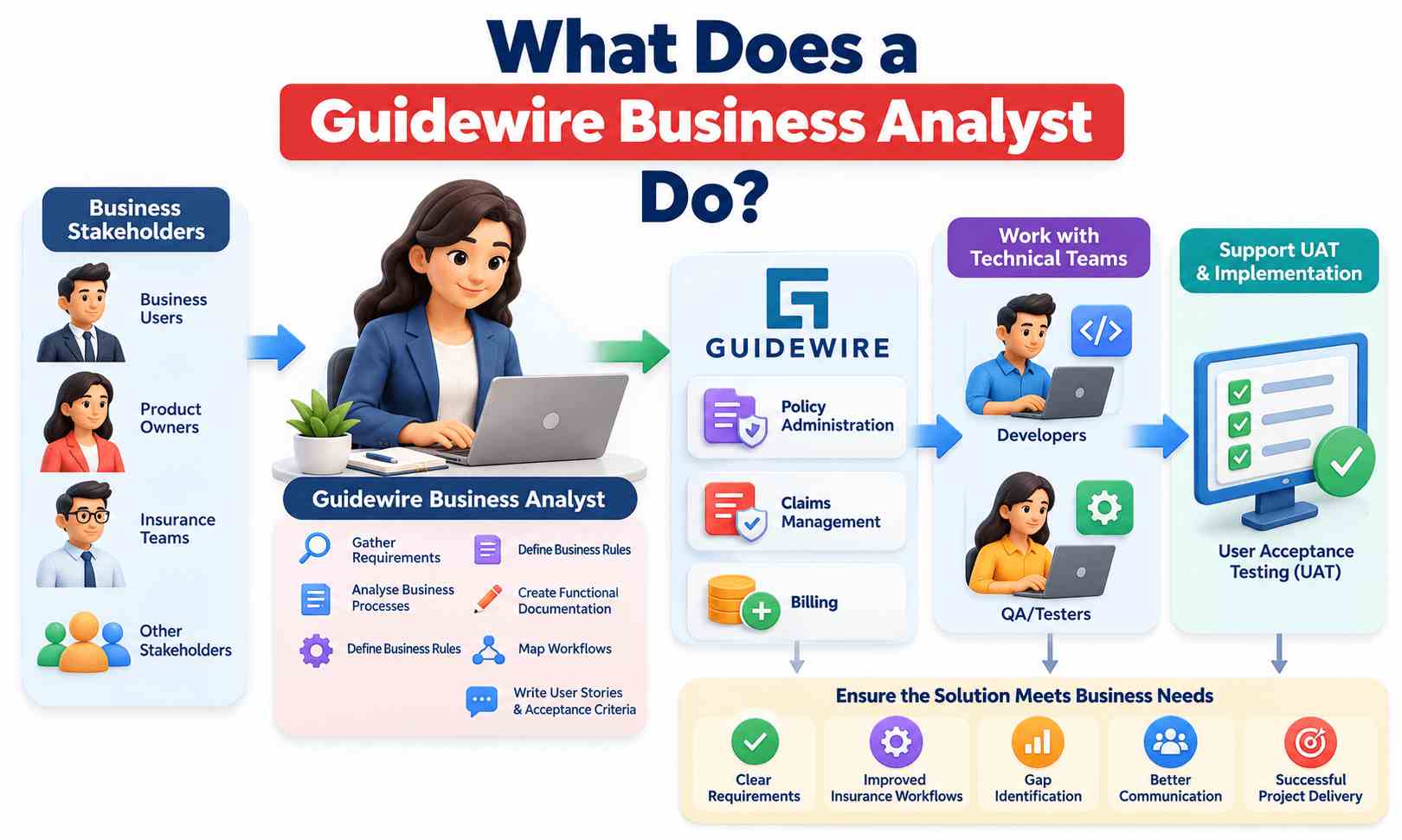
A Guidewire Business Analyst acts as a bridge between business stakeholders and technical teams working on insurance software projects. The role involves gathering business requirements, analysing insurance workflows, preparing functional documentation, and ensuring that the proposed solution meets business needs. They also collaborate with developers and testers to clarify requirements, review functionality, and support User Acceptance Testing (UAT).
Key Roles and Responsibilities
The responsibilities of a Guidewire Business Analyst may include:
- Gathering requirements from business stakeholders.
- Understanding insurance processes and business rules.
- Preparing functional requirement documents.
- Writing user stories and acceptance criteria.
- Mapping existing and proposed business workflows.
- Coordinating with development and quality assurance teams.
- Supporting User Acceptance Testing (UAT).
- Identifying gaps between business expectations and system functionality.
- Communicating requirement changes throughout the project.
For example, an insurance company may want to simplify its policy renewal process. The business analyst studies the existing workflow, discusses the required changes with stakeholders, documents business rules, and communicates the expected functionality to the technical team. This process helps ensure that the final solution addresses the actual business problem.
Skills Required to Become a Guidewire Business Analyst
A successful business analyst needs a combination of analytical, communication, documentation, and domain-specific skills. You do not need to master every Guidewire application at the beginning, but you should develop a strong understanding of how insurance businesses operate.
1. Insurance Domain Knowledge
Insurance domain knowledge is an important starting point for anyone planning to enter Guidewire business analysis. You should understand common insurance terms, policy lifecycles, underwriting, claims, and billing processes. Focus on learning concepts such as:
- Policy issuance and renewal
- Premium calculation and underwriting
- Policy endorsements and changes
- Claims registration and settlement
- Billing accounts, invoices, and payments
- Insurance business rules and workflows
2. Requirement Gathering and Documentation
Requirement gathering is one of the most important responsibilities of a business analyst. It involves understanding stakeholder expectations, identifying business needs, and converting them into clear, actionable requirements. You should learn how to prepare functional requirement documents, business process flows, user stories, and acceptance criteria. It is equally important to identify exceptions, clarify ambiguous requirements, and document changes accurately.
3. Understanding Guidewire InsuranceSuite
Guidewire InsuranceSuite includes applications that support different insurance operations. A business analyst should understand their purpose and the business processes they support.
4. Communication and Stakeholder Management
Business analysts interact with stakeholders who have different priorities and levels of technical knowledge. Strong communication skills help ensure that everyone understands the business objectives and expected outcomes. Important skills include asking relevant questions, conducting requirement discussions, explaining complex processes in simple language, managing expectations, and communicating changes clearly.
5. Testing and Agile Fundamentals
Business analysts often work closely with quality assurance teams to confirm that delivered functionality meets business requirements. Understanding testing concepts helps them review scenarios, clarify expected outcomes, and support UAT. Learn the basics of functional testing, integration testing, acceptance criteria, and defect reporting.
You should also understand Agile concepts such as sprints, product backlogs, user stories, and sprint reviews. These skills make it easier to collaborate with developers and testers throughout the project lifecycle.Understanding testing concepts can also help you collaborate effectively with QA teams.
A Step-by-Step Learning Path for Aspiring Guidewire Business Analysts
A structured learning path can help you develop the required skills without trying to learn everything at once. Begin with general business analysis concepts and gradually move towards insurance processes and Guidewire applications.
How to Choose the Right Learning Resources
Choosing the right learning resource depends on your current knowledge, career goals, and preferred learning format. A suitable Guidewire Business Analyst course should cover insurance fundamentals, Guidewire application workflows, requirement documentation, and relevant project practices. Before selecting a programme, consider the following factors:
The right resource should help you understand how a business analyst approaches real-world problems, rather than simply introducing technical terminology.
What Should You Consider When Learning in India?
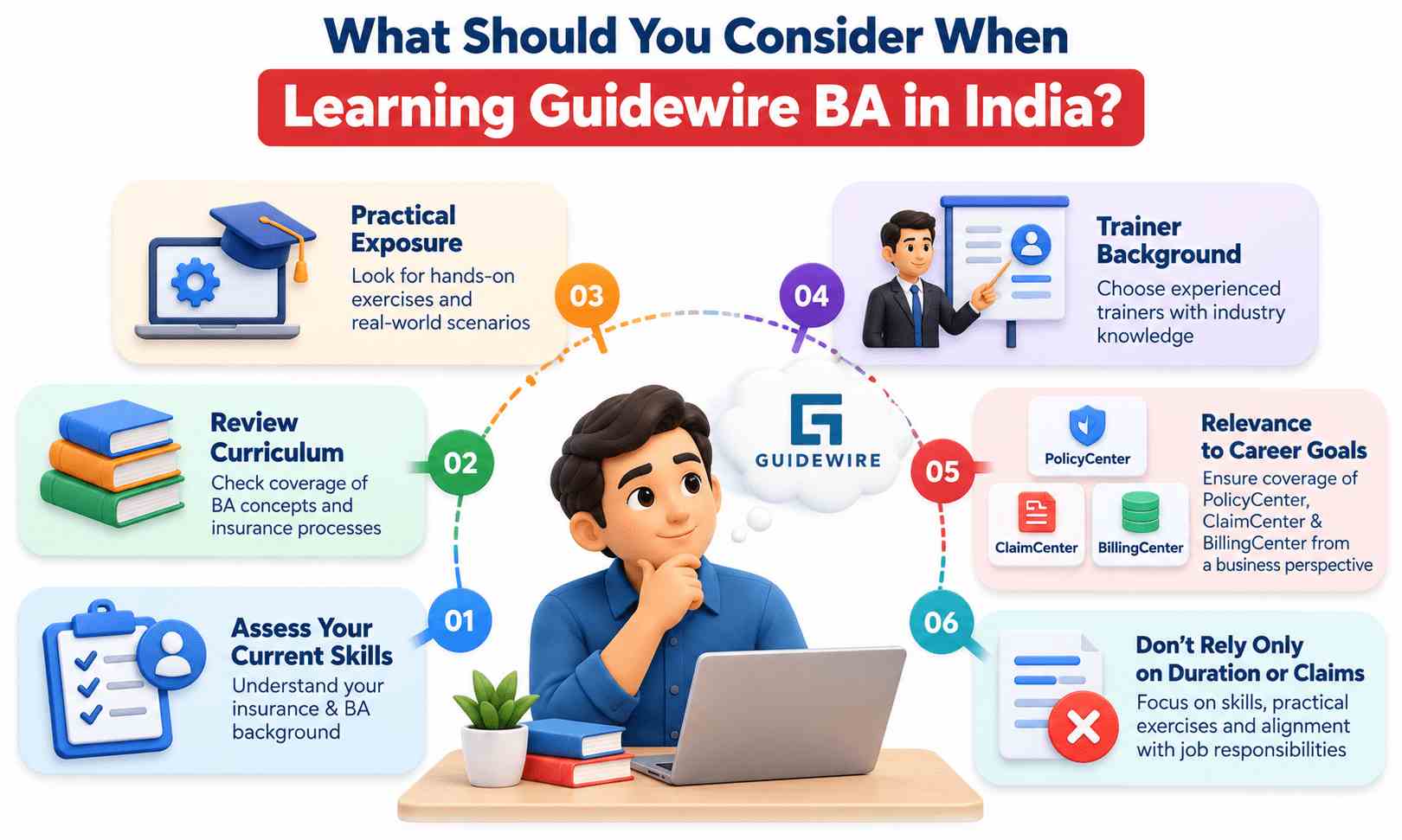
Professionals comparing Guidewire BA training in India should assess their existing skills before choosing a learning programme. Someone with insurance operations experience may already understand policy or claims processes, while a beginner may need to start with basic insurance terminology and business analysis concepts.
Review the curriculum, practical exposure, trainer background, and relevance of the topics to your career goals. It is also useful to check whether the learning programme explains PolicyCenter, ClaimCenter, and BillingCenter from a business perspective. Do not select a programme based only on its duration or promotional claims. Focus on the skills you will develop, the practical exercises available, and how the content aligns with the responsibilities described in relevant job openings.
Can You Learn Guidewire Business Analysis Online?
Online learning can be useful for fresh graduates, working professionals, and career switchers who need flexibility while developing new skills. It allows learners to study according to a suitable schedule, depending on the course format and available support.
Guidewire Business Analyst online training may be worth considering if the programme offers structured lessons, practical assignments, and clear explanations of insurance workflows and application fundamentals. Before enrolling, check whether the learning experience includes:
- A step-by-step curriculum for beginners or your current experience level.
- Practical examples involving insurance business requirements.
- Exercises covering documentation and business process analysis.
- Guidance on Guidewire application fundamentals.
- Opportunities to clarify doubts and review learning materials.
Online delivery alone does not guarantee practical knowledge. Your progress will also depend on consistent practice, revision, and the ability to apply concepts to realistic business scenarios.
Career Opportunities for Guidewire Business Analysts
Guidewire business analysis skills may be relevant to insurance companies, consulting firms, technology service providers, and implementation partners working on insurance software projects. Depending on your experience and skill set, potential career directions may include:
- Business Analyst
- Guidewire Business Analyst
- Insurance Business Analyst
- Functional Business Analyst
- Senior Business Analyst
- Business Analysis Lead
These roles have different experience and responsibility requirements, so they should not be treated as automatic progression steps. To prepare for relevant opportunities, develop your understanding of insurance operations, business requirements, Guidewire applications, stakeholder communication, and project documentation. Review job descriptions to identify which skills and application-specific knowledge employers expect.
Frequently Asked Questions
Can a fresher become a Guidewire Business Analyst?
Is coding required for a Guidewire Business Analyst?
Which Guidewire applications should a business analyst learn?
What skills are important for a Guidewire Business Analyst?
Conclusion
Becoming a Guidewire Business Analyst requires a combination of insurance knowledge, business analysis skills, and an understanding of how Guidewire applications support insurance operations. Start with the fundamentals, practise documenting business requirements, and gradually build your knowledge of PolicyCenter, ClaimCenter, and BillingCenter.
A structured learning plan and practical exercises can help you understand the responsibilities involved in insurance technology projects. Evaluate learning resources carefully, practise realistic business scenarios, and prepare for interviews using the skills and experience relevant to your target roles.
Related Articles

Top Guidewire Interview Questions and Answers
Guidewire interview questions and answers covering core concepts, configuration, Gosu, PolicyCenter, ClaimCenter, BillingCenter, and interview prepara

Guidewire Skills and Career Opportunities for IT Professionals
Explore essential Guidewire skills, career opportunities, AI trends, and a practical roadmap for IT professionals entering insurance technology.





 +91-8882178896
 +1 (343) 477-0926