Preparing for a Guidewire interview requires more than memorizing definitions. Interviewers often evaluate your understanding of the insurance domain, Guidewire applications, configuration, Gosu, integrations, testing, and your ability to solve practical project situations.
Whether you are a fresher starting your Guidewire career or an experienced professional preparing for a new opportunity, knowing the most common Guidewire interview questions and answers can help you prepare with greater confidence.
Guidewire is widely used by insurance organizations to manage core processes across policy administration, claims, billing, and related insurance operations. Because of this, interview questions can vary depending on whether the role focuses on development, configuration, integration, QA, business analysis, or production support.
What Is Guidewire?
Guidewire is an insurance technology platform that helps insurance companies manage important business operations such as policy administration, claims, billing, and customer service. Its InsuranceSuite includes applications such as PolicyCenter, ClaimCenter, and BillingCenter, which support different stages of the insurance lifecycle.
Guidewire professionals can work in areas such as configuration, development, integration, testing, business analysis, implementation, and application support. Depending on the role, candidates may need knowledge of Gosu, workflows, data models, business rules, APIs, and insurance processes.
For a Guidewire interview, it is important to understand both the technical side of the platform and how Guidewire applications are used to solve real insurance business requirements.
What Topics Are Covered in a Guidewire Interview?
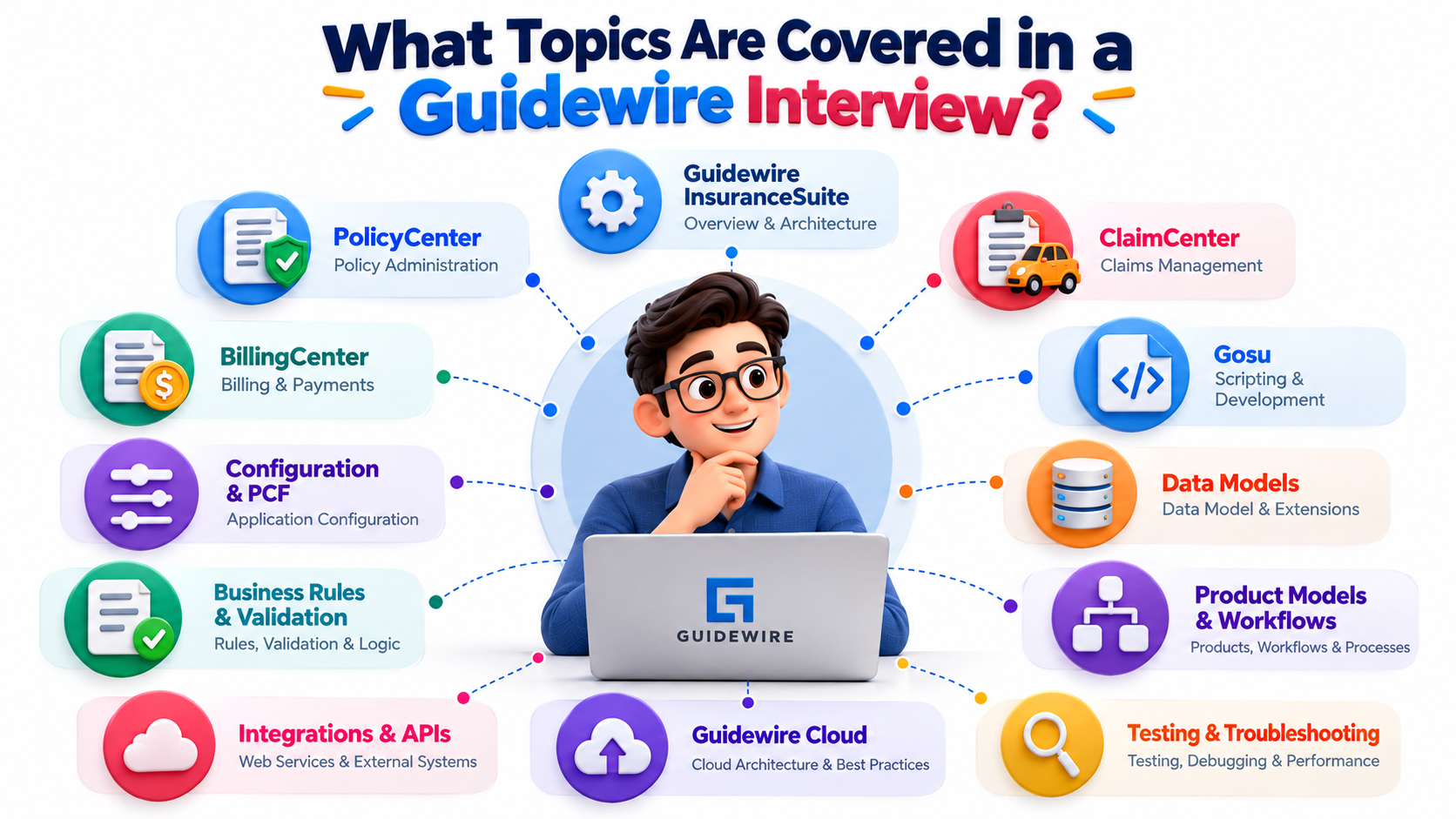
A Guidewire interview can cover a combination of technical, functional, development, and insurance domain topics. Candidates may be asked about the Guidewire InsuranceSuite and applications such as PolicyCenter, ClaimCenter, and BillingCenter. Technical discussions can include Gosu, configuration, PCF, data models, business rules, validation, product models, workflows, integrations, APIs, and web services. Depending on the role, interviewers may also discuss Guidewire Cloud, testing, debugging, troubleshooting, and application performance.
Candidates should also be prepared for questions related to insurance processes and real-world project scenarios. Scenario-based questions may test how a candidate approaches business requirements, identifies issues, configures solutions, or works with integrations and application changes. The exact topics, difficulty level, and depth of questions can vary based on the job role, project requirements, and candidate’s experience.
Basic Guidewire Interview Questions and Answers
Here are some basic Guidewire interview questions and answers:
1. What is Guidewire?
Guidewire is an insurance technology platform that helps insurance companies manage core business processes such as policy administration, claims management, billing, underwriting, and related operations. It provides applications and tools that support different stages of the insurance lifecycle. Guidewire InsuranceSuite includes key applications such as PolicyCenter, ClaimCenter, and BillingCenter, which can work with other systems through integrations.
2. What is Guidewire InsuranceSuite?
Guidewire InsuranceSuite is a collection of applications designed to support the core operations of insurance companies. Its major applications include PolicyCenter for policy administration, ClaimCenter for claims management, and BillingCenter for billing and payment processes. These applications help insurers manage business workflows while supporting configuration, integration, and automation requirements.
3. What is PolicyCenter?
PolicyCenter is a Guidewire application used to manage the insurance policy lifecycle. It supports processes such as product setup, quoting, policy issuance, renewals, endorsements, cancellations, and reinstatements. PolicyCenter can be configured according to an insurer's products, business rules, workflows, and operational requirements.
4. What is ClaimCenter?
ClaimCenter is a Guidewire application designed to manage the insurance claims lifecycle. It supports activities such as claim creation, assignment, investigation, coverage evaluation, claim handling, payments, and closure. It helps claims teams manage information and workflows throughout the claims process.
5. What is BillingCenter?
BillingCenter is a Guidewire application used to manage insurance billing and payment processes. It supports functions such as account management, billing instructions, invoices, payments, collections, and payment-related transactions. It can also integrate with external payment and financial systems as required by the business.
6. What is Gosu in Guidewire?
Gosu is a programming language used in the Guidewire platform to implement application-specific logic and customization. Developers can use Gosu for business rules, enhancements, validation logic, integrations, and other development requirements. Understanding Gosu is important for Guidewire developers because it is commonly used to extend and customize Guidewire applications.
7. What is Guidewire configuration?
Guidewire configuration is the process of adapting the platform to meet specific business and application requirements using supported configuration capabilities. Depending on the requirement, configuration may involve the data model, user interface, business rules, validation, typelists, workflows, and product model. Configuration helps teams implement business requirements while reducing the need for custom development where standard platform capabilities are sufficient.
Guidewire Configuration Interview Questions
8. What is PCF in Guidewire?
PCF stands for Page Configuration Files and is used to define and configure the user interface in Guidewire applications. PCF files control elements such as screens, input fields, buttons, menus, and other UI components. Developers and configurators can work with PCF to modify existing screens or create UI behavior based on specific application requirements.
9. What is the Guidewire data model?
The Guidewire data model defines how business entities, properties, and relationships are represented and managed within a Guidewire application. It helps applications store and process business information consistently. A good understanding of entities and their relationships is important when working with configuration, queries, rules, integrations, and application customizations.
10. What are typelists in Guidewire?
Typelists are predefined collections of values used to represent specific types of business information in Guidewire applications. For example, a field may use a typelist to provide a controlled set of values instead of allowing users to enter arbitrary data. They help maintain consistency, data quality, and standardized values across business processes.
11. What is validation in Guidewire?
Validation in Guidewire is used to ensure that required business and data conditions are satisfied before an operation or transaction can proceed. For example, a validation may check whether mandatory information has been entered or whether a selected value meets a specific business condition. Validations help prevent incorrect or incomplete data from moving through the application.
12. What are business rules in Guidewire?
Business rules are used to implement business-specific logic and decision-making conditions within a Guidewire application. They determine how the application should behave when certain conditions or events occur. For example, a rule may control whether a transaction is allowed, trigger a required action, or apply a specific business condition based on policy or claim information.
PolicyCenter Interview Questions and Answers
13. What is the policy lifecycle in PolicyCenter?
The policy lifecycle represents the different stages a policy goes through from initial creation to its completion or termination. Depending on the insurance product and business process, it may include submission, quote creation, underwriting, binding, issuance, policy changes, renewal, cancellation, and reinstatement. PolicyCenter helps manage these transactions while applying configured business rules, validations, and workflows.
14. What is a policy transaction?
A policy transaction represents a specific business operation performed during the lifecycle of an insurance policy. Common examples include new submissions, policy changes, renewals, cancellations, and reinstatements. Each transaction can involve different business rules, validations, effective dates, and underwriting requirements depending on the insurance product.
15. What is the Product Model in PolicyCenter?
The Product Model in PolicyCenter is used to define and configure the structure of an insurance product. It can include coverages, conditions, exclusions, modifiers, availability rules, and other product-related elements. It allows insurers to represent their insurance products within PolicyCenter and control how those products are presented and processed during policy transactions.
ClaimCenter Interview Questions and Answers
16. What is the basic claim lifecycle in ClaimCenter?
The claim lifecycle represents the stages involved in managing an insurance claim from its initial report to final closure. A typical process may include claim creation, assignment, investigation, coverage evaluation, reserve or financial handling, settlement or payment, and closure. The exact workflow can vary depending on the insurer, claim type, and business requirements.
17. How is ClaimCenter used in an insurance organization?
ClaimCenter helps insurance organizations manage claims throughout their lifecycle, from first notice of loss through investigation, evaluation, settlement, payment, and closure. It can support claim workflows, business rules, validations, financial processes, and integrations with external systems. This helps claims teams manage information and follow standardized processes while handling different types of insurance claims.
18. What is FNOL in ClaimCenter?
FNOL stands for First Notice of Loss and represents the initial reporting of an insurance claim to the insurer. In ClaimCenter, FNOL information can be captured and used to create a claim record. The information may include details about the policy, loss event, involved parties, location, and reported incident.
19. What are reserves in ClaimCenter?
Reserves represent the estimated amount an insurer expects to pay for a claim or a specific financial component of a claim. ClaimCenter supports the management of claim financials, including reserves and payments. Reserves can be updated as more information becomes available during claim investigation and evaluation.
20. How does ClaimCenter support claim assignment?
ClaimCenter can support the assignment of claims to appropriate users or teams based on configured business requirements. Assignment may consider factors such as claim type, location, workload, expertise, or organizational rules. This helps insurers distribute claims efficiently and ensure that they are handled by suitable claim professionals.
BillingCenter Interview Questions and Answers
21. What is the purpose of BillingCenter?
BillingCenter is a Guidewire application used to manage the billing and financial operations associated with insurance policies. It supports activities such as account management, billing instructions, invoicing, payments, collections, and financial transactions. It can also work with PolicyCenter and external financial systems to support the overall insurance billing process.
22. What is an account in BillingCenter?
An account in BillingCenter represents the financial relationship between an insurer and a customer for billing purposes. It contains information needed to manage billing activity, such as invoices, payments, payment plans, and other financial transactions. An account can be associated with one or more policies depending on the business structure.
23. What is an invoice in BillingCenter?
An invoice is a billing document that represents the amount due from a customer for insurance-related charges. BillingCenter can generate and manage invoices based on configured billing schedules and transactions. Invoice information can include amounts due, due dates, payments, and outstanding balances.
24. What is a payment in BillingCenter?
A payment represents an amount received from a customer toward an outstanding billing obligation. BillingCenter supports the recording and processing of payments and can track how payments are applied to invoices or other financial transactions. Payment processing may also involve integration with external payment systems.
25. What is the role of collections in BillingCenter?
Collections in BillingCenter relate to managing outstanding or overdue amounts owed by customers. The application can support collection-related activities such as tracking unpaid balances, applying configured collection rules, and managing actions associated with overdue accounts. The exact collection process depends on the insurer's business policies and requirements.
Guidewire Integration Interview Questions
26. What is Guidewire integration?
Guidewire integration is the process of connecting Guidewire applications with external systems and services so that data and business information can be exchanged between them. Integrations may be required with payment platforms, customer applications, document services, third-party data providers, data warehouses, and other enterprise applications.
27. What technologies can be involved in Guidewire integration?
Depending on the project requirements, Guidewire integrations can involve technologies and mechanisms such as REST APIs, SOAP web services, messaging, web services, and other integration interfaces. The appropriate approach depends on factors such as the systems being connected, data requirements, security, and the type of communication needed.
28. Why are APIs important in Guidewire projects?
APIs provide a structured way for Guidewire applications to communicate and exchange data with other applications. They can support processes such as retrieving customer information, sending policy details, exchanging claim data, or connecting with external services. APIs help different systems work together as part of a larger insurance technology environment.
29. What is the difference between REST and SOAP integration?
REST and SOAP are different approaches for communication between applications. REST commonly uses HTTP methods and formats such as JSON, making it widely used for modern API-based integrations. SOAP is a protocol that typically uses XML-based messages and provides defined standards for structured web services. The choice depends on the integration requirements and systems involved.
Scenario-Based Guidewire Interview Questions
Technical interviews often become more practical as the candidate gains experience. Scenario-based questions help interviewers understand how you approach real project requirements.
30. How would you handle a requirement to add a new field to a Guidewire screen?
First, I would understand the business requirement and identify the appropriate entity or data source for the field. Then I would determine whether the requirement can be handled through configuration. I would review the relevant data model and PCF configuration, implement the change, and perform functional and regression testing to ensure the existing functionality is not affected.
31. What would you do if a Guidewire transaction fails during processing?
I would first identify the failed transaction and review the error message or application logs. Then I would check the relevant rules, configuration, data, validation, and integration responses to identify the root cause. After applying the appropriate fix, I would test the transaction again and perform regression testing before moving the change forward.
32. How would you troubleshoot a Guidewire integration failure?
I would verify whether the request was generated correctly and review the integration logs, request details, response, endpoint, and required data. I would determine whether the problem originated within Guidewire or the external system. After identifying the cause, I would correct the issue, test the integration flow, and verify the complete end-to-end transaction.
33. How would you approach a new business requirement in Guidewire?
I would begin by understanding the business requirement and identifying the affected Guidewire application and process. Next, I would determine whether the requirement can be addressed through configuration, customization, or integration. After implementation, I would perform functional, integration, and regression testing to confirm that the requirement works correctly without affecting existing functionality.
Guidewire Cloud Interview Questions
34. What is Guidewire Cloud?
Guidewire Cloud provides cloud-based capabilities for Guidewire applications and supports modern approaches to delivering and managing insurance software. Professionals working with Guidewire Cloud should understand cloud-based application delivery, configuration, integrations, security, and deployment-related concepts relevant to their role.
35. Why should Guidewire professionals learn cloud concepts?
Understanding cloud concepts helps professionals work more effectively with modern Guidewire implementations. It can improve their understanding of application architecture, deployment processes, integrations, security, and environment management in cloud-based projects.
36. What are the benefits of Guidewire Cloud?
Guidewire Cloud can help insurance organizations adopt a more modern approach to running and managing their Guidewire applications. It can support scalability, managed infrastructure, regular platform updates, operational efficiency, and integration with cloud-based services, depending on the implementation and services being used.
37. What should developers consider when working with Guidewire Cloud?
Developers should understand the cloud environment, supported configuration and extension approaches, integration patterns, security requirements, deployment processes, and application dependencies. They should also consider how changes are developed, tested, and promoted across different environments while following the project's cloud-specific development practices.
Guidewire QA Interview Questions
38. What does a QA professional do in a Guidewire project?
A Guidewire QA professional tests application functionality against business and technical requirements. Depending on the project, testing can cover policy transactions, claims, billing processes, integrations, business rules, data, user interfaces, and regression scenarios. QA professionals also identify defects, document test results, and verify fixes.
39. What should a Guidewire QA Tester know?
A Guidewire QA Tester should understand the relevant Guidewire application, insurance workflows, test case design, functional testing, integration testing, regression testing, defect reporting, and basic Guidewire configuration concepts. Knowledge of insurance processes and business requirements also helps in creating practical test scenarios.
40. How do you test a Guidewire policy transaction?
A QA Tester first understands the expected business flow and prepares test scenarios based on the requirements. Testing can include positive and negative cases, validations, business rules, data updates, and expected transaction outcomes. The tester should also verify that related integrations and downstream processes work correctly.
41. How does regression testing help in a Guidewire project?
Regression testing verifies that a new change, configuration update, or defect fix has not affected existing functionality. In Guidewire projects, regression testing may cover policy, claim, billing, integration, and configuration-related scenarios. It helps identify unexpected issues before changes are moved to higher environments or released.
Guidewire Business Analyst Interview Questions
42. What is the role of a Business Analyst in a Guidewire project?
A Guidewire Business Analyst helps translate insurance business requirements into clear functional requirements for the implementation team. The role may involve requirement gathering, process analysis, documentation, stakeholder communication, user acceptance testing, and coordination with functional and technical teams throughout the project.
43. What should a Guidewire BA understand?
A Guidewire BA should understand insurance processes, Guidewire application functionality, business workflows, requirements analysis, user stories, acceptance criteria, and stakeholder communication. A basic understanding of PolicyCenter, ClaimCenter, or BillingCenter can also help the BA communicate requirements effectively with technical teams.
44. How does a Guidewire BA gather requirements?
A BA gathers requirements by communicating with business stakeholders, subject matter experts, and project teams. The BA analyzes existing processes, identifies business needs, documents functional requirements, and clarifies expected outcomes. Requirements may then be converted into user stories, acceptance criteria, process flows, or functional specifications.
45. What is the role of a Guidewire BA during User Acceptance Testing?
During User Acceptance Testing, a Guidewire BA helps ensure that the implemented solution meets the agreed business requirements. The BA may support test scenario preparation, requirement clarification, stakeholder coordination, result review, and defect discussion. The goal is to confirm that the application supports the expected business processes before release.
How to Prepare for a Guidewire Interview in Hyderabad
Hyderabad has an established technology ecosystem, making it a relevant location for professionals exploring enterprise software and insurance technology careers.
Candidates looking to develop structured Guidewire skills can consider Guidewire Training in Hyderabad when they need guided learning, practical exercises, and interview preparation.
A good learning program should ideally cover:
- Guidewire fundamentals
- Insurance domain concepts
- PolicyCenter
- ClaimCenter
- BillingCenter
- Configuration
- Gosu
- Integration
- Testing
- Practical projects
- Interview preparation
The objective should not be to memorize interview answers. Instead, training should help you understand why a particular configuration, development approach, or integration is used.
How to Choose the Best Guidewire Institute in Hyderabad
Choosing the right Guidewire Institute in Hyderabad is important for learners who want to build practical skills and prepare for Guidewire-related career opportunities. A good training program should cover the Guidewire platform along with the insurance concepts required to understand real project requirements.
When comparing different training options, look for:
- Hands-On Learning
- Practical Curriculum
- Real-World Project Exposure
- Interview Preparation
- Insurance Domain Knowledge
- Role-Based Training
TechPratham provides Guidewire-focused learning with practical concepts, project-oriented scenarios, and interview preparation to help learners develop skills relevant to real-world Guidewire projects and career opportunities.
Final Thoughts
Successful Guidewire interview preparation is not just about memorizing questions and answers. It requires a clear understanding of Guidewire applications, insurance processes, configuration concepts, development, integration, and practical project scenarios.
Start with the fundamentals and gradually build your knowledge of PolicyCenter, ClaimCenter, BillingCenter, Gosu, configuration, and integration. Regular practice with technical and scenario-based questions can also help you explain your approach more confidently during interviews.
For learners in Hyderabad, choosing a training program that combines practical learning, project exposure, and interview preparation can help build stronger skills and improve career readiness.







 +91-8882178896
 +1 (343) 477-0926