The movement of goods from suppliers to warehouses, distribution centres, and customers involves several connected activities. Businesses need to coordinate transportation routes, manage carriers, monitor shipments, control freight costs, and ensure timely deliveries. As supply chains become more complex, managing these activities manually can create operational challenges.
SAP Transportation Management (SAP TM) helps organisations manage transportation processes through an integrated system. It supports transportation planning, freight order management, shipment execution, carrier selection, freight cost calculation, and settlement.
For learners interested in supply chain management, logistics operations, or SAP consulting, understanding this solution can open opportunities to develop relevant enterprise software skills. SAP Transportation Management Training provides a structured way to understand these business processes and learn how they are managed within the SAP environment.
This guide explains SAP TM functionality, important learning areas, practical workflows, required skills, career opportunities, and factors to consider before choosing a training programme.
What Is SAP Transportation Management?
SAP Transportation Management is an SAP solution designed to plan, execute, monitor, and manage transportation activities across supply chains. It helps businesses coordinate the movement of goods through different transportation modes, including road, rail, air, and sea.
The system connects transportation requirements with planning and execution activities. It also supports carrier collaboration, freight charge calculations, and transportation performance analysis.
For example, consider a manufacturing company that needs to deliver products from its warehouse to multiple retail locations. The logistics team must decide which vehicles to use, select suitable carriers, calculate transportation costs, and monitor deliveries.
SAP TM helps manage these activities within a connected business process rather than relying on separate manual records.
Why Is SAP TM Important for Supply Chain Operations?
Transportation affects delivery timelines, customer satisfaction, inventory movement, and overall logistics expenditure. An organised transportation management process helps businesses coordinate these activities more effectively.
Some important business benefits include:
1. Better Transportation PlanningBusinesses can plan routes, assign transportation resources, consolidate freight requirements, and consider vehicle capacity when organising shipments. SAP TM helps transportation teams evaluate different planning options based on delivery schedules, transportation constraints, and available resources. This can improve vehicle utilisation, reduce unnecessary transportation activities, and support more organised shipment planning.
2. Improved Shipment Visibility
Transportation teams can monitor shipment progress and manage important execution milestones, helping them identify delays and respond to operational changes. SAP TM provides visibility into transportation activities, including planned movements, loading, departure, arrival, and delivery-related updates. Better shipment tracking helps businesses coordinate with carriers, warehouse teams, and customers while managing transportation operations more effectively.
3. Efficient Carrier Management
Selecting and coordinating the right transportation service providers is an important part of logistics management. SAP TM supports carrier selection, subcontracting, and tendering processes. Businesses can manage carrier-related information, evaluate transportation requirements, and coordinate freight assignments based on applicable agreements and operational conditions. This helps improve communication between logistics teams and external transportation providers.
4. Effective Freight Cost Management
Transportation expenses can include freight charges, fuel-related costs, handling fees, and additional service charges. SAP TM supports freight rate determination, charge calculation, and settlement processes to help businesses manage these expenses. Organisations can use freight agreements and calculation rules to determine transportation costs according to agreed conditions. This provides better visibility into freight expenditure and supports transportation cost control.
5. Connected Logistics Processes
SAP TM works with relevant SAP business processes to connect transportation requirements with purchasing, sales, delivery, warehouse, and financial activities. This integration helps reduce information gaps between departments and supports a more coordinated supply chain process. For example, transportation requirements generated through sales or purchasing activities can be considered during shipment planning, allowing logistics teams to work with more consistent business information.
Key Features and Functions of SAP Transportation Management
Understanding the major functional areas is an important part of learning SAP TM. Each area contributes to a different stage of the transportation lifecycle.
1. Transportation Requirements and Order Management
Transportation activities begin when a business needs to move goods. These requirements may originate from sales orders, purchase orders, stock transport orders, or delivery documents.
SAP TM uses relevant business information to create transportation requirements and organise the demand for shipment planning.
2. Transportation Planning and Optimisation
Transportation planning involves deciding how goods should move from their origin to their destination.
Important activities include:
- Assigning freight units to transportation resources.
- Planning transportation routes and schedules.
- Selecting suitable carriers.
- Considering vehicle and capacity availability.
- Consolidating shipments where appropriate.
- Evaluating transportation constraints.
SAP TM supports manual, semi-automated, and optimisation-based planning methods.
3. Freight Unit Management
A freight unit represents transportation demand that needs to be planned. It helps organise goods according to defined transportation requirements and planning rules. Understanding freight unit building, planning relevance, and freight unit assignment is important for learners exploring SAP transportation workflows.
4. Freight Order Management
A freight order contains important information about a planned transportation activity, including locations, dates, resources, cargo details, and carrier information. Freight orders help organise transportation execution and coordinate the movement of goods between locations.
5. Transportation Execution and Monitoring
Once transportation is planned, the execution process begins. It involves coordinating shipment activities and recording important transportation milestones. These may include loading, departure, arrival, and unloading. Shipment status information helps logistics teams monitor transportation progress.
6. Freight Cost Calculation and Settlement
Transportation involves costs such as carrier charges, fuel-related expenses, handling fees, and other agreed service charges. SAP TM supports freight agreements, calculation sheets, rate determination, charge calculation, and settlement-related activities.
7. Reporting and Analytics
Transportation data can help organisations evaluate delivery performance, transportation expenditure, resource utilisation, and operational efficiency. Reporting and analytical capabilities support better visibility into transportation activities.
SAP S/4HANA Transportation Management: How Does It Work?
SAP S/4HANA Transportation Management provides transportation management capabilities within the SAP S/4HANA business environment. It helps organisations connect transportation planning and execution with broader enterprise processes.
The solution supports different transportation activities, from managing transportation requirements to planning freight movements and handling settlement-related processes.
Some important areas to understand include:
- Transportation requirement management.
- Freight unit building and planning.
- Transportation planning and optimisation.
- Freight order processing.
- Carrier selection and collaboration.
- Transportation execution and monitoring.
- Freight cost calculation and settlement.
- Integration with relevant SAP business processes.
The available capabilities and deployment options depend on the SAP S/4HANA edition, release, and system architecture.
For learners, understanding the relationship between SAP TM and SAP S/4HANA is useful when exploring modern enterprise supply chain environments. It also helps build knowledge of how transportation operations connect with other business functions.
SAP TM Training: What Will You Learn?
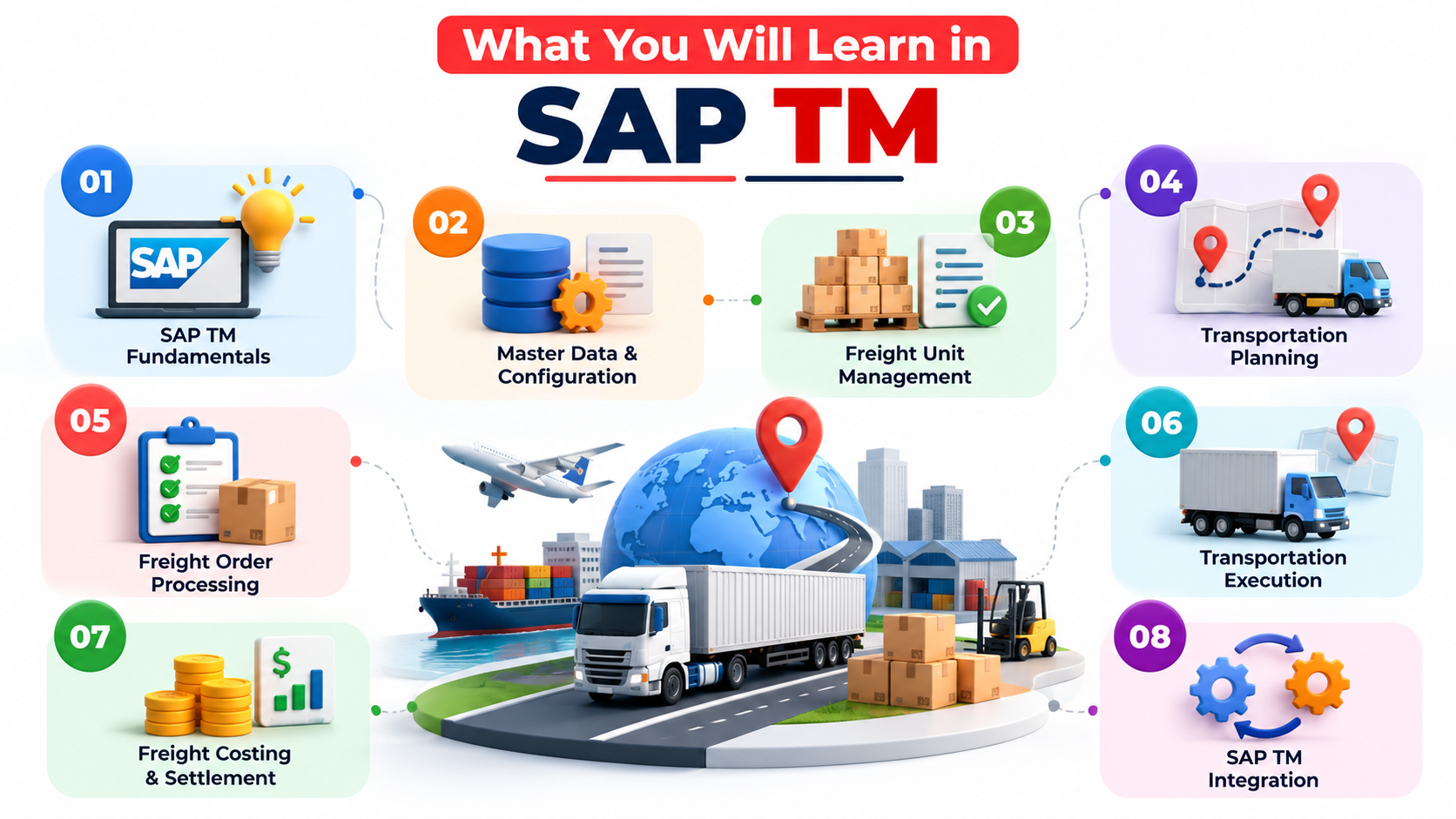
SAP TM Training introduces learners to the key processes involved in managing transportation and logistics operations. The learning journey covers SAP TM fundamentals, master data configuration, freight unit management, transportation planning, and freight order processing. Learners also explore shipment execution, freight costing, and settlement to understand how transportation activities are managed from planning to delivery.
The programme also explains how SAP TM integrates with other SAP solutions, including SAP SD, SAP MM, and SAP EWM. These concepts help learners understand how transportation management connects with broader supply chain operations and supports the movement of goods across different business functions.
Practical SAP TM Workflow: From Transportation Demand to Delivery
Understanding an end-to-end business scenario makes the learning process more meaningful.
Consider a company that manufactures electronic products in Noida and needs to deliver customer orders to distributors in different cities.
The transportation process can be understood through the following stages:
Step 1: Transportation Requirement Creation
A sales order or delivery creates the demand for moving products from the warehouse to the customer.
Step 2: Freight Unit Building
The transportation requirement is converted into freight units according to relevant freight unit building rules.
Step 3: Transportation Planning
The logistics team evaluates shipment requirements, available resources, transportation routes, and delivery schedules.
Step 4: Freight Order Creation
Suitable freight units are assigned to transportation resources, and freight orders are created to organise the planned movement.
Step 5: Carrier Selection
The company selects an appropriate carrier based on availability, transportation requirements, agreements, and applicable costs.
Step 6: Transportation Execution
The shipment moves towards its destination. Loading, departure, arrival, and unloading information can be recorded or updated through supported processes.
Step 7: Freight Cost Calculation and Settlement
Transportation charges are calculated according to applicable agreements and rates. Settlement activities are then processed.
This workflow demonstrates how SAP TM connects different transportation activities into a coordinated business process.
Skills Required to Learn SAP Transportation Management
Learners do not necessarily need extensive programming knowledge to begin exploring SAP TM functional processes. However, understanding business operations and enterprise software concepts can be helpful.
Some useful skills include:
- Basic knowledge of supply chain management.
- Understanding of transportation and logistics operations.
- Familiarity with purchase orders, sales orders, and deliveries.
- Knowledge of inventory and warehouse processes.
- Basic understanding of SAP navigation.
- Analytical and problem-solving abilities.
- Awareness of SAP integration concepts.
For functional consultants, understanding business requirements and process configuration is particularly important. Technical or integration-focused roles may require additional knowledge of interfaces, data exchange, and related SAP technologies.
Who Should Consider SAP TM Training?
SAP Transportation Management can be relevant to different learner groups depending on their career interests.
Fresh Graduates: Graduates interested in enterprise applications, logistics, and supply chain technology can begin by developing an understanding of transportation business processes.
Supply Chain Professionals: Professionals working in logistics, distribution, procurement, or transportation operations can explore how SAP supports their existing responsibilities.
SAP Functional Consultants: Consultants with experience in SAP business processes may consider expanding their knowledge into transportation planning and freight management.
Working Professionals: Individuals looking to move towards SAP consulting or enterprise supply chain roles can explore SAP TM as an additional functional skill.
Logistics and Operations Professionals: People involved in shipment coordination, carrier management, and freight operations can benefit from understanding the system behind these activities.
Career Opportunities After SAP TM Training
Knowledge of SAP Transportation Management can be relevant to several supply chain and enterprise application roles. The actual opportunities depend on practical experience, business knowledge, SAP exposure, and project requirements.
Potential career paths include:
- SAP Transportation Management Functional Consultant.
- SAP TM Business Process Analyst.
- SAP Supply Chain Consultant.
- Transportation Management Analyst.
- SAP Logistics Consultant.
- SAP TM Support Consultant.
- SAP Integration Consultant.
A learner starting without SAP experience should first develop a strong understanding of supply chain fundamentals and SAP business processes. Practical system exposure and implementation knowledge can help build a stronger foundation for consulting opportunities.
SAP TM vs Traditional Transportation Management
Traditional transportation management often depends on spreadsheets, manual coordination, and separate systems to manage shipments, carriers, and delivery updates. This can make it difficult to track transportation activities and manage costs efficiently.
SAP Transportation Management (SAP TM) brings these activities together in one integrated system. It supports transportation planning, freight order management, shipment tracking, carrier coordination, and freight cost calculation.
Unlike traditional methods, SAP TM also helps businesses connect transportation operations with other SAP processes, such as sales, procurement, and warehouse management. This improves information sharing, shipment visibility, and coordination across the supply chain.
The main advantage of SAP TM is its ability to make transportation processes more organised, connected, and easier to monitor.
How to Choose the Right SAP Transportation Management Course
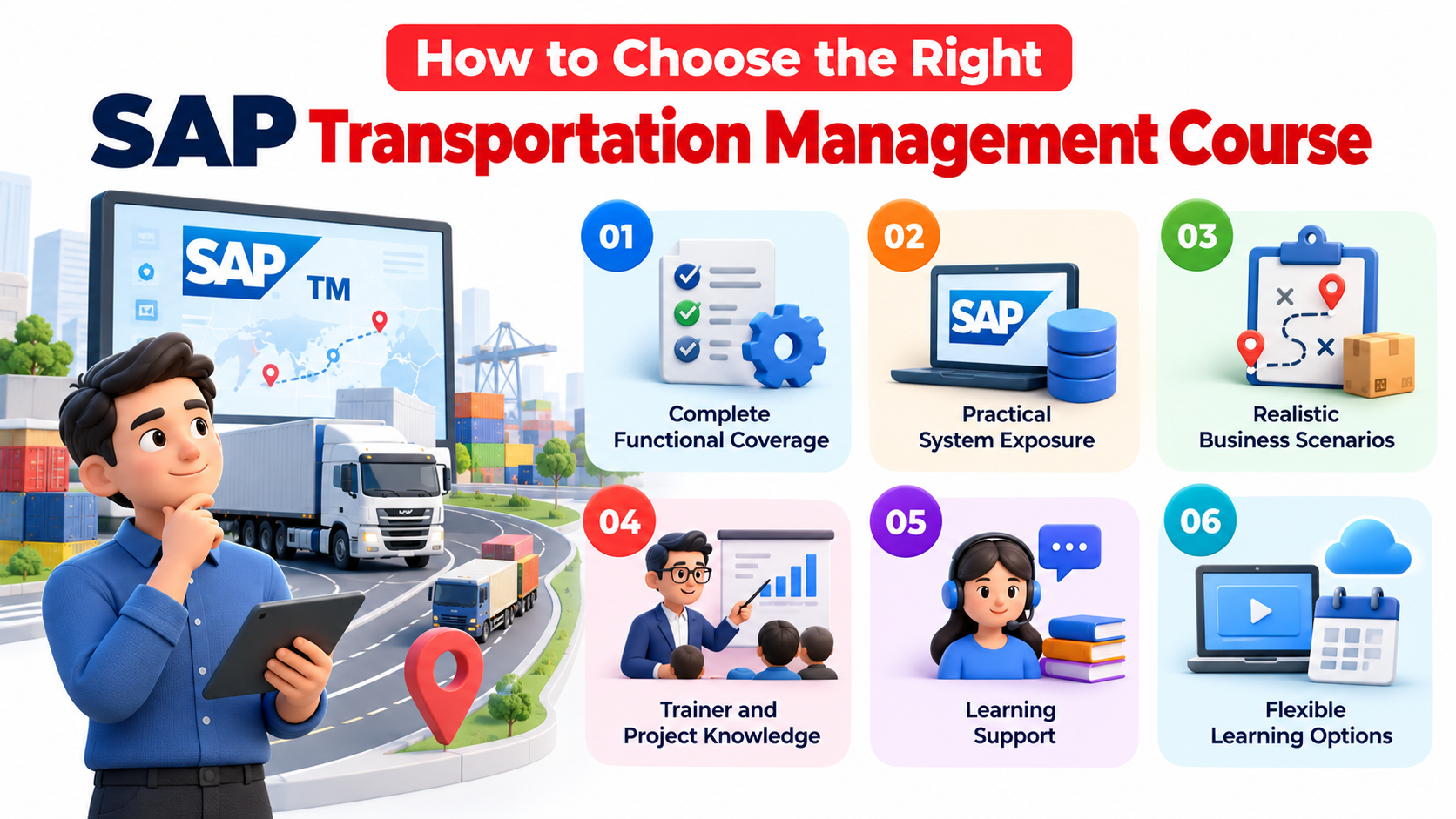
Choosing the right SAP Transportation Management Course involves evaluating the syllabus, practical system exposure, trainer experience, and learning support rather than focusing only on fees or course duration. A good programme should cover essential SAP TM concepts, including master data, freight unit management, transportation planning, freight orders, execution, and freight settlement. Learners should also check whether the training provides access to an SAP environment for practising business transactions and understanding real-world transportation workflows.
Trainer knowledge of SAP TM concepts, implementation processes, and functional business scenarios is another important factor. Before enrolling, check whether the programme offers doubt-clearing sessions, practice exercises, revision support, and guidance throughout the learning process. Learners who prefer remote classes can consider SAP TM Online Training, but should first review the live session schedule, trainer interaction, recorded classes, practical system access, and doubt-clearing facilities. These factors can help learners select a programme that matches their learning goals and professional requirements.
How to Evaluate SAP TM Training in India
When comparing SAP TM Training in India, learners should look beyond promotional claims and evaluate the actual learning experience.
Consider the following points before selecting a training provider:
Course Curriculum: Check whether the syllabus covers important functional areas and end-to-end transportation workflows.
Practical Learning: Confirm whether the programme provides access to an SAP system for hands-on exercises.
Trainer Experience: Understand the trainer's functional knowledge and experience with relevant SAP projects.
Training Format: Compare online, classroom, and live interactive learning options based on your schedule.
Career Guidance: Check whether the provider offers interview preparation, resume guidance, or career support, and clarify exactly what is included.
Certification Preparation: Understand whether the course provides structured preparation for the relevant SAP certification.
At TechPratham, learners can explore available SAP training options and discuss their learning requirements with the training team before selecting a suitable programme. Confirm the current syllabus, practical system access, course format, and support facilities before enrolling.
SAP Transportation Management Certification: What Should You Know?
An SAP Transportation Management Certification can help demonstrate knowledge of relevant SAP transportation management concepts and functional processes.
However, certification preparation should begin with understanding the official examination requirements rather than relying only on a general course syllabus.
Learners should consider these preparation steps:
1. Review the Official Certification RequirementsCheck the current SAP certification catalogue for the relevant examination, eligibility details, and assessment objectives.
2. Understand Core SAP TM Concepts
Develop a clear understanding of transportation requirements, master data, freight units, planning, freight orders, execution, and settlement.
3. Practise Business Scenarios
Use practical exercises to understand how transportation activities connect throughout the business process.
4. Strengthen Integration Knowledge
Understand how SAP TM connects with relevant SAP solutions and business functions.
5. Revise According to the Examination Scope
Prepare using current SAP learning resources and the specific objectives published for the certification you intend to pursue.
A structured training programme can support this preparation, but completing a course and earning an official SAP certification are two different things. Certification is awarded according to SAP's applicable examination and assessment requirements.
Frequently Asked Questions
1. What is SAP Transportation Management used for?SAP Transportation Management is used to manage transportation activities such as shipment planning, freight order processing, carrier selection, transportation execution, freight cost calculation, and settlement. It helps organisations coordinate logistics operations through connected business processes.
2. What topics are covered in SAP TM training?
A comprehensive SAP TM learning programme generally covers transportation management fundamentals, master data, transportation requirements, freight unit building, transportation planning, freight order management, execution, freight costing, settlement, and integration with other SAP processes.
3. Do I need coding knowledge to learn SAP TM?
Coding knowledge is not generally required to begin learning functional SAP TM concepts. Functional roles focus more on business processes, system configuration, and transportation workflows. Technical integration roles may require additional technical skills.
4. Is SAP TM Online Training suitable for working professionals?
Yes. Online learning can be suitable for working professionals who need flexibility in their schedules. However, learners should check whether the programme includes interactive sessions, practical system access, trainer support, and opportunities to practise business scenarios.
5. How can I choose SAP TM Training in India?
Compare the course curriculum, trainer experience, practical SAP system access, training format, learning support, and certification preparation. Select a programme that matches your current knowledge, career goals, and preferred learning schedule.
Conclusion
Transportation management plays an important role in modern supply chain operations. Understanding how businesses manage transportation requirements, plan freight movements, coordinate carriers, monitor shipments, and calculate transportation costs can help learners develop valuable enterprise application knowledge.
A structured approach to SAP Transportation Management Training can help beginners and working professionals understand these processes and explore relevant SAP career paths. Whether you choose classroom learning or SAP TM online Training, focus on functional concepts, practical workflows, integration knowledge, and continuous learning to build a strong foundation.
At TechPratham, learners can explore the available SAP learning options, review the course curriculum, and discuss their learning goals with the training team before choosing a suitable programme.






 +91-8882178896
 +1 (343) 477-0926