
ServiceNow
167 min read5 viewsServiceNow Interview Questions for Experienced Candidates (3, 5 and 7 Years): Scenario-Based Answers
By TechPratham TeamPublished November 2, 2026Updated November 2, 2026

ServiceNow interviews for experienced professionals require more than theoretical knowledge of the platform. Employers want candidates who can troubleshoot real technical issues, implement business requirements, optimize workflows, and explain their decisions using practical project experience.
For professionals with 3, 5, or 7 years of experience, interview expectations generally become more complex. Candidates with three years of experience may be evaluated on scripting and configuration, while professionals with five years may face questions about integrations and performance. Senior candidates with seven years of experience are often expected to demonstrate architecture, scalability, security, and technical leadership.
This guide covers ServiceNow interview questions for experienced candidates, including practical scenarios and detailed answers for developers, administrators, and technical consultants.
ServiceNow Interview Questions for 3 Years of Experience
At this experience level, interviewers generally focus on platform fundamentals, scripting, configuration, and troubleshooting.
1. A Business Rule is triggering repeatedly when an incident is updated. How would you troubleshoot it?
Scenario: An After Business Rule updates the same incident record, causing additional executions.
Answer: I would first examine the Business Rule script to determine whether it contains current.update() or other operations that update the triggering record.
My troubleshooting process would include:
- Reviewing Business Rule conditions and execution order.
- Checking other Business Rules that modify the incident.
- Reviewing Flow Designer executions.
- Examining system logs for repeated operations.
- Determining whether the logic should execute before the record is saved.
If the requirement involves populating a field before saving, I would generally consider a Before Business Rule. I would avoid unnecessary record updates inside Business Rules because they can create additional database operations and unexpected recursion.
2. What is the difference between Client Scripts and Business Rules?
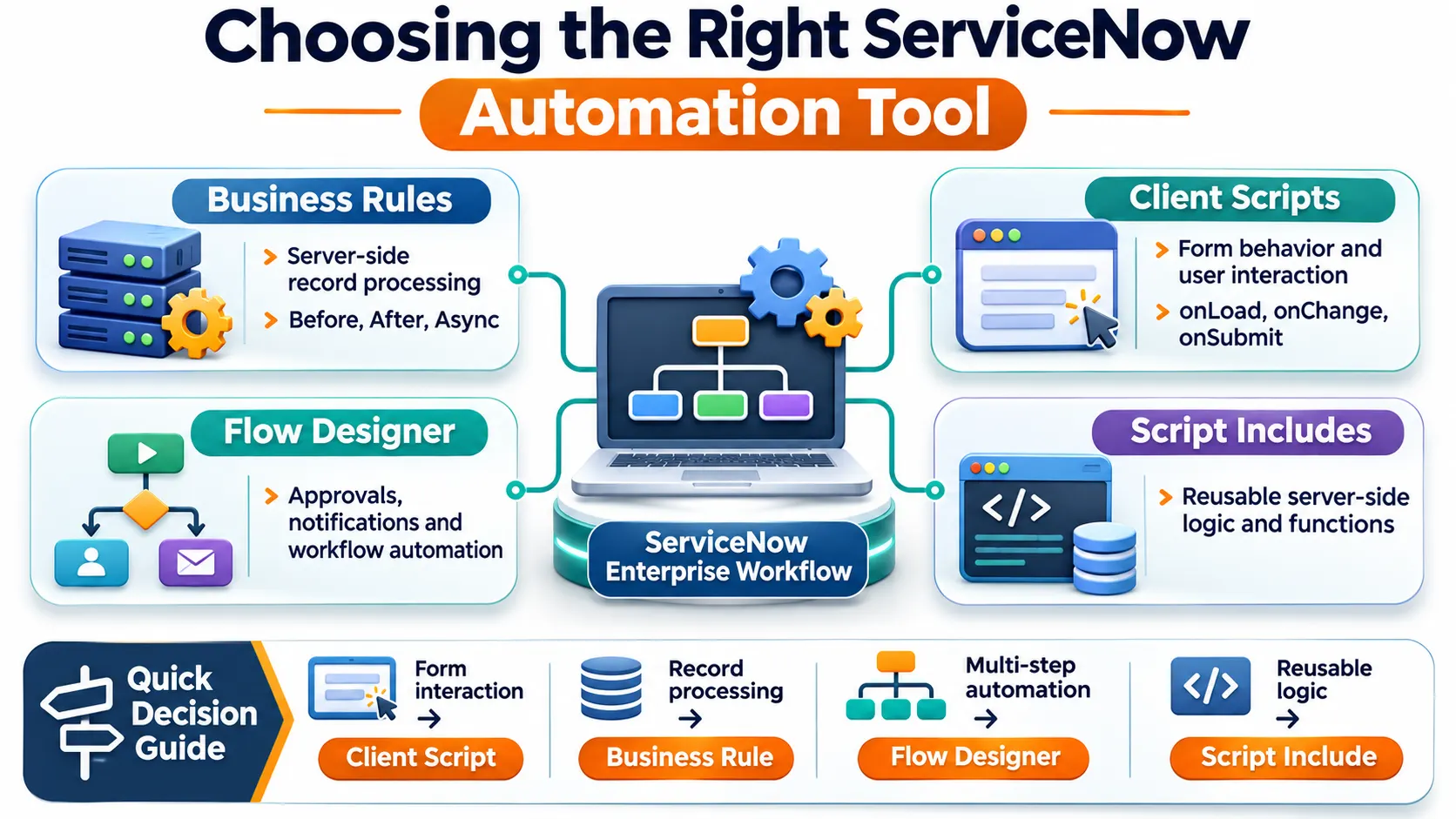
Answer: Client Scripts execute on the client side and control form behavior, while Business Rules execute on the server side and support record processing. For example, a Client Script may display a message when a user selects a particular category. A Business Rule may automatically populate a field or enforce server-side logic when a record is inserted or updated.
If a requirement must apply to API operations and imports, I would not rely only on Client Scripts because they generally do not execute during those server-side operations. The choice depends on whether the requirement concerns form interaction or server-side processing.
3. A user cannot access a particular field on an incident form. How would you investigate?
Answer: I would verify whether the issue is caused by security or form configuration. My investigation would include field-level ACLs, table-level ACLs, assigned roles, UI Policies, Client Scripts, and form views.
I would use impersonation and security debugging to identify the restriction. If the field is hidden through client-side logic, I would review the relevant UI Policy or Client Script. If access is denied by an ACL, I would investigate the security configuration instead. This distinction is important because changing form visibility does not necessarily resolve a security restriction.
4. How would you prevent duplicate incidents created through a REST integration?
Answer: I would implement duplicate prevention using a unique external reference identifier. Before creating a new incident, the integration would check whether a record already exists with the same external identifier.
If a matching record exists, the integration can update it when appropriate. Otherwise, it can create a new record. For high-volume integrations, I would also consider appropriate uniqueness constraints and concurrency handling to prevent duplicate creation when multiple requests arrive simultaneously.
ServiceNow Interview Questions for 5 Years of Experience
Candidates with five years of experience should demonstrate their ability to solve complex technical problems and select appropriate implementation approaches.
5. A Script Include is taking too long to execute. How would you improve performance?
Answer:
I would identify the performance bottleneck before modifying the script.
My approach would include:
- Reviewing execution logs.
- Identifying GlideRecord queries inside loops.
- Removing unnecessary database operations.
- Retrieving only the required records.
- Avoiding repeated calculations.
- Reviewing query conditions.
- Evaluating asynchronous processing where appropriate.
For example, instead of querying each related record individually inside a loop, I would investigate whether the required records could be retrieved through a more efficient query. I would then test the updated script using representative data volumes.
6. A REST integration works in development but fails in production. What would you check?
Answer: I would compare the configuration and execution behavior between both environments. Important areas include authentication credentials, OAuth configuration, endpoint URLs, integration user permissions, network restrictions, MID Server connectivity, and system properties.
I would also review REST response codes and error messages. A production failure may be caused by different credentials, access restrictions, missing configuration, or deployment-related issues. I would isolate the cause before modifying the integration script.
7. A Flow Designer flow is triggering multiple times. How would you resolve it?
Answer:
I would examine the flow trigger conditions and determine whether the flow updates the same record that initiated the execution.
Potential improvements include:
- Restricting the trigger to relevant field changes.
- Adding appropriate conditions.
- Avoiding unnecessary record updates.
- Reviewing flow execution details.
- Separating unrelated automation.
I would verify that the solution does not prevent legitimate flow executions. The objective is to eliminate unnecessary processing while preserving business functionality.
8. How would you choose between Business Rules, Flow Designer, and Script Includes?
Answer:
I would select the component based on the requirement. Business Rules are useful for server-side record processing and record lifecycle operations. Flow Designer is appropriate for process automation, approvals, notifications, and multi-step workflows.
Script Includes are useful for reusable server-side logic. For example, if multiple Business Rules require the same validation logic, I would consider placing that reusable logic in a Script Include. This approach improves maintainability and reduces duplicated code.
ServiceNow Interview Questions for 7 Years of Experience
Senior ServiceNow professionals are expected to demonstrate architectural thinking, technical leadership, and the ability to manage complex enterprise implementations
9. Your organization has hundreds of custom Business Rules on the Incident table. How would you improve performance?
Answer:
I would conduct a platform assessment before removing or modifying existing customizations.
My investigation would include:
- Identifying frequently executed Business Rules.
- Reviewing unnecessary database operations.
- Finding duplicate or overlapping logic.
- Evaluating execution conditions.
- Reviewing synchronous processing.
- Identifying opportunities for asynchronous execution.
- Assessing whether standard platform functionality can replace custom scripts.
I would also investigate whether performance issues originate from other components, including Flow Designer, integrations, and scheduled jobs. Any optimization would be tested carefully to avoid disrupting existing business processes.
10. How would you design a scalable ServiceNow integration handling thousands of records daily?
Answer: I would first understand the data volume, frequency, business requirements, and integration dependencies. The design would consider REST or SOAP APIs, authentication, batch processing, pagination, retry handling, logging, and monitoring. For high-volume integrations, I would evaluate asynchronous processing and suitable batch sizes.
I would also implement duplicate prevention and reconciliation mechanisms to identify records that were not successfully processed. The integration should be secure, maintainable, and capable of recovering from temporary failures.
11. A client requests extensive customization of a standard ServiceNow application. How would you approach the requirement?
Answer: I would first understand the business problem rather than immediately agreeing to the proposed customization.
My approach would include:
- Reviewing standard platform capabilities.
- Evaluating configuration-based solutions.
- Assessing customization risks.
- Reviewing upgrade implications.
- Considering performance and security.
- Explaining the trade-offs to stakeholders.
- Recommending a maintainable solution.
I would prefer supported extension points and standard configuration wherever possible. Senior professionals should be able to explain when customization is justified and when it introduces unnecessary complexity.
12. How would you handle a critical production issue after a deployment?
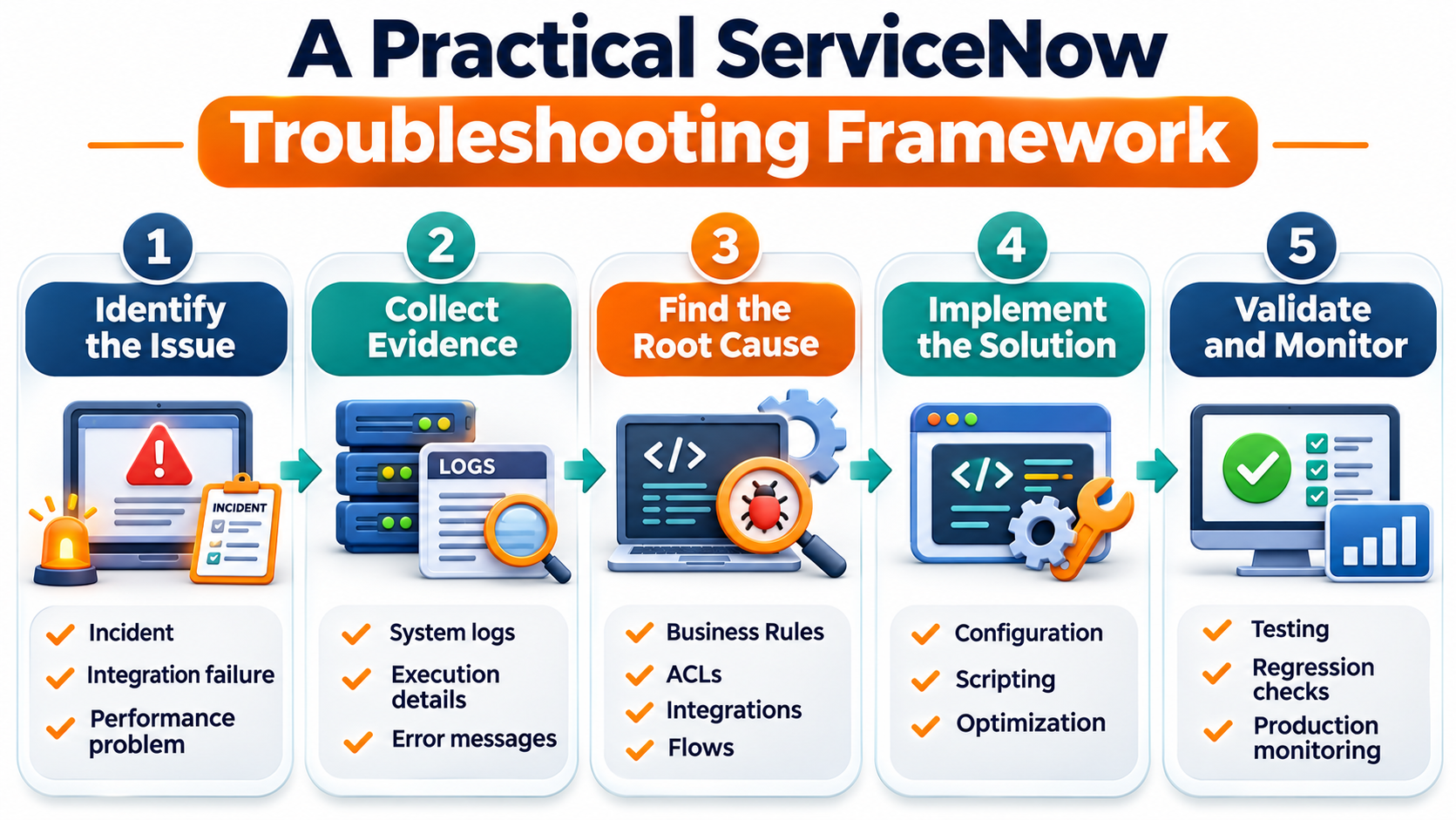
Answer: I would prioritize restoring business functionality while minimizing risk. First, I would identify affected users and business processes. Then I would review recent changes, system logs, and error messages.
I would determine whether the issue requires rollback, a corrective deployment, or another controlled recovery approach. After restoring functionality, I would validate the solution, document the root cause, and identify preventive measures.
Communication with stakeholders and adherence to change management procedures are important throughout the process.
Advanced ServiceNow Technical Interview Questions
13. What is the difference between GlideRecord and GlideRecordSecure?
GlideRecord is used to query and manipulate records on the ServiceNow platform. GlideRecordSecure provides security-aware record access behavior by incorporating applicable access controls.
For user-facing functionality, I would evaluate the security requirements and choose the appropriate data access method. I would also verify that unauthorized users cannot access restricted records or fields through alternative interfaces.
14. How would you troubleshoot a GlideRecord query returning unexpected results?
I would verify the table name, field names, query conditions, data types, reference values, and encoded query syntax. I would simplify the query and test individual conditions before combining them.
For complex queries, I would carefully examine AND and OR conditions to identify incorrect logic. I would also verify whether the expected records exist and whether access restrictions affect the results.
15. How would you troubleshoot an HTTP 401 or 403 error in a ServiceNow integration?
An HTTP 401 response generally indicates an authentication problem, while HTTP 403 usually indicates an authorization or access restriction. For a 401 error, I would review credentials, OAuth tokens, authentication configuration, and token expiration.
For a 403 error, I would investigate user permissions, roles, ACLs, OAuth scopes, and API authorization requirements. I would verify the actual response details before making changes.
ServiceNow ITSM Scenario-Based Interview Questions
16. An incident is assigned to the wrong group. How would you investigate?
I would review Assignment Rules, Business Rules, Flow Designer, assignment conditions, and custom scripts. I would also examine the incident history to identify which component changed the assignment group.
The goal would be to identify the actual source of the incorrect assignment rather than manually correcting individual incidents.
17. A Change Request is not moving to the expected state after approval. What would you check?
I would investigate the approval record, Flow Designer execution, Business Rules, state transition conditions, and user permissions. I would verify whether approval was completed successfully and whether another condition is preventing the state change. I would also review customizations that may affect the change lifecycle.
18. CMDB contains duplicate Configuration Items. How would you resolve the issue?
I would investigate the sources of duplicate records, including Discovery, integrations, imports, and manual creation. I would review identification and reconciliation rules and determine whether multiple data sources are creating conflicting records. Rather than simply deleting duplicates, I would address the source of the problem and validate the correction.
How to Prepare for a ServiceNow Interview
Candidates should prepare according to their experience and responsibilities.
For 3 years of experience:
Focus on Business Rules, Client Scripts, GlideRecord, UI Policies, ACLs, ITSM processes, and basic integrations.
For 5 years of experience:
Focus on Script Includes, Flow Designer, REST APIs, complex scripting, performance optimization, and troubleshooting.
For 7 years of experience:
Focus on architecture, scalability, security, enterprise integrations, platform governance, upgrade planning, and technical leadership.
Prepare examples from actual projects and explain the business requirement, technical solution, challenges, and testing approach.
Corporate Training for ServiceNow: Building Enterprise Skills
ServiceNow knowledge is valuable not only for individual career development but also for organizations implementing or expanding enterprise workflows.
Companies often need employees who understand ITSM processes, ServiceNow development, platform configuration, integrations, and automation.
Corporate training for ServiceNow can help organizations strengthen technical capabilities across development, administration, and implementation teams.
Depending on organizational requirements, training may cover:
Depending on organizational requirements, training may cover:
- ServiceNow Administration and Developer fundamentals
- ITSM modules and business processes
- Business Rules, Client Scripts, and Script Includes
- Flow Designer and workflow automation
- CMDB and ITOM concepts
- REST API integrations
- Practical development exercises
- Project-oriented learning and troubleshooting
Organizations exploring enterprise technology learning options can visit TechPratham Corporate Training to understand available training solutions. A structured learning program can help teams align platform knowledge with business requirements and improve their readiness for enterprise implementation projects.
Strengthening Practical ServiceNow Knowledge
Interview preparation becomes more effective when candidates combine theoretical knowledge with practical platform experience. Working on Incident Management, CMDB, scripting, automation, and integration scenarios helps professionals understand how ServiceNow components interact in real business environments.
Candidates looking to strengthen their administration and development fundamentals can explore ServiceNow Training in India – Admin and Developer Course.
Professionals interested in developer-focused skills and certification preparation can also review the ServiceNow Developer Certification Training.
Choose learning resources according to your current experience and career objectives. Practical implementation, troubleshooting ability, and a clear understanding of platform fundamentals remain important for experienced-level interviews.
Frequently Asked Questions
Q : What are the most important ServiceNow interview questions for 3 years of experience?
Ans : Focus on Business Rules, Client Scripts, GlideRecord, ACLs, UI Policies, ITSM processes, and basic integration scenarios.
Q : What should I prepare for a ServiceNow interview with 5 years of experience?
Ans : Prepare complex scripting, REST integrations, Flow Designer, Script Includes, performance optimization, and real project troubleshooting.
Q : What are the expectations for a ServiceNow Developer with 7 years of experience?
Ans : Senior candidates are generally expected to demonstrate architecture, scalability, security, integration design, technical leadership, and performance optimization.
Q : Are scenario-based questions important in ServiceNow interviews?
Ans : Yes. Scenario-based questions help interviewers evaluate how candidates apply technical knowledge to practical business problems
Q : Is ServiceNow certification enough to clear an experienced-level interview?
Ans : Certification can demonstrate platform knowledge, but experienced-level interviews also evaluate project experience, troubleshooting, implementation skills, and technical decision-making.
Final Thoughts
ServiceNow interviews for experienced professionals increasingly focus on practical problem-solving, implementation knowledge, and technical decision-making.
Candidates with three years of experience should strengthen their scripting and configuration fundamentals. Professionals with five years of experience should demonstrate complex development and troubleshooting skills. Senior candidates with seven years of experience should prepare for architecture, scalability, security, and technical leadership discussions. The most effective preparation combines platform knowledge with practical project experience.
A strong ServiceNow interview answer demonstrates not only what a feature does, but also how it solves a real business problem.
Related Articles

ServiceNow
ServiceNow Discovery Troubleshooting: 6 Common Errors, Fixes and Interview Questions
Learn ServiceNow Discovery troubleshooting, fix MID Server and credential errors, resolve CMDB issues, and prepare for ITOM interviews.

ServiceNow
ServiceNow AI Use Cases: How AI Automates IT, HR and Customer Service
Explore ServiceNow AI use cases across IT, HR and customer service, including Now Assist, AI Agents, automation and real-world applications.





 +91-8882178896
 +1 (343) 477-0926