
Software Testing Training
198 min read9 viewsAI vs Traditional Software Testing: What's Changing in 2026?
By TechPratham TeamPublished November 5, 2026Updated November 5, 2026
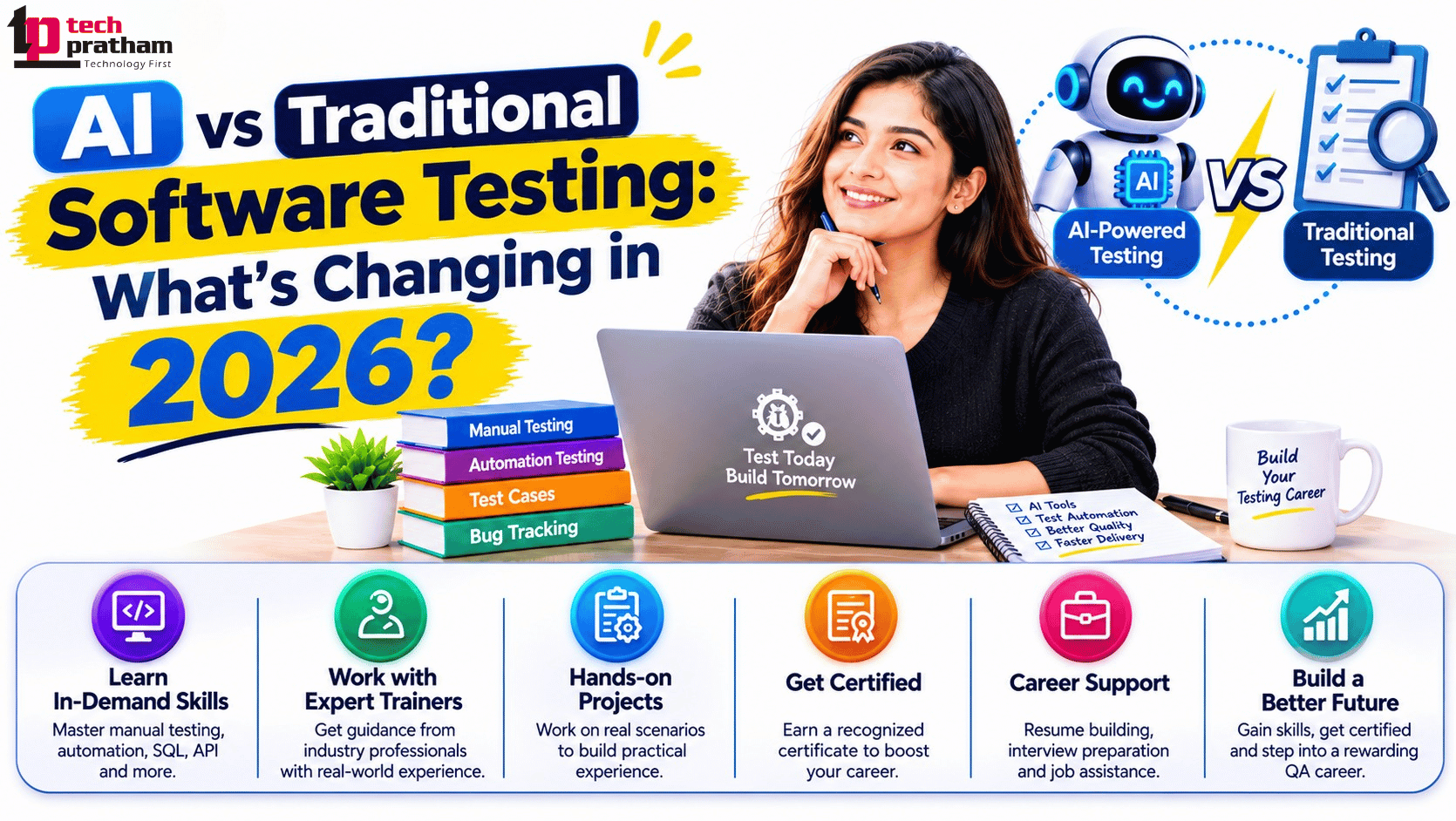
Technology is changing faster than ever, and Artificial Intelligence (AI) is becoming an important part of the software development industry. From writing code to finding errors, AI is helping software development teams complete different tasks more quickly. Software testing is also experiencing this change.
In traditional software testing, testers manually check applications, prepare test cases, execute them, identify bugs, and report issues to developers. Automation testing makes some of these activities faster by using scripts and testing tools. However, many testing activities still require human knowledge, attention, and decision-making.
In 2026, AI is bringing a new approach to software testing. AI-powered tools can help generate test cases, analyse application behaviour, identify possible defects, and support automation testing. These features are changing how testers work and how companies maintain software quality.
But does this mean traditional software testing is becoming outdated? Not really. Traditional testing methods are still important, while AI is helping improve the testing process.
In this blog, we will understand the differences between AI and traditional software testing, explore the latest changes in 2026, and discuss the skills software testers need to build a successful career in the future.
1. What Is Traditional Software Testing?
Traditional software testing is the process of checking a software application to make sure it works according to business requirements. Testers examine different features, identify errors, and verify whether the application provides the expected results.
In this approach, testers follow predefined steps to test an application. They prepare test cases, execute them manually or through automation scripts, and report defects whenever they find unexpected behaviour.
For example, consider an online shopping website. A tester needs to check whether users can register, log in, search for products, add items to their shopping cart, and complete payments successfully.
The tester creates different test scenarios and checks whether each feature works correctly.
Some common activities in traditional software testing include:
1). Manual Testing: Checking application features manually without using automation scripts.
2). Test Case Creation: Writing steps to verify different application functionalities.
3). Functional Testing: Checking whether application features work according to requirements.
4). Regression Testing: Making sure new changes do not affect existing features.
5). Automation Testing: Using scripts and tools to execute repetitive test cases.
6). Defect Reporting: Recording bugs and sharing them with developers for correction.
Traditional software testing provides a strong foundation for checking application quality. However, testing large applications manually can take considerable time, especially when the same test cases need to be executed repeatedly.
2. What Is AI in Software Testing?
AI in software testing refers to the use of Artificial Intelligence technologies to support and improve different testing activities.
Instead of depending completely on manually written instructions and predefined scripts, Software Testing Training in India helps learners understand how AI-powered tools analyse information, identify patterns, and suggest possible testing scenarios.
For example, a tester can provide an AI tool with the requirements of a login page and ask it to generate test cases. The tool may suggest scenarios for valid login details, incorrect passwords, empty fields, invalid email addresses, and password length restrictions.
The tester can review these suggestions, make necessary changes, and use them during the testing process.
AI can support several testing activities, including:
.png)
- Generating test cases from requirements.
- Creating automation scripts.
- Identifying possible defects.
- Analysing test execution results.
- Finding gaps in test coverage.
- Supporting regression testing.
- Analysing application logs.
- Identifying unusual application behaviour.
In 2026, AI is also moving beyond basic assistance. Some advanced testing systems use AI agents to perform multiple related activities, such as understanding a task, interacting with an application, executing tests, and analysing results.
However, AI-generated results still need proper verification. Testers must check whether the suggested test cases are correct and whether the application behaves as expected.
3. AI vs Traditional Software Testing: Key Differences
Both AI-based and traditional software testing aim to improve software quality. However, their working methods and capabilities are different.
Here are some important differences:
The main difference is that traditional testing depends more on predefined testing steps, while AI-assisted testing can use data and patterns to support testing decisions.
However, AI does not automatically make every testing activity better. The quality of results depends on requirements, application behaviour, testing data, and human verification.
4. What's Changing in Software Testing in 2026?
AI is changing different parts of the software testing life cycle. Let's understand some important developments that are becoming increasingly relevant in 2026.
4.1 AI-Powered Test Case Generation
Earlier, testers generally prepared test cases by studying business requirements and identifying possible testing scenarios.
Now, AI tools can help generate test cases from requirement documents, user stories, and simple instructions.
For example, if the requirement says that a user must register using a valid email address and password, AI can suggest positive and negative test scenarios. It may include:
.png)
- Registration with valid details.
- Registration with an invalid email address.
- Submission with empty fields.
- Password below the required length.
- Registration using an already registered email.
This helps testers explore more scenarios and reduces the effort required to prepare initial test cases.
However, testers should review every generated scenario before using it.
4.2 Smarter Automation Testing
Automation testing is already an important part of modern software development. However, maintaining automation scripts can become difficult when application elements or user interfaces change.
AI-powered automation tools can help identify changes in application elements and suggest alternative ways to locate them.
Some tools also support self-healing capabilities, which can help update broken test steps when application changes are detected.
For example, if a button's locator changes after a website update, an AI-assisted tool may identify the new element and suggest an updated locator. This can reduce script maintenance efforts, but testers must confirm that the updated test still checks the correct functionality.
4.3 Faster Bug Identification and Analysis
Finding a bug is only one part of software testing. Testers also need to understand how the issue occurred and provide useful information to developers.
AI can help analyse application logs, error messages, and previous defect records to identify patterns that may be related to a problem.
For example, if users repeatedly experience errors during payment processing, an AI tool may help highlight common error messages or related application events.
This information can help testers investigate the problem more efficiently.
4.4 Risk-Based Testing
Not every feature of an application has the same level of importance. Some features are more critical because they involve payments, personal information, or important business operations.
AI can analyse historical defect data, application changes, and test results to help identify areas that may require more attention.
For example, if a recent update affects the payment module, AI may help recommend prioritising payment-related regression test cases. The final decision should still consider business requirements and the tester's understanding of the application.
4.5 Better Regression Testing
Regression testing checks whether changes in an application have affected existing functionalities.
In large applications, executing every regression test case after each update can consume significant time.
AI-assisted testing systems can analyse code changes and historical test results to suggest which test cases should be prioritised.
This helps testing teams focus on areas that may be more affected by recent changes.
However, skipping tests only because an AI tool considers them low-risk can create problems. Test teams must maintain suitable regression coverage.
4.6 AI-Assisted Test Reporting
Preparing test reports is another important responsibility of software testers.
AI tools can help summarise test execution results, organise defect information, and prepare initial report drafts.
For example, a tester can use an AI assistant to convert technical test results into a simple summary that explains how many test cases passed, how many failed, and which areas need attention.
This saves time on report preparation and allows testers to focus more on analysing application quality.
Recent industry research also shows that AI adoption in testing is growing, particularly in test case creation, automation script development, and test coverage analysis. <a href="https://www.applause.com/state-of-digital-quality-2026/functional-testing-report/">Applause's 2026 Digital Quality Report</a> highlights these changing use cases.
5. Benefits of AI in Software Testing
AI is creating new opportunities for software testing teams. When used correctly, it can improve productivity and support better testing decisions.
Some important benefits include:
1. Saves Time: AI can help generate test cases, summarise reports, and analyse large amounts of testing information.
2. Improves Test Coverage: It can suggest additional scenarios that testers may not have considered initially.
3. Reduces Repetitive Work: Testers can use AI to support routine activities and spend more time on complex testing tasks.
4. Supports Faster Defect Analysis: AI can identify patterns in logs and historical defect data, helping testers investigate issues.
5. Helps Maintain Automation Scripts: Some AI-powered tools can suggest changes when application elements are updated.
6. Supports Better Decision-Making: AI can provide useful information about risky application areas and testing priorities.
It is important to understand that these benefits depend on the quality of the tools, testing data, and the way teams use AI.
6. Limitations of AI in Software Testing
Although AI offers several benefits, it also has limitations. Software testing teams should understand these challenges before depending heavily on AI tools.
1. Incorrect Test Cases: AI may generate test cases that do not match actual business requirements. Testers need to review them carefully.
2. Lack of Business Understanding: AI may not fully understand the purpose of a feature or the business impact of a particular defect.
3. Data Privacy Concerns: Sharing confidential application information, customer data, or company documents with external AI tools can create security risks.
4. False Results: AI tools may provide incorrect suggestions or fail to identify certain application issues.
5. Tool Integration Challenges: Connecting AI tools with existing testing frameworks and development processes may require additional effort.
6. Human Verification Is Necessary: Testers must verify important testing decisions instead of accepting every AI-generated result.
According to IBM's 2026 discussion on AI-assisted quality assurance, human judgment remains important for business context, usability, security, and reviewing AI-generated results.
This is why companies should use AI as a support system rather than depending on it completely.
7. Will AI Replace Manual and Automation Testers?
This is one of the biggest questions among people planning to enter the software testing industry.
The simple answer is that AI is changing the role of software testers, but it does not remove the need for human testing expertise.
AI can help with repetitive activities such as generating test cases, preparing scripts, and analysing reports. However, many testing activities require human understanding and practical experience.
For example, imagine a banking application where users transfer money between accounts. An AI tool may generate test cases for successful and unsuccessful transactions.
But a human tester must also think about situations such as:
(a). What happens if the internet connection stops during a transaction?
(b). Can a user transfer more money than the available balance?
(c). What happens if the same payment request is submitted twice?
(d). Is the transaction confirmation message clear?
(e). Does the application protect sensitive customer information?
These situations require logical thinking, business understanding, and the ability to consider real user behaviour.
Therefore, manual testers and automation testers who learn to use AI tools can improve their professional skills.
The future is more likely to involve collaboration between human testers, automation frameworks, and AI-powered tools rather than complete replacement of testers.
8. Skills Software Testers Need in 2026
As software testing continues to evolve, testers should develop both traditional testing knowledge and modern technical skills.
Here are some important skills to focus on:
1. Manual Testing Fundamentals
Testers should understand software testing concepts, test scenarios, test cases, defect life cycles, and different testing types. These fundamentals help them identify application issues correctly.
2. Automation Testing
Learning automation tools and frameworks helps testers execute repetitive test cases efficiently. Knowledge of programming languages such as Java, Python, or JavaScript can also be useful.
3. AI Tools for Testing
Testers should learn how to use AI assistants for test case generation, test script suggestions, debugging support, and test report analysis.
4. API Testing
Modern applications communicate through APIs. Understanding API requests, responses, status codes, and validation is important for testing application functionality.
5. SQL and Database Testing
Testers should understand basic SQL queries and learn how to verify whether application data is stored and retrieved correctly.
6. Analytical and Logical Thinking
AI can suggest testing scenarios, but testers need to evaluate whether those scenarios are meaningful and identify missing requirements.
7. Communication Skills
Testers regularly communicate with developers, business analysts, and project managers. Clear communication helps teams understand defects and resolve them efficiently.
8. Continuous Learning
New testing tools and technologies continue to appear. Testers should keep learning and updating their knowledge to stay relevant in the industry.
9. How to Start a Career in Software Testing in the AI Era?
If you are planning to start a career in software testing, learning the fundamentals is the right first step.
You do not need to become an AI expert immediately. Instead, focus on understanding how software applications work and how different testing methods help improve their quality.
Here is a simple learning roadmap:
Step 1: Learn Manual Testing
Start with software testing basics, SDLC, STLC, test case writing, test scenarios, and defect reporting.
Step 2: Understand Different Testing Types
Learn functional testing, regression testing, smoke testing, sanity testing, integration testing, and other important testing concepts.
Step 3: Practise Automation Testing
Understand automation fundamentals and practise with suitable tools and programming languages.
Step 4: Learn API and Database Testing
Practise API validation and basic SQL queries to understand how applications exchange and store information.
Step 5: Explore AI Testing Tools
Use AI assistants to generate test cases, understand error messages, prepare test data, and support automation activities. Always verify the results.
Step 6: Work on Practical Projects
Practise testing real-world application workflows such as login systems, shopping websites, payment pages, and registration forms.
Practical experience helps you understand how testing concepts are applied in actual projects.
10. The Future of Software Testing: AI and Human Collaboration
The future of software testing will not be based entirely on manual methods or AI tools. Instead, testing teams will increasingly combine traditional testing knowledge, automation frameworks, and AI capabilities.
AI will continue to support repetitive tasks, analyse large amounts of information, and help teams identify potential risks. At the same time, human testers will remain important for understanding business requirements, exploring unusual scenarios, checking usability, and making quality-related decisions.
In 2026, the focus is gradually shifting from simply executing more test cases to understanding whether the application is reliable and provides a good user experience.
Testers who understand both traditional software testing and AI-assisted testing will be better prepared for changing industry requirements.
For beginners, this is a good time to enter the software testing field because they can build their careers with a combination of foundational testing knowledge and modern tools.
Conclusion
AI is changing the way software testing is performed in 2026. From generating test cases and supporting automation to analysing defects and prioritising regression testing, AI is making several testing activities more efficient.
However, traditional Software Testing Course in India is still important. Manual testing, logical thinking, business understanding, and practical experience continue to play a major role in maintaining software quality.
The best approach is not to choose between AI and traditional testing. It is to understand both and learn how they work together.
If you want to build a career in this field, start by learning manual testing fundamentals, automation testing, API testing, and database testing. Gradually explore AI-powered testing tools and practise using them in real-world scenarios.
Related Articles
Software Testing Training
Can AI Replace Manual Software Testers? Skills You Need for the Future
Can AI replace manual software testers? Explore the future of testing, essential AI skills, and how testers can stay relevant.

Software Testing Training
How Many Types of QA Are There?
Learn how many types of QA exist, their key differences, testing methods, and how quality assurance helps deliver reliable software applications.





 +91-8882178896
 +1 (343) 477-0926