
Software Testing Training
129 min read10 viewsCan AI Replace Manual Software Testers? Skills You Need for the Future
By TechPratham TeamPublished November 4, 2026Updated November 4, 2026
.png)
Artificial Intelligence (AI) is changing the way businesses develop, test and deliver software applications. Today, many companies are using AI-powered tools to automate repetitive tasks, generate test cases, identify defects and improve software quality. These developments have created an important question among beginners and working professionals: Can AI replace manual software testers in the future?
Manual testing has always played an important role in software development. Testers check applications from the user's point of view, identify unexpected problems and make sure that software works as expected. Although AI can perform many testing activities faster, it does not completely understand human behaviour, business requirements and real-world user experiences.
Instead of completely replacing manual testers, AI is changing their responsibilities. Testers who understand AI tools, testing fundamentals and automation techniques can prepare themselves for new opportunities in the IT industry.
In this blog, we will explore whether AI can replace manual software testers, how AI is changing software testing and which skills testers should learn to build a successful career in the future.
1. Understanding the Role of Manual Software Testers
Manual software testing is the process of checking an application without using automation scripts to execute test cases. A tester interacts with the application, performs different actions and checks whether the actual results match the expected results.
For example, consider an online shopping website. A manual tester checks whether users can create accounts, log in, search for products, add items to their shopping carts and complete payments successfully.
If a user receives an incorrect error message or the payment process fails, the tester reports the issue to the development team.
Some important responsibilities of manual software testers include:
- Understanding software requirements and business needs.
- Preparing test scenarios and test cases.
- Executing test cases manually.
- Identifying and reporting software defects.
- Performing functional and regression testing.
- Checking application usability and user experience.
- Working with developers to resolve reported defects.
- Verifying whether reported issues have been fixed.
These activities require logical thinking, observation skills and an understanding of how users interact with applications.
2. How Is AI Changing Software Testing?
AI is making software testing more efficient by helping testers complete repetitive and time-consuming activities. Modern AI-powered tools can analyse requirements, suggest test scenarios, generate test data and identify possible defects.
For example, a tester can provide a login page requirement to an AI tool and ask it to suggest test cases. The tool may generate scenarios for valid login, invalid passwords, empty fields, password visibility and account locking.
The tester can review these suggestions, correct missing details and execute the relevant test cases.
Here are some important ways AI is changing software testing:
Automated Test Case Generation: AI tools can analyse application requirements and suggest test cases for different functionalities.
Faster Defect Identification: AI can analyse test results, application logs and historical defect information to help identify possible problems.
Test Data Generation: AI can help create sample data for testing different application scenarios.
Regression Testing Support: AI-powered tools can help identify important test cases that should be executed after application changes.
Test Script Assistance: Generative AI tools can suggest automation scripts and help testers understand or correct code.
Test Maintenance: Some AI-based automation platforms can identify changes in application elements and help update broken test scripts.
These capabilities reduce repetitive work and allow testers to spend more time on complex testing activities.
3. Can AI Completely Replace Manual Software Testers?
The simple answer is no. AI can automate several testing tasks, but it cannot completely replace the knowledge, judgement and experience of a skilled manual software tester.
Software testing is not limited to executing test cases. It also involves understanding business requirements, exploring application behaviour and identifying problems that may not be mentioned in the original requirements.
Consider a banking application where users transfer money between accounts. An AI tool can suggest test cases for successful transfers, insufficient balances and invalid account details. However, a human tester may identify additional problems related to confusing instructions, unexpected user behaviour or unclear confirmation messages.
Human testers also understand the importance of business priorities. They can communicate with developers, business analysts and project managers to understand the impact of defects.
AI can provide suggestions, but testers must review the results and decide whether the application is ready for release.
Therefore, the future of software testing is more likely to involve collaboration between humans and AI rather than complete replacement.
4. What Are the Limitations of AI in Manual Testing?
Although AI offers many advantages, it still has limitations. Understanding these limitations helps testers identify where human involvement is necessary.
1. Limited Understanding of Human Behaviour
AI can analyse patterns and suggest testing scenarios, but it may not fully understand how different users interact with an application. Human testers can explore applications from different user perspectives.
2. Difficulty Understanding Complex Business Requirements
Some business requirements are unclear or depend on specific company processes. Testers often need to communicate with stakeholders to understand the correct expected behaviour.
3. Incorrect AI-Generated Results
AI tools may generate incomplete or incorrect test cases. Testers must verify the suggestions before using them in real projects.
4. Limited Creativity in Exploratory Testing
Exploratory testing requires testers to investigate an application without following only predefined test cases. Human curiosity and experience help identify unexpected problems.
5. Privacy and Security Concerns
Sharing application data, business information or customer details with AI tools may create privacy risks. Testers must follow company policies and use approved tools.
These limitations show why human knowledge remains important in software quality assurance.
5. Skills Manual Software Testers Need for the Future
As AI becomes more common in the IT industry, manual testers should improve their technical and analytical skills. Learning only basic test execution may not be enough for long-term career growth.
Here are some important skills that can help testers stay relevant.
1. Strong Manual Testing Fundamentals
Manual testing fundamentals are still important because every tester needs to understand how software applications should behave.
Learn concepts such as:
- Software Testing Life Cycle (STLC).
- Software Development Life Cycle (SDLC).
- Test scenarios and test case preparation.
- Defect life cycle.
- Functional and non-functional testing.
- Smoke, sanity and regression testing.
- Boundary Value Analysis and Equivalence Partitioning.
A strong understanding of these concepts helps testers evaluate AI-generated suggestions and identify missing test scenarios.
2. AI Tool Knowledge
Testers should learn how to use AI tools to improve their daily testing activities. For example, ChatGPT can help testers:
- Generate test cases from requirements.
- Create positive and negative test scenarios.
- Prepare sample test data.
- Understand error messages.
- Draft bug reports.
- Explain testing concepts.
However, AI-generated content should always be reviewed before it is used in actual projects.
3. Automation Testing Skills
Learning automation testing can help manual testers expand their career opportunities. Automation is useful when the same test cases need to be executed repeatedly.
Testers can start by learning tools and technologies such as Selenium, Playwright, Java, Python or other relevant automation frameworks.
They should understand how to create test scripts, execute automated tests, analyse results and maintain test suites.
4. API Testing Knowledge
Modern applications communicate with different services through APIs. Therefore, API testing is an important skill for software testers.
Testers should learn how to check API requests, responses, status codes, response time and data accuracy.
Tools such as Postman can help beginners understand and perform API testing.
5. Analytical and Problem-Solving Skills
AI can provide suggestions, but testers need analytical thinking to understand whether those suggestions are correct.
For example, if an application displays an incorrect account balance, a tester should investigate possible reasons, identify the affected functionality and explain the issue clearly to the development team.
Problem-solving skills help testers identify the root cause and understand the impact of defects.
6. Communication and Collaboration Skills
Software testing requires regular communication with developers, business analysts, project managers and other team members.
Testers should know how to explain defects, discuss requirements and share testing results.
Clear communication helps teams understand problems and resolve them faster.
7. Exploratory Testing Skills
Exploratory testing involves learning about an application while testing it. Instead of depending only on predefined test cases, testers explore different workflows and look for unexpected behaviour.
This skill is valuable because real users may interact with applications in ways that were not considered during development.
6. Popular AI Tools That Software Testers Should Know
Several AI-powered tools are helping software testing teams improve productivity. Beginners and experienced testers can explore these tools to understand how AI is used in real testing environments.
ChatGPT: Helps generate test cases, prepare test scenarios, create sample data and explain testing concepts.
GitHub Copilot: Assists developers and automation testers by suggesting code and helping write automation scripts.
Applitools: Uses visual AI technology to identify visual differences in application interfaces.
Testim: Provides AI-assisted test automation and helps maintain automated test scripts.
Mabl: Supports intelligent test automation for web applications and helps teams identify application issues.
Functionize: Uses AI-based technologies to support test creation, execution and maintenance.
Testers should understand that each tool has different features and requirements. Learning how to use a tool effectively is more important than simply knowing its name.
7. How Manual Testers Can Prepare for an AI-Powered Future
Manual testers do not need to become AI experts overnight. They can gradually improve their skills by following a practical learning approach.
Here is a simple roadmap:
Step 1: Strengthen Manual Testing Knowledge
Start with testing fundamentals, test case writing, defect reporting and different testing techniques.
Step 2: Practise with Real Applications
Choose an e-commerce website, banking application or booking platform. Prepare test scenarios and execute them manually.
Step 3: Learn AI Tools
Use AI tools such as ChatGPT to generate test cases, prepare test data and understand testing requirements.
Step 4: Learn Automation Testing
Choose an automation tool such as Selenium or Playwright. Start with basic scripts and gradually practise more complex scenarios.
Step 5: Understand API Testing
Learn how APIs work and practise sending requests, checking responses and validating application data using Postman.
Step 6: Build Practical Projects
Work on real-world testing projects where you combine manual testing, AI assistance and automation techniques.
Step 7: Keep Learning New Technologies
The software testing industry continues to evolve. Follow new tools, testing practices and AI developments to improve your professional knowledge.
8. Future Career Opportunities for Software Testers
AI is creating new possibilities in software quality assurance. Companies need professionals who can understand testing fundamentals and work with modern technologies.
Some career roles that testers can explore include:
Manual Software Tester.
Quality Assurance Analyst.
Automation Test Engineer.
AI Testing Engineer.
Software Test Analyst.
API Test Engineer.
QA Automation Specialist.
Software Quality Engineer.
The skills required for these roles may differ depending on the company, project and technology.
Manual testers who develop knowledge of automation, AI tools and API testing can prepare themselves for a wider range of opportunities.
9. Is Software Testing Still a Good Career Choice in the AI Era?
Yes, software testing continues to be an important part of software development. Every application needs to be checked for functionality, reliability, performance and security before it is released to users.
AI can make testing activities faster, but companies still need professionals who can understand requirements, evaluate results and identify problems that automated tools may miss.
For freshers, learning software testing can be a starting point for entering the IT industry. Working professionals can also upgrade their existing skills by learning automation and AI-based testing techniques.
The most important thing is to develop practical knowledge instead of depending only on theoretical concepts.
Enrolling in a structured Software Testing Training in India program can help beginners understand testing fundamentals, practise real-world scenarios and develop the skills required for software testing roles.
Conclusion
Artificial Intelligence is changing software testing, but it does not mean that manual software testers will completely disappear. AI can generate test cases, analyse results, support automation and reduce repetitive work. However, human testers are still important for understanding business requirements, exploring applications, evaluating user experience and making testing decisions.
The future belongs to testers who can combine strong manual testing fundamentals with AI tools, automation, API testing and problem-solving skills.
Instead of worrying about whether AI will replace their jobs, manual testers should focus on learning how to work with AI. Continuous learning and practical experience can help them remain valuable in the changing software testing industry.
Related Articles

Software Testing Training
How Many Types of QA Are There?
Learn how many types of QA exist, their key differences, testing methods, and how quality assurance helps deliver reliable software applications.
Software Testing Training
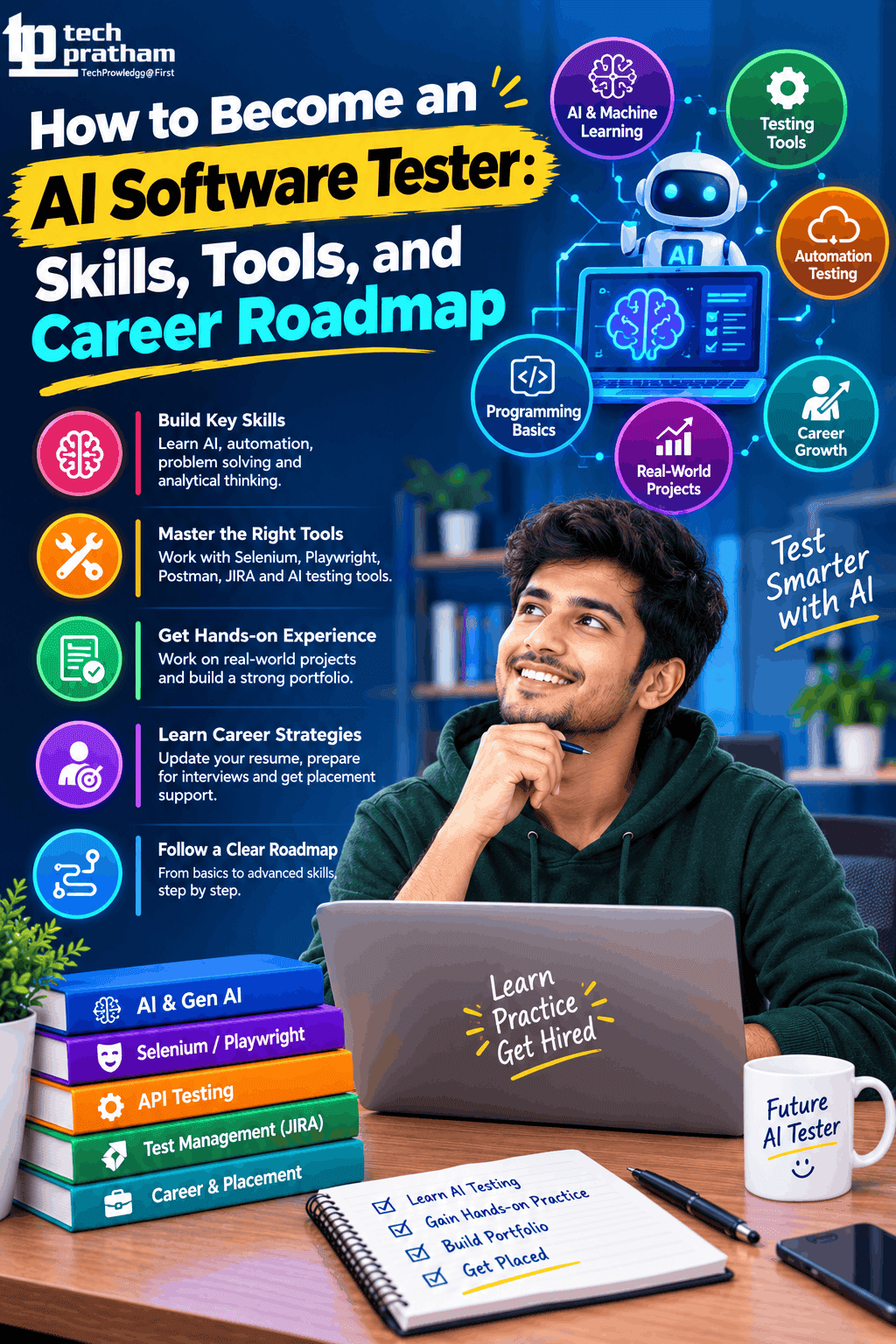
How to Become an AI Software Tester: Skills, Tools, and Career Roadmap
Learn how to become an AI software tester with essential skills, testing tools, practical projects, and a step-by-step career roadmap.





 +91-8882178896
 +1 (343) 477-0926