
Software Testing Training
140 min read2 viewsHow to Become an AI Software Tester: Skills, Tools, and Career Roadmap
By TechPratham TeamPublished October 22, 2026Updated October 22, 2026
.png)
Artificial intelligence is changing the way software applications are developed, tested, and maintained. From generating test cases to identifying potential defects, AI-powered tools are helping software testers improve testing efficiency and explore new ways to ensure software quality. As organizations adopt AI-driven technologies, understanding how to use AI in software testing is becoming a valuable skill for quality assurance professionals.
If you are a beginner planning to enter the IT industry or an experienced tester looking to upgrade your skills, becoming an AI software tester can be an interesting career direction. However, learning AI tools alone is not enough. You also need to understand software testing fundamentals, test design techniques, automation, API testing, and defect management.
In this guide, we will explain what an AI software tester does, which skills you need to learn, how AI tools support testing activities, and how you can follow a practical roadmap to enter this field.
What Is an AI Software Tester?
An AI software tester is a quality assurance professional who uses artificial intelligence tools and techniques to support software testing activities. These activities may include creating test cases, analyzing requirements, identifying possible defects, generating test data, and improving automated testing workflows.
Traditional Software Testing Course in India relies on manual techniques, predefined test cases, automation scripts, and the tester's knowledge of the application. AI-assisted testing adds another layer by helping testers analyze information, identify patterns, and automate repetitive tasks.
For example, a tester working on an online shopping application may use an AI tool to generate test scenarios for product searches, shopping carts, payment processing, and order tracking. The tester must still review these scenarios, verify the results, and ensure that the application behaves according to business requirements.
It is important to understand that AI does not eliminate the need for human testers. Testers must evaluate AI-generated outputs, identify missing scenarios, investigate unexpected results, and make decisions based on business risks.
What Does an AI Software Tester Do?
The responsibilities of an AI software tester depend on the organization, project, and tools being used. Common responsibilities include:
1). Test case generation: Using AI assistants to suggest test cases from requirements and user stories.
1). Test case generation: Using AI assistants to suggest test cases from requirements and user stories.
2). Test automation: Creating and maintaining scripts with tools such as Selenium or Playwright, sometimes with AI assistance.
3). Defect analysis: Using AI tools to summarize error logs, identify patterns, and support root-cause investigation.
4). Test data preparation: Generating suitable test data while protecting sensitive information.
5). API testing: Validating API responses, status codes, data structures, and error handling.
6). Regression testing: Identifying important tests to rerun after software changes.
7). Test reporting: Summarizing execution results, defects, and potential risks.
8). AI output validation: Checking whether AI-generated test cases and recommendations are accurate, relevant, and complete.
AI tools can make certain tasks faster, but testers remain responsible for deciding what needs to be tested and whether the results are reliable.
AI tools can make certain tasks faster, but testers remain responsible for deciding what needs to be tested and whether the results are reliable.
How to Become an AI Software Tester: Step-by-Step Roadmap
You do not need to learn every testing tool at once. A structured learning plan can help you build the right foundation before moving toward AI-assisted testing.
Step 1: Learn Software Testing Fundamentals
Start by understanding the basic principles of software testing. These concepts help you identify defects, evaluate application behavior, and determine whether a product meets its requirements.
Important topics include:
- Software Development Life Cycle (SDLC)
- Software Testing Life Cycle (STLC)
- Manual testing fundamentals
- Functional and non-functional testing
- Smoke, sanity, regression, and retesting
- Test scenarios and test cases
For example, when testing a login page, you should verify valid credentials, incorrect passwords, empty fields, account lockout behavior, and appropriate error messages. AI may suggest additional scenarios, but your understanding of testing fundamentals helps you determine which scenarios are necessary.
Learners who need structured guidance can explore Software Testing Training in India to develop a foundation in testing concepts before progressing to automation and AI-assisted workflows.
Step 2: Practise Test Case Design
Test case design is an essential skill for both manual and AI-assisted testing. A tester should understand how to convert business requirements into clear, testable conditions.
Learn techniques such as:
- Equivalence partitioning
- Boundary value analysis
- Decision table testing
- State transition testing
- Error guessing
- Risk-based testing
Suppose an application accepts a discount percentage between 1 and 50. You can design test cases for values below the limit, at the lower boundary, within the valid range, at the upper boundary, and above the limit.
1). Selenium: Automates browser interactions and supports multiple programming languages.
An AI tool may help suggest these scenarios, but you should validate them against the actual requirements. This combination of testing knowledge and AI assistance helps you create more meaningful test coverage.
Step 3: Develop Basic SQL and Database Skills
Software testers frequently work with databases to verify whether information is stored, updated, and retrieved correctly.
Start with basic SQL commands, including SELECT, WHERE, ORDER BY, GROUP BY, and JOIN. Practise checking records, comparing application results with database values, and identifying missing or incorrect data.
For example, after placing an order in an e-commerce application, you may need to verify that the order details, payment status, and customer information are stored correctly.
Database knowledge is especially useful when testing applications that process customer records, financial transactions, inventory, or employee information.
Step 4: Learn API Testing
APIs allow different software systems to communicate with one another. API testing helps verify whether these communications work correctly.
Focus on HTTP methods, status codes, request and response structures, headers, authentication, and JSON data. You can practise API testing using tools such as Postman.
An AI assistant may help explain an API response, suggest negative test cases, or draft assertions. However, you should independently verify the expected response and confirm that sensitive information is handled properly.
API testing is valuable because many application defects occur in the interaction between services rather than in the visible user interface.
Step 5: Learn Test Automation
Automation testing is an important next step for testers who want to work with AI-assisted testing workflows.
Begin with basic programming concepts such as variables, conditions, loops, functions, and exception handling. Python or Java can be useful choices, depending on the automation tools and jobs you are targeting.
You can then explore tools such as:
1). Selenium: Automates browser interactions and supports multiple programming languages.
2). Playwright: Supports modern browser automation, including synchronization and cross-browser testing.
3). Pytest: Helps organize and execute Python-based automated tests.
4). Postman: Supports API testing and automated test execution.
AI coding assistants can suggest scripts, explain errors, and help generate test code. Nevertheless, generated code may contain incorrect assertions, weak selectors, or incomplete validation. You should understand the script, run it, and confirm that it tests the intended behavior.
Step 6: Explore AI Tools for Software Testing
After developing your testing foundation, start exploring how AI can assist with everyday QA tasks.
Common applications include:
- Generating test ideas from user stories
- Drafting test cases and test data
- Explaining automation code
- Summarizing application logs
- Suggesting edge cases
- Assisting with defect classification
General-purpose AI assistants can help with brainstorming and code explanations, while specialized testing platforms may offer AI-based test generation, visual comparison, or maintenance features.
Tool capabilities and pricing change over time, so evaluate each tool based on your project requirements. Avoid assuming that every AI-generated suggestion is correct. Verify results using application requirements, expected outcomes, and independent test execution.
Step 7: Understand How to Test AI-Based Applications
There is an important difference between using AI to test conventional software and testing an application that itself uses AI.
When testing an AI-based application, results may not always be identical for the same input. Testing may therefore require additional attention to accuracy, consistency, fairness, privacy, robustness, and inappropriate outputs.
For example, when testing a customer support chatbot, you may check whether it answers common questions correctly, handles ambiguous requests, avoids exposing confidential information, and responds appropriately to unsupported questions.
You should also consider incorrect or misleading responses, prompt injection risks, and whether the system follows its intended safety boundaries.
This area requires both software testing knowledge and an understanding of how the AI application is expected to behave.
Which Skills Are Required to Become an AI Software Tester?
You can build these skills gradually instead of trying to master everything at once.
Technical skills:
- Manual testing and test case design
- Basic programming with Python or Java
- Selenium or Playwright automation
- API testing using Postman
- SQL and database validation
- Defect tracking and test management
Professional skills
- Analytical and critical thinking
- Problem-solving
- Clear documentation
- Communication with developers and business teams
- Attention to detail
- Risk assessment
You do not need to be an AI researcher to start learning AI-assisted software testing. A solid QA foundation, practical projects, and the ability to evaluate AI-generated results are a useful starting point.
Do You Need Coding Skills to Become an AI Software Tester?
Coding requirements depend on the role you want to pursue.
Manual testing roles may require little or no programming at the beginning. However, automation-focused positions generally require you to understand programming logic and maintain test scripts. AI-assisted tools may help you write code, but they do not remove the need to understand how that code works.
If you are a beginner, start with manual testing, SQL, and API testing. Next, learn basic programming and practise browser automation. Finally, introduce AI tools into your workflow to generate test ideas, review code, and investigate failures.
This gradual approach can make the transition easier for learners who have limited technical experience.
Practical Projects to Build Your AI Software Testing Portfolio
Employers often want to understand how you apply your knowledge to real testing problems. Completing practical projects can help demonstrate your skills.
Project 1: E-Commerce Website Testing
Test product search, filters, shopping cart functionality, checkout, and order confirmation.
Use AI to brainstorm test scenarios, then create and execute test cases manually. Document defects with clear steps, expected results, and actual results.
Project 2: Web Automation with Playwright or Selenium
Automate a registration or login workflow on a suitable practice application.
Use an AI assistant to help explain automation code or suggest additional scenarios. Validate the script yourself and demonstrate how it handles incorrect inputs and application errors.
Project 3: API Testing with Postman
Test a sample REST API for valid requests, invalid inputs, authentication errors, and unexpected responses.
Create assertions, document the results, and use AI to help identify missing negative scenarios. Verify all suggested cases before including them in your test suite.
Project 4: AI Chatbot Testing
Evaluate a chatbot using factual questions, ambiguous requests, unsupported queries, and potentially sensitive prompts.
Record whether responses are accurate, relevant, consistent, and safe. Identify situations where the chatbot provides misleading information or fails to follow its intended behavior.
For each project, maintain test cases, execution evidence, defect reports, and a short summary of your findings. Never upload real customer data, confidential company documents, or credentials to public AI tools.
How Can Software Testing Training Help You Learn AI Testing?
A structured learning program can help you progress from basic QA concepts to more advanced testing practices. Instead of learning unrelated tools individually, look for a learning path that combines theory, practical assignments, and project-based experience.
When evaluating a Software Testing course in India, check whether the curriculum covers manual testing, test case design, defect management, SQL, API testing, automation fundamentals, and real-world projects. AI-assisted testing can then be added to this foundation.
A Software Testing Certification Training in India program may also help you prepare for relevant certification exams, depending on the course and certification provider. Before enrolling, confirm whether the program prepares you for an external certification or awards only its own course-completion certificate.
If you are comparing options for the Best Software Testing Training in India, consider the trainer's practical experience, curriculum coverage, project quality, batch format, learning support, and opportunities to practise. Do not choose a program based only on promotional claims or a certificate title.
For beginners, the right training should help you understand why a test is needed, how to execute it, how to report defects, and how to evaluate the results. These skills are more valuable than simply knowing the names of multiple tools.
Career Opportunities for AI Software Testers
As companies introduce AI into development and quality assurance workflows, testers can explore several related career paths. Available opportunities depend on experience, technical skills, and employer requirements.
Potential roles include:
- Software Test Engineer
- Quality Assurance Analyst
- Automation Test Engineer
- AI-Assisted QA Engineer
- API Test Engineer
- Test Automation Developer
Some roles focus on conventional software testing with AI tools used to improve efficiency. Others involve evaluating machine learning models, generative AI applications, or AI-powered features.
Do not assume that every AI testing position is an entry-level job. Some require strong automation, programming, data analysis, or machine learning knowledge. Review job descriptions to identify the skills employers expect and use them to guide your learning plan.
Common Mistakes to Avoid While Learning AI Software Testing
Learning AI tools without testing fundamentals: AI suggestions are useful only when you can judge whether they meet the requirements.
Depending entirely on generated code: Always understand, execute, and validate automation scripts before relying on them.
Ignoring negative testing: Test invalid inputs, boundary conditions, access controls, and failure scenarios instead of focusing only on successful workflows.
Skipping practical projects: Tool knowledge is easier to demonstrate when you can show test cases, scripts, execution results, and defect reports.
Assuming AI will replace all testers: AI can assist with repetitive work, but human judgment remains important for risk analysis, exploratory testing, and business decisions.
Adding unverified skills to your resume: Include tools and techniques you have actually practised, and prepare to explain your projects during interviews.
Final Thoughts
Becoming an AI software tester is a learning journey that combines traditional software quality assurance with newer AI-assisted techniques. The most effective starting point is to learn manual testing, test design, SQL, and API testing before progressing to automation and AI tools.
Build practical projects, verify AI-generated suggestions, and develop the ability to explain your testing decisions. These habits can help you prepare for QA roles in which AI is used to support test creation, execution, analysis, and maintenance.
If you are starting from scratch, consider a structured learning path through Software Testing Course in India, followed by hands-on automation practice and focused exploration of AI testing tools. With consistent practice and a clear understanding of software quality, you can develop the skills needed to explore opportunities in modern software testing.
Related Articles
Software Testing Training
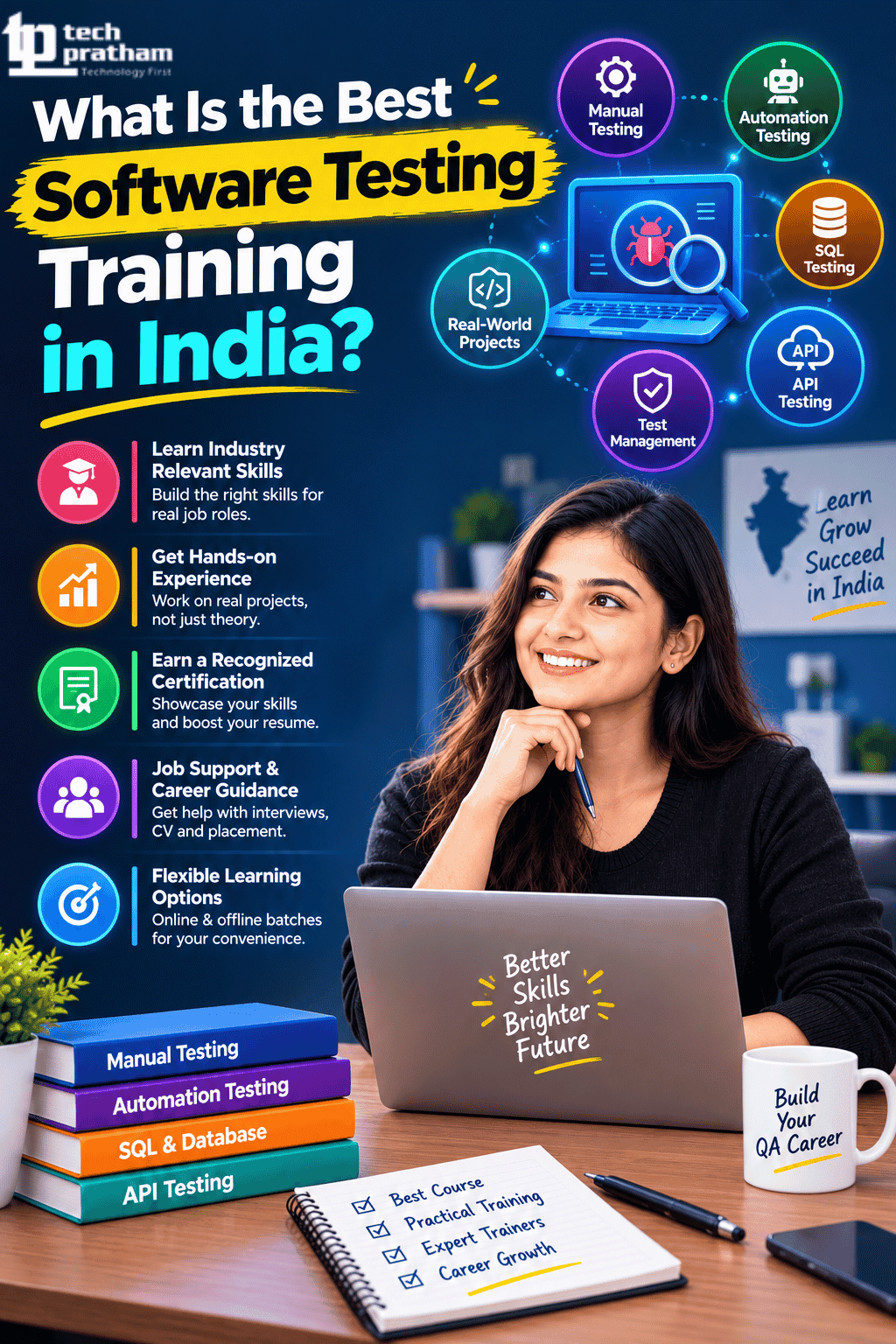
What Is the Best Software Testing Training in India?
Explore the best Software Testing Training in India with practical projects, expert guidance, certification, and career support.
Software Testing Training
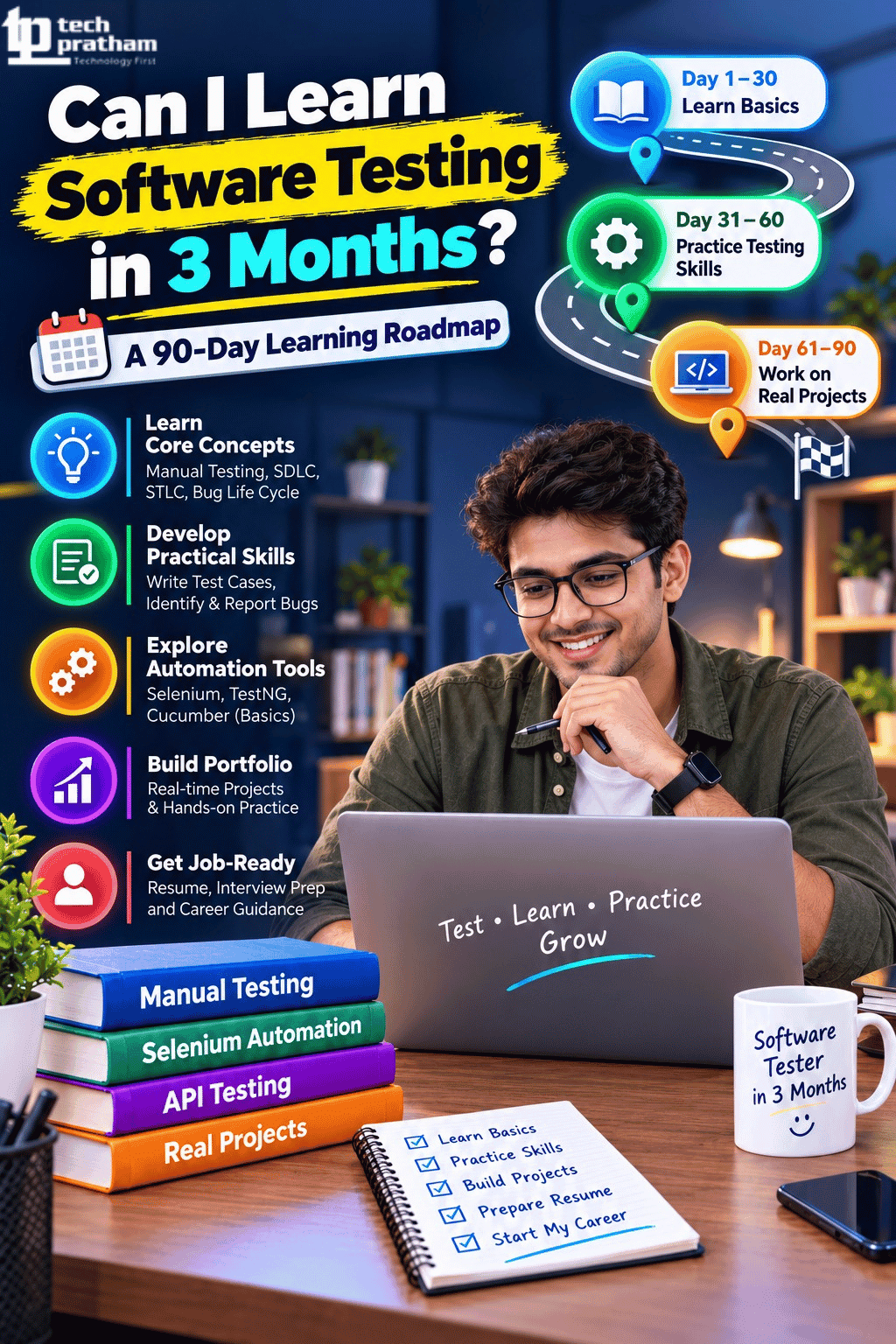
Can I Learn Software Testing in 3 Months? A 90-Day Learning Roadmap
Learn software testing in 3 months with a 90-day roadmap covering manual testing, test cases, SQL, API testing and automation tools.





 +91-8882178896
 +1 (343) 477-0926