
workday
189 min read7 viewsWorkday Finance Month-End Close: Steps, Reconciliation and Common Challenges
By TechPratham TeamPublished November 13, 2026Updated November 13, 2026
.webp)
Month-end closing is an important accounting activity for organizations that need to maintain accurate financial records and prepare reliable financial reports. At the end of each accounting period, finance teams review transactions, verify journal entries, reconcile account balances and complete the necessary accounting adjustments. For organizations using Workday Financial Management, these activities involve different financial processes, including general ledger, accounts payable, accounts receivable, expense management, cash management and financial reporting.
A well-organized closing process helps finance teams identify discrepancies, manage outstanding transactions and maintain consistency across financial records. In this guide, we will explore how the Workday Finance month-end close process works, the key activities involved, common challenges and practical approaches that organizations can use to improve their financial closing activities.
A well-organized closing process helps finance teams identify discrepancies, manage outstanding transactions and maintain consistency across financial records. In this guide, we will explore how the Workday Finance month-end close process works, the key activities involved, common challenges and practical approaches that organizations can use to improve their financial closing activities.
What Is Month-End Close in Workday Finance?
Month-end close refers to the process of reviewing and finalizing financial transactions for a particular accounting period. Before an accounting period is considered complete, finance teams need to verify that transactions have been recorded correctly, outstanding activities have been reviewed and necessary adjustments have been processed.
In a Workday Financial Management environment, month-end activities may include:
- Reviewing financial transactions recorded during the month.
- Verifying journal entries and accounting adjustments.
- Checking accounts payable and accounts receivable balances.
- Reviewing employee expense transactions.
- Performing bank and financial account reconciliation.
- Investigating differences in account balances.
- Reviewing financial reports.
- Completing required period-close activities.
The exact process depends on the organization's accounting policies, financial configuration, business structure and internal approval requirements.
Key Steps in the Workday Finance Month-End Close Process
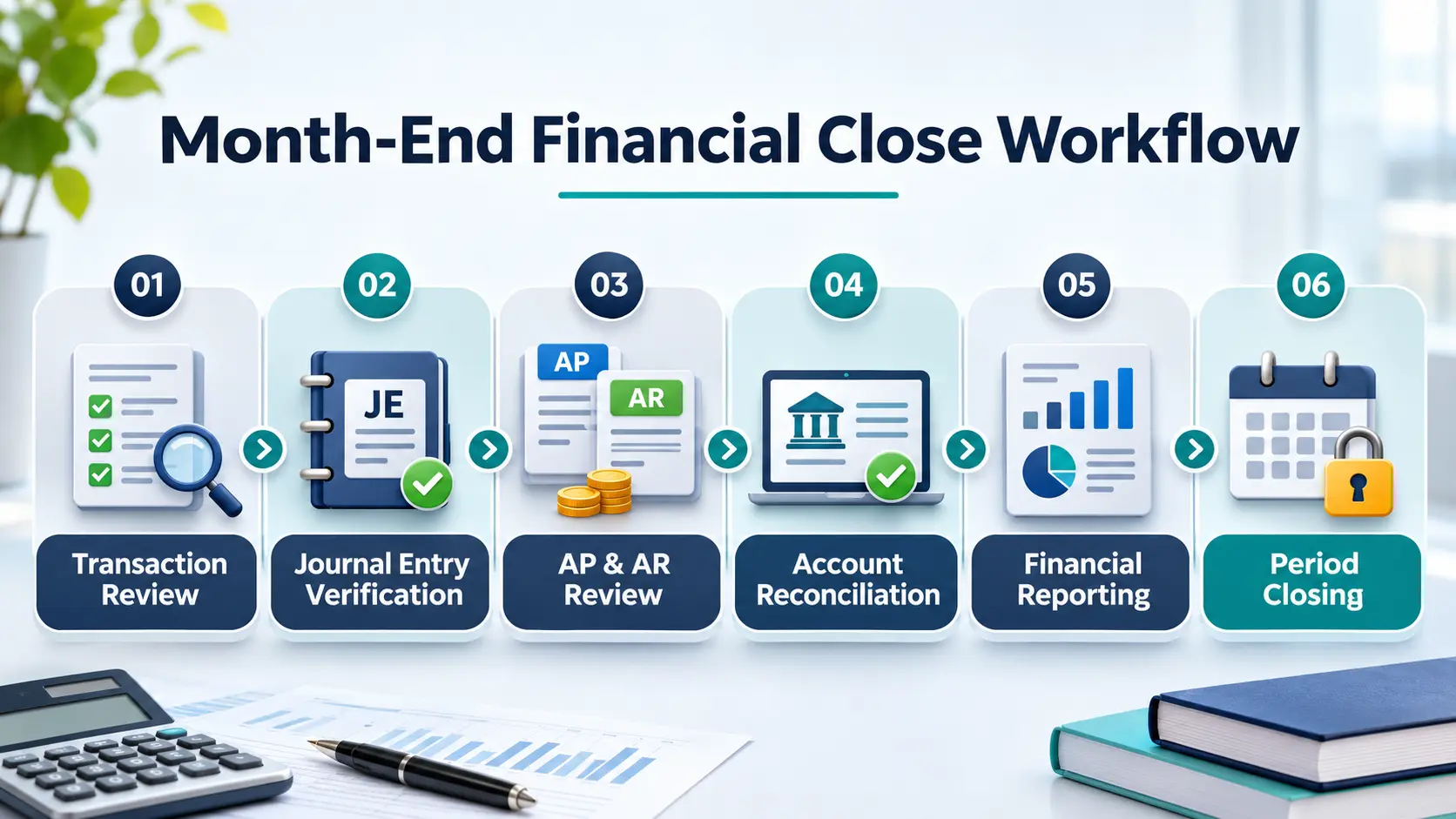
Month-end closing involves several activities that need to be completed in a logical sequence. Although individual organizations may follow different procedures, the following steps represent common activities within an enterprise financial close process.
1. Review Pending Financial Transactions
The first step is identifying transactions that have not been fully processed or recorded. Finance teams review transactions across different financial areas to determine whether anything requires attention before the accounting period is finalized.
Examples include:
- Pending supplier invoices.
- Unapproved expense reports.
- Incomplete customer transactions.
- Transactions awaiting accounting review.
- Unprocessed financial adjustments.
Unresolved transactions can affect the accuracy of financial reports. Reviewing them early helps reduce unexpected issues during closing.
2. Verify Journal Entries
Journal entries are essential for maintaining accurate accounting records. During month-end closing, finance teams review journal entries to ensure that transactions have been recorded in the appropriate accounts and accounting periods.
Common journal-related activities include:
- Reviewing manually created journals.
- Checking debit and credit balances.
- Verifying accounting dates.
- Reviewing journal approvals.
- Identifying incorrect or incomplete entries.
- Processing necessary adjustments.
For example, if an organization records an expense in the wrong account, the finance team may need to review and correct the accounting entry before completing the period close.
3. Review Accounts Payable and Accounts Receivable
Accounts payable and accounts receivable represent important parts of the month-end financial review.
Accounts Payable (AP)
The finance team reviews supplier-related transactions to verify that invoices, payments and outstanding liabilities are properly recorded.
The finance team reviews supplier-related transactions to verify that invoices, payments and outstanding liabilities are properly recorded.
Important checks include:
- Outstanding supplier invoices.
- Payment status.
- Invoice accounting.
- Unmatched or incomplete transactions.
- Supplier balance differences
Accounts Receivable (AR)
The receivables review focuses on customer-related transactions and outstanding amounts.
Finance teams may examine:
- Customer invoices.
- Outstanding receivables.
- Payment applications.
- Uncollected balances.
- Credit adjustments.
Reviewing both areas helps organizations maintain accurate liability and receivable balances.
4. Review Employee Expense Transactions
Employee expenses can affect financial records when they are not reviewed or recorded within the appropriate accounting period. During month-end activities, finance teams may examine expense reports, reimbursement status, approval workflows and expense accounting.
For example, an employee may submit a travel expense report near the end of the month. The finance team needs to determine whether the expense has been approved and recorded in the appropriate accounting period according to company policy. Reviewing expense transactions helps reduce incomplete financial records and unexpected adjustments.
5. Perform Bank and Account Reconciliation
Reconciliation is an important activity during financial closing. It involves comparing financial records with supporting information to identify differences and confirm that account balances are accurate. For example, during bank reconciliation, the finance team compares recorded cash transactions with bank statement information.
Common reconciliation activities include:
- Comparing bank statement transactions.
- Reviewing outstanding payments.
- Identifying unmatched deposits.
- Investigating transaction differences.
- Verifying account balances.
- Documenting reconciliation adjustments.
If a transaction appears in one record but not another, the finance team investigates the reason before treating the account as reconciled. Workday Financial Management supports financial processes that can help organizations manage account reconciliation and related financial reviews, depending on their configuration and enabled capabilities.
6. Review Accruals and Accounting Adjustments
Some expenses and revenues need to be recognized in an accounting period even when the corresponding payment or invoice has not yet been processed. This is where accrual accounting becomes important.
Common month-end adjustments include:
- Accrued expenses.
- Prepaid expense adjustments.
- Depreciation entries.
- Revenue adjustments.
- Expense reclassifications.
For example, an organization may receive an electricity bill in the following month for services used during the current month. An appropriate accrual may be required to recognize the expense in the correct accounting period. Finance teams review these adjustments to ensure that financial statements reflect the organization's activities accurately.
7. Review Financial Reports and Account Balances
After reviewing major transaction categories and accounting adjustments, finance teams examine financial reports and account balances. The purpose is to identify unexpected movements, missing information and differences that require further investigation.
Important reports and reviews may include:
- Trial balance.
- General ledger balances.
- Balance sheet.
- Income statement.
- Expense reports.
- Accounts payable and receivable reports.
- Cash and bank balances.
For example, if an expense account shows an unusually high balance compared with the previous month, the finance team may investigate recent transactions and journal entries. Financial reporting helps teams identify these differences before the closing process is completed.
Common Month-End Close Challenges in Workday Finance
Even with an integrated financial management system, month-end closing can involve operational challenges.
Some common examples include:
How Finance Teams Can Address These Challenges
Organizations can improve their closing activities by following a structured review process.
Some useful practices include:
- Review outstanding transactions before the final closing days.
- Monitor pending journal approvals.
- Reconcile important accounts regularly.
- Investigate unusual account movements.
- Maintain supporting documentation for adjustments.
- Establish clear responsibilities for closing activities.
- Review financial reports before completing the period-close process.
These practices help finance teams identify problems earlier rather than waiting until the final stage of closing.
How Workday Financial Management Supports the Closing Process
Workday Financial Management provides an integrated environment for managing financial activities across an organization. Its capabilities can support several activities involved in month-end closing.
Integrated Financial Transactions
Financial transactions from different business processes can contribute to an organization's accounting records. This helps finance teams review financial activity across areas such as supplier invoices, customer transactions and employee expenses.
Journal Management
Journal management supports the creation, review and processing of accounting entries. Organizations can establish appropriate approval requirements and accounting controls based on their financial policies.
Financial Reporting and Analysis
Financial reporting capabilities help finance teams examine account balances, review financial activity and analyze organizational performance. These insights can help identify unusual movements that require investigation before period closing.
Accounting Data Management
For organizations using Workday Accounting Center, accounting data from external operational systems can be transformed into accounting entries through configured accounting rules. This can help businesses manage accounting information originating outside their core Workday financial transactions. Organizations interested in understanding this specialized area can explore Workday Accounting Center to learn more about its role in enterprise accounting processes. The specific capabilities available depend on the organization's implementation and configuration.
Practical Example: A Finance Team Completing Month-End Closing
Consider a company that manages its accounting activities through Workday Financial Management. At the end of November, its finance team needs to complete the monthly closing activities. The team follows a structured approach.
Step 1: Transaction Review
The finance team checks supplier invoices, customer transactions and employee expenses recorded during November.
Step 2: Journal Verification
The team reviews journal entries to identify incorrect account assignments, missing approvals and necessary adjustments.
Step 3: Reconciliation
Bank balances and selected financial accounts are compared with supporting records. Any differences are investigated.
Step 4: Expense and Accrual Review
The team examines outstanding expenses and identifies adjustments required for the November accounting period.
Step 5: Financial Reporting
The team reviews the trial balance, income statement and balance sheet to identify unusual account movements.

Step 6: Period-Close Activities
Once the required reviews and approvals are completed, authorized finance users proceed with the organization's period-close procedures. This example demonstrates how multiple accounting activities contribute to a single month-end closing process. Professionals who want to understand these financial workflows, journal management, reconciliation and reporting processes can explore Workday Finance Training to develop practical knowledge of Workday Financial Management concepts.
Best Practices for a Smooth Month-End Close
A structured closing approach can help organizations reduce delays and improve financial accuracy. The following practices are useful for finance teams.
Maintain a Month-End Closing Checklist
A checklist helps teams track important activities, pending reviews and outstanding approvals. It also makes responsibilities clearer across different finance functions.
Monitor Transactions Throughout the Month
Waiting until the last few days to review financial transactions can create unnecessary pressure. Regular monitoring helps identify incomplete records and approval delays earlier.
Perform Regular Account Reconciliation
Reconciliation should not always be postponed until the end of the month. Reviewing important accounts periodically can help reduce the volume of unresolved differences during closing.
Maintain Proper Documentation
Supporting documents for journal entries, adjustments and reconciliation activities should be maintained according to organizational policies. Proper documentation makes financial reviews and audit preparation easier.
Review Financial Reports Before Period Close
Finance teams should examine important financial reports and investigate unusual balances before completing closing activities. This helps improve the reliability of financial information used by management.
Building Broader Knowledge of Workday Financial Processes
Understanding month-end closing is one part of working with enterprise financial systems. Finance professionals may also need familiarity with other Workday areas, including business processes, reporting, accounting structures and financial management workflows. Developing knowledge across these areas can help learners understand how different Workday functions connect within an organization. Those interested in exploring additional learning paths and the wider platform can visit Workday Training for more information.
Frequently Asked Questions
Q1 : What is month-end close in Workday Finance?
Ans : Month-end close is the process of reviewing financial transactions, journal entries, account balances and other accounting activities before finalizing a monthly accounting period.
Q2 : What activities are included in the Workday Finance month-end close process?
Ans : Common activities include journal review, accounts payable and receivable checks, expense review, account reconciliation, accounting adjustments and financial reporting.
Q3 : Why is account reconciliation important during month-end closing?
Ans : Account reconciliation helps identify differences between recorded financial information and supporting records. It helps finance teams verify balances and investigate discrepancies.
Q4 : What is the role of journal entries in month-end closing?
Ans : Journal entries record financial transactions and adjustments in the appropriate accounts. Reviewing them helps ensure that accounting records reflect the correct amounts and periods.
Q5 : Does Workday automate the entire month-end close process?
Ans : Not necessarily. Workday supports various financial workflows, accounting processes and reporting capabilities, but the overall closing process depends on organizational configuration, approval controls, accounting policies and the responsibilities of finance users.
Q6 : What is the difference between month-end close and year-end close?
Ans : Month-end close involves finalizing accounting activities for a monthly period, whereas year-end close involves additional activities required to finalize the organization's financial records for the full fiscal year.
Conclusion
Month-end closing is more than reviewing financial balances at the end of a month. It involves coordinating transactions, journal entries, reconciliation, accounting adjustments and financial reporting to maintain reliable financial records. Workday Financial Management provides capabilities that support these activities within an integrated financial environment. However, successful closing also depends on accurate transaction processing, appropriate financial controls and effective coordination between finance teams. Understanding these processes helps finance professionals work more effectively with enterprise financial systems and manage accounting responsibilities with greater confidence.
Related Articles

workday
Future Scope of Workday in India: Jobs, Skills, AI Impact and Salary
Explore Workday career opportunities in India, in-demand skills, AI impact, job roles, salary expectations, and a 90-day learning roadmap.

workday
How Can Non-IT Professionals Start a Career in Workday HCM?
Learn how non-IT professionals can enter Workday HCM, build relevant skills, gain practical experience, and explore suitable career opportunities.





 +91-8882178896
 +1 (343) 477-0926