
Agentic AI
153 min read9 viewsInside an Agentic AI Course: Curriculum, Real-World Projects and Career Scope
By TechPratham TeamPublished November 25, 2026Updated November 25, 2026

Artificial Intelligence is moving beyond systems that simply respond to questions. Modern AI applications are increasingly designed to understand goals, plan tasks, use tools, process information and complete multi-step workflows. This shift has brought Agentic AI into focus. For learners who want to move beyond basic AI concepts, an Agentic AI course can provide structured exposure to autonomous agents, large language models (LLMs), workflow orchestration and practical AI application development. But what does an Agentic AI course actually teach? Which tools and frameworks should learners understand? What kind of projects can they build, and how can these skills connect with future career opportunities?
This guide explores the typical curriculum, practical learning areas, project examples and career scope of Agentic AI training, helping students and working professionals understand what to expect before starting their learning journey.
What Is Agentic AI?
Agentic AI refers to AI systems that can work towards a defined goal by planning steps, making decisions, using connected tools and responding to changing information. Instead of generating only a single response, an AI agent can coordinate multiple actions to complete a task.
For example, a conventional chatbot may explain how to process an invoice. An invoice-processing AI agent could be designed to read the document, extract relevant information, validate fields, identify missing details and prepare structured output for further review.
An agentic system may involve several components:
- Reasoning and planning: Breaking a larger goal into smaller tasks.
- Tool integration: Connecting with APIs, databases and external services.
- Memory and context: Using relevant information across multiple steps.
- Workflow orchestration: Managing the sequence of actions and decisions.
- Human oversight: Escalating sensitive or uncertain actions for approval.
These capabilities make Agentic AI relevant to business automation, IT operations, document processing, customer support and other multi-step workflows.
What Does an Agentic AI Course Curriculum Cover?
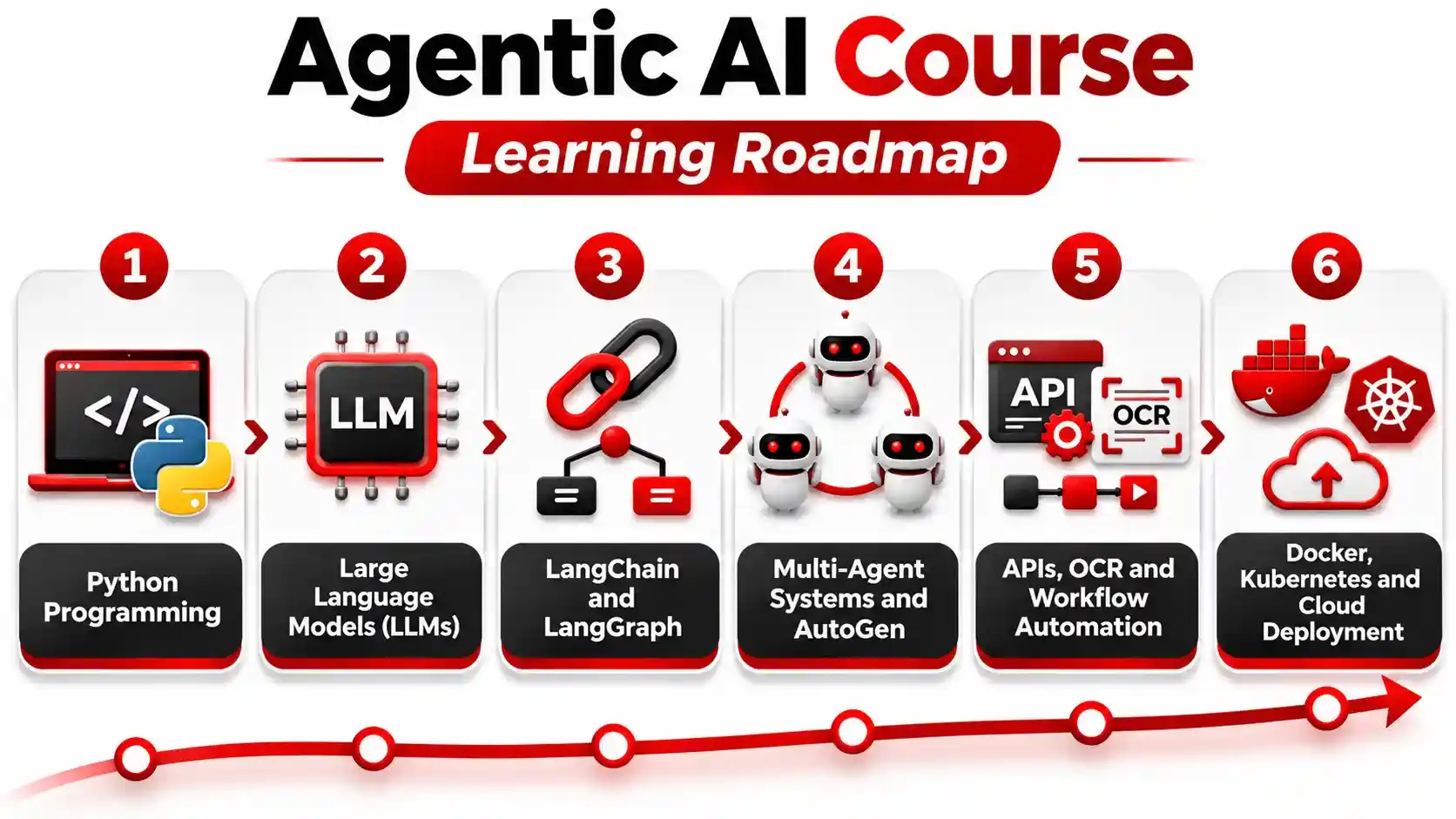
A well-structured Agentic AI curriculum should combine programming foundations, LLM concepts, agent frameworks, practical implementation and deployment knowledge. Learning only how to write prompts is not enough to build reliable AI agents.
Here are the major learning areas to look for.
1. Python for AI and Automation
Python is an important foundation for building AI applications and connecting different system components. Learners should understand how to write reusable code, work with data and integrate external services.
Common topics include:
- Python syntax, data types and control flow
- Functions, modules and object-oriented programming
- File handling and exception handling
- APIs, JSON and REST API consumption
- Asynchronous programming fundamentals
- Libraries such as NumPy and Pandas
- Introduction to FastAPI
These concepts help learners build the programming foundation required for AI workflows and automation.
2. Understanding LLMs and the Agentic AI Ecosystem
Large language models provide the language understanding and generation capabilities used by many AI agents. A course should explain how LLMs interact with tools, instructions and workflow components.
Important concepts include:
- How large language models work at an application level
- The relationship between LLMs and autonomous agents
- Agent roles, tasks and workflows
- Prompt design and structured outputs
- Tool calling and external integrations
- An overview of model platforms such as OpenAI, Azure OpenAI and AWS Bedrock
Understanding this ecosystem helps learners see how an AI model becomes part of a larger application rather than functioning as an isolated chatbot.
3. LangChain and LangGraph
Frameworks help developers connect language models with tools, data sources and application logic.
LangChain provides components for working with models, prompts, tools and memory. LangGraph supports the design of stateful, multi-step workflows in which different nodes perform tasks and transitions determine what happens next.
A practical learning path may include:
- Working with chains, tools and memory
- Understanding LangGraph architecture
- Nodes, edges and graph states
- Conditional transitions and workflow loops
- Context management across multiple steps
- Building simple agent workflows
- Testing individual workflow components
These concepts are useful when developing agents that need to follow a structured process instead of generating a one-time response.
4. Multi-Agent Systems with AutoGen and LangGraph
Some tasks are easier to manage by dividing responsibilities among multiple agents. A multi-agent system may include a researcher, a data analyst and a reviewer, each assigned a specific role.
An Agentic AI course may introduce frameworks such as AutoGen and explain how agents can communicate and coordinate tasks.
Learners can explore:
- Creating custom agents with defined roles
- Setting up communication between agents
- Building helper and supervisor agents
- Assigning tasks dynamically
- Combining AutoGen and LangGraph
- Managing errors and edge cases in multi-agent workflows
The objective is to understand how multiple AI components can collaborate while maintaining a controlled workflow.
5. APIs, OCR and Document Processing
Many business processes involve extracting information from documents and transferring it into structured systems. Agentic AI can help coordinate these steps.
A curriculum may cover:
- Reading and processing document inputs
- OCR fundamentals
- Extracting text from scanned documents and images
- Validating extracted information
- Connecting OCR tools with agent workflows
- Producing structured JSON or spreadsheet outputs
Tools such as Azure AI Vision, AWS Textract and Tesseract can be introduced as part of document-processing workflows.
6. Testing, Deployment and Cloud Infrastructure
Building an AI agent is only one part of application development. A practical system also needs testing, deployment, monitoring and maintenance.
A comprehensive curriculum may introduce:
- Docker and containerisation
- Docker Compose for multi-service applications
- Kubernetes fundamentals
- Azure and AWS deployment
- CI/CD workflows
- API security and key management
- Logging, monitoring and observability
- Rate limits, retries and error handling
- Performance and cost optimisation
These topics help learners understand the engineering considerations involved in moving an AI workflow from a development environment towards a production setup.
Real-World Project Examples in Agentic AI Training
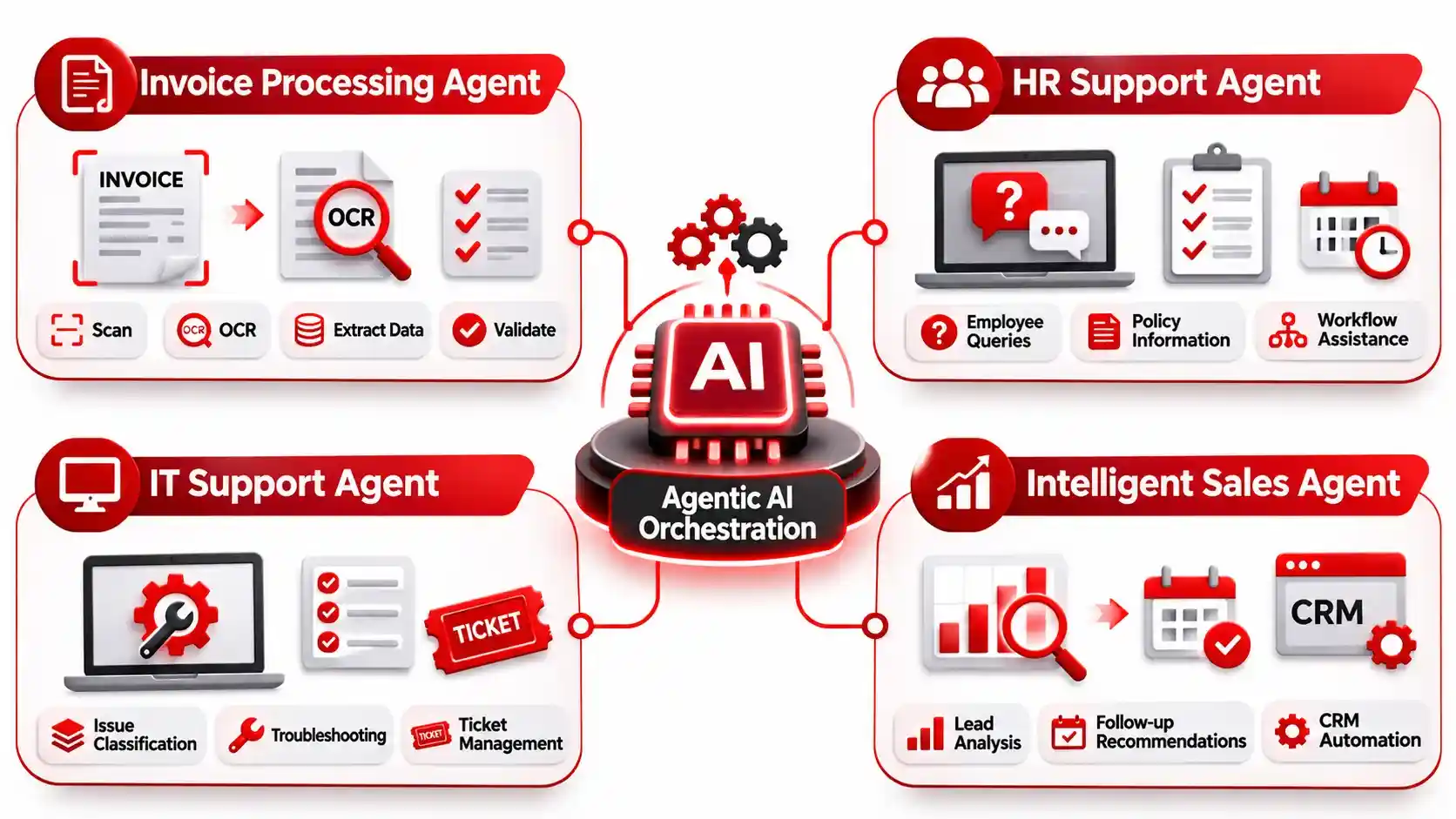
Projects help learners connect theoretical concepts with practical implementation. Instead of studying frameworks separately, learners can apply them to business scenarios that involve multiple steps, decisions and integrations.
Here are some examples of project types that can be explored during Agentic AI training.
1. Autonomous HR Support Agent
An HR support agent can be designed to understand employee queries, identify the relevant process and guide or trigger appropriate workflow steps.
A project may involve:
- Understanding employee intent
- Categorising HR requests
- Retrieving relevant policy information
- Connecting with workflow tools
- Escalating requests that need human approval
This type of project demonstrates how AI agents can support repetitive HR processes while keeping important decisions under human supervision.
2. Intelligent IT Support Agent
An IT support agent can help organise and process common technical support requests.
Possible project components include:
- Understanding reported technical issues
- Classifying incidents by type or priority
- Retrieving troubleshooting information
- Suggesting or initiating approved resolution steps
- Recording actions and escalating unresolved cases
This project introduces learners to tool integration, decision workflows and controlled automation.
3. AI-Powered Invoice Processing Agent
Invoice processing is a useful example of a multi-step AI workflow because it involves document reading, information extraction, validation and structured output.
A project can include:
- Uploading an invoice document
- Extracting text through OCR
- Identifying invoice numbers, dates and amounts
- Validating required fields
- Flagging missing or inconsistent information
- Generating structured JSON or Excel output
This scenario can help learners understand how OCR, Python, LangGraph and validation logic work together.
4. Intelligent Sales Assistant
A sales assistant can be designed to support lead-related tasks and organise follow-up workflows.
Possible features include:
- Analysing incoming lead information
- Categorising leads based on defined criteria
- Preparing follow-up suggestions
- Coordinating tasks between different agents
- Updating connected systems after approval
This type of project demonstrates how AI agents can support business teams through structured information processing and workflow automation.
5. Multi-Agent Research Workflow
A multi-agent research system can divide a complex research task into smaller responsibilities.
For example, one agent may collect information, another may organise findings, and a third may review the output for missing details.
Learners can explore:
- Analysing incoming lead information
- Categorising leads based on defined criteria
- Defining agent responsibilities
- Coordinating task execution
- Sharing context between agents
- Reviewing generated results
- Handling incomplete or conflicting information
- Coordinating tasks between different agents
- Updating connected systems after approval
The project helps demonstrate agent collaboration and workflow orchestration.
Note: These are illustrative project scenarios. Actual project scope, integrations and implementation requirements depend on the learning environment and available tools.
Why Practical Projects Matter in Agentic AI Learning
Agentic AI development involves more than connecting an LLM to an application. Developers need to understand how agents behave when information is incomplete, a tool fails or a workflow produces an unexpected result. Practical projects provide opportunities to work through these challenges.
A useful project should help learners understand:
- Problem definition: What task should the agent complete?
- Workflow design: Which steps should happen, and in what order?
- Tool integration: Which APIs or services are required?
- Validation: How can the output be checked?
- Error handling: What should happen when a step fails?
- Human oversight: Which actions need approval?
- Deployment: How can the application be tested and hosted?
A project that includes testing and deployment can demonstrate a broader understanding of AI application development than a simple chatbot demonstration.
Career Scope After Learning Agentic AI
As organisations explore AI-powered automation and intelligent workflows, professionals with skills in Python, LLM applications, APIs and agent orchestration may find opportunities across different technical and business functions.
Career outcomes depend on prior experience, programming knowledge, project quality and the requirements of individual employers. An Agentic AI course does not automatically guarantee a particular job role, but it can help learners develop relevant technical capabilities.
Some roles connected with this skill set include:
Agentic AI Engineer
An Agentic AI Engineer works on designing and developing AI agents that can perform tasks through models, tools and structured workflows. Relevant skills may include Python, LLM integration, APIs and agent frameworks.
AI Workflow Architect
An AI Workflow Architect focuses on designing how different AI components, tools and business processes work together. Workflow orchestration, system design and integration knowledge can be useful in this role.
Autonomous Systems Developer
An Autonomous Systems Developer works on applications that can perform defined tasks with limited manual intervention. This may involve agent logic, automation, APIs, testing and deployment.
AI Agent Product Manager
An AI Agent Product Manager connects business requirements with AI product development. The role may involve defining use cases, prioritising features, coordinating technical teams and evaluating product performance.
The exact responsibilities and required qualifications vary by organisation.
Is an Agentic AI Course Suitable for Working Professionals?
Yes, Agentic AI learning can be relevant to working professionals who want to understand how intelligent automation can be applied in their existing domain.
The learning path may differ depending on a person's current role.
- Software developers: Can explore Python, LLM integration, agent frameworks and application deployment.
- IT professionals: Can study IT support automation, workflow orchestration and system integrations.
- Business analysts: Can understand how business processes can be translated into AI-powered workflows.
- QA professionals: Can explore agent testing, output validation and scenario-based evaluation.
- Cloud and infrastructure professionals: Can build knowledge of containerisation, cloud deployment and monitoring.
- Operations and HR professionals: Can identify suitable automation use cases and understand how AI agents support business workflows.
Professionals without a strong programming background may need to spend additional time learning Python and API fundamentals before moving into advanced agent development.
What to Check Before Enrolling in an Agentic AI Course
Before choosing a programme, review its curriculum and practical learning structure rather than relying only on the course title.
Consider these points:
- Programming foundation: Does the course cover Python, APIs and JSON?
- LLM concepts: Does it explain how language models are integrated into applications?
- Agent frameworks: Does it include practical exposure to frameworks such as LangChain, LangGraph or AutoGen?
- Multi-agent workflows: Will you understand how multiple agents coordinate tasks?
- Hands-on projects: Are projects based on meaningful business scenarios?
- Testing and deployment: Does the curriculum include validation, error handling and cloud deployment?
- Learning support: Are assignments, recordings, feedback or doubt-resolution options available?
- Career preparation: Does the programme offer guidance for resumes, portfolios and interviews?
A clear curriculum and practical implementation opportunities can help learners make a more informed decision.
Explore the Master in Agentic AI Programme at TechPratham
For learners looking for structured training in applied and Agentic AI, TechPratham offers a Master in Agentic AI programme designed around AI application development, autonomous agents and practical implementation. The programme is listed as an advanced-level course with an eight-week duration. Its curriculum includes Python for AI and automation, the LLM ecosystem, LangChain, LangGraph, AutoGen, multi-agent workflows, OCR-based document processing and agent behaviour tuning. The programme also covers technical areas such as Docker, Kubernetes, Azure and AWS deployment, CI/CD, logging, monitoring and production-oriented system considerations.
Its training plan lists module-wise assignments and MCQs, session recordings, learning materials, project work, resume-building guidance and interview preparation. The course page also describes project scenarios involving HR support, IT support, sales workflows and process automation. Learners can review the detailed syllabus, training plan and project information before deciding whether the programme matches their experience and learning goals.
Explore the Agentic AI Online Course to understand its curriculum and available learning support.
Final Thoughts
Agentic AI is an evolving area of AI application development, bringing together language models, programming, APIs, workflow orchestration and automation. Learning these concepts requires more than understanding how to write prompts. It involves designing workflows, integrating tools, testing agent behaviour and considering how applications operate in real environments.
A well-planned Agentic AI course can help learners build this foundation through structured modules and practical projects. Whether you are a developer, IT professional, business analyst or someone exploring a transition into AI, focus on developing skills that you can demonstrate through working projects.
The most valuable learning outcome is not simply knowing the names of AI frameworks. It is understanding how to use them to solve practical problems responsibly and reliably.
Frequently Asked Questions
1. What is included in an Agentic AI course?
Ans: An Agentic AI course may cover Python, large language models, prompt engineering, APIs, agent frameworks, multi-agent systems, workflow orchestration, testing and deployment. The exact curriculum varies by programme.
2. Do I need Python to learn Agentic AI?
Ans: Python is useful for building AI agents and integrating tools. Learners with limited programming experience should start with Python fundamentals, functions, APIs and JSON before moving into advanced agent development.
3. Which frameworks are used in Agentic AI development?
Ans: Commonly discussed frameworks include LangChain, LangGraph and AutoGen. The choice depends on the application, workflow requirements and development approach.
4. What projects can I build after Agentic AI training?
Ans: Possible projects include invoice-processing agents, HR support assistants, IT support workflows, sales assistants and multi-agent research systems. Project complexity depends on your programming skills and implementation experience.
5. Is Agentic AI useful for working professionals?
Ans: Yes. Developers, IT professionals, business analysts, QA engineers and cloud professionals can explore Agentic AI applications relevant to their existing roles. The learning path should match their technical background.
6. What is the difference between Generative AI and Agentic AI?
Ans: Generative AI focuses on creating content such as text, images or code in response to instructions. Agentic AI focuses on completing goals through planning, tool usage and coordinated actions. Agentic systems may use generative AI models as part of their workflow.
7. Does an Agentic AI course include deployment?
Ans: Some advanced programmes include deployment topics such as Docker, Kubernetes, cloud platforms, CI/CD and monitoring. Always review the syllabus to confirm the level of practical coverage.
8. What career roles are related to Agentic AI?
Ans: Related roles may include Agentic AI Engineer, AI Workflow Architect, Autonomous Systems Developer and AI Agent Product Manager. Job requirements differ based on the organisation and role.
9. Can beginners enrol in an advanced Agentic AI programme?
Ans: Beginners can explore the subject, but an advanced programme may require additional preparation in Python, programming logic and APIs. Reviewing the prerequisites and curriculum before enrolment is recommended.
10. How long does it take to learn Agentic AI?
Ans: The learning timeline depends on your existing programming knowledge, study time and project complexity. A structured course can provide a learning roadmap, but developing confidence through practice requires continued experimentation and project work.
Related Articles

Agentic AI
How to Learn Agentic AI: Skills, AI Agent Projects and Training Guide
Learn how to build AI agents through essential skills, practical projects, tools and a structured Agentic AI training roadmap.

Agentic AI
How to Choose the Right AI Training in India: Skills, Certification and Online Learning Guide
Explore AI Training in India, essential AI skills, certification options, practical projects and online learning pathways for career development.