Best Data Science Courses in India: A Complete Guide
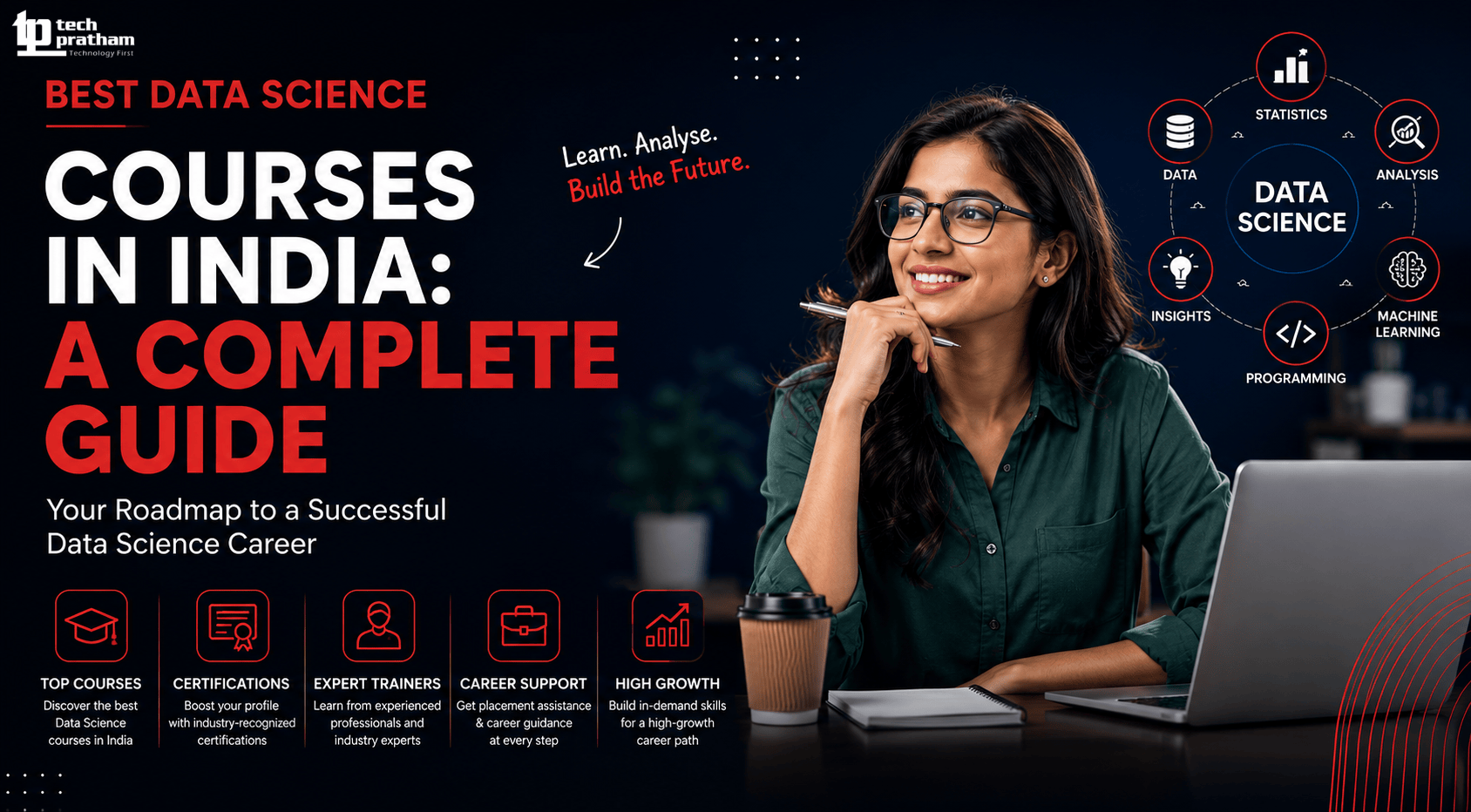
Data science has become one of the most sought-after career fields in India. As businesses increasingly depend on data to make decisions, professionals who can collect, analyze, interpret, and model data are in high demand across industries such as IT, finance, healthcare, e-commerce, manufacturing, telecommunications, and consulting. For students, fresh graduates, working professionals, and even people looking to transition from another career, choosing the right data science program can be an important step toward building relevant technical and analytical skills. However, with so many programs available, selecting the Best Data Science Course in India can be challenging. A good course should go beyond teaching programming or theoretical concepts. It should provide a structured understanding of statistics, Python, data analysis, machine learning, visualization, databases, and real-world problem-solving. Depending on your career goals, you may also want exposure to artificial intelligence, deep learning, natural language processing, cloud platforms, and MLOps. This guide explains what to look for when comparing the Best Data Science Courses in India, the skills you can learn, different learning formats, career opportunities, and how to select a program that matches your goals.
What Is Data Science?
Data science is an interdisciplinary field that combines statistics, mathematics, programming, analytical techniques, and domain knowledge to extract meaningful insights from structured and unstructured data.
A data science professional may work with large datasets to identify trends, build predictive models, automate analytical processes, or support business decisions. For example, an e-commerce company can use data science to recommend products, while a financial organization can use predictive analytics to identify potentially fraudulent transactions.
Because the field combines several disciplines, a comprehensive Data Science Course in India generally covers multiple areas instead of focusing on only one technology.
Some of the core areas include:
- Python programming
- Statistics and probability
- Data cleaning and preprocessing
- Exploratory data analysis
- SQL and database concepts
- Data visualization
- Machine learning
- Feature engineering
- Predictive analytics
- Deep learning
- Natural language processing
- Generative AI concepts
- Model evaluation
- Deployment and MLOps
- Real-world projects
Why Learn Data Science in India?
India has developed a large technology and analytics ecosystem, creating opportunities for professionals with data-related skills. Organizations of different sizes are using data to improve customer experiences, optimize operations, understand markets, manage risks, and develop technology products. This has increased interest in structured learning programs that combine technical knowledge with practical application.
Another advantage of learning data science is that the skills are transferable across industries. A professional with strong analytical and technical capabilities can potentially work in sectors such as:
- Information technology
- Banking and financial services
- Healthcare
- Retail
- E-commerce
- Telecommunications
- Manufacturing
- Logistics
- Consulting
What Should You Look for in the Best Data Science Course in India?
Not every data science program has the same curriculum, learning methodology, or level of practical exposure. Before enrolling, it is useful to compare programs based on several factors.
1- Comprehensive Curriculum
The curriculum should cover the fundamentals before moving toward advanced topics. Beginners should ideally learn Python, statistics, data manipulation, SQL, and visualization before progressing to machine learning and advanced analytics. A structured curriculum makes it easier to understand how different concepts connect.
2- Python Programming
Python is widely used in data analysis and machine learning because of its extensive ecosystem of libraries and relatively accessible syntax. A strong course should cover Python fundamentals as well as libraries commonly used for data work, such as NumPy, Pandas, Matplotlib, and other relevant tools. You should understand how to:
- Work with variables and data structures
- Write functions
- Handle files and datasets
- Manipulate data
- Work with arrays and dataframes
- Perform basic statistical analysis
- Visualize information
3- Statistics and Probability
Statistics is one of the foundations of data science. Without understanding statistical concepts, it can be difficult to interpret datasets or evaluate machine learning results correctly.
Important concepts can include:
- Descriptive statistics
- Mean, median, and mode
- Variance and standard deviation
- Probability
- Distributions
- Sampling
- Correlation
- Hypothesis testing
- Confidence intervals
4- SQL and Database Skills
Data scientists frequently work with databases, making SQL an important skill. A good program should introduce learners to queries, filtering, sorting, joins, grouping, aggregation, subqueries, and other database operations. SQL knowledge can also be useful when working with business intelligence teams, data engineers, analysts, and application databases.
5- Data Cleaning and Exploratory Data Analysis
Real-world data is rarely perfect. It may contain missing values, duplicate records, inconsistent formats, incorrect entries, or outliers. Therefore, students should learn how to prepare datasets before building models.
Exploratory data analysis helps professionals understand patterns, relationships, distributions, and potential problems within data.
6- Data Visualization
Being able to communicate findings is just as important as finding them. A data science program should teach learners how to present analytical results through meaningful visualizations. Depending on the curriculum, this may involve Python visualization libraries and business intelligence tools.
7- Machine Learning
Machine learning is a major component of modern data science. A comprehensive program should introduce both supervised and unsupervised learning concepts. Common topics include:
- Linear regression
- Logistic regression
- Decision trees
- Random forests
- Support vector machines
- K-nearest neighbors
- Clustering
- Dimensionality reduction
- Ensemble methods
Learners should also understand concepts such as overfitting, underfitting, training and testing datasets, cross-validation, and performance metrics.
Data Science Certification Training in India
For learners who prefer a structured learning path, Data Science Certification Training in India can provide a systematic approach to acquiring technical skills. Certification can demonstrate that a learner has completed a particular program or assessment, but it should not be the only factor used to evaluate a data Science course.
Before choosing certification-oriented training, check:
- Curriculum depth
- Practical assignments
- Projects
- Trainer experience
- Learning format
- Assessment methodology
- Tools covered
- Support provided
The actual skills gained through the program are often more important than the certificate itself. Employers typically evaluate candidates based on their technical understanding, projects, problem-solving ability, communication skills, and relevant experience.
Data Science Course in India: Beginner to Advanced Learning
A good Data Science Course in India should ideally provide a gradual learning path.
Beginner Level
Beginners can start with:
- Python fundamentals
- Basic statistics
- SQL
- Data handling
- Data visualization
- Introduction to machine learning
At this stage, the objective is to develop a strong foundation.
Intermediate Level
Once the fundamentals are clear, learners can move into:
- Advanced Pandas
- Statistical analysis
- Feature engineering
- Machine learning algorithms
- Model evaluation
- Advanced SQL
- Business analytics
Advanced Level
Advanced learners may explore:
- Deep learning
- Neural networks
- Natural language processing
- Computer vision
- Generative AI
- Model deployment
- Cloud-based machine learning
The right level depends on your existing knowledge and career objective.
Data Science Certification Course: Is It Worth It?
A Data Science Certification Course can be useful when it provides structured learning and practical exposure. It may also help learners demonstrate their commitment to professional development. However, certification alone does not make someone a data scientist.
A stronger approach is to combine certification with:
- Strong programming fundamentals
- Statistical understanding
- Machine learning knowledge
- Practical projects
- Portfolio development
- Problem-solving skills
- Communication abilities
For example, a learner who has completed several projects involving customer segmentation, sales forecasting, fraud detection, or recommendation systems may be able to demonstrate their practical understanding more effectively than someone who has only completed theoretical coursework.
Online Data Science Course vs Classroom Training
Learners today can choose between classroom-based and online programs. Both formats have advantages.
Online Data Science Course
An Online Data Science Course can be suitable for working professionals, students, and learners who prefer flexible schedules for Learning. Potential advantages include:
- Flexible learning
- Remote accessibility
- Recorded sessions in some programs
- Ability to learn from different locations
- Easier integration with work or college schedules
- Flexible learning
- Remote accessibility
- Recorded sessions in some programs
- Ability to learn from different locations
- Easier integration with work or college schedules
However, online learners need consistency and self-discipline.
Classroom-Based Training
Classroom learning can offer direct interaction with instructors and other students. It may be particularly useful for beginners who prefer guided learning and immediate clarification of doubts.
When comparing classroom programs, consider the teaching methodology, practical sessions, batch size, project work, and accessibility.
Importance of Hands-On Projects
Projects are one of the most important parts of practical data science learning. Instead of simply studying algorithms, learners should work with datasets and solve problems that resemble real business scenarios. Potential project areas include:
1- Customer Churn Prediction
Build a model that predicts whether customers may leave a service based on historical customer behavior.
2- Sales Forecasting
Analyze historical sales data and develop a model to estimate future sales trends.
3- Customer Segmentation
Use clustering techniques to group customers according to characteristics such as purchasing behavior, engagement, or spending patterns.
4- Fraud Detection
Analyze transaction-related data to identify patterns that may indicate potentially fraudulent activity.
5- Recommendation Systems
Explore how data can be used to recommend products, movies, courses, or other items based on user behavior.
Tools and Technologies Covered in Data Science Training
The technology stack can vary between programs, but learners should look for exposure to commonly used tools.
Programming
- Python
- SQL
- Basic command-line concepts
Python Libraries
- NumPy
- Pandas
- Matplotlib
- Scikit-learn
Databases
- MySQL
- PostgreSQL
- Other relational database systems
Machine Learning
- Scikit-learn
- Relevant machine learning frameworks
Visualization
Courses may introduce visualization libraries and business intelligence platforms depending on their curriculum. The objective should be to understand the principles behind these technologies rather than simply collecting a long list of tools.
Who Can Join a Data Science Course?
Data science is not limited to computer science graduates. Depending on the program requirements, learners can come from backgrounds such as:
- Computer science
- Information technology
- Engineering
- Mathematics
- Statistics
- Economics
- Business
- Finance
- Science
- Other analytical disciplines
Non-technical learners may need additional time to develop programming and mathematical foundations. That is not necessarily a barrier, but they should choose a course that starts with fundamentals. Working professionals from software development, testing, business analysis, finance, operations, and other analytical roles may also consider data science as part of a career transition or skill expansion.
Career Opportunities After Data Science Training
Data science skills can support several career paths.
Data Scientist
Data scientists work on analyzing data, developing predictive models, experimenting with machine learning techniques, and communicating findings.
Data Analyst
Data analysts focus heavily on data preparation, reporting, visualization, business analysis, and identifying trends.
Machine Learning Engineer
Machine learning engineers generally focus on developing, deploying, and maintaining machine learning systems.
Business Analyst
Professionals with strong analytical skills can also pursue business-focused roles where data supports decision-making.
AI and Machine Learning Roles
With additional specialization, learners can explore areas such as artificial intelligence, deep learning, NLP, computer vision, and generative AI.
How to Choose the Best Data Science Course for Your Career Goals
Choosing the Best Data Science Course in India should begin with understanding your current level and desired career path.
Ask yourself:
Are you a beginner?
Choose a program that starts with Python, statistics, SQL, and data analysis rather than assuming advanced programming knowledge.
Are you a working professional?
An online or flexible program may be more convenient if you need to balance learning with your job.
Do you already know Python?
You may prefer a program that spends less time on programming basics and provides greater depth in machine learning, advanced analytics, or AI.
Are you planning a career transition?
Look for a curriculum that includes projects and practical assignments so you can build a portfolio while learning.
Are you interested in AI?
Consider advanced modules covering deep learning, NLP, computer vision, generative AI, and model deployment.
Common Mistakes to Avoid When Choosing a Course
Many learners focus heavily on promotional claims and overlook the actual curriculum. Avoid choosing a course solely because it promises:
- Guaranteed high salaries
- Extremely short completion times
- Instant job opportunities
- Hundreds of tools in one curriculum
- A certificate without practical assessment
You should also avoid programs that teach machine learning without explaining statistics and data preparation. Building models without understanding the underlying data can create significant gaps in practical knowledge.
Another common mistake is completing a course without building projects. Practical implementation is essential for developing confidence.
How to Build a Data Science Learning Roadmap
A simple roadmap can make your learning journey more organized.
Step 1: Learn Python
Start with programming fundamentals and gradually move toward data-oriented Python libraries.
Step 2: Learn Statistics
Understand descriptive statistics, probability, distributions, correlation, and hypothesis testing.
Step 3: Learn SQL
Practice extracting, filtering, joining, and aggregating data from databases.
Step 4: Learn Data Analysis
Use Python to clean datasets, explore patterns, and generate insights.
Step 5: Learn Visualization
Practice presenting analytical results through appropriate charts and dashboards.
Step 6: Learn Machine Learning
Study algorithms, model training, evaluation, feature engineering, and optimization.
Step 7: Build a Portfolio
Document your projects and explain the problem, methodology, results, and business implications.
Step 8: Prepare for Interviews
Practice Python, SQL, statistics, machine learning concepts, case studies, and project-based questions.
Frequently Asked Questions
Which is the Best Data Science Course in India?
The best course depends on your background, learning objectives, budget, schedule, curriculum preferences, and career goals. Rather than selecting a program solely by its name, compare the syllabus, practical projects, instructor expertise, learning format, and overall structure.
Is a Data Science Certification Course enough to get a job?
A certification can demonstrate course completion, but it is generally not enough by itself. Employers may also evaluate programming, SQL, statistics, machine learning, projects, communication, and problem-solving skills.
Can beginners learn data science?
Yes. Beginners can learn data science by following a structured path that starts with programming, statistics, SQL, and data analysis before moving to machine learning and advanced topics.
Is an Online Data Science Course suitable for working professionals?
Yes. Online learning can be particularly convenient for professionals who need flexible schedules. However, learners should ensure that the program includes sufficient practical work and opportunities to clarify doubts.
Is Python necessary for data science?
Python is one of the most widely used programming languages for data science and machine learning. Learning Python can therefore be highly useful for aspiring data professionals.
Final Thoughts
For learners seeking structured development, Data Science Certification Training in India or a well-designed Data Science Certification Course can provide a roadmap for building these capabilities. Most importantly, remember that data science is not learned through a certificate alone. Continuous practice, project development, experimentation, and keeping up with emerging technologies are essential for long-term growth.
Related Articles

How to Switch Your Career to Data Science: A Pathway to a New Career
Learn how to switch your career to Data Science with the right skills, projects, AI knowledge, portfolio and career guidance.

Is Data Science a Good Career? A Complete Guide for Beginners
Is Data Science a good career? Explore career opportunities, skills, roadmap, AI impact, and practical guidance for beginners.





 +91-8882178896
 +1 (343) 477-0926