Workday Financials vs. SAP: A Comprehensive Comparison in 2026

In today’s rapidly evolving digital economy, organizations are constantly searching for financial management systems that are not only powerful but also flexible enough to adapt to modern business needs. With cloud technology transforming the way enterprises manage finance operations, two platforms often dominate the conversation: Workday Financials and SAP. Both solutions are widely used by global organizations to handle core financial processes such as accounting, reporting, compliance, and financial planning. But in 2026, as businesses prioritize real-time data, automation, and scalability, the question many decision-makers ask is: which platform truly delivers the best value for modern enterprises?
Workday Financials vs. SAP is more than just a comparison between two software systems—it represents a shift between next-generation cloud-native finance platforms and traditional enterprise ERP ecosystems evolving toward the cloud. While Workday Financials is known for its unified cloud architecture, real-time analytics, and user-friendly interface, SAP offers a robust and deeply integrated financial management framework trusted by large enterprises for decades. In this comprehensive 2026 comparison, we will explore the key differences between these two platforms, including their architecture, features, scalability, implementation, and business benefits, helping organizations and professionals understand which solution aligns best with their financial transformation goals.
Introduction to Workday Finance and SAP
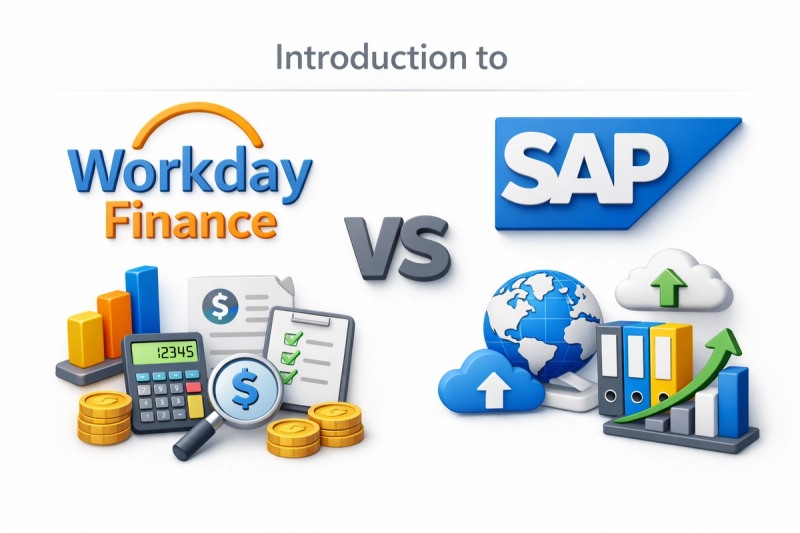
Workday Finance and SAP are two widely used financial management systems that help organizations manage their accounting, financial reporting, budgeting, and overall financial operations efficiently. In today’s digital business environment, companies need advanced financial software that can provide real-time insights, automation, and better control over financial data. Both Workday Finance and SAP offer powerful enterprise solutions designed to support businesses in managing complex financial processes while improving decision-making and operational efficiency.
Workday Financial Management, commonly known as Workday Finance, is a cloud-based financial system designed to provide a unified platform for finance, planning, and analytics. It allows organizations to manage core financial activities such as general ledger, accounts payable, accounts receivable, expense management, and financial reporting within a single cloud environment. One of the major advantages of Workday is its modern cloud-native architecture, which enables real-time data access, better integration with business processes, and a user-friendly interface that helps finance teams work more efficiently.
On the other hand, SAP is one of the most established enterprise resource planning (ERP) systems used by large organizations around the world. SAP provides comprehensive financial management capabilities through solutions such as SAP ERP and SAP S/4HANA Finance. These systems help businesses handle complex financial operations, regulatory compliance, risk management, and detailed financial analysis. With its strong industry presence and extensive customization options, SAP has been a trusted solution for enterprises that require a robust and scalable financial management platform.
Workday Finance vs SAP: Key Differences
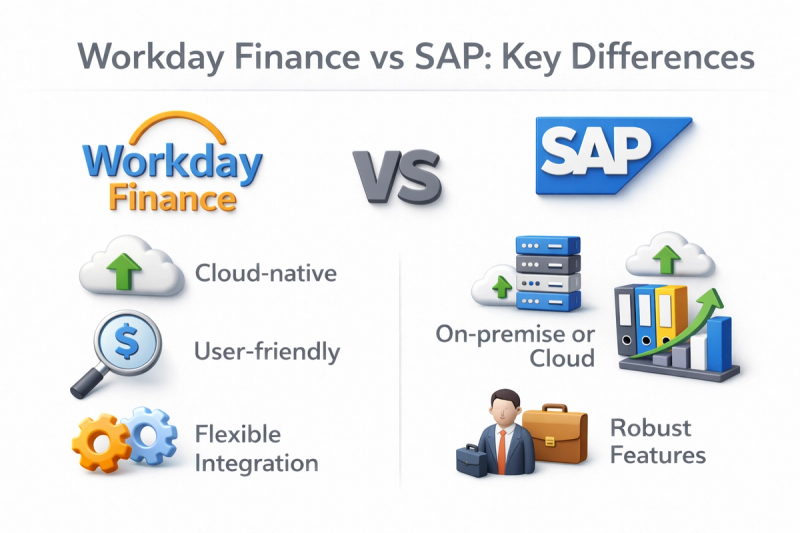
When comparing Workday Finance vs SAP, organizations often evaluate factors such as cloud architecture, scalability, user experience, and implementation complexity. Both platforms are powerful enterprise financial management systems, but they are designed with different technological approaches. Workday Finance is a cloud-native solution built specifically for modern enterprises that want real-time financial insights, automated workflows, and seamless integration across business functions. In contrast, SAP financial systems, including SAP S/4HANA Finance, provide a robust and highly customizable ERP framework that has been widely used by large enterprises for decades.
Another major difference between Workday Financials and SAP lies in deployment flexibility, reporting capabilities, and overall user experience. Workday focuses on a unified data model and intuitive interface, allowing finance teams to access real-time analytics and make faster business decisions. SAP, on the other hand, offers deep industry-specific functionalities and extensive configuration options, which can be beneficial for organizations with complex financial operations. Understanding these differences helps businesses choose the right ERP platform based on their operational needs, scalability requirements, and long-term digital transformation strategy.
Key Differences Between Workday Financials and SAP
- Deployment Model – Workday Financials is a fully cloud-native platform, while SAP supports cloud, hybrid, and on-premise deployments.
- User Interface – Workday offers a modern, intuitive user interface, whereas SAP systems can be more complex due to extensive customization.
- Real-Time Analytics – Workday provides real-time financial reporting and analytics through its unified data model, while SAP relies on powerful analytics tools integrated with its ERP system.
- Implementation Time – Workday implementations are generally faster, while SAP implementations can take longer due to complex configurations.
- Scalability and Integration – Both systems support large enterprises, but Workday is designed for seamless cloud integration, while SAP integrates deeply with existing enterprise ecosystems.
- Customization – SAP provides extensive customization options, while Workday focuses on standardized cloud updates and streamlined configurations.
Workday vs. SAP: Market Positioning & Market Domination
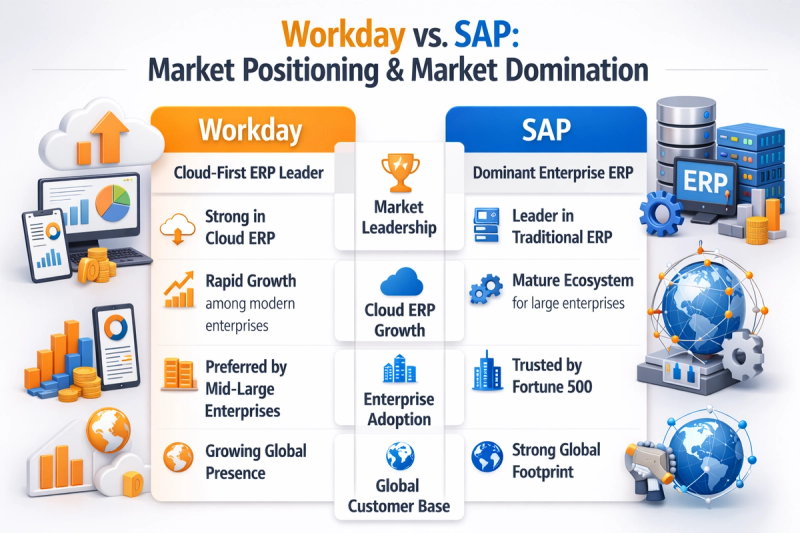
In the global enterprise resource planning (ERP) and financial management software market, both Workday and SAP have established strong positions but approach the market with different strategies. SAP has been a dominant force in enterprise software for decades and is widely recognized for its comprehensive ERP solutions used by large organizations worldwide. With a vast ecosystem of products, industry-specific solutions, and extensive integration capabilities, SAP has built a strong reputation among enterprises that require highly scalable and customizable financial management systems. Its long-standing presence in the market has allowed it to dominate many traditional ERP environments, particularly among large multinational companies.
Workday, in contrast, represents a newer generation of cloud-native ERP and financial management platforms. The company has positioned itself as a leader in modern cloud-based enterprise solutions by focusing on simplicity, real-time data processing, and seamless integration across finance, HR, and planning systems. Over the past decade, Workday has gained significant market traction among organizations undergoing digital transformation and looking to move away from traditional on-premise systems. As more businesses adopt cloud technologies and prioritize agile financial operations, Workday continues to strengthen its position as a major competitor to SAP in the enterprise financial software market.
Workday vs SAP: Cloud ERP Architecture Comparison
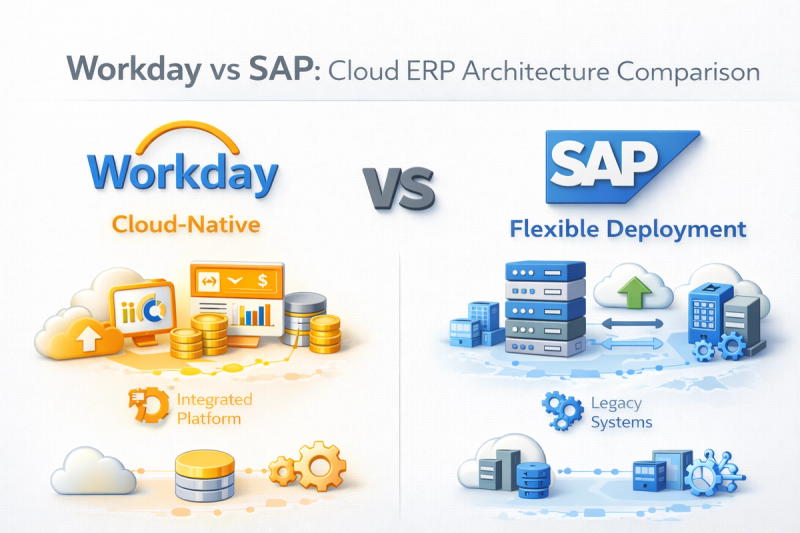
When comparing Workday vs SAP cloud ERP architecture, one of the biggest differences lies in how the platforms were originally designed. Workday is built as a cloud-native ERP system, meaning it was developed from the beginning to operate entirely in the cloud. This architecture allows organizations to access real-time financial and operational data from a unified system without relying on complex on-premise infrastructure. Workday uses a single data model and unified platform for finance, HR, and analytics, which helps businesses streamline processes, improve collaboration, and gain faster insights for decision-making.
SAP, on the other hand, offers a more flexible architecture that supports cloud, hybrid, and on-premise deployments. While traditional SAP ERP systems were initially designed for on-premise environments, modern solutions like SAP S/4HANA have expanded to support cloud-based deployments as well. SAP’s architecture is highly scalable and provides deep customization capabilities, making it suitable for large enterprises with complex operational requirements. However, due to its broad ecosystem and configuration options, SAP implementations can sometimes be more complex compared to the simplified and unified cloud approach used by Workday.
Workday vs SAP: User Experience and Interface
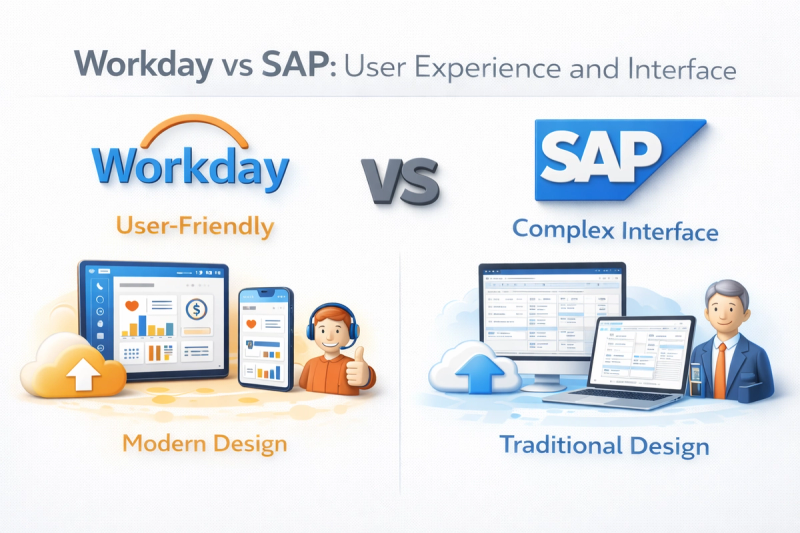
When comparing Workday vs SAP in terms of user experience and interface, one of the key differences lies in the design approach and ease of use. Workday is known for its modern and intuitive interface that focuses on simplicity and user accessibility. The platform provides a clean dashboard, easy navigation, and a consistent design across all modules such as finance, HR, and analytics. Because of its cloud-native architecture, users can easily access the system from different devices, including mobile and tablets. This user-friendly design helps organizations reduce training time and improves overall productivity for employees working with financial and operational data.
SAP, in contrast, offers a more complex interface due to its wide range of features and deep enterprise functionalities. While modern SAP solutions have introduced improved interfaces and better navigation, the system can still require more training for new users to fully understand its structure. However, this complexity also comes with strong customization capabilities and powerful tools that support large enterprises with highly detailed operational processes. As a result, SAP focuses more on flexibility and enterprise-level functionality, whereas Workday emphasizes simplicity, usability, and a streamlined user experience.
Which Companies Use Workday Financials and SAP?
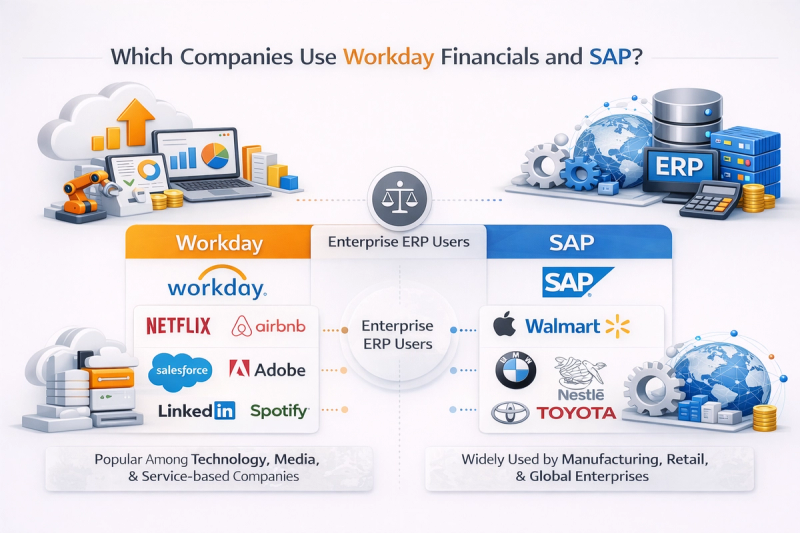
Many global organizations use Workday Financials and SAP ERP systems to manage their financial operations, accounting processes, and enterprise resource planning activities. These platforms are widely adopted by large enterprises because they provide advanced financial management, reporting, automation, and real-time analytics. Companies choose between Workday and SAP depending on factors such as business size, industry requirements, cloud strategy, and system complexity.
Companies That Use Workday Financials
Workday Financials is commonly used by organizations that prefer cloud-based financial management systems, especially in industries like technology, education, healthcare, and professional services. Some well-known companies that use Workday solutions include:
- Netflix
- Airbnb
- Spotify
- Salesforce
- Adobe
- AstraZeneca
- Target
These companies rely on Workday for real-time financial insights, cloud integration, and modern business process management.
Companies That Use SAP
SAP ERP is one of the most widely used enterprise software systems in the world and is commonly adopted by large multinational corporations with complex operations. Many global companies use SAP to manage finance, supply chain, and business processes. Examples include:
- Apple
- Walmart
- Microsoft
- BMW
- Nestlé
- Siemens
- Toyota
- ExxonMobil
SAP is particularly popular in industries such as manufacturing, automotive, retail, and energy, where businesses require highly scalable and customizable ERP systems.
Overall, Workday Financials is often preferred by modern cloud-focused organizations, while SAP is widely used by large enterprises with complex global operations and industry-specific requirements.
Conclusion
In conclusion, the comparison between Workday Financials and SAP highlights two powerful financial management platforms that serve different types of business needs in the modern enterprise environment. Workday Financials stands out as a modern cloud-native solution designed for organizations that prioritize real-time analytics, streamlined processes, and a user-friendly interface. Its unified platform for finance, HR, and analytics makes it a strong choice for companies that want to adopt cloud technology and improve operational efficiency through a simplified system architecture.
On the other hand, SAP continues to be a dominant enterprise ERP solution known for its deep functionality, scalability, and extensive customization capabilities. It is particularly suitable for large multinational organizations with complex business processes and industry-specific requirements. Ultimately, the choice between Workday Financials vs SAP depends on an organization’s size, operational complexity, and digital transformation strategy. Companies looking for a modern cloud-first financial system may find Workday more suitable, while enterprises requiring a highly configurable and comprehensive ERP ecosystem may benefit more from SAP’s powerful platform.
You Can Visit - Workday Training Course






 +91-8882178896
 +1 (343) 477-0926