
Guidewire Course Fees, Syllabus and Certification: What Learners Should Know Before Enrolling

Guidewire is used by insurance companies to support important operations such as policy administration, billing, and claims management. For learners interested in insurance technology, understanding the platform can be a useful step toward developing relevant technical or business skills. However, choosing a training program requires more than looking at its price or course title.
What Determines Guidewire Course Fees?
There is no single fee that applies to every Guidewire training program. A fundamentals course may have different requirements from a technical integration program or certification preparation. The total cost depends on the course structure and what the training provider includes.
When comparing Guidewire course fees in India, consider the following factors:
Rather than selecting a course based only on price, request a breakdown of the syllabus, schedule, support, and additional costs. This gives you a clearer basis for comparing different programs.
What Should You Check Before Paying?
Before making a payment, confirm the total fee, number of teaching hours, course prerequisites, available study materials, and support arrangements. Ask whether practical exercises are included and whether recordings or revision sessions are available. If certification is important to you, clarify exactly what the course provides. A training program that prepares you for an examination is not necessarily the same as one that includes the official examination fee.
What Does the Guidewire Course Syllabus Cover?
The Guidewire course syllabus depends on the area you want to learn. Some programs focus on insurance business processes, while others cover technical integration, quality assurance, business analysis, or certification preparation. TechPratham offers seven learning options covering these areas. Understanding their differences can help you select a course based on your existing knowledge and the skills you want to develop.
These are general learning areas, not a guarantee that every topic is included in every course. Review the actual curriculum before enrolling.
PolicyCenter, BillingCenter and ClaimCenter
These three applications address different aspects of insurance operations.
PolicyCenter focuses on policy administration, including processes associated with policy creation, changes, and renewals. Learners interested in policy-related workflows can explore Guidewire PolicyCenter & Fundamentals to understand how these activities are managed within the application. BillingCenter relates to insurance billing operations. Depending on the curriculum, Guidewire BillingCenter & Fundamentals may introduce billing accounts, invoicing, payment processing, and associated transactions.
Integration, Business Analysis and QA
Not every learner needs to focus on a single insurance application. Some roles require an understanding of how systems communicate, how business requirements are documented, or how software is tested.
Guidewire Integration & Web Services focuses on concepts related to connecting applications and exchanging data. Depending on the syllabus, this may include APIs, web services, integration patterns, and troubleshooting concepts. Guidewire BA Training is relevant to learners interested in requirements gathering, user stories, acceptance criteria, process documentation, and communication between business and technical teams.
Guidewire QA Training focuses on software quality and testing. Potential learning areas include test scenarios, test case preparation, functional testing, defect reporting, and regression testing.
Which Guidewire Course Is Right for You?
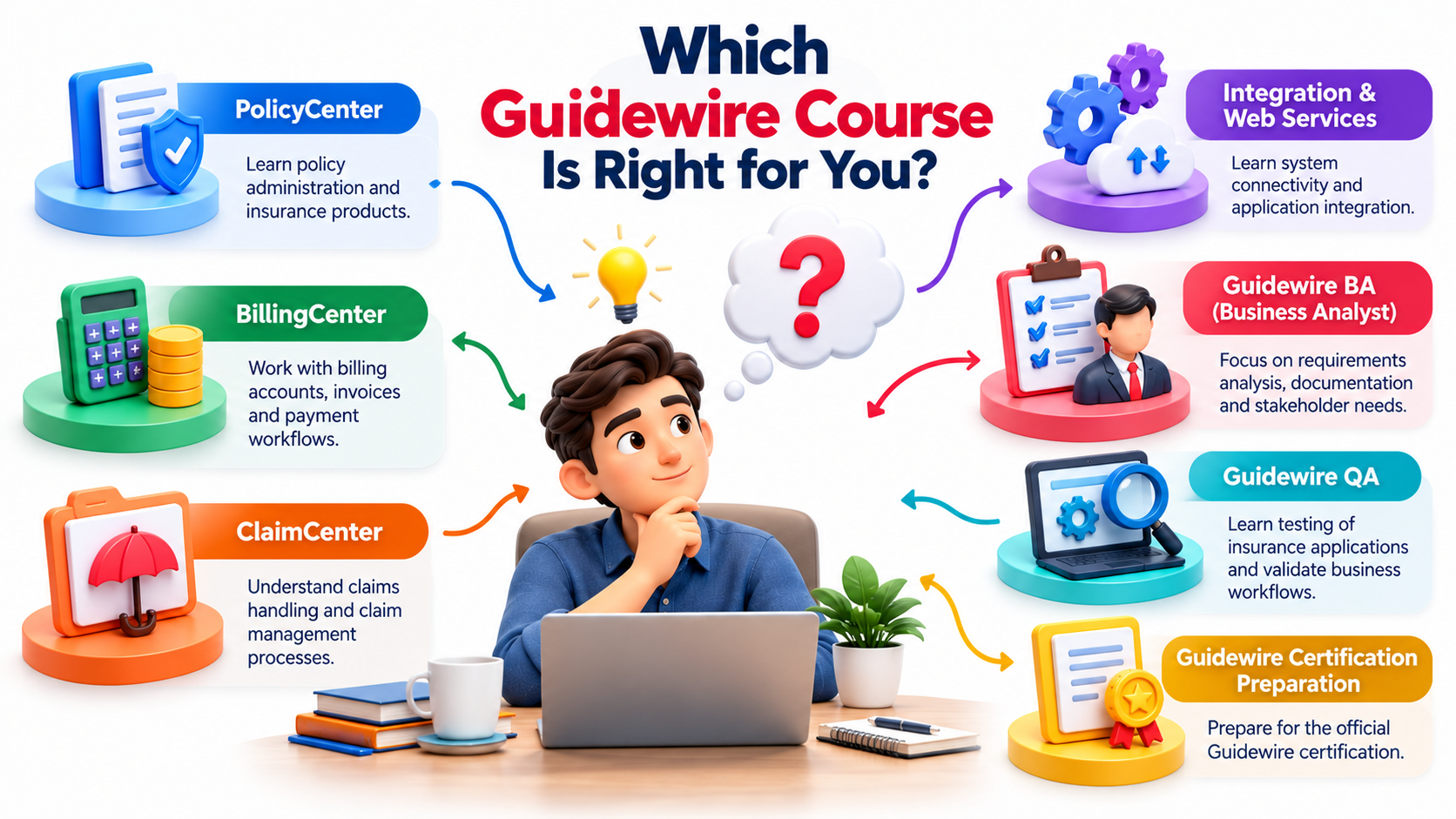
Choosing a Guidewire course becomes easier when you understand the skills covered in each program. PolicyCenter, BillingCenter, and ClaimCenter focus on different insurance operations, while Integration & Web Services covers system connectivity. Business Analyst and QA training follow different learning paths related to requirements analysis and software testing.
Learners who want to understand policy administration can start by exploring PolicyCenter fundamentals. BillingCenter is relevant for those interested in billing accounts, invoices, and payment workflows, whereas ClaimCenter focuses on claims handling. Those interested in connecting applications can consider Integration & Web Services.
For learners who prefer understanding business requirements, documentation, and stakeholder needs, Guidewire BA (Business Analyst) Training may be a suitable option. Similarly, Guidewire QA Training focuses on testing insurance applications and validating business workflows. Learners who already have relevant knowledge and want to prepare for an official credential can consider Guidewire Certification Preparation.
How Long Does Guidewire Training Take?
The time required to complete a course depends on its syllabus, teaching schedule, and the learner's background. A fundamentals program may have a different structure from a course covering integration concepts or certification preparation.
When reviewing Guidewire course duration, look beyond the number of calendar days. Consider the total teaching hours, frequency of sessions, time available for practice, and amount of revision required.
Working professionals may prefer schedules that fit around their existing responsibilities. Beginners may need extra time to become comfortable with insurance processes and application concepts.
Guidewire Certification: What Should You Know?
Certification is an important consideration for learners who want to validate their knowledge through an official credential. However, it is essential to distinguish between completing a training program and earning a certification.
Is the Certification Exam Included in the Course Fee?
How Can You Prepare Effectively?
Start by identifying the certification relevant to your learning goals. Review its official objectives, assess your current knowledge, and create a revision plan around the topics you need to strengthen. Practice exercises and structured revision can help you identify knowledge gaps. If you choose a preparation course, check whether it provides exam-focused guidance and relevant learning resources.
What to Check Before Enrolling in a Guidewire Course
A suitable training provider should offer a clear curriculum, transparent pricing, and learning arrangements that match your needs. Before enrolling, evaluate the course as a whole rather than relying only on promotional claims.
Explore Guidewire Training in India and Top Cities
Explore Guidewire training options in different cities to find a program that suits your learning needs.
Frequently Asked Questions
Conclusion
Choosing the right Guidewire course requires understanding the fees, syllabus, training format, and certification requirements. Before enrolling, compare the course content, practical learning opportunities, course duration, and trainer support to find a program that matches your learning goals and budget. It is also helpful to check the topics covered and clarify whether certification preparation or examination fees are included.
Whether you are interested in PolicyCenter, BillingCenter, ClaimCenter, Integration & Web Services, Business Analyst training, QA training, or certification preparation, select a course based on your interests and existing knowledge. Each learning path focuses on different skills used in insurance technology, so consider which area best fits your career plans.
Related Articles

How to Become a Guidewire Business Analyst: Skills and Learning Path
Learn how to become a Guidewire Business Analyst, develop essential skills, understand insurance workflows, and follow a practical learning path.

Top Guidewire Interview Questions and Answers
Guidewire interview questions and answers covering core concepts, configuration, Gosu, PolicyCenter, ClaimCenter, BillingCenter, and interview prepara





 +91-8882178896
 +1 (343) 477-0926