
Multi agent system with langgraph
Table of Contents
What if AI systems could collaborate, delegate tasks, and make decisions together—just like a real team? That’s exactly what a multi-agent system enables. Instead of relying on a single AI model to handle everything, multi-agent systems break complex problems into smaller tasks handled by specialized agents that communicate and coordinate with each other. This approach leads to smarter decision-making, better scalability, and more reliable outcomes, especially for complex, real-world workflows.
LangGraph makes building these multi-agent systems structured, controllable, and production-ready. By using a graph-based architecture, LangGraph allows developers to define how agents interact, share state, and move through workflows with clear rules and conditional logic. This makes it easier to design agentic AI systems that are transparent, scalable, and far more predictable than traditional autonomous agents—positioning LangGraph as a powerful framework for building next-generation multi-agent applications.
What Is a Multi-Agent System?
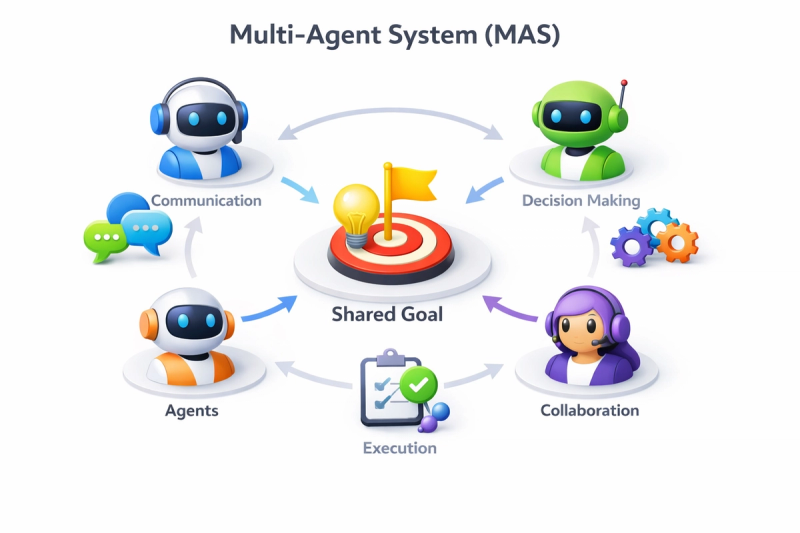
A multi-agent system (MAS) is an artificial intelligence framework where multiple autonomous agents interact with each other to achieve individual or shared goals. Each agent is designed to perceive its environment, make decisions, and take actions independently while collaborating with other agents through communication and coordination. By distributing responsibilities across specialized agents, multi-agent systems can solve complex problems more efficiently than traditional single-agent models.
One of the key advantages of a multi-agent system is its ability to handle complex, dynamic, and large-scale tasks. Agents can work in parallel, adapt to changes in real time, and continue functioning even if one agent fails. This makes multi-agent systems highly scalable and resilient, which is why they are widely used in agentic AI, robotics, supply chain optimization, smart grids, and enterprise workflow automation.
Multi-agent systems are especially valuable in modern AI applications where decision-making, collaboration, and autonomy are essential. By mimicking how human teams operate—delegating tasks, sharing feedback, and optimizing outcomes—MAS architectures enable more intelligent, flexible, and reliable AI solutions. As AI systems continue to evolve, multi-agent systems are becoming a foundational approach for building advanced, production-ready AI workflows.
Single-Agent vs Multi-Agent Systems
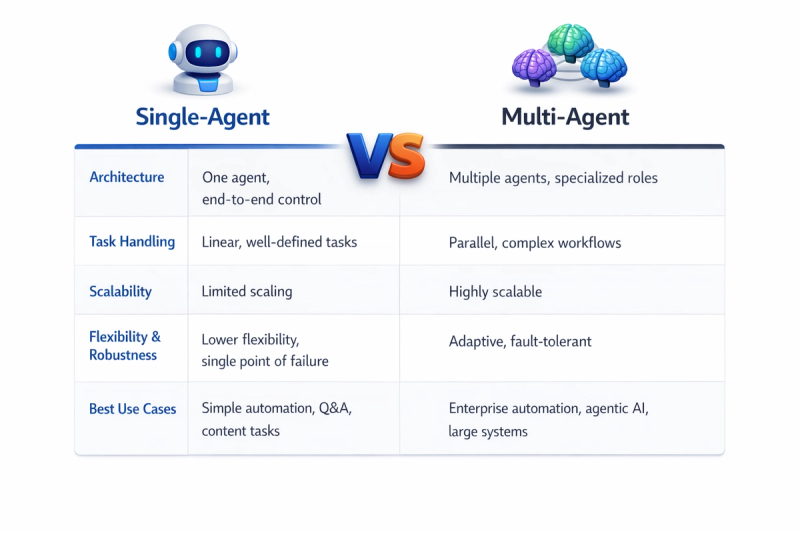
A single-agent system relies on one intelligent agent to perceive inputs, make decisions, and execute actions to complete a task. This agent handles the entire workflow end to end, making the system simpler to design, deploy, and maintain. Single-agent systems are effective for well-defined, linear tasks such as text generation, question answering, or simple automation where minimal coordination is required.
In contrast, a multi-agent system consists of multiple autonomous agents, each with a specialized role, working together to solve complex problems. These agents communicate, collaborate, and coordinate their actions to achieve shared objectives. Multi-agent systems excel in complex, dynamic environments where tasks can be parallelized, decisions require multiple perspectives, or workflows involve planning, execution, and validation steps.
The key difference between single-agent and multi-agent systems lies in scalability, flexibility, and fault tolerance. While single-agent systems are easier to implement and cost-effective for smaller use cases, they can become inefficient as task complexity grows. Multi-agent systems, on the other hand, offer greater robustness, adaptability, and performance by distributing responsibilities across agents—making them a preferred choice for agentic AI, enterprise automation, and large-scale AI applications
What Is LangGraph and Why It’s Built for Agent Workflows
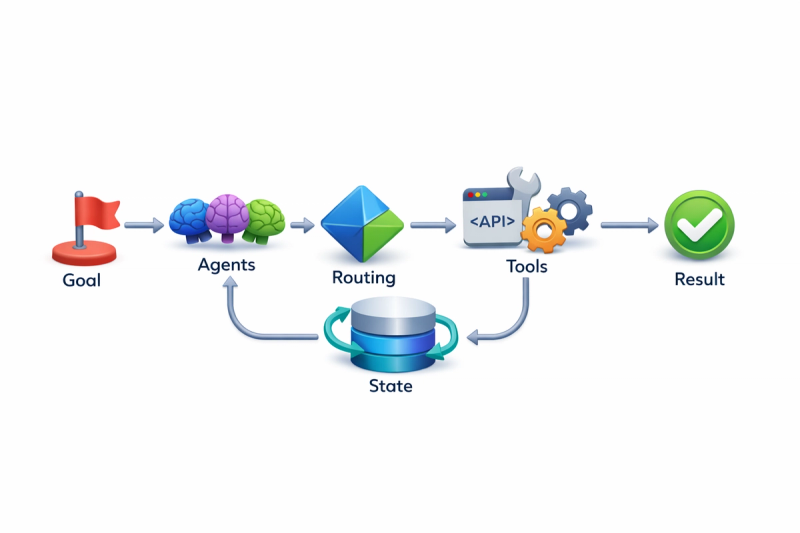
LangGraph is a powerful framework designed to build and manage AI agent workflows using a graph-based approach. Instead of relying on simple linear chains, LangGraph allows developers to model complex processes as interconnected nodes and edges, where each node represents an agent, tool, or decision point. This structure makes LangGraph especially effective for creating multi-agent systems that require coordination, state management, and clear execution logic, making it a natural fit for modern agentic AI applications.
LangGraph is built specifically for agent workflows because it gives developers precise control over how agents plan, act, and interact. It supports stateful execution, conditional routing, and feedback loops, enabling agents to make decisions based on previous steps and shared context. These capabilities help reduce unpredictable behavior often seen in autonomous AI systems and ensure workflows remain transparent, repeatable, and easier to debug.
By combining flexibility with structure, LangGraph makes it easier to build scalable, production-ready agent systems. Whether you are designing research assistants, enterprise automation pipelines, or collaborative AI agents, LangGraph provides the tools needed to orchestrate complex workflows reliably. Its focus on determinism, observability, and modular design makes LangGraph an ideal framework for teams looking to deploy robust AI agent solutions in real-world environments.
Why Use LangGraph for Multi-Agent Systems?
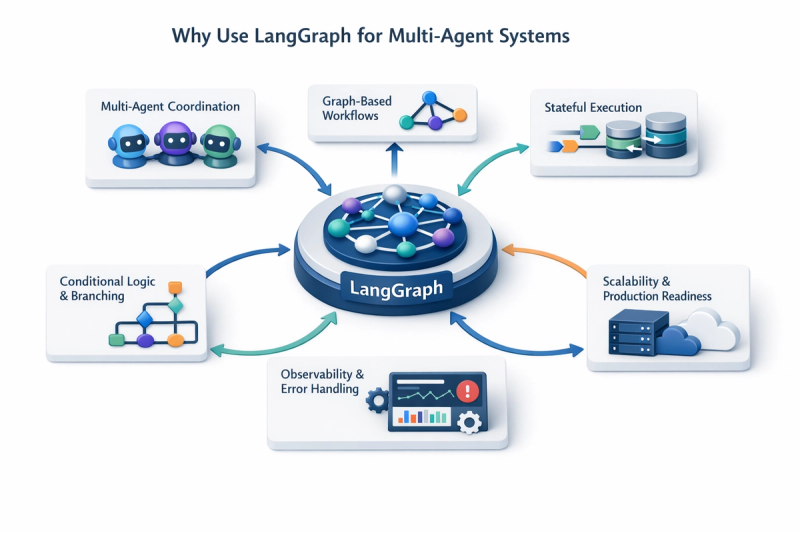
LangGraph is an ideal framework for building multi-agent systems because it provides a structured, graph-based approach to agent orchestration. In multi-agent environments, multiple AI agents must communicate, collaborate, and make decisions in a coordinated way. LangGraph enables developers to define these interactions clearly using nodes and edges, ensuring that agent workflows remain predictable, organized, and easy to manage—even as system complexity grows.
One of the key reasons to use LangGraph for multi-agent systems is its support for stateful execution and conditional logic. Agents can share context, pass intermediate results, and adjust their behavior based on previous outcomes. This allows multi-agent systems to handle dynamic scenarios such as feedback loops, retries, and branching workflows, which are difficult to manage with traditional linear pipelines or loosely connected agents.
Additionally, LangGraph is designed with scalability and production readiness in mind. It offers better observability, error handling, and control over agent autonomy, making it easier to debug and optimize multi-agent workflows. These capabilities make LangGraph a strong choice for building reliable agentic AI solutions in real-world applications such as enterprise automation, autonomous research, and collaborative decision-making systems.
Core Components of a Multi-Agent System in LangGraph
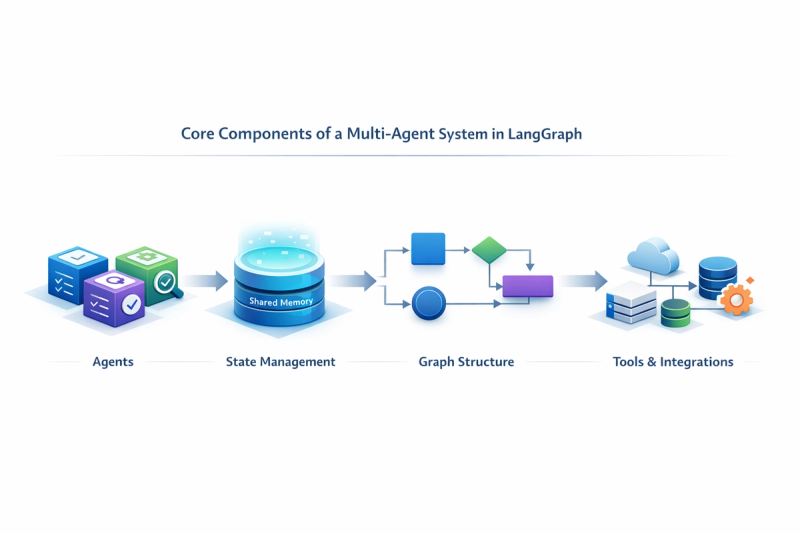
A multi-agent system in LangGraph is built on several core components that work together to enable intelligent collaboration, decision-making, and workflow orchestration. These components define how agents operate, communicate, and move through complex processes in a controlled and scalable way. Understanding these building blocks is essential for designing reliable and production-ready agentic AI systems using LangGraph.
Agents are the foundation of any multi-agent system in LangGraph. Each agent is typically powered by a large language model and assigned a specific role, such as planning, execution, analysis, or validation. LangGraph allows these agents to operate autonomously while still following predefined workflow rules, ensuring that each agent contributes effectively without causing unpredictable behavior.
Another critical component is state management and graph structure, which includes nodes, edges, and conditional routing. Nodes represent agents or actions, while edges define the flow of execution between them. LangGraph maintains shared state across agents, enabling context-aware decisions and smooth coordination. Together with tool integrations and error-handling mechanisms, these components allow LangGraph to orchestrate complex multi-agent workflows with transparency, scalability, and control.
Agents: Autonomous, role-based AI agents (planner, executor, reviewer) that collaborate to complete complex tasks.
State Management: Shared and persistent state that allows agents to remember context and make informed decisions.
Graph Structure (Nodes & Edges): Nodes represent agents or actions, while edges control execution flow and conditional routing.
Tools & Integrations: External APIs, databases, and services that agents use to perform real-world actions efficiently.
Step-by-Step Guide to Build a Multi-Agent System with LangGraph
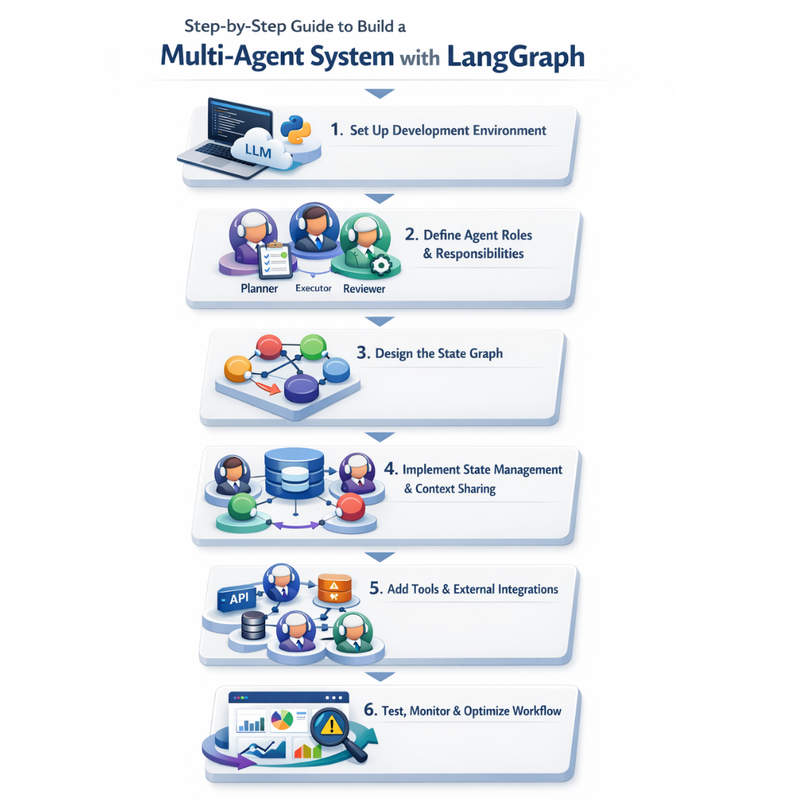
- Set Up the Development Environment: Install LangGraph and its dependencies, configure your Python environment, and connect your preferred large language model to ensure smooth agent execution.
- Define Agent Roles and Responsibilities: Create specialized agents such as planners, executors, and reviewers, each with clearly defined tasks to improve coordination and workflow efficiency.
- Design the State Graph: Build a graph where nodes represent agents or actions and edges define how information flows between them, including conditional paths and loops.
- Implement State Management and Context Sharing: Enable shared state so agents can access previous outputs, maintain context, and make informed decisions throughout the workflow.
- Add Tools and External Integrations: Connect APIs, databases, or automation tools that agents can use to perform real-world actions and retrieve external data.
- Test, Monitor, and Optimize the Workflow: Run the multi-agent system, monitor execution paths, handle errors, and refine agent logic to improve performance and reliability.
Challenges and Limitations in Multi-Agent Systems Using LangGraph
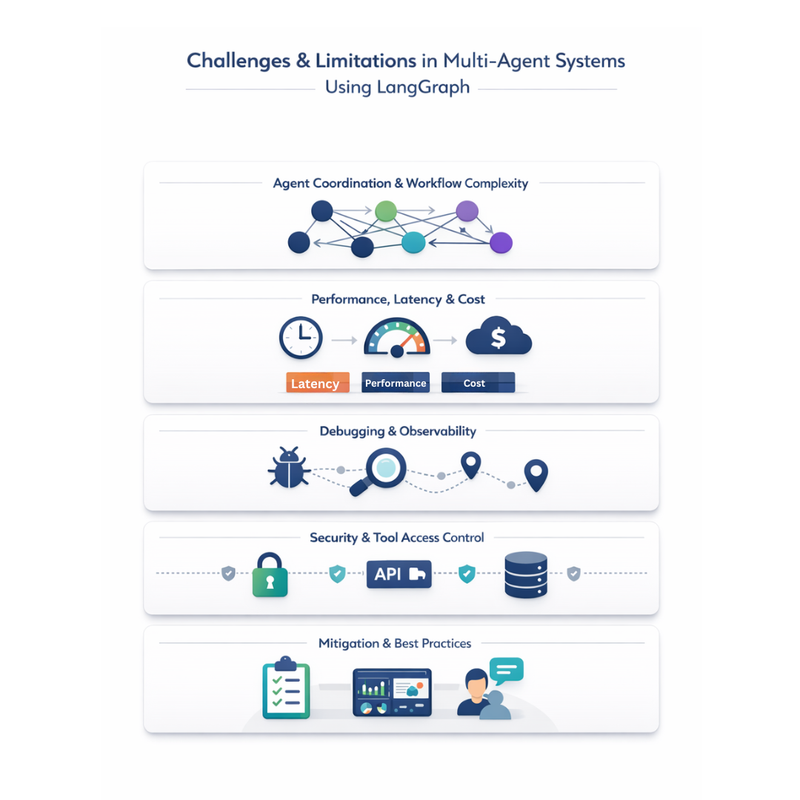
Although LangGraph provides a structured and scalable framework for building multi-agent systems, implementing such systems still comes with several challenges. One of the main difficulties is managing agent coordination and workflow complexity. As the number of agents and decision paths increases, designing clear execution flows and preventing conflicts between agents requires careful planning and well-defined roles.
Another challenge involves performance, latency, and cost management. Multi-agent systems often rely on multiple LLM interactions, tool calls, and state updates, which can increase response times and operational costs. Without optimization techniques such as caching, agent pruning, or selective execution, these systems may struggle to meet real-time or large-scale production requirements.
Debugging and maintaining multi-agent systems can also be complex. Tracking errors across interconnected agents, understanding decision-making paths, and ensuring secure access to tools and data demand strong observability and monitoring practices. Despite these limitations, most challenges can be effectively mitigated through thoughtful architecture design, proper logging, and human-in-the-loop controls, making LangGraph a reliable choice for production-ready agentic AI systems.
Real-World Use Cases of Multi-Agent Systems with LangGraph
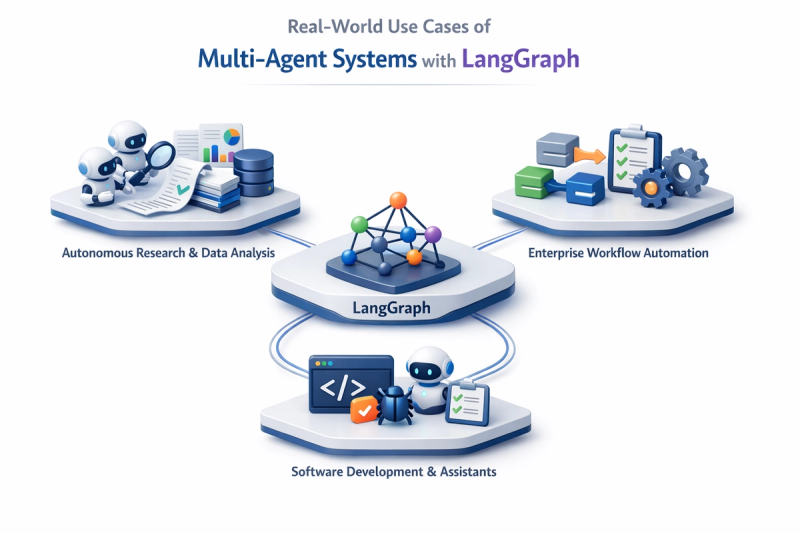
Multi-agent systems built with LangGraph are increasingly used in real-world applications where complex workflows require coordination, decision-making, and autonomy. One of the most common use cases is autonomous research and data analysis, where multiple agents collaborate to gather information, analyze sources, validate findings, and generate structured reports. LangGraph’s graph-based orchestration ensures that each agent follows a clear execution path while sharing context across the workflow.
Another major application is enterprise workflow automation. Organizations use LangGraph-powered multi-agent systems to automate tasks such as document processing, compliance checks, customer support, and internal operations. Different agents handle specific responsibilities—such as data extraction, validation, and action execution—resulting in faster processing, reduced manual effort, and improved accuracy across business workflows.
LangGraph is also well suited for software development and intelligent assistant systems. Multi-agent systems can assist with code generation, testing, debugging, and review by assigning specialized agents to each task. Additionally, collaborative AI assistants built with LangGraph can manage scheduling, decision support, and personalized recommendations. These real-world use cases highlight how LangGraph enables scalable, reliable, and production-ready multi-agent systems across industries.
Conclusion
Multi-agent systems are transforming the way AI applications are built by enabling multiple intelligent agents to collaborate, delegate tasks, and make decisions together. By breaking complex problems into specialized roles, these systems deliver greater scalability, flexibility, and reliability compared to traditional single-agent approaches. This makes multi-agent architectures especially effective for dynamic, real-world use cases such as enterprise automation, autonomous research, and intelligent decision-support systems.
LangGraph provides the structure and control needed to build these multi-agent systems in a production-ready and predictable manner. Its graph-based orchestration, state management, and conditional logic allow developers to design transparent and scalable agent workflows with confidence. As agentic AI continues to advance, LangGraph stands out as a powerful framework for organizations looking to deploy robust, collaborative AI solutions at scale.