Choosing a technology career is not just about learning a popular platform. It is about understanding the work you will do, the problems you will solve, and the skills employers expect from you. Salesforce vs Guidewire is a useful comparison for professionals exploring enterprise technology careers, as both platforms offer different professional pathways.
Salesforce is widely associated with customer relationship management, sales operations, service processes, and business automation. Guidewire, on the other hand, is designed for the property and casualty insurance industry, where software supports policy administration, claims processing, and billing operations.
Both platforms offer opportunities for technical and functional professionals. However, their learning requirements, industry focus, and day-to-day responsibilities differ. If you are a fresher, an experienced IT professional, or someone planning a career switch, understanding these differences can help you evaluate the career opportunities in Salesforce and Guidewire.
What Makes Salesforce and Guidewire Different?
The easiest way to understand these platforms is to look at the business problems they address.
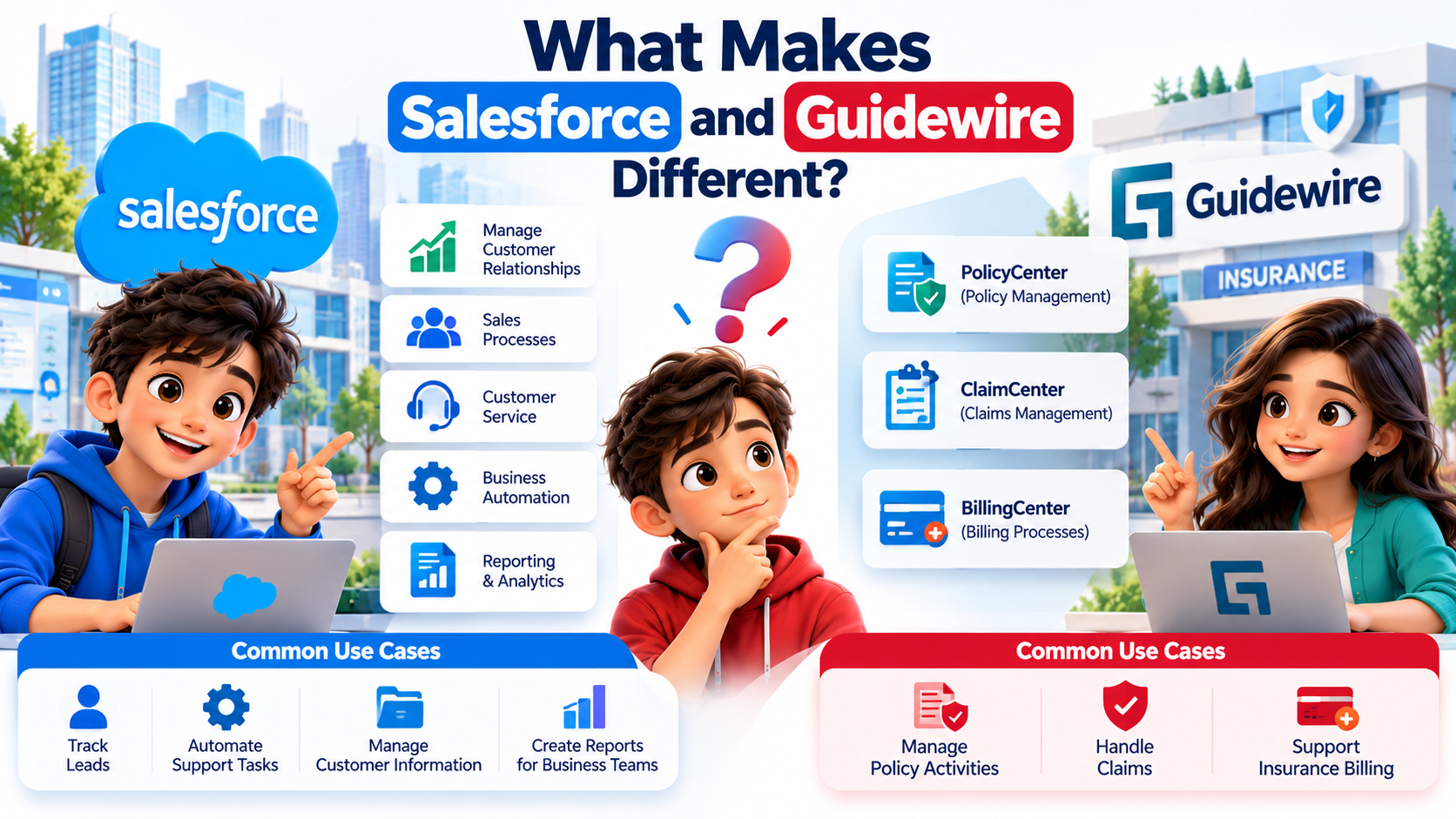
Salesforce helps organizations manage customer relationships and improve processes across sales, service, and other business functions. A company might use it to track leads, automate customer support tasks, manage customer information, or create reports for business teams.
Guidewire supports insurance operations. An insurer might use PolicyCenter to manage policy-related activities, ClaimCenter to handle claims, and BillingCenter to support insurance billing processes.
This distinction affects the kind of knowledge professionals develop. Salesforce careers often involve CRM processes, customer data, automation, and application customization. Guidewire careers require an understanding of insurance workflows alongside the relevant platform skills.
Neither platform is simply a substitute for the other. The better fit depends on the industry and type of technology work you want to pursue.
Career Paths You Can Explore with Salesforce
Salesforce offers several specializations, so learners do not need to follow the same route. Some professionals focus on configuration and business operations, while others move toward coding, consulting, or architecture.
Administration and CRM Operations
Salesforce Administrators help maintain the platform and make it useful for business teams. Their work can include managing users, configuring objects and fields, maintaining reports, controlling access, and automating routine processes. This path may suit people who enjoy solving operational problems and working with business users. A strong understanding of CRM fundamentals is a useful starting point.
Development and Custom Applications
Salesforce Developers work on custom functionality that goes beyond standard configuration. Depending on the project, they may use Apex, Lightning Web Components, APIs, and integration techniques to implement business requirements. People with programming experience may find this route relevant because it combines software development with knowledge of the Salesforce platform.
Consulting and Business Analysis
Salesforce Consultants help organizations determine how Salesforce can support their business processes. Business Analysts focus on understanding requirements, documenting workflows, and communicating between stakeholders and technical teams. With experience, professionals may move toward solution architecture, where they help design secure, maintainable solutions that meet broader business needs.
Exploring Specialized Salesforce Modules
The Salesforce ecosystem also includes specialized areas that can shape a professional's learning plan.
- Salesforce Data Cloud Training can help learners explore customer data unification and data-driven customer experiences.
- Salesforce CPQ Training focuses on product configuration, pricing, and quotation processes.
- Salesforce Agentforce Training relates to AI agents and their implementation within the Salesforce ecosystem.
- Salesforce Developer Training emphasizes custom applications, programming, and integrations.
The right specialization depends on your current skills and the type of projects you want to work on. Professionals exploring these options can consider Salesforce Training in India that matches their preferred role, rather than choosing a module solely because it is receiving attention in the market.
Where Guidewire Can Take Your Career
Guidewire provides a different professional direction for people interested in insurance technology. Its modules support important insurance processes, and project teams need people who can connect technical implementation with business requirements.
PolicyCenter and Policy Administration
Guidewire PolicyCenter supports policy administration activities. Professionals working with this module may deal with product configuration, policy workflows, business rules, and changes throughout the policy lifecycle. This area can suit learners who want to understand how insurance products and policy processes are represented in enterprise software.
ClaimCenter and Claims Management
Guidewire ClaimCenter supports the handling of insurance claims. Depending on the project, professionals may work on claim intake, investigation workflows, business rules, payments, and settlement-related processes. A developer may focus on implementation and configuration, while a tester validates whether the workflows behave as expected. A business analyst may help translate claims requirements into clear functional specifications.
BillingCenter and Billing Processes
Guidewire BillingCenter supports insurance billing activities, including invoicing, payments, and account-related processes. Work in this area requires attention to transaction handling, billing rules, and the relationships between different insurance operations. Understanding these processes can help professionals contribute to implementation, testing, and troubleshooting activities.
Business Analysis, QA, and Integration
Guidewire Business Analysts help gather requirements and explain insurance processes to technical teams. Guidewire QA professionals test business scenarios, identify defects, and validate application changes. Guidewire Integration Developers work on data exchange and communication between Guidewire and other enterprise systems.
Professionals interested in these responsibilities can explore Guidewire Training in India to build familiarity with InsuranceSuite modules and the practical concepts relevant to their target roles.
Salesforce vs Guidewire: Which Skills Match Your Background?
Your existing experience can help you decide which platform to learn first.
Your background or interest
Business operations and customer processes
Salesforce Administration or Consulting
Programming and application development
Salesforce Developer or Guidewire Developer
Insurance operations and domain knowledge
Guidewire Business Analyst or functional roles
Software testing and quality assurance
Salesforce QA or Guidewire QA opportunities
APIs and enterprise integrations
Salesforce Integraion or Guidewire Integration rolest
Data management and customer information
Salesforce Data Cloud or related CRM roles
This is a starting point, not a fixed rule. For example, an experienced tester can move into either ecosystem after learning the relevant tools and workflows. Similarly, a business analyst with insurance experience may find that domain knowledge is useful when exploring Guidewire projects.
The important question is whether your existing strengths align with the responsibilities of your target role and whether you are willing to learn the additional skills required.
Which Platform Has Better Job Opportunities in India?
Salesforce vs Guidewire jobs should be evaluated using actual vacancies rather than broad assumptions about which platform is more popular.
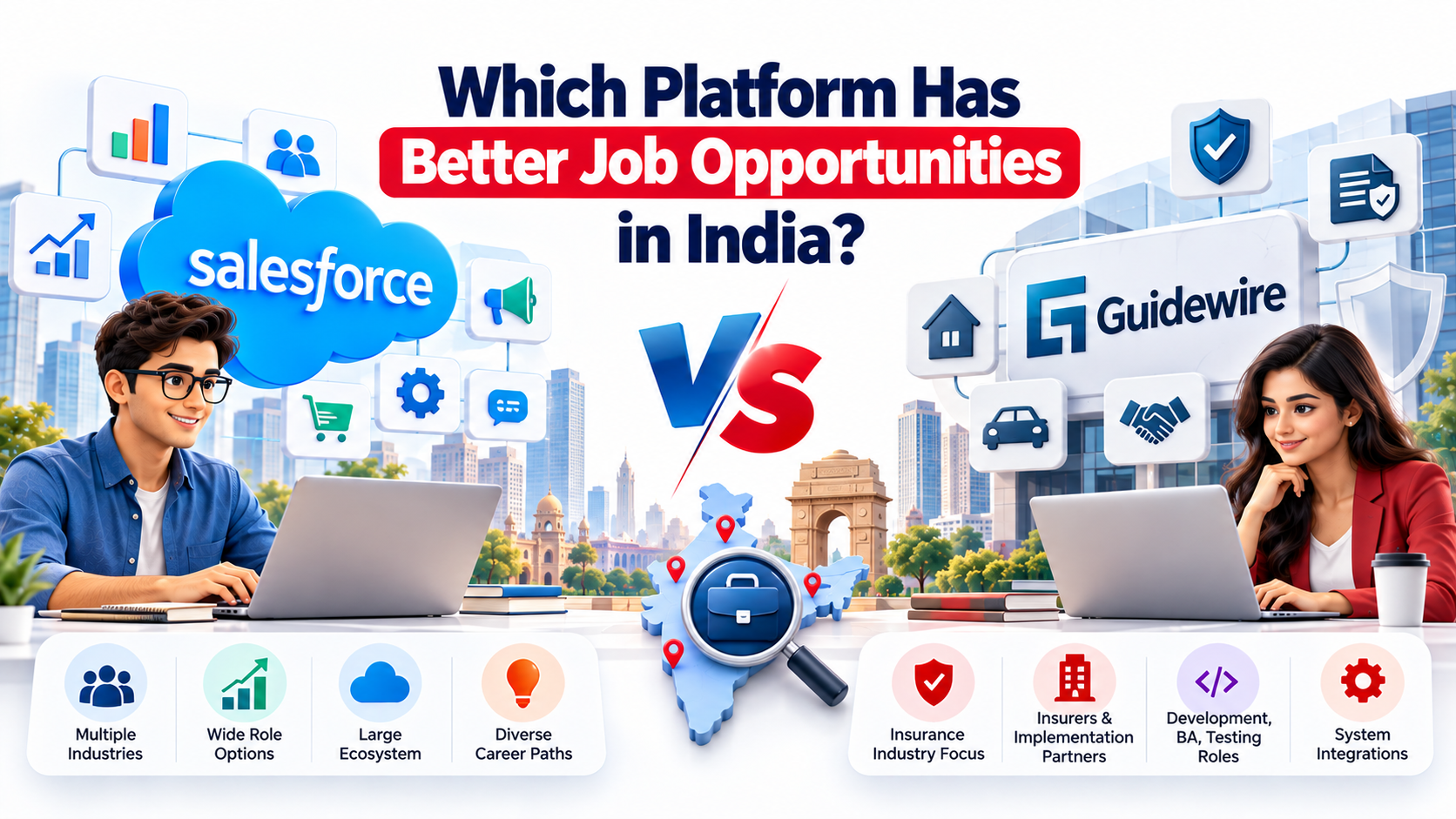
Salesforce supports projects across different industries, including customer management, sales operations, service delivery, and business automation. This makes its ecosystem relevant to a range of business functions and technical specializations.
Guidewire opportunities are more closely associated with insurance technology, including insurers, implementation partners, and technology service providers working on insurance systems. Relevant positions may involve development, configuration, business analysis, testing, and integrations.
When researching Salesforce jobs in India and Guidewire jobs in India, look beyond job titles. Check the required experience, technical skills, industry knowledge, project responsibilities, and location. Also distinguish between entry-level openings and roles that require prior implementation experience.
For a realistic comparison, review recent vacancies for similar job levels in your preferred city or for remote opportunities. This gives you a clearer picture of which skills are being requested and what you may need to learn before applying.
Salary and Long-Term Career Growth
Salesforce vs Guidewire salary is an important consideration, but comparing the two platforms using a single average can give an incomplete picture. A Salesforce Administrator, Salesforce Developer, Guidewire Business Analyst, and Guidewire Developer perform different types of work and may be assessed against different experience requirements.
Compensation can depend on technical depth, years of experience, employer, project complexity, location, communication skills, and specialist knowledge. Seniority and the ability to handle complex implementations may also influence career progression.
For a useful salary comparison, examine vacancies with similar experience requirements and responsibilities. Review the skills employers request and identify whether they expect configuration knowledge, coding ability, insurance expertise, integration experience, or team leadership.
Long-term growth also depends on how you continue developing your skills. Salesforce professionals may expand into advanced development, consulting, data-related solutions, or architecture. Guidewire professionals may deepen their expertise in InsuranceSuite modules, integrations, technical design, or insurance business processes.
Neither path guarantees a particular salary or promotion. Consistent learning, relevant project experience, and the ability to solve practical problems remain important.
Training and Certification: What Should You Consider?
A good learning plan should prepare you for the work associated with your intended role, not just introduce platform terminology.
For Salesforce, beginners can start with CRM concepts and platform fundamentals before progressing into administration, development, or a specialized module. Salesforce Trailhead provides guided learning resources for different career paths.
For Guidewire, learners should build an understanding of insurance operations alongside the relevant InsuranceSuite module. The appropriate preparation will differ depending on whether the target role is functional, development-focused, testing-oriented, or integration-related.
Before selecting a training programme, evaluate the curriculum, trainer experience, practical exercises, project scenarios, and interview preparation. Check current certification requirements through the relevant official provider, as certification options and requirements can change.
A course should help you develop skills you can explain and demonstrate. Completing training or obtaining a certification alone does not guarantee a job.
How to Make the Right Career Decision
Instead of choosing a platform based only on popularity, use a few practical questions to narrow your options.
1. Which business domain interests you?
If customer relationships, CRM operations, and sales or service processes appeal to you, explore Salesforce. If insurance policies, claims, billing, and insurance system implementation interest you, investigate Guidewire.
2. What kind of work do you prefer?
Configuration, coding, business analysis, testing, and integration require different strengths. Review the day-to-day responsibilities of each role before committing to a learning path.
3. How much technical experience do you already have?
Programming experience may help with developer roles. Business process knowledge can be useful in consulting and analysis, while insurance experience may be valuable for Guidewire-related work.
4. What are employers asking for?
Check current job descriptions for your target location and experience level. Use them to identify the technical concepts, certifications, and practical experience you need to build.
5. Can you practise the skills?
Choose a learning path that gives you opportunities to work through realistic scenarios, explain your decisions, troubleshoot issues, and demonstrate your understanding.
Answering these questions will give you a more useful basis for comparison than relying on general claims that one platform is always better than the other.
Frequently Asked Questions
Is Salesforce or Guidewire better for a career?
Both offer different career paths. Salesforce is relevant to CRM, administration, development, consulting, and customer data solutions. Guidewire focuses on insurance technology, including policy administration, claims, billing, and integrations. Your interests, existing skills, and target job responsibilities should guide your choice.
Can freshers learn Salesforce or Guidewire?
Freshers can explore either platform, provided they build the necessary fundamentals. Salesforce learners can begin with CRM concepts and administration, while Guidewire learners should understand insurance workflows alongside the platform. Reviewing entry-level job requirements can help you choose an appropriate starting point.
Which Salesforce module should I learn first?
The right module depends on your goals. Beginners interested in CRM operations may start with administration fundamentals. Those with programming experience may explore development, while learners interested in customer data or pricing processes can investigate Data Cloud or CPQ after understanding the platform basics.
Which Guidewire module is suitable for beginners?
PolicyCenter, ClaimCenter, and BillingCenter serve different insurance functions. Your choice should depend on the type of work you want to pursue and the opportunities available to you. Learn the basic insurance lifecycle first, then explore the module that aligns with your target role.
Are Salesforce and Guidewire certifications necessary to get a job?
Certification may help demonstrate knowledge, but it is not a guarantee of employment. Employers may also evaluate practical skills, project experience, problem-solving, domain understanding, and communication. Choose certifications relevant to your target role and verify current requirements through official resources.
Can an experienced IT professional switch to Guidewire or Salesforce?
Yes, a transition can be possible. Existing experience in programming, testing, integration, or business analysis may be transferable. However, you will still need to learn the target platform and its business context. Insurance domain knowledge is particularly useful when moving into Guidewire projects.
Final Takeaway
Salesforce and Guidewire offer distinct routes into enterprise technology. Salesforce is worth exploring if you want to work with CRM, customer-related processes, automation, or application development. Guidewire is worth considering if you want to specialize in insurance software and the systems that support policy, claims, and billing operations.
The best starting point is to identify your preferred role, understand its skill requirements, and compare those requirements with your current experience. Explore relevant training options, practise with realistic scenarios, and use current job descriptions to guide your preparation.
TechPratham learners can explore the relevant Salesforce and Guidewire training paths based on their interests and career goals. A focused learning plan and practical understanding of the chosen platform can help you prepare for relevant opportunities.









 +91-8882178896
 +1 (343) 477-0926