Artificial intelligence is changing how businesses build applications, automate processes, and manage customer relationships. Within the Salesforce ecosystem, AI-powered tools are helping teams explore faster ways to write code, analyse errors, and improve business workflows. At the same time, technologies such as Agentforce are creating new opportunities to build applications that combine business data, automation, and AI-driven actions.
These developments are changing the skills expected from Salesforce developers. Writing code remains important, but developers also need to understand system architecture, data security, integration, testing, and how AI-generated solutions should be evaluated before deployment.
For aspiring professionals, the key question is not simply whether AI will replace developers. It is how the role is evolving and which technical skills will remain valuable as Salesforce development practices change.
What Is Agentic AI in Salesforce?
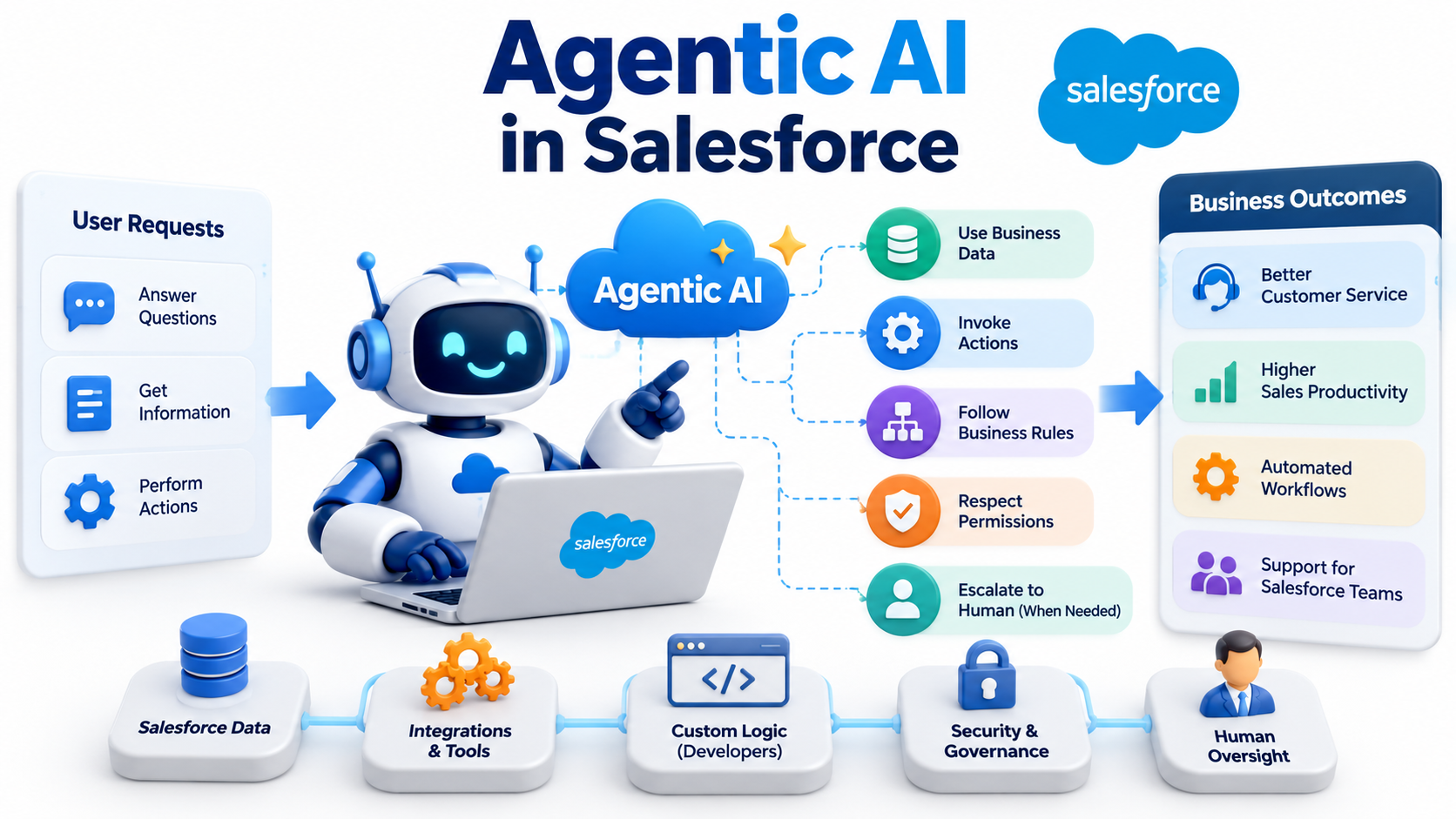
Agentic AI refers to AI systems that can work toward a defined goal, determine appropriate steps, and use available tools to perform tasks within specified boundaries. Unlike a conventional chatbot that mainly responds to questions, an AI agent may interact with business systems and initiate actions based on its instructions, permissions, and available information.
Salesforce Agentforce enables organisations to build AI agents for business processes such as customer service, sales support, and workflow assistance. Depending on the implementation, an agent can use relevant business data, invoke configured actions, and work alongside existing Salesforce automation.
For example, a customer service agent could retrieve information about a case, summarise its history, and recommend an appropriate next step. A Salesforce developer may build the supporting logic, configure integrations, define permissions, and ensure that the workflow behaves as expected.
Agentic AI does not remove the need for business rules or application controls. Developers must still determine what an agent can access, which actions it can perform, and when a task should be escalated to a human.
How Is Agentic AI Changing Salesforce Development?
AI is influencing several stages of the development process, from initial implementation to debugging and testing. Its usefulness depends on the quality of the requirements, the capabilities of the tools, and the developer's ability to review the output.
AI-Assisted Coding and Debugging
Salesforce developers use Apex to implement custom business logic and Lightning Web Components (LWC) to build custom user interfaces. AI coding assistants can help draft code, explain unfamiliar methods, suggest improvements, and identify possible errors.
Consider a developer creating a validation process for customer records. An AI assistant may help generate an initial Apex method, but the developer must verify the business rules, exception handling, bulk processing, and security requirements.
Generated code can contain errors or overlook important dependencies. Developers therefore need to understand the code they use rather than relying on AI output without review.
Changes in Testing and Quality Assurance
AI tools can help developers explore test scenarios, understand error messages, and identify potential gaps in existing tests. These capabilities may reduce some manual effort during development.
However, testing must still cover expected results, invalid inputs, permission restrictions, integration failures, and unusual business scenarios. A solution that works in a simple demonstration may not behave correctly under production conditions.
Developers who understand testing principles and can evaluate the reliability of AI-generated code will be better positioned to deliver maintainable applications.
More Connected Business Workflows
Salesforce applications frequently connect with external systems, databases, and enterprise applications. AI-enabled workflows introduce additional considerations because an agent may need to retrieve information or trigger actions across these systems.
Developers must understand API integration, authentication, data mapping, error handling, and the dependencies between different components. This broader technical understanding becomes especially important when a change in one part of the application affects another.
Will Agentic AI Replace Salesforce Developers?
Agentic AI is changing Salesforce development, but it does not eliminate the need for developers who can design, validate, and maintain reliable business applications.
AI can assist with repetitive coding tasks, documentation, debugging suggestions, and initial test generation. However, these capabilities do not automatically translate into production-ready solutions.
Consider an organisation that uses Salesforce Flow, Apex triggers, custom objects, and external integrations. A generated code change might satisfy a new requirement while introducing duplicate automation, unexpected data updates, or performance problems.
A developer must understand the existing system, identify these risks, and verify that the solution meets the business requirement.
Several responsibilities continue to require strong technical judgment:
- Translating business requirements into an appropriate technical design.
- Choosing between declarative automation and custom development.
- Managing data access, authentication, and application security.
- Ensuring that integrations handle failures and unexpected responses.
- Reviewing AI-generated code and validating its behaviour.
- Maintaining applications as business needs and platform capabilities evolve.
The exact impact of AI will vary across organisations and projects. Developers who combine platform expertise with problem-solving, testing, and responsible AI adoption can adapt more effectively as development workflows change.
Skills Salesforce Developers Need in the AI Era
Preparing for AI-enabled Salesforce development starts with understanding the platform. Developers should build core technical skills before moving into specialised areas such as AI-agent configuration and development.
Salesforce Platform Fundamentals
A strong foundation includes Salesforce objects, relationships, data modelling, user permissions, sharing rules, and application architecture. These concepts help developers understand how business information is organised and how users interact with it. Without this foundation, it becomes difficult to assess whether an AI-generated solution follows the organisation's data and security requirements.
Apex, SOQL, and Lightning Web Components
Apex supports custom business logic, while SOQL is used to retrieve Salesforce data. Lightning Web Components enable developers to create interactive interfaces. Developers should understand how these technologies work together, how to troubleshoot problems, and how to build solutions that follow Salesforce platform limits and development practices. AI tools can assist with implementation, but a clear understanding of programming fundamentals remains essential for reviewing and maintaining the resulting code.
Salesforce Flow and Business Automation
Not every requirement needs custom code. Salesforce Flow can support many business processes through declarative automation, while Apex is useful when requirements call for more specialised programmatic behaviour. Developers should learn how to evaluate the requirement, select the appropriate approach, and avoid conflicts between multiple automations.
Agentforce and AI Agent Development
Developers interested in AI-enabled Salesforce projects can explore Agentforce, agent instructions, configured actions, data access, and testing. They should understand how an agent uses the capabilities made available to it and how to control its interactions with business processes. This includes checking permissions, handling uncertain results, and ensuring that important actions follow the organisation's policies.
Integration, Security, and Testing
Enterprise applications depend on reliable communication between systems. Knowledge of REST APIs, authentication, data transformation, and integration patterns helps developers build solutions that work beyond a single Salesforce environment. Security and testing are equally important. Developers must validate that applications respect access controls, handle errors correctly, and produce the expected outcomes before deployment.
A Practical Example of Salesforce Development with Agentic AI
Imagine an insurance company that wants to help its customer service team review incoming service cases more efficiently.
An AI-enabled Salesforce workflow could be designed around the following process:
1. Understand the business requirement. Identify the information the service team needs, the actions that may be automated, and the decisions that require human approval.
2. Prepare the data and access controls. Review the relevant Salesforce records and determine which information the agent is permitted to access.
3. Build the supporting functionality. Use Salesforce Flow, Apex, or integrations where appropriate to retrieve information, validate inputs, and execute approved operations.
4. Configure the agent. Define its instructions and available actions, along with clear limits on what it can do.
5. Test different scenarios. Check missing information, restricted access, conflicting records, failed integrations, and situations where the agent should escalate the request.
6. Review the results. Monitor the workflow, investigate unexpected behaviour, and improve the implementation based on testing and feedback.
This example demonstrates that developing an AI-enabled Salesforce solution involves more than configuring an agent. It requires platform knowledge, business logic, integration, security, and quality assurance.
Career Opportunities for Salesforce Developers
Salesforce developers can explore different technical career paths depending on their experience, interests, and the requirements of individual projects.
Salesforce Developer: Develops custom business logic, interfaces, automation, and platform functionality.
Salesforce Integration Developer: Connects Salesforce with external applications and services using APIs and integration technologies.
Salesforce Technical Consultant: Converts business requirements into technical solutions and helps organisations implement them.
Agentforce Developer: Works on AI-agent configuration, actions, integrations, testing, and the supporting Salesforce functionality.
Salesforce Technical Architect: Designs broader solutions involving application structure, security, integrations, performance, and scalability.
These roles have different responsibilities, and moving into a specialised position generally requires relevant technical experience. Learning Agentforce alone does not automatically qualify someone for an advanced development or architecture role. For beginners, building a solid understanding of Salesforce development is a practical starting point. AI-related knowledge can then complement that foundation as learners work on increasingly complex projects.
How to Prepare for a Salesforce Developer Career
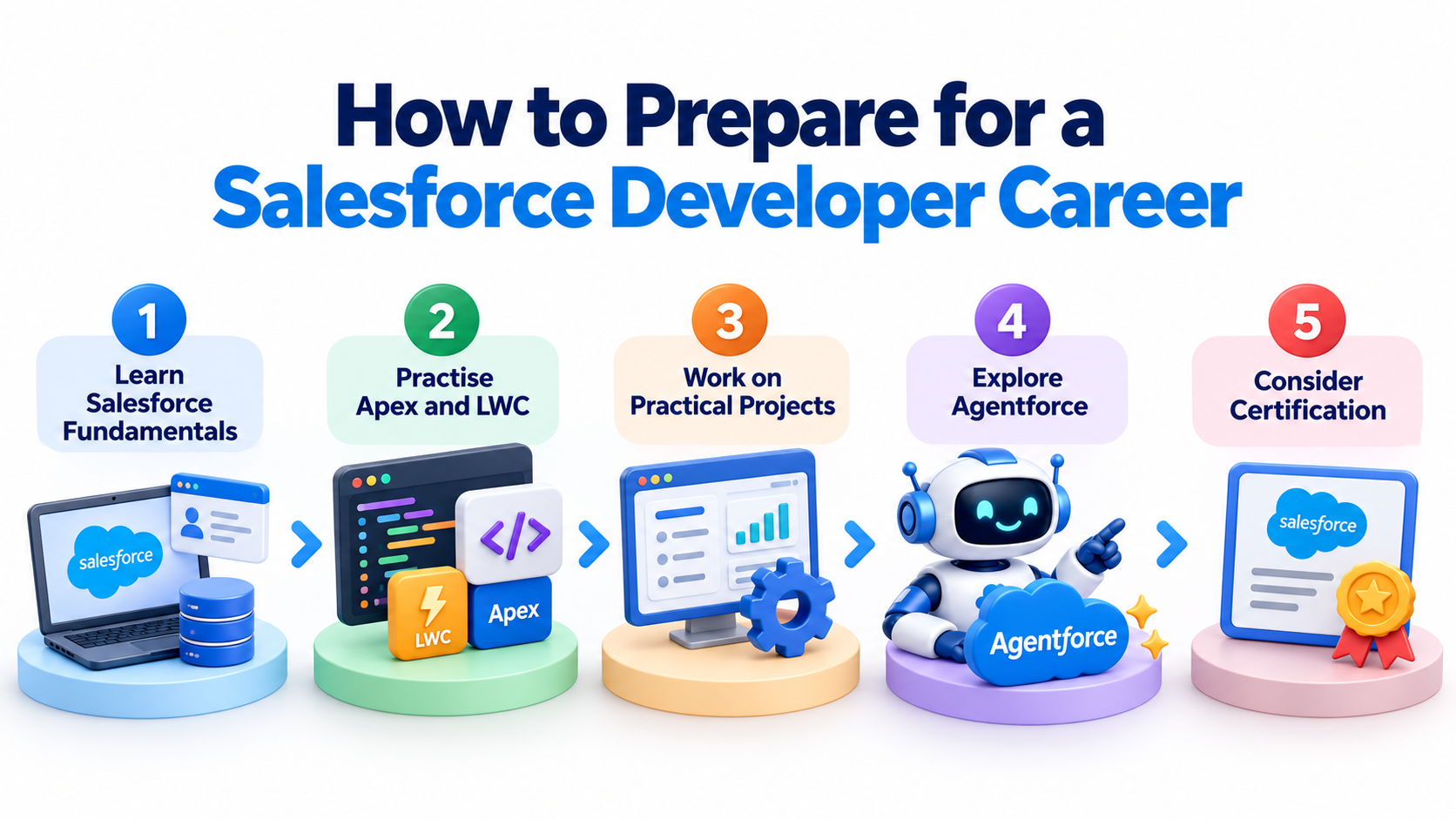
Learners planning to enter Salesforce development should follow a structured path that combines technical knowledge with hands-on practice.
Step 1: Learn Salesforce FundamentalsBegin with CRM concepts, objects, relationships, data modelling, permissions, and basic platform configuration. This helps establish an understanding of how Salesforce applications operate.
Step 2: Practise Apex and LWC
Learn programming fundamentals, Apex, SOQL, and Lightning Web Components. Build small applications and practise debugging, handling errors, and testing different scenarios.
Step 3: Work on Practical Projects
Apply your knowledge to realistic business requirements. For example, create a service case management application with appropriate validation, user permissions, automation, and reporting. Projects help demonstrate how technical concepts work together and reveal areas that need further practice.
Step 4: Explore Agentforce
Once you understand the Salesforce platform, explore how AI agents use data and configured actions. Practise defining instructions, validating results, and applying appropriate security controls.
Step 5: Consider Relevant Certification
A Salesforce developer certification can help demonstrate knowledge of platform development concepts. Choose a credential that matches your experience and career goals, and use the official exam guide to prepare.
Learners who prefer guided instruction can compare a Salesforce Developer Course based on its technical curriculum, practical exercises, trainer expertise, and learning support. When evaluating
Salesforce Developer Training in India, check whether the programme covers the fundamentals required for real development work rather than focusing only on emerging AI tools.
Salesforce Developer Certification: Is It Worth Considering?
A Salesforce developer certification can provide structured learning goals and help demonstrate knowledge of the platform. Its value depends on the credential, the learner's practical experience, and the expectations of prospective employers.
The Salesforce Certified Platform Developer I credential is relevant to professionals who build custom business logic and interfaces on Salesforce. More advanced development credentials may suit professionals who have developed deeper platform expertise.
Before choosing a Salesforce Developer Certification, review the current official credential requirements, exam objectives, and recommended preparation resources. Salesforce updates its certification programmes over time, so learners should verify the latest details directly.
Certification preparation should be combined with coding practice, debugging, testing, and project work. A credential can support a professional profile, but it does not guarantee employment or replace the ability to solve real technical problems.
Frequently Asked Questions
Will AI replace Salesforce developers?AI can assist with coding, debugging, documentation, and test generation, but developers remain responsible for understanding requirements, designing systems, managing security, and validating solutions. The role is evolving as AI becomes part of development workflows.
What skills should Salesforce developers learn for the future?
Developers should build skills in Salesforce fundamentals, Apex, SOQL, Lightning Web Components, Flow, APIs, testing, and security. Those interested in AI-enabled applications can also learn Agentforce and how to validate AI-agent behaviour.
Is Salesforce development a good career for beginners?
Salesforce development can suit beginners who enjoy programming, logical thinking, and building business applications. Learning the platform, practising technical skills, and completing projects can help learners prepare for relevant entry-level opportunities. Actual opportunities depend on experience and market requirements.
What should a Salesforce Developer Course include?
A useful course should cover platform fundamentals, data modelling, Apex, SOQL, Lightning Web Components, automation, debugging, testing, and hands-on projects. Agentforce can be an additional learning area for students interested in AI-enabled development.
Which Salesforce Developer Certification should I consider?
The Salesforce Certified Platform Developer I credential is relevant to professionals learning custom Salesforce development. Review the current official exam guide to understand its scope and determine whether your existing knowledge is sufficient for preparation.
Do Salesforce developers need to learn Agentforce?
Not every Salesforce developer needs to specialise in Agentforce immediately. However, understanding how AI agents interact with Salesforce data, actions, and business workflows can be useful for developers working on projects that adopt these capabilities.
Conclusion
The future of Salesforce development will be shaped by the combination of platform expertise, software engineering, and responsible use of AI. Agentic AI can assist with selected development tasks and enable new business workflows, but reliable applications still require thoughtful design, security, testing, and ongoing maintenance.
Developers preparing for this changing environment should focus on Salesforce fundamentals, Apex, SOQL, Lightning Web Components, automation, and integration before expanding into AI-agent development. Practical projects and relevant certification preparation can help strengthen that foundation.
For learners exploring their next steps, a suitable
Salesforce Developer Course can provide a structured way to develop these skills. The priority should be to understand how Salesforce solutions work, solve realistic business problems, and evaluate AI-generated results carefully. These capabilities provide a more sustainable foundation for adapting to changes across the Salesforce ecosystem.








 +91-8882178896
 +1 (343) 477-0926