
How SAP PP Training in India Integrates with SAP MM and SAP QM

Manufacturing companies need connected business processes to manage production, materials, inventory, and quality efficiently. SAP PP Training in India helps learners understand how Production Planning (PP) works with SAP MM (Materials Management) and SAP QM (Quality Management) to support smooth manufacturing operations.
Instead of learning SAP PP in isolation, a comprehensive training program focuses on how these modules work together in real business scenarios. This practical approach helps learners understand end-to-end manufacturing workflows, from material procurement and production planning to quality inspections and finished goods management.Whether you're a fresher starting your SAP career or a manufacturing professional looking to upgrade your skills, understanding the integration between SAP PP, SAP MM, and SAP QM can improve your job opportunities. Many organizations prefer SAP professionals who can manage complete manufacturing processes rather than a single module.
What is SAP PP?
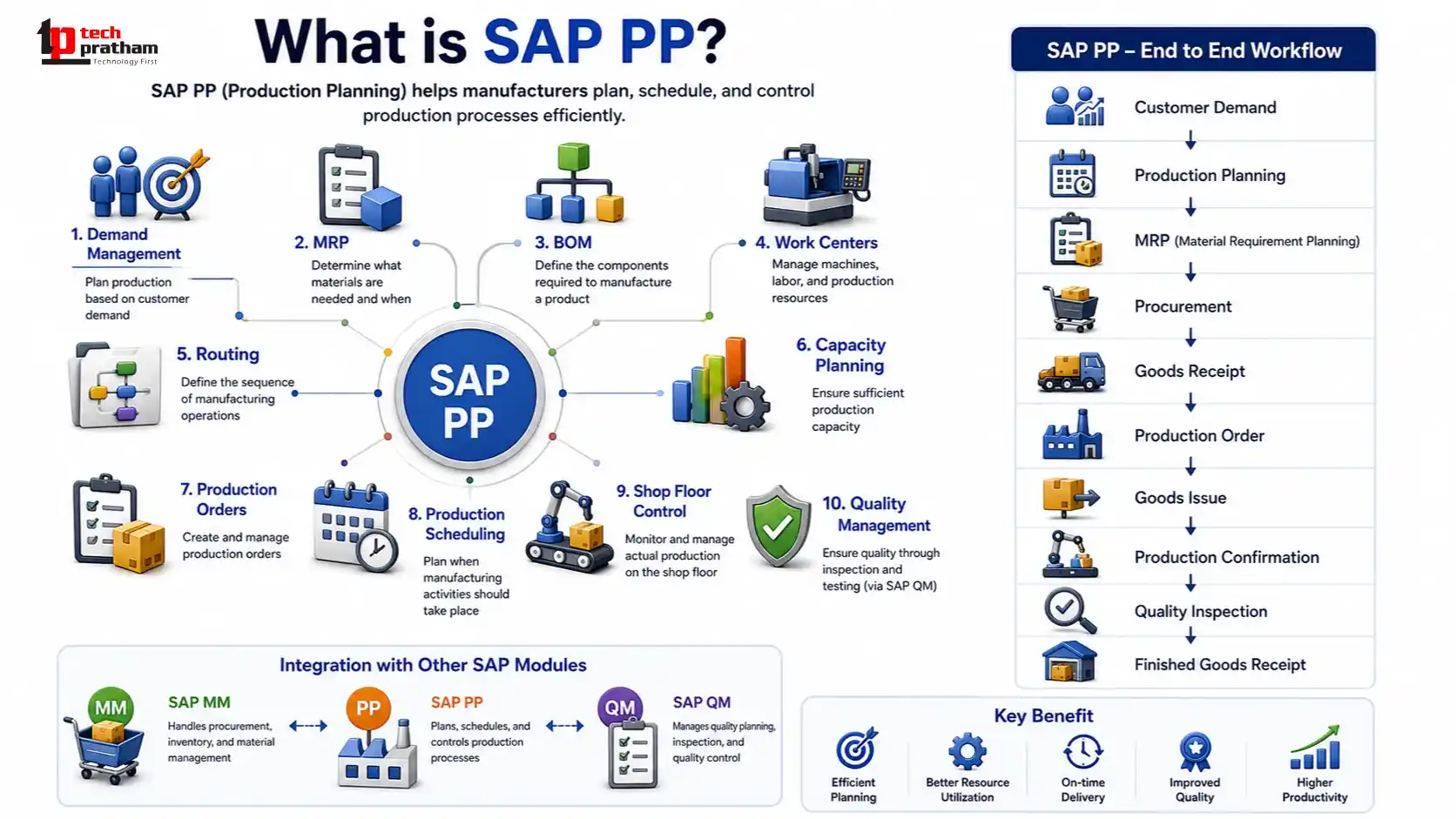
SAP PP, or SAP Production Planning, is one of the core functional modules in SAP ERP that helps organizations manage every stage of the manufacturing process. From forecasting demand and planning production schedules to executing manufacturing orders and monitoring shop floor activities, SAP PP provides the tools needed to streamline production operations.
The module is widely used by manufacturing companies across industries such as automotive, pharmaceuticals, electronics, food processing, engineering, chemicals, textiles, and consumer goods. It enables organizations to optimize resources, reduce production delays, and improve operational efficiency.
Some of the key functions of SAP PP include:
- Production Planning
- Material Requirement Planning (MRP)
- Bill of Materials (BOM)
- Work Centers
- Routing
- Capacity Planning
- Production Orders
- Shop Floor Control
- Production Scheduling
- Batch Management
Each of these functions plays an important role in ensuring that production activities are completed efficiently. However, none of them can operate independently. Production planning depends on accurate inventory information and consistent quality control, making integration with SAP MM and SAP QM essential.
A professionally designed SAP PP Certification Training in India focuses not only on learning these features but also on understanding how they interact with other SAP modules in real-world business scenarios.
Why SAP Module Integration Matters
Modern businesses cannot afford disconnected systems where departments work independently. Manufacturing involves multiple teams working together toward a common objective—delivering high-quality products on time while maintaining cost efficiency.
A customer places an order for 500 industrial pumps. The production team immediately creates a production plan. However, before manufacturing begins, the organization must answer several questions:
- Are all the required raw materials available?
- Should additional materials be purchased?
- Are machines available for production?
- Will the finished products meet quality standards?
- Can inventory be updated automatically after production?
If these processes are managed manually, businesses often face delays, inaccurate inventory records, duplicate data entry, and communication gaps between departments. SAP eliminates these challenges by integrating different business modules. Instead of transferring information manually, SAP automatically shares data between Production Planning, Material Management, and Quality Management. This integration offers several advantages:
Improved Operational Efficiency
Reduced Manual Errors
Better Inventory Control
Enhanced Product Quality
Faster Decision-Making
Better Career Opportunities for SAP Professionals
Understanding the Relationship Between SAP PP, SAP MM, and SAP QM
Manufacturing businesses rely on multiple departments to work together efficiently. Production planning, material procurement, inventory management, and quality assurance are all interconnected. SAP simplifies these operations by integrating different modules into a single ERP system, allowing information to flow automatically between departments.
Although SAP PP (Production Planning) is responsible for planning and controlling manufacturing activities, it depends heavily on SAP MM (Materials Management) and SAP QM (Quality Management) to complete the production cycle successfully. Without raw materials from SAP MM or quality checks managed by SAP QM, production cannot operate efficiently.
Each module has a specific responsibility:
Together, these modules create a complete manufacturing solution. For example:
- SAP PP plans production.
- SAP MM ensures materials are available.
- SAP QM verifies product quality.
- SAP MM stores approved finished products in inventory.
How SAP PP Integrates with SAP MM
One of the strongest integrations in SAP ERP exists between SAP Production Planning and SAP Material Management. While SAP PP manages manufacturing activities, SAP MM Training in india focuses on procurement, inventory management, purchasing, and warehouse operations.
1. Material Requirement Planning (MRP)
Material Requirement Planning, commonly known as MRP, is one of the most important features of SAP PP. Whenever production demand is created, SAP PP performs an MRP run to calculate material requirements.
During this process, SAP automatically checks:
- Current inventory levels
- Open purchase orders
- Existing production orders
- Customer demand
- Forecasted demand
If sufficient stock is available, production continues without interruption. However, if inventory is insufficient, SAP MM automatically generates purchase requisitions or purchase orders based on the organization's configuration. This eliminates the need for procurement teams to manually identify raw material shortages and speeds up the purchasing process.
2. Bill of Materials (BOM)
The Bill of Materials (BOM) is one of the most important elements in SAP PP. It contains a complete list of raw materials, components, and quantities required to manufacture a finished product. During production planning, SAP PP uses the BOM to determine exactly which materials are needed before production begins. For example, manufacturing a desktop computer requires several components, including:
- Motherboard
- Processor
- RAM
- Hard Drive
- Cabinet
- Power Supply
- Cooling Fan
When a production order is created, SAP PP reads the BOM and identifies all the required components. SAP MM then checks the warehouse inventory to verify whether these materials are available. If sufficient stock exists, production proceeds as planned. If any component is missing or falls below the required quantity, SAP MM automatically initiates the procurement process to replenish the inventory.
3. Inventory Availability Check
Before a production order is released, SAP PP performs an Inventory Availability Check by integrating with SAP MM. This process verifies whether all the raw materials and components required for manufacturing are available in the warehouse before production begins. The availability check helps production planners answer key questions such as:
- Are all the required materials available?
- Which components are currently out of stock?
- Is additional procurement required before production starts?
- Can the production order be released on schedule?
If any material is unavailable, SAP MM immediately identifies the shortage and supports the procurement process to replenish inventory. This proactive approach allows businesses to resolve material issues before production begins instead of facing unexpected delays during manufacturing.
4. Purchase Requisition Generation
One of the biggest advantages of integrating SAP PP with SAP MM is the automation of procurement activities. During production planning, if SAP PP identifies that raw materials are unavailable or insufficient, the system automatically generates Purchase Requisitions based on material requirements.
Instead of manually calculating shortages and sending requests to the procurement team, SAP streamlines the entire process. The purchasing department reviews the automatically generated purchase requisitions and converts them into purchase orders for suppliers. This ensures that the required materials are ordered on time, helping manufacturers avoid production delays and maintain a continuous production schedule.
5. Goods Issue During Production
Once production starts, the required raw materials are issued from the warehouse to the production line. SAP MM records this transaction as a Goods Issue (GI), while SAP PP simultaneously updates the production order with the materials consumed during manufacturing. This real-time integration automatically:
- Reduces inventory quantities based on material consumption.
- Updates production orders with actual material usage.
- Records consumption data for reporting and cost analysis.
- Keeps warehouse inventory accurate and up to date.
Because SAP PP and SAP MM exchange information instantly, businesses always have real-time visibility into inventory levels and production progress. This improves inventory accuracy, supports better production planning, prevents stock discrepancies, and enables more informed business decisions.
6. Goods Receipt: Completing the Production Cycle
After the production process is completed, the manufactured products are moved back into inventory. This stage is known as Goods Receipt, and it is another important point where SAP PP integrates with SAP MM. Once a production order is confirmed in SAP PP, the system automatically updates inventory in SAP MM by recording the finished goods. This means there is no need for manual stock updates, reducing the chances of inventory mismatches or data entry errors.
How SAP PP Integrates with SAP QM
In a manufacturing organization, producing goods on time is only one part of the process. Companies also need to make sure that the finished products meet defined quality standards. This is where SAP PP and SAP QM integration becomes important. SAP Production Planning (PP) manages production activities such as material planning, production orders, scheduling, and shop-floor execution, while SAP Quality Management (QM) helps organizations plan, perform, and monitor quality inspections throughout the manufacturing process.
For professionals learning SAP, understanding this integration provides a clearer picture of how different SAP modules work together in a real business environment. This is also one of the practical areas covered in SAP QM Training in india, where learners can understand how production and quality processes are connected within an SAP system.
Instead of waiting until production is completed to identify defects, SAP QM allows quality checks to be incorporated into different stages of the production process. Inspection results can then influence production decisions, material usage, and the release of products for further processing or delivery.
1. Quality Planning Before Production
Quality management can begin even before manufacturing starts. Organizations define the quality requirements that products and production processes need to meet. Depending on the industry and product, quality planning may include:
- Inspection plans
- Quality specifications
- Inspection characteristics
- Testing procedures
- Acceptance criteria
- Sampling methods
- Tolerance limits
These predefined requirements provide a standard for quality inspectors and production teams. For example, a pharmaceutical manufacturer may define specific parameters for tablet weight, chemical composition, hardness, and packaging. Similarly, an automobile manufacturer may establish dimensional and performance requirements for a component before production begins.
By defining quality requirements in advance, organizations can make quality checks more consistent and reduce dependency on manual procedures.
2. In-Process Quality Inspection
Quality inspection does not always have to happen after manufacturing is complete. In many industries, checking quality during production is essential because defects can become more expensive to correct if they are discovered too late. SAP QM can support in-process inspections at relevant stages of production.
For example:
- Checking dimensions after machining
- Verifying temperature during chemical production
- Inspecting welding quality in automobile manufacturing
- Measuring pressure during equipment assembly
- Checking weight or concentration during batch production
These inspections can be connected to the production process managed through SAP PP. If a quality issue is identified during production, the organization can investigate the problem and take corrective action before additional defective products are produced. This can help reduce material waste, rework, production delays, and unnecessary manufacturing costs.
3. Inspection Lots and Production Quality Checks
One of the important concepts in SAP QM is the inspection lot. An inspection lot represents a request or record for carrying out a specific quality inspection. In production-related scenarios, inspection lots can be generated according to the configured inspection process. Depending on the inspection type and business requirements, they may be used for inspections during production or for checking goods after production.
Quality inspectors can perform the required tests based on predefined inspection characteristics and inspection plans. These tests may include:
- Visual inspection
- Functional testing
- Dimensional measurements
- Performance testing
- Material testing
- Safety and compliance checks
The inspection results are recorded in SAP QM, creating a traceable quality record for the relevant production process or material. The organization can then evaluate the results and determine whether the material meets the required quality specifications.
4. Results Recording and Usage Decision
After an inspection is performed, the quality team records the inspection results in SAP QM. The results may be based on measured values, observations, or predefined acceptance criteria. For example, a quality inspector may record the diameter of a manufactured component and compare it with the specified tolerance range.
5. Defect Recording and Quality Notifications
If inspectors identify defects, SAP QM can be used to document the problem and communicate important quality information. A quality issue may include details such as:
- Type of defect
- Affected material
- Inspection results
- Production-related information
- Possible root cause
- Corrective action
- Preventive action
For example, suppose repeated inspections show scratches on a finished component. The quality team can record the defect and investigate whether it is related to machinery, tooling, material handling, storage, or packaging. This information can help production and quality teams identify recurring problems instead of treating each defective item as an isolated incident.
Over time, organizations can use this quality data to improve production processes and reduce the frequency of similar defects.
6. Quality Feedback to Production
One of the biggest advantages of integrating SAP PP with SAP QM is that quality information can provide valuable feedback to production. Consider a situation where a particular production operation repeatedly results in products falling outside the required specifications. The quality data can help the organization investigate the production process and identify possible causes. The production team may then review:
- Machine settings
- Production methods
- Raw materials
- Work instructions
- Tools and equipment
- Operator procedures
- Process parameters
This creates a continuous improvement cycle:
Production → Quality Inspection → Defect Identification → Root Cause Analysis → Corrective Action → Improved Production
Rather than simply identifying defective products, the organization can use quality information to improve the manufacturing process itself.
7. Quality Certificates and Compliance
Many manufacturing industries operate under strict quality and regulatory requirements. Companies may need to maintain detailed records proving that products were manufactured and inspected according to defined standards. SAP QM can support quality-related documentation and certificate processes based on the organization's requirements.
Quality documentation may be relevant to areas such as:
- ISO quality standards
- GMP requirements
- Food safety regulations
- Pharmaceutical quality requirements
- Automotive quality standards
- Customer-specific specifications
For example, a customer may require evidence that a particular batch was inspected and met defined quality specifications. The organization can use its SAP quality records and relevant documentation to support such requirements. This improves traceability and can make customer audits, internal reviews, and compliance activities easier to manage.
End-to-End Manufacturing Workflow Using SAP PP, SAP MM, and SAP QM
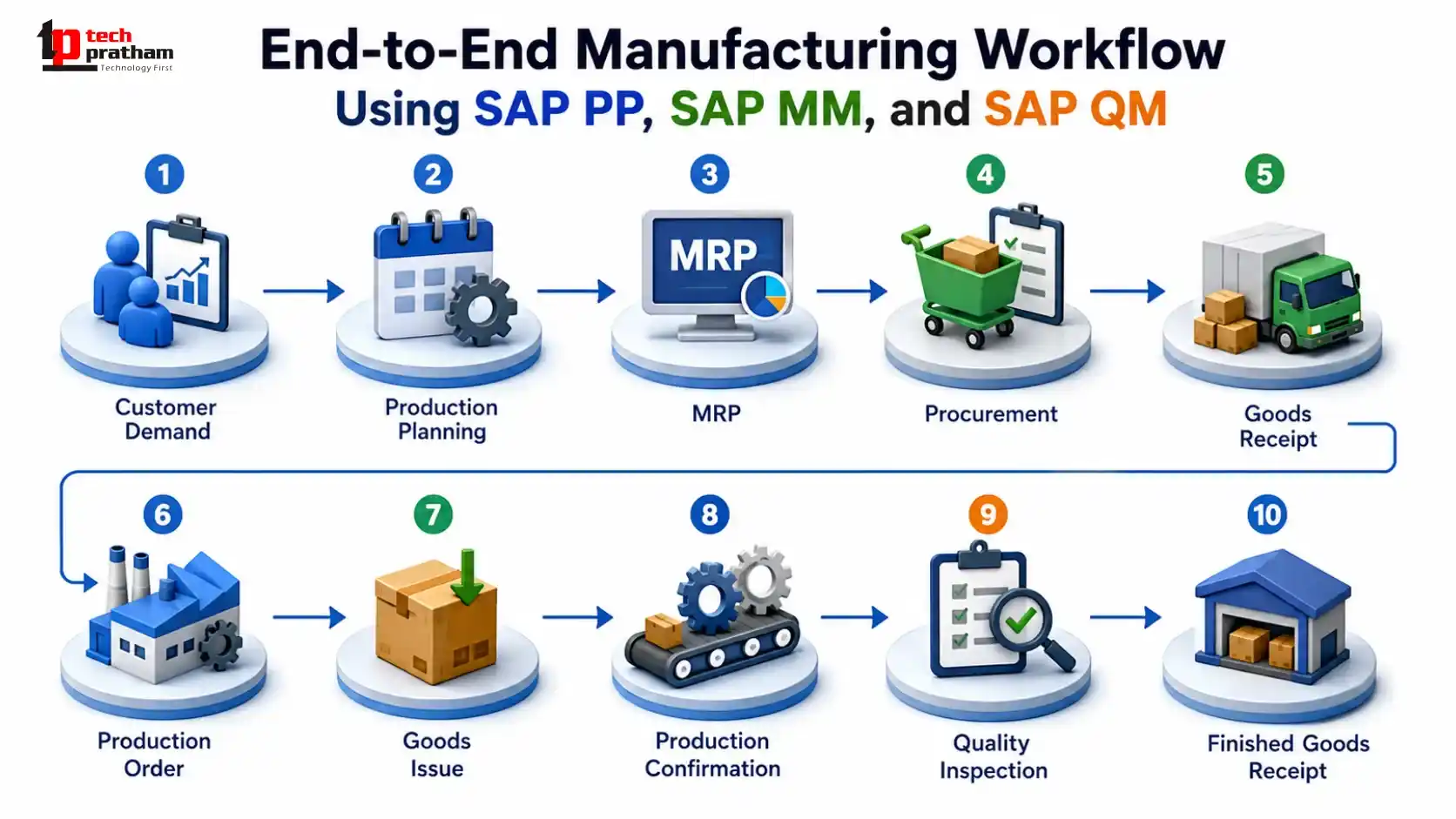
Understanding the complete manufacturing workflow makes it easier to see how SAP PP, SAP MM, and SAP QM work together in a real business environment. The process starts when customer demand or a forecast creates a requirement for production. SAP PP uses this demand to plan production quantities, schedules, and required resources, while MRP calculates the materials needed for manufacturing. SAP MM checks available stock and identifies any material shortages.
If additional materials are required, the procurement process begins through purchase requisitions and purchase orders. Once the materials arrive, SAP MM records the goods receipt and updates inventory. After the required materials are available, SAP PP releases the production order and manufacturing begins according to the defined routing and work centers. Raw materials are issued for production, and production confirmations record the actual manufacturing activities and quantities. SAP QM then supports the required quality inspections to determine whether the manufactured products meet the defined standards.
Industries That Benefit from SAP PP, MM, and QM Integration
Many industries depend on integrated SAP solutions to manage complex manufacturing operations. Some of the major industries include:
- Automotive Manufacturing
- Pharmaceuticals
- Food and Beverage
- Electronics
- Chemical Manufacturing
- Textile Industry
- FMCG
- Engineering and Heavy Machinery
- Medical Device Manufacturing
- Consumer Goods
These industries require accurate production planning, efficient inventory management, and consistent quality control, making SAP integration an essential business requirement.
What You Learn During SAP PP Training in India
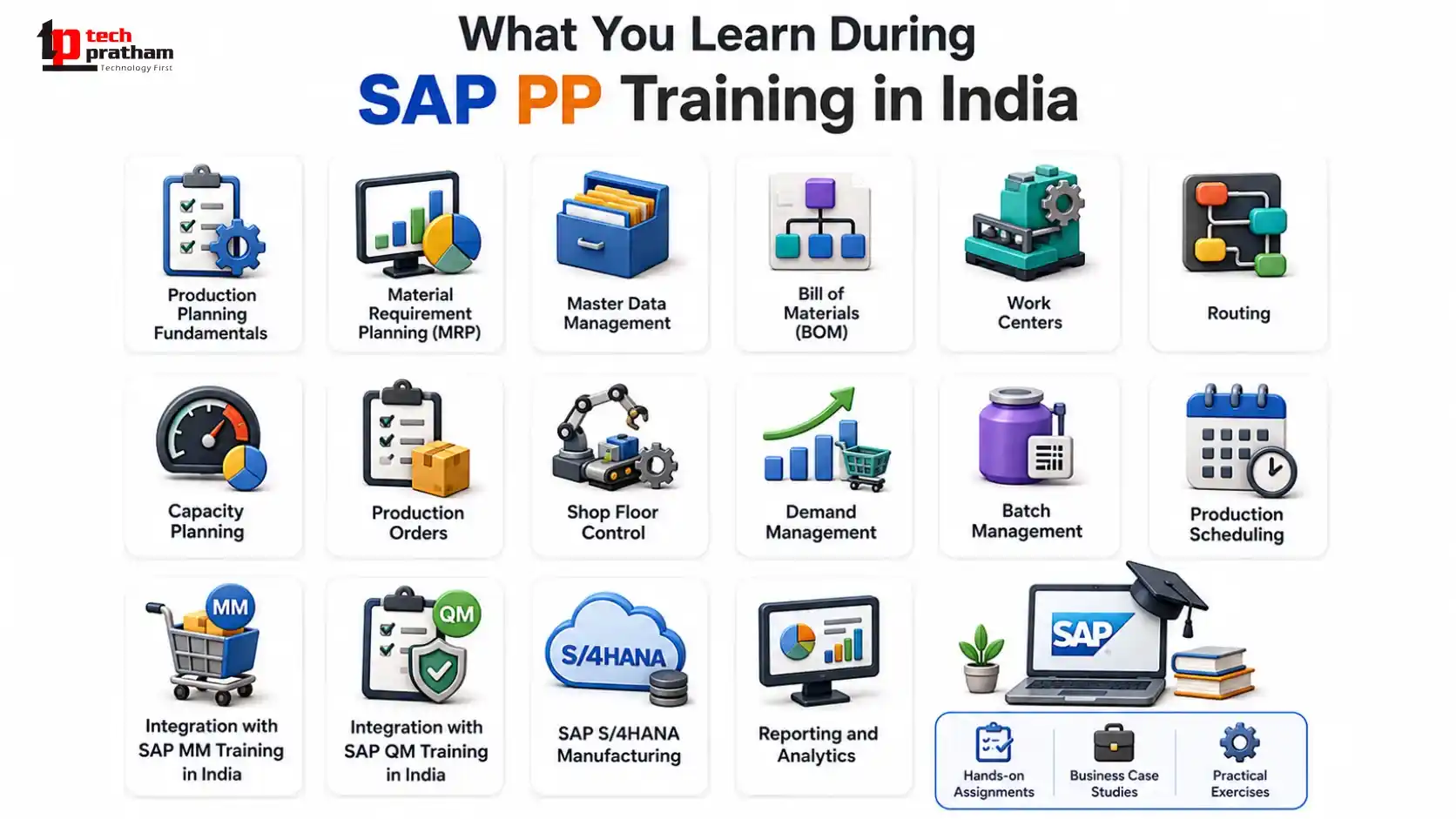
A well-designed SAP PP Training in India program helps learners develop a practical understanding of how production planning and manufacturing operations are managed through SAP. The training covers essential concepts such as production planning, Material Requirement Planning (MRP), master data, Bill of Materials (BOM), work centers, routing, capacity planning, production orders, shop floor control, demand management, batch management, and production scheduling. Learners also understand how production activities are connected with material availability and quality requirements through SAP MM Training in India and SAP QM Training in India.
Career Opportunities After SAP PP Training in India
As organizations continue to adopt SAP ERP solutions, the demand for skilled SAP professionals remains strong. Completing a SAP PP Course in India can open opportunities in manufacturing companies, consulting firms, and IT service organizations. Some popular career roles include:
- SAP PP Consultant
- SAP Functional Consultant
- Manufacturing Business Analyst
- Production Planner
- SAP Support Consultant
- SAP S/4HANA Manufacturing Consultant
- ERP Functional Analyst
- Production Planning Executive
Professionals who understand integration with SAP MM and SAP QM are often preferred because they can support complete business processes instead of working on isolated modules.
Why Learn SAP PP Along with SAP MM and SAP QM?
Learning only one SAP module may provide basic knowledge, but understanding how multiple modules work together gives professionals a broader perspective of enterprise operations. By combining SAP PP Training in India with knowledge from SAP MM Course in India and SAP QM Training in India, learners can:
- Understand complete manufacturing workflows
- Improve inventory and procurement planning
- Support quality assurance processes
- Solve cross-functional business challenges
- Increase employability in manufacturing industries
- Prepare for SAP implementation and support projects
This integrated knowledge is especially valuable in organizations using SAP S/4HANA, where connected business processes play a critical role in operational success.
Frequently Asked Questions (FAQs)
1. What is the scope of SAP PP in India?
2. How does SAP PP integrate with SAP MM?
3. What is the role of SAP MM and SAP QM in SAP PP?
4. Is SAP QM knowledge useful for SAP PP professionals?
Conclusion
SAP PP Training in India provides much more than production planning knowledge. It introduces learners to the complete manufacturing lifecycle by integrating production planning with material management and quality management. Understanding how SAP PP works with SAP MM Training in India and SAP QM Training in India enables professionals to manage production, inventory, procurement, and quality assurance more effectively.
Related Articles

How to Start a SAP FICO Career With a Finance Background
Build a successful SAP FICO career with a finance background. Learn the skills, practical steps, career opportunities, and path to move from finance t

Why Are SAP Skills in High Demand in Hyderabad?
Discover why SAP skills are in high demand in Hyderabad, the top SAP modules, career opportunities, and the value of SAP training for professionals.

Top 40 SAP Interview Questions and Answers for Job Preparation
Prepare for SAP Interview Questions with 40 practical questions and answers covering SAP basics, modules, scenarios, troubleshooting, and job preparat





 +91-8882178896
 +1 (343) 477-0926