
How to Start a SAP FICO Career With a Finance Background

For finance professionals, moving into the world of enterprise technology can be a natural next step. If you already work with accounting, financial reporting, accounts payable, accounts receivable, cost management, or other finance-related activities, you may already have a strong foundation for learning SAP FICO.
The transition does not require you to leave your finance knowledge behind. Instead, you can build on what you already know and learn how financial processes are managed within an ERP system. Your understanding of accounting concepts can help you relate to SAP financial processes and business scenarios more easily.
Why Finance Professionals Are Choosing SAP FICO
Finance has changed significantly with the growing use of digital business systems. Organizations use ERP platforms to manage financial transactions, reporting, purchasing, sales, inventory, and other business activities in a connected environment. This creates opportunities for professionals who understand both finance processes and business systems.
For someone from a finance background, learning SAP can be easier to relate to because many of the underlying concepts are already familiar. General ledger, vendor payments, customer receipts, financial reporting, and cost management do not become completely new concepts. What changes is the way these processes are handled within an enterprise system.
Is SAP FICO a Good Career Choice for Finance Professionals?

For finance professionals, SAP FICO can be a relevant career path because it combines existing finance knowledge with enterprise technology skills. If you already understand accounting and financial processes, you have a useful foundation for learning how these activities are managed within SAP.
SAP FICO may be a good choice if you:
- Enjoy working with finance and accounting processes
- Want to understand how business software works
- Are interested in ERP systems
- Like solving process-related problems
- Want to combine finance knowledge with technology
- Are comfortable learning new software and business processes
- Want to move from a traditional finance role toward a technology-oriented career
It can be particularly useful for professionals who want to build a more specialized skill set without completely moving away from their finance background. Your existing knowledge of accounting, reporting, payments, costs, and financial processes can help you understand SAP FICO concepts more easily.
How Your Finance Background Gives You an Advantage
One of the biggest benefits of coming from finance is that you already understand the business behind many SAP processes. For example, you may already know how a company records revenue, manages vendor invoices, tracks expenses, prepares financial statements, or handles month-end closing.
That knowledge can help you understand SAP concepts more easily.
The important thing is not to assume that finance experience alone is enough. Your existing knowledge gives you the business foundation. You then need to learn how that foundation works inside SAP.
What Do You Need to Learn?
Once you decide to explore this career path, it is important to know what skills you need to build. Your finance knowledge gives you a strong foundation, but you also need to understand how these processes work within SAP. Start with the basics and gradually learn FI, CO, integration, configuration, and practical business processes instead of trying to cover everything at once.
Understand ERP and SAP Basics
First, understand what an ERP system does and how different departments share information through one system. This gives you context for understanding why a finance transaction may be connected to purchasing, sales, inventory, or other business activities. .
Learn Financial Accounting
The FI side focuses on financial accounting activities such as:
- General Ledger
- Accounts Payable
- Accounts Receivable
- Asset Accounting
- Bank Accounting
- Financial reporting
Your existing accounting knowledge can make these areas easier to understand. As you progress, it is also useful to understand how financial processes are handled in SAP S/4HANA Finance, where finance activities are integrated with other business processes. This helps you connect your existing accounting knowledge with how modern SAP environments manage financial information.
Learn Controlling
The CO side focuses more on internal financial management. You may come across concepts such as:
- Cost centers
- Profit centers
- Internal orders
- Product costing
- Profitability analysis
The purpose is to understand how organizations monitor costs, performance, and profitability.
Understand Business Processes
Do not learn individual transactions in isolation. Try to understand complete processes such as:
Purchase → Vendor Invoice → Payment → Financial Posting
or
Sales → Customer Invoice → Receipt → Financial Impact
Can You Learn SAP FICO Without an IT Background?
Yes, you can learn the functional side of SAP without coming from a traditional IT background. In fact, a finance or accounting background can give you a useful starting point because many SAP FICO processes are based on familiar financial activities. A finance professional does not need to become a programmer to work in functional SAP FICO roles. The focus is more on understanding business requirements, financial processes, SAP functionality, configuration concepts, testing, reporting, and problem-solving.
You will still need to become comfortable with ERP concepts, SAP terminology, and how different business functions connect with finance. For example, purchasing and sales activities can have a direct impact on financial records, so understanding these connections is important.
How to Start Your Journey From Finance to SAP FICO
A career transition becomes easier when you break it into smaller steps. Start by building on your existing finance knowledge and gradually develop SAP skills through structured learning and practical scenarios. This approach can help you understand the transition more clearly and prepare for relevant SAP FICO roles.
What Should You Learn First?
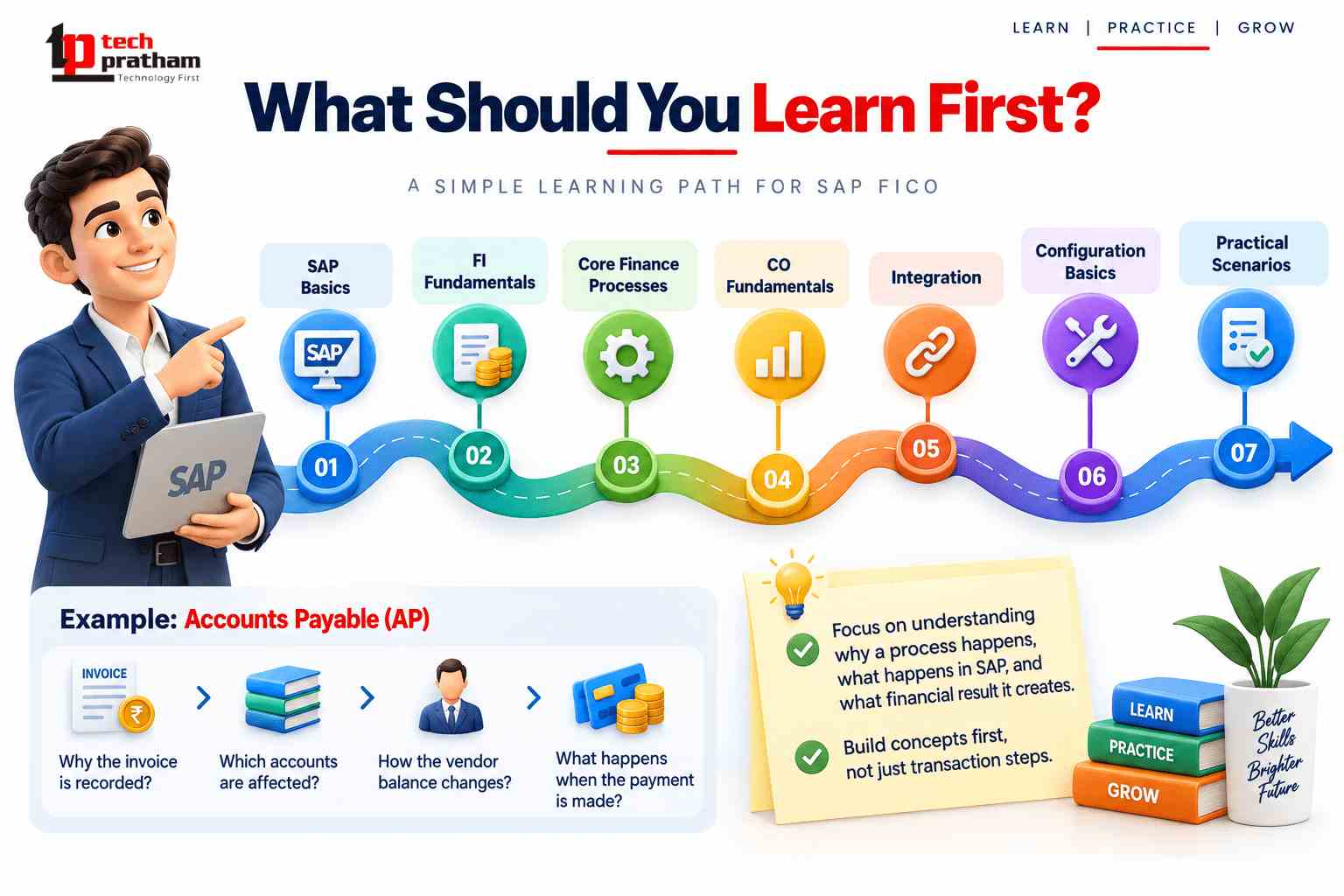
If you are completely new to SAP, it is easy to feel overwhelmed by the number of topics available. A simple order can make the process easier:
SAP basics → FI fundamentals → Core finance processes → CO fundamentals → Integration → Configuration basics → Practical scenarios
Do not try to memorize every transaction or configuration step at the beginning. Focus on understanding why a process happens, what happens in SAP, and what financial result it creates.
For example, when studying Accounts Payable, do not only learn how to enter an invoice. Understand why the invoice is recorded, which accounts are affected, how the vendor balance changes, and what happens when the payment is made. That approach creates deeper understanding and makes interview preparation easier later.
How to Build Real SAP FICO Experience
Practical experience is important because knowing the theory does not automatically mean you understand how a business process works in a real environment. You can build practical understanding by working through scenarios such as:
- Vendor invoice processing
- Customer invoice processing
- Incoming and outgoing payments
- General ledger postings
- Asset-related transactions
- Cost center activities
- Profit center reporting
- Month-end closing
- Financial reporting
- Purchasing and finance integration
- Sales and finance integration
For every scenario, try to understand three things:
For example, imagine a company purchases raw materials from a vendor. The finance team receives the vendor invoice and records the transaction in SAP. The system posts the relevant financial entry and creates a payable amount against the vendor. When the payment is made, the vendor balance is cleared and the corresponding bank account is updated. This helps a finance professional understand how an everyday accounting process moves through SAP and how different financial entries are connected.
What Career Opportunities Can You Explore?
After developing relevant SAP and finance skills, you can explore different functional roles depending on your background and level of experience. Some possible career directions include:
The responsibilities can vary from one organization to another, so always compare your skills with the actual requirements listed in a job description.
Is SAP FICO Certification Worth It?
Certification can be useful when you are building credibility in a new technology area. It can demonstrate that you have studied a defined set of SAP concepts and are serious about developing your skills. However, certification should not be treated as a replacement for practical knowledge.
For a finance professional, a stronger profile can come from combining:
- Finance domain knowledge
- SAP FI and CO understanding
- Business-process knowledge
- Configuration fundamentals
- Practical project exposure
- Problem-solving skills
- Interview preparation
- Relevant certification
Your finance experience remains valuable because it helps you understand the business problems that SAP is being used to solve.
Will AI Affect SAP FICO Careers?

AI is changing the way many business and finance activities are performed, and SAP FICO is also becoming part of this changing technology landscape. However, this does not mean that SAP FICO professionals will simply be replaced by AI. Some repetitive finance activities, reporting tasks, data processing, and routine operations can become more automated. At the same time, organizations still need professionals who understand finance processes, business requirements, SAP functionality, and how different business activities affect financial results.
For finance professionals planning a career in SAP FICO, the better approach is to understand how technology is evolving and continue developing relevant skills. Along with SAP FI and CO knowledge, professionals can benefit from improving their understanding of automation, integrated business processes, data, and emerging SAP technologies.
The future of SAP FICO is likely to involve more technology-enabled finance processes rather than the complete removal of human expertise. Professionals who combine finance knowledge, SAP skills, practical experience, and the ability to adapt to new technologies can be better prepared for this changing environment.
What Challenges Should You Be Ready For?
Moving from finance to SAP can be easier in some areas, but it still comes with a learning curve.
How Can Your Career Grow With SAP FICO?
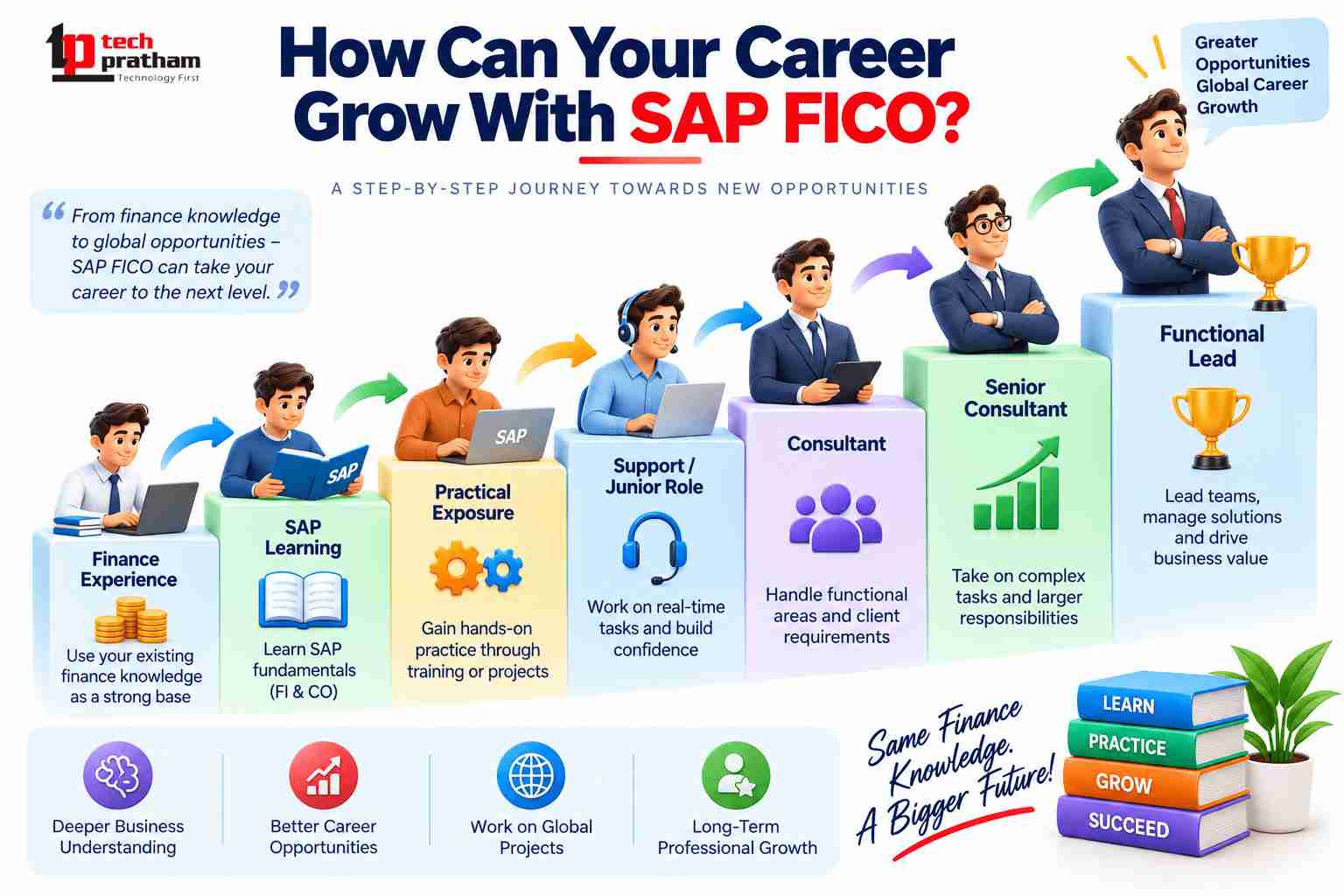
A career transition usually happens gradually rather than overnight. A finance professional may begin by learning SAP fundamentals, then develop practical knowledge and move toward an entry-level or support-oriented role. With project experience, the person can take on more complex responsibilities.
A possible career journey could look like:
Finance Experience → SAP Learning → Practical Exposure → Support/Junior Role → Consultant → Senior Consultant → Functional Lead
The actual path depends on your previous experience, SAP skills, project exposure, and career goals. Long-term growth also depends on continuing to understand business processes rather than focusing only on SAP transactions.
Why Consider TechPratham for Your SAP FICO Journey?
Choosing the right learning platform can make the transition from finance to SAP FICO more structured and practical. TechPratham provides career-focused IT training designed to help learners build relevant skills and understand how technology is applied in real business environments.
For finance professionals, the learning approach can help connect existing accounting knowledge with SAP FI and CO concepts, business processes, practical scenarios, and project-based learning. Instead of focusing only on theoretical concepts, the goal is to develop an understanding of how finance activities are handled within SAP.
Frequently Asked Questions
Can a finance professional start a career in SAP FICO?
Is SAP FICO suitable for accountants?
Do I need coding skills for SAP FICO?
How can I gain practical experience?
Final Thoughts
Starting a career in SAP FICO with a finance background does not mean starting from the beginning. Your existing understanding of accounting and financial processes can give you a useful foundation. The key is to build on that foundation with SAP knowledge, business-process understanding, practical experience, and problem-solving skills.
Related Articles

Why Are SAP Skills in High Demand in Hyderabad?
Discover why SAP skills are in high demand in Hyderabad, the top SAP modules, career opportunities, and the value of SAP training for professionals.

Top 40 SAP Interview Questions and Answers for Job Preparation
Prepare for SAP Interview Questions with 40 practical questions and answers covering SAP basics, modules, scenarios, troubleshooting, and job preparat