Start typing to search courses...

Type in the search box to find courses
Software Testing Training
119 min read24 views

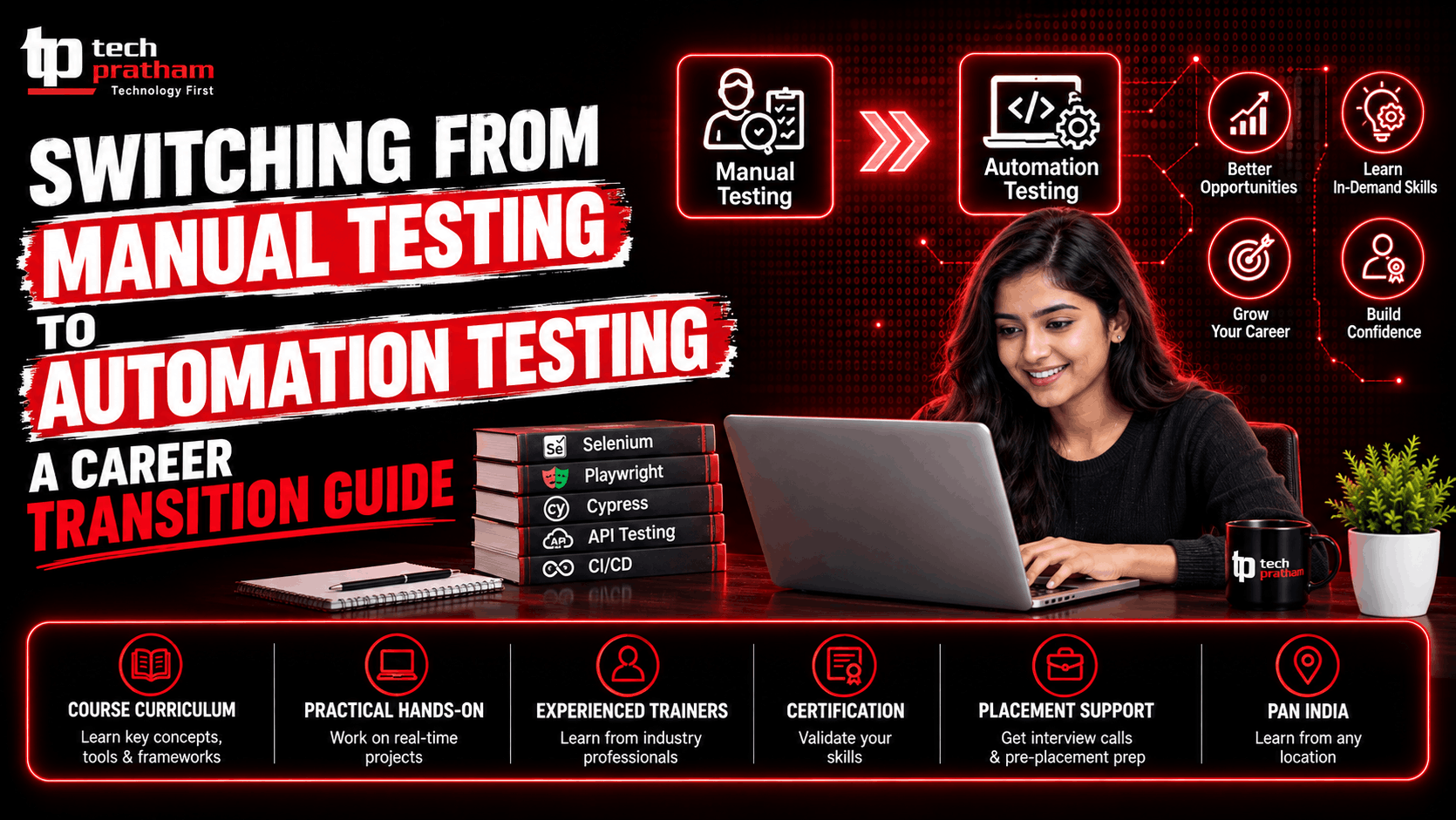
Switching from Manual Testing to Automation Testing: A Career Transition Guide
By TechPratham TeamPublished September 19, 2026Updated September 19, 2026

Many software testers begin their careers with manual testing because it helps them understand software quality, test cases, defects, user requirements, and the overall testing process. But after gaining experience, many manual testers start asking an important question: How can I move into automation testing without starting my career from zero?

The good news is that moving from manual testing to automation testing is a skill upgrade within the same testing domain. Your existing testing experience can become a strong foundation while you gradually develop programming, automation, and tool-related skills.

This guide explains what changes when you move from manual to automation testing, which skills you need, how to learn them, and how to prepare yourself for automation-focused roles.

Why Move From Manual Testing to Automation Testing?

Manual testing builds essential QA knowledge, but automation allows testers to automate repetitive test scenarios and execute tests more efficiently.

A manual tester already understands concepts such as:

  • Test cases and test scenarios
  • Functional and regression testing
  • Defect identification and reporting
  • Requirements analysis
  • Test execution
  • SDLC and STLC
  • Different types of testing
These skills remain valuable in automation testing. The main difference is that automation testers also need to understand programming and automation frameworks.

Therefore, the transition does not mean leaving manual testing behind. It means building on your existing QA experience by developing automation skills through practical learning and Software Testing Training in India.

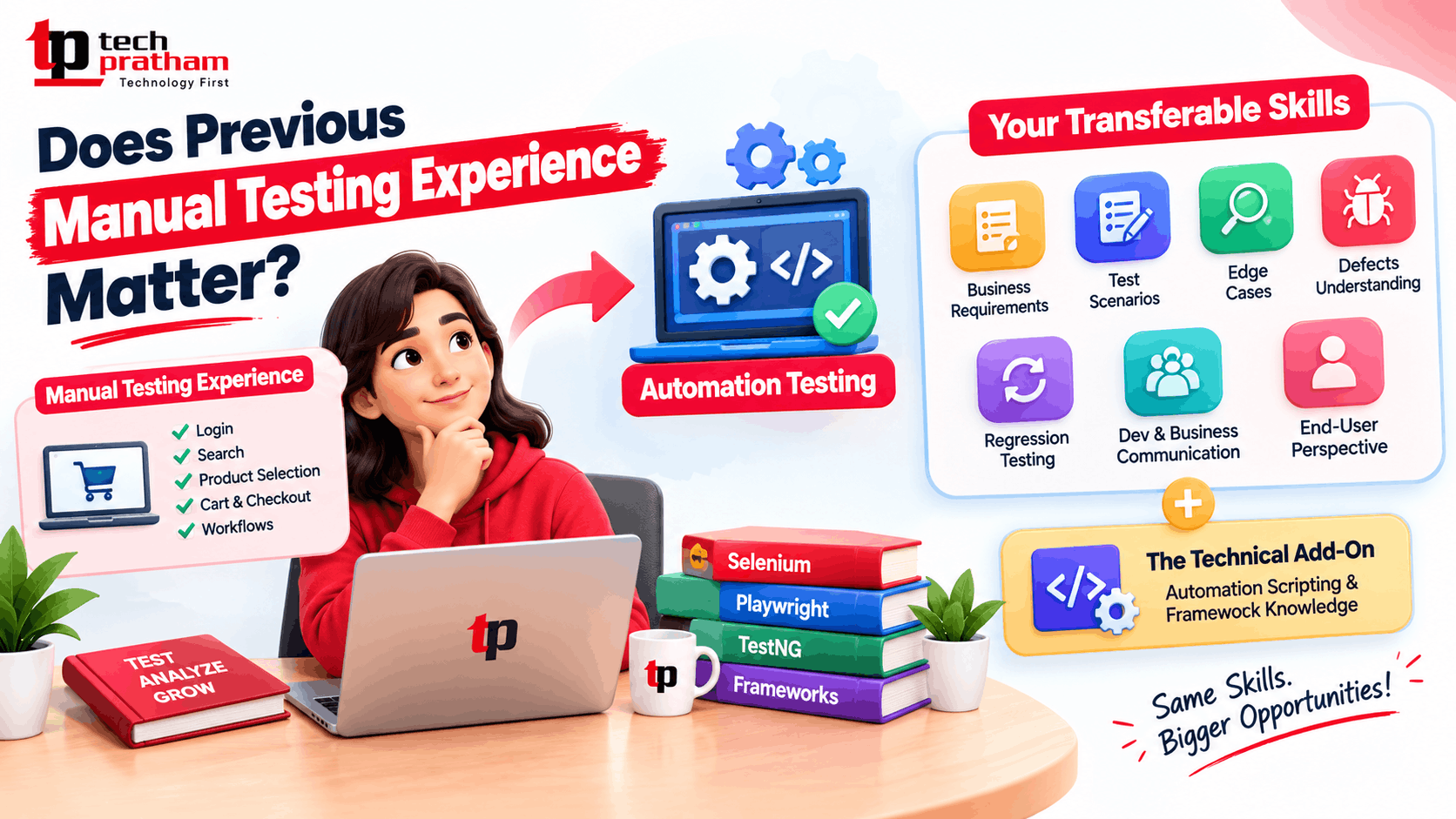
Does Previous Manual Testing Experience Matter?

Yes. Your manual testing experience can help you understand what should be automated and why.

For example, imagine you have tested an e-commerce application manually. You already know how to verify login, search, product selection, cart functionality, checkout, and other workflows.

When you move into automation, you can use that understanding to identify repetitive and stable scenarios that are suitable for automation.

Your transferable skills include:

  • Understanding business requirements
  • Creating effective test scenarios
  • Identifying edge cases
  • Understanding defects
  • Regression testing knowledge
  • Communicating with developers and business teams
  • Thinking from an end-user perspective
The technical part you need to add is automation scripting and framework knowledge.

Do You Need Coding Skills for Automation Testing?

Basic programming knowledge becomes important when moving into automation testing.

You do not necessarily need to become a software developer, but you should be comfortable understanding and writing basic code.

Depending on the automation technology you choose, you may need to learn concepts such as:

  • Variables and data types
  • Conditions and loops
  • Functions or methods
  • Arrays and collections
  • Object-oriented programming basics
  • Exception handling
  • File handling
  • Debugging
Start with programming fundamentals rather than trying to learn an entire programming language at once. Your goal is to understand enough programming to create, maintain, troubleshoot, and improve automation scripts.

What Skills Should a Manual Tester Learn?

A manual tester transitioning to automation can follow a gradual learning path.

1. Strengthen Testing Fundamentals

Do not skip your existing testing knowledge. Automation works best when you understand what needs to be tested. Review functional testing, regression testing, test case design, defect management, and basic QA processes.

2. Learn Programming Basics

Choose a programming language relevant to the automation tools you plan to use and learn its fundamentals. Focus on writing small programs and understanding how code works rather than memorizing syntax.

3. Learn an Automation Tool

After building programming fundamentals, start with an automation framework or tool relevant to your target role.

Learn how to:

  • Identify application elements
  • Create automated test scripts
  • Execute tests
  • Handle different test conditions
  • Maintain scripts
  • Generate and understand test results

4. Understand Automation Frameworks

As your skills improve, learn how automation projects are structured. You may encounter concepts such as page object models, reusable functions, test data management, reporting, and framework organization.

5. Practice With Realistic Projects

Project practice helps connect individual concepts. Instead of only following tutorials, automate workflows that resemble actual applications.

A Simple Roadmap From Manual to Automation Testing

A practical progression can look like this:

Manual Testing Fundamentals → Programming Basics → Automation Tool → Framework Concepts → Test Automation Projects → Version Control/CI Concepts → Portfolio → Interview Preparation


You do not have to master everything at once.

For example, begin by automating simple login and search scenarios. Then move toward regression suites, data-driven testing, reusable components, and more complex workflows.

How Can You Build Practical Automation Experience?

Practical experience is important because knowing the commands of an automation tool is different from building a maintainable test suite.


Start with a small application and follow a realistic testing process:

Requirement → Test Scenario → Automation Script → Execution → Defect Identification → Result Analysis

Beginner project ideas could include:

  • E-commerce website testing
  • Login and registration automation
  • Product search and filtering
  • Shopping cart testing
  • Form validation
  • Booking workflow automation

For each project, document what you tested, why you selected those scenarios, how the automation was structured, and what results you achieved.


This gives you something concrete to discuss during interviews.

How Is AI Changing Automation Testing?


AI is increasingly becoming part of software testing workflows. Testers may use AI-assisted tools to help generate test ideas, create code suggestions, analyze test results, or identify patterns in testing data.

However, AI does not remove the need for core testing knowledge.

A tester still needs to understand:

  • What should be tested
  • Whether a generated test is relevant
  • Whether the result is reliable
  • Which defects matter to the business
  • When human validation is required

For someone moving from manual to automation testing, the sensible sequence is:

Testing Fundamentals → Automation Skills → AI Awareness → AI-Assisted Testing → Human Validation

Learning AI alongside automation can be useful, but it should complement—not replace—the fundamentals.

Is Certification Necessary for the Transition?

Certification can support your professional profile, particularly when it demonstrates structured knowledge or preparation in software testing.


A Software Testing Certification Training in India program may help learners organize their preparation and understand important testing concepts.

However, certification alone does not demonstrate that you can build or maintain automation scripts.

A stronger profile combines:

Testing Knowledge + Automation Skills + Projects + Certification + Interview Preparation

When evaluating certification or training, look beyond the certificate itself and consider whether you will actually practice the skills covered.

Can Working Manual Testers Learn Automation?

Yes. Working professionals can gradually develop automation skills alongside their existing responsibilities.


A realistic approach is to create a consistent learning schedule rather than trying to complete everything in a short period.

For example:

  • Learn programming concepts during the initial stage.
  • Practice automation scripts regularly.
  • Build one project at a time.
  • Review your existing manual testing knowledge.
  • Gradually explore frameworks and advanced concepts.

Consistency is more useful than trying to learn a large number of tools simultaneously.

How to Choose Software Testing Training in India

If you decide to take structured training, look for a program that supports the complete transition from testing fundamentals to automation.


Consider whether the Software Testing Course in India includes:

  • Testing fundamentals
  • Programming basics
  • Automation tools
  • Practical assignments
  • Hands-on exercises
  • Project-based learning
  • Framework concepts
  • Resume preparation

Also consider whether the learning format works with your current experience and schedule.


The right training should help you understand the concepts rather than simply provide recorded lessons or tool demonstrations.

Why Choose TechPratham for Software Testing Training?

For manual testers who want structured guidance while developing automation skills, training can provide a clear learning sequence and regular practice.


TechPratham's Software Testing Course in India can be considered as part of this learning journey when you are looking for structured software testing education. Learners should evaluate the curriculum, practical assignments, project exposure, recordings where applicable, resume preparation, and interview preparation based on their individual goals.

The objective should be to build skills that you can demonstrate—not simply complete a course.

Frequently Asked Questions

Can a manual tester become an automation tester?

Yes. Manual testing experience provides a useful foundation. The main additional skills are programming, automation tools, frameworks, and practical automation experience.

Is coding mandatory for automation testing?

Programming knowledge is important for most modern automation roles. Beginners can start with basic programming concepts and gradually progress to writing and maintaining automation scripts.

Should I stop learning manual testing after moving to automation?

No. Manual testing concepts remain important because automation testers still need to understand requirements, test scenarios, defects, and testing strategies.

How long does it take to learn automation testing?

The timeline depends on your existing testing experience, programming knowledge, learning schedule, and practice. A consistent learning routine is more important than a fixed timeline.

Is a software testing certification enough to get an automation testing role?

No. Certification can support your profile, but employers may also look for practical automation skills, programming knowledge, project experience, and the ability to explain your testing approach.

Can a non-programmer learn automation testing?

Yes. A person without strong programming experience can begin with programming fundamentals and gradually build automation skills through practice.

Final Thoughts

Switching from manual testing to automation testing is a gradual skill transition rather than a complete career restart. Your existing QA knowledge can remain valuable while you add programming, automation tools, frameworks, project experience, and AI awareness.


The most useful approach is to learn step by step, practice on realistic testing scenarios, build projects, and prepare yourself to explain your technical work during interviews.

If you are ready to develop your testing skills in a structured environment, explore a suitable Software Testing Training in India program based on your current experience and career goals.