
Software Testing Training
142 min read15 viewsThe Future of Software Testing: How AI Is Changing the Industry
By TechPratham TeamPublished November 18, 2026Updated November 18, 2026
.png)
Software testing has always been an important part of software development. Before an application is released, testing teams check whether its features work correctly, identify bugs, and make sure users get a smooth experience. As technology continues to change, the way software testing is performed is also changing.
Artificial Intelligence (AI) is one of the biggest technologies influencing the software testing industry. It is helping testers create test cases, write automation scripts, identify possible defects, and analyse test results in less time.
Earlier, testers had to perform many testing activities manually. Today, AI-powered tools can assist with several repetitive tasks and make the testing process faster. However, this does not mean that human testers are no longer required.
The future of software testing will involve a combination of human knowledge, automation skills, and artificial intelligence. In this article, we will understand how AI is changing the software testing industry, what new skills testers need, and what opportunities may be available in the coming years.
1. How AI Is Changing the Software Testing Industry
AI is changing the way testers perform their daily activities. It can analyse information, suggest test scenarios, generate scripts, and help identify problems in applications.
For example, imagine a tester is working on an online shopping application. The application has features such as user registration, login, product search, shopping cart, payment, and order tracking.
Earlier, the tester would prepare test cases for each feature manually. With AI assistance, the tester can provide the application requirements to an AI tool and ask it to suggest different test scenarios.
The tester can then review those scenarios, make corrections, and use them during testing.
Some important changes include:
- Faster test case creation.
- Better support for automation testing.
- Quick analysis of test results.
- Reduced repetitive testing activities.
- Improved identification of possible testing gaps.
AI is making testing activities more efficient, but testers still need to check whether the results are correct.
2. Automation Testing Will Become More Advanced
Automation testing is already an important part of modern software development. It helps testing teams execute repetitive test cases without performing every step manually. With the introduction of AI, automation testing is becoming more advanced.
Earlier, automation testers had to write scripts, identify application elements, and update scripts whenever application changes affected the existing tests. AI-powered automation tools can now assist with script creation, test maintenance, and identifying changes in application elements.
For example, if a button on a website changes its position or properties, some AI-powered tools can identify the updated element and help maintain the automation test. This is commonly associated with self-healing test automation.
In the future, AI-assisted automation is likely to become more common in areas such as:
- Web application testing.
- Mobile application testing.
- API testing.
- Regression testing.
- Cross-browser testing.
- End-to-end testing.
Automation testers who understand programming, testing concepts, and AI-based tools will be better prepared to work with these developments.
3. AI Will Help Testers Create Better Test Cases
Writing test cases is one of the most important activities in Software Testing Course in India. A good test case helps testers check whether an application works according to business requirements.
However, preparing test cases for applications with many features can take considerable time.
AI can help testers create test cases by analysing requirements and suggesting different scenarios.
For example, consider a user login page. A tester can ask an AI tool to prepare test cases for the following situations:
.png)
- Login with valid username and password.
- Login with an incorrect password.
- Submit the form with empty fields.
- Enter an invalid email address.
- Check the password visibility option.
- Verify account locking after repeated failed attempts.
AI can also suggest negative and boundary test scenarios that may need further attention.
This does not mean testers should use every generated test case without checking it. They must review the scenarios and confirm that they match the actual application requirements.
In the future, AI-assisted test case generation may help teams prepare testing documentation faster and improve test coverage.
4. Manual Testing Will Continue to Play an Important Role
Many people believe that AI and automation will completely replace manual testing. However, this is not necessarily true.
Manual testing involves more than following predefined steps. Testers also need to understand user behaviour, explore applications, identify unusual problems, and check whether an application provides a good user experience.
For example, imagine a food delivery application. A tester may check whether users can search for restaurants, place orders, make payments, and track deliveries.
But the tester may also notice that the application displays confusing information, has an inconvenient navigation flow, or creates problems during an unusual user interaction.
These situations require human observation and judgement.
AI can assist with repetitive tasks, but human testers are still important for:
- Exploratory testing.
- Understanding business requirements.
- Checking user experience.
- Evaluating unexpected application behaviour.
- Making testing decisions.
- Reviewing AI-generated results.
Therefore, manual testing knowledge will continue to be a valuable foundation for software testers.
5. AI Will Improve Regression Testing
Regression testing is performed to make sure that new changes in an application do not affect existing features.
For example, an e-commerce application may introduce a new payment option. After this change, testers need to check whether existing features such as login, product search, shopping cart, and order placement are still working correctly.
Running every test case after every small change can take a lot of time.
AI can help analyse application changes and suggest which test cases should be executed first.
It can also help identify areas that may be more likely to be affected by recent code changes.
This can help testing teams focus on important test cases and use their testing time more effectively.
As applications become larger and software updates become more frequent, intelligent regression testing will become an important part of software quality assurance.
6. AI Will Create New Testing Challenges
Although AI offers several benefits, it also creates new challenges for software testing teams.
AI-powered applications do not always produce the same output for the same input. For example, an AI chatbot may provide slightly different answers when a user asks the same question multiple times.
Traditional testing often depends on predefined expected results. But testing AI-based applications requires testers to check additional factors such as response accuracy, consistency, relevance, and safety.
Some important challenges include:
Testing AI-generated responses: Testers need to check whether AI-generated answers are correct, useful, and relevant.
Data privacy: AI tools may process business information and application data. Testing teams must follow company security policies when using external AI services.
Incorrect AI suggestions: AI-generated test cases and automation scripts may contain errors. Testers need to validate them before using them.
Changing application behaviour: AI-based applications may produce different results depending on user inputs and available data.
Bias in AI results: Testers may need to check whether an AI application produces unfair or biased responses.
Understanding these challenges will become increasingly important for software testing professionals.
7. New Skills Software Testers Will Need in the Future
As the software testing industry changes, testers will also need to improve their technical skills.
Learning only basic manual testing may not be enough for professionals who want to explore modern testing roles. A combination of testing knowledge, automation skills, and AI awareness can help them adapt to industry changes.
Here are some important skills testers should consider learning.
1. Manual Testing
Testers should understand test cases, test scenarios, functional testing, regression testing, and defect management.
2. Automation Testing
Knowledge of automation frameworks and tools helps testers automate repetitive testing activities.
3. Programming Basics
Learning languages such as Java, Python, or JavaScript can help testers understand automation scripts and work with testing frameworks.
4. AI Testing Tools
Testers should become familiar with AI tools that help generate test cases, analyse results, and support automation activities.
5. API Testing
Modern applications use APIs to exchange information between different systems. Understanding API testing is an important technical skill.
6. Analytical Skills
Testers need to understand application behaviour, analyse defects, and identify possible reasons behind failures.
7. Communication Skills
Testing professionals regularly work with developers, business analysts, project managers, and other team members. Clear communication helps them explain issues and discuss solutions.
Developing these skills can help testers prepare for changing responsibilities in the software testing industry.
8. Will AI Replace Software Testing Jobs?
This is one of the most common questions among students and working professionals who want to build a career in software testing.
AI can automate many repetitive testing activities, but software testing requires much more than executing test cases.
A testing professional needs to understand business requirements, identify important risks, evaluate application behaviour, and make decisions about software quality.
For example, an AI tool may generate 50 test cases for a banking application. However, a tester needs to decide whether those cases cover the actual banking requirements and whether the results are correct.
The role of testers may change as AI becomes more widely used. Instead of spending most of their time on repetitive activities, testers may spend more time reviewing AI-generated results, improving test strategies, analysing complex problems, and checking application quality.
Therefore, learning new technologies and improving testing skills will be important for professionals who want to remain relevant in this industry.
9. What Does the Future of Software Testing Look Like?
The future of software testing will likely involve more intelligent automation, continuous testing, and AI-assisted quality checks.
Here are some developments that may become increasingly important:
AI-Assisted Test Automation: AI will continue to support the creation, execution, and maintenance of automated tests.
Continuous Testing: Testing will become more closely connected with software development so that issues can be identified earlier.
Predictive Testing: AI may help teams identify high-risk application areas before they create major problems.
Testing AI Applications: As more businesses introduce AI features, testers will need to check the accuracy, reliability, and safety of these applications.
Human and AI Collaboration: Testing teams will increasingly combine human decision-making with AI-powered assistance.
These developments show that software testing is not disappearing. Instead, testing methods and professional responsibilities are evolving.
10. How Beginners Can Prepare for the Future of Software Testing
If you are planning to start a career in software testing, this is a good time to build a strong foundation and understand modern testing technologies.
You do not need to learn every AI tool at once. Start with the basic concepts and gradually move towards advanced testing skills.
Here is a simple learning path:
- Learn software testing fundamentals and the software development life cycle.
- Understand manual testing concepts and test case writing.
- Learn how to identify, report, and track software defects.
- Explore SQL and basic database testing.
- Understand API testing and web application testing.
- Learn an automation testing framework and programming basics.
- Explore AI tools that can assist with test case creation and automation.
This approach can help beginners develop the knowledge required for software testing roles.
Conclusion
Artificial Intelligence is changing the software testing industry by making test case creation, automation, defect analysis, and regression testing more efficient.
However, AI is not a complete replacement for human testers. Understanding application requirements, identifying complex problems, evaluating user experience, and making important testing decisions still require human knowledge and judgement.
The future of Software Testing Training in India will depend on how well professionals combine traditional testing concepts with modern technologies.
For beginners and working professionals, the best approach is to strengthen manual testing fundamentals, learn automation testing, and gradually explore AI-powered testing tools.
At TechPratham, learners can build their software testing knowledge through online live instructor-led training, practical assignments, working professional trainers, and live project exposure. The training also includes interview preparation and placement assistance to help learners prepare for software testing career opportunities.
Learning the right skills today can help you prepare for the changing demands of tomorrow's software testing industry.
Frequently Asked Questions (FAQs)
1. What is the future of software testing?
The future of software testing will involve AI-assisted automation, continuous testing, intelligent test case generation, and improved defect analysis. Human testers will continue to play an important role in software quality.
2. How is AI changing software testing?
AI is helping testers generate test cases, create automation scripts, analyse test results, identify possible defects, and reduce repetitive testing work.
3. Will AI replace manual testers?
AI is unlikely to replace all manual testing activities. Human testers are still important for exploratory testing, understanding business requirements, evaluating user experience, and making testing decisions.
4. What skills should software testers learn in the future?
Software testers should develop skills in manual testing, automation testing, programming, API testing, SQL, AI testing tools, and analytical problem-solving.
5. Is software testing a good career in the age of AI?
Software testing can remain a good career option for people who are willing to learn new technologies and improve their technical skills. Knowledge of automation and AI-assisted testing can be useful.
6. Can beginners learn AI in software testing?
Yes. Beginners can start with software testing fundamentals and gradually learn how to use AI tools for test case generation, automation, and defect analysis.
7. What is AI-powered automation testing?
AI-powered automation testing uses artificial intelligence to assist with activities such as creating test scripts, identifying application changes, maintaining tests, and analysing execution results.
8. Why is manual testing still important?
Manual testing helps identify usability issues, unexpected behaviour, and problems that may require human observation and judgement. It also provides an important foundation for automation testing.
Related Articles
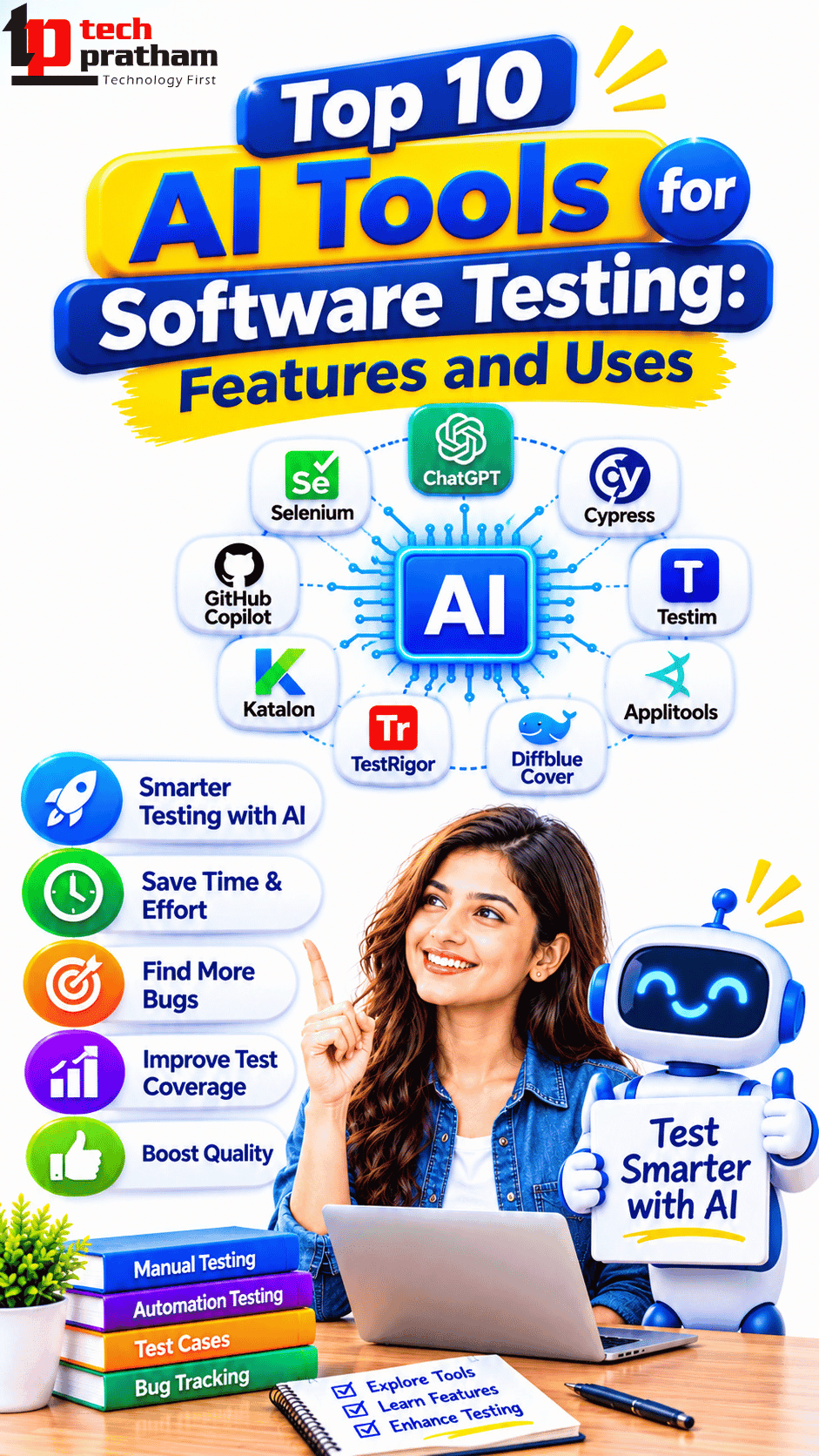
Software Testing Training
Top 10 AI Tools for Software Testing: Features and Uses
Explore the top 10 AI tools for software testing, their key features, benefits, and uses to improve software quality and efficiency.

Software Testing Training
AI vs Traditional Software Testing: What's Changing in 2026?
AI is transforming software testing in 2026 with smarter automation, faster bug detection, and improved testing accuracy.





 +91-8882178896
 +1 (343) 477-0926