
Software Testing Training
161 min read18 viewsTop 10 AI Tools for Software Testing: Features and Uses
By TechPratham TeamPublished November 11, 2026Updated November 11, 2026
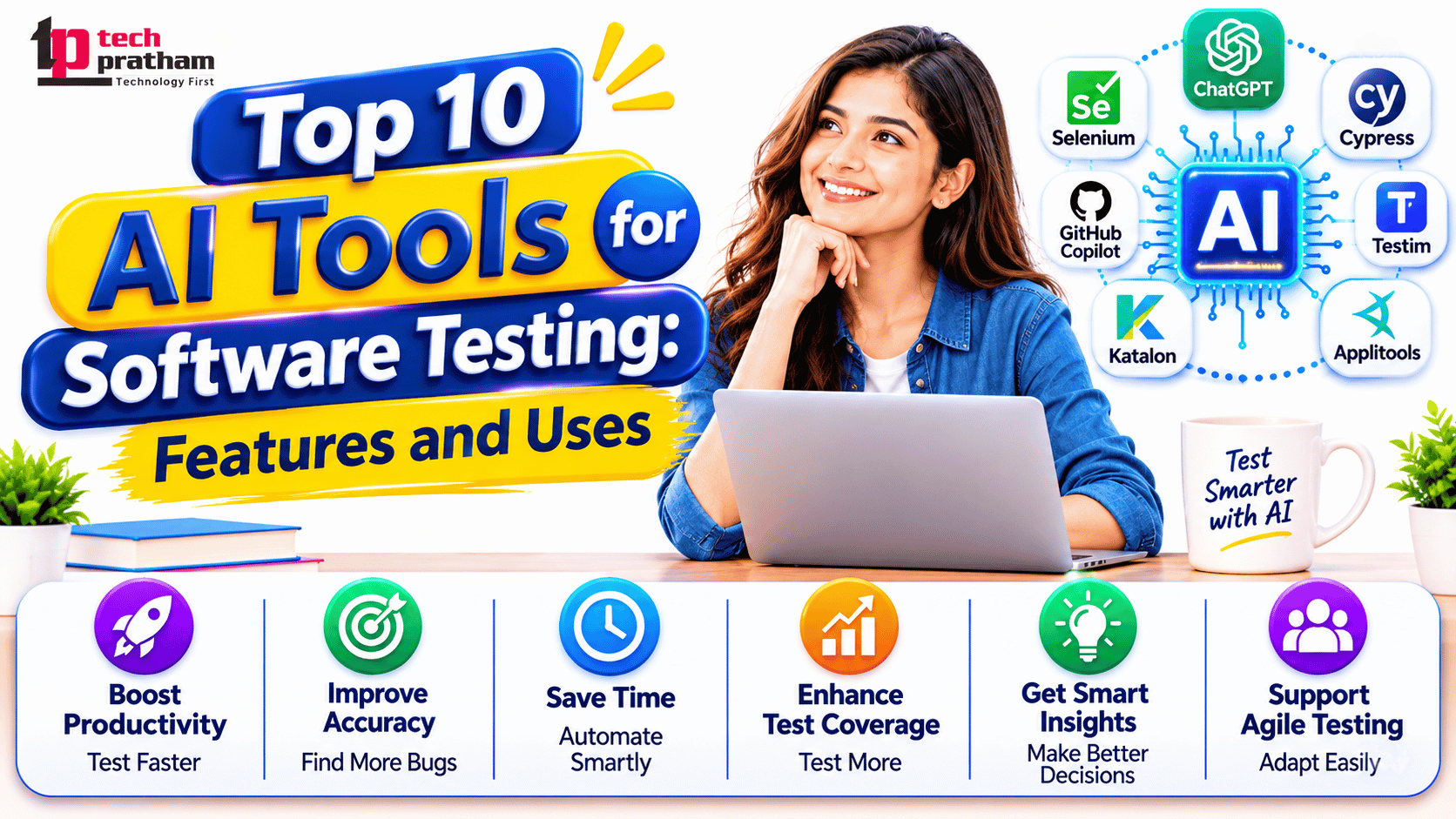
Software testing is an important part of software development. It helps developers and testing teams find bugs, check application performance, and make sure that software works as expected. However, traditional testing methods can take a lot of time, especially when applications have many features and complex workflows.
Artificial Intelligence (AI) is changing the way software testing is performed. Today, testers can use AI tools to create test cases, generate automation scripts, identify defects, analyse test results, and reduce repetitive testing work.
AI tools do not completely replace software testers. Instead, they help testers complete different testing activities more efficiently. They also make it easier for beginners to understand test scenarios and learn automation testing.
In this article, we will explore the top 10 AI tools for software testing, their important features, and how testers can use them in real-world projects.
What Are AI Tools for Software Testing?
AI tools for software testing are applications that use artificial intelligence, machine learning, or language models to support different testing activities. These tools help testers perform tasks such as:
- Creating test cases from software requirements.
- Generating automation scripts.
- Finding errors and unexpected application behaviour.
- Analysing failed test results.
- Checking changes in application interfaces.
- Reducing manual work in repetitive testing activities.
For example, a tester can provide an application requirement to an AI tool and ask it to generate positive, negative, and boundary test scenarios. The tester can review these scenarios and use them during the testing process.
Top 10 AI Tools for Software Testing
Different AI tools support different testing activities. Some help generate test cases, while others focus on automation, visual testing, and defect analysis. Let's understand 10 popular tools and their uses.
1. ChatGPT
In Software Testing Course in India ChatGPT is an AI assistant that helps software testers with test planning, test case creation, bug analysis, and documentation. Testers can provide application requirements in simple English and ask ChatGPT to prepare different testing scenarios.
For example, if a tester is working on a login page, ChatGPT can suggest test cases for valid login details, incorrect passwords, empty fields, password visibility, and account locking.
Important Features:
- Generates manual test cases from requirements.
- Creates positive and negative test scenarios.
- Helps prepare bug reports.
- Explains software testing concepts.
- Generates sample test data.
- Helps understand automation scripts.
Uses in Software Testing:
ChatGPT is useful for manual testers, automation testers, and beginners. It can reduce the time required to prepare testing documentation and help testers identify scenarios they may have missed. However, generated results should always be reviewed before using them in actual projects.
2. GitHub Copilot
GitHub Copilot is an AI coding assistant that helps developers and automation testers write code. It provides code suggestions while working in supported development environments.
Automation testers can use it to write test scripts, understand existing code, and improve automation frameworks.
For example, a tester working with Selenium and Java can describe a login testing requirement and ask Copilot to suggest an automation script.
Important Features:
.png)
- Helps generate unit tests.
- Explains existing code.
- Assists with code debugging.
- Supports multiple programming languages.
- Helps improve code readability.
Uses in Software Testing:
GitHub Copilot is particularly useful for automation testers who work with programming languages such as Java, Python, and JavaScript. It can speed up script development, but testers still need to validate the generated code and check whether it covers the required scenarios.
3. Katalon
Katalon is a software testing platform that supports web, mobile, API, and desktop application testing. It provides automation capabilities along with AI-assisted features that help testing teams manage different testing activities.
Testers can use Katalon to create, execute, and maintain automated test cases.
Important Features:
- Supports web and mobile testing.
- Provides API testing capabilities.
- Offers low-code and scripting-based automation.
- Includes AI-assisted testing features.
- Supports test execution and reporting.
- Helps manage different testing activities.
Uses in Software Testing:
Katalon is useful for teams that need to test different types of applications through one platform. Beginners can explore its low-code capabilities, while experienced automation testers can use scripting features to create more advanced test cases.
4. Testim
Testim is an AI-powered test automation platform designed to help teams create and maintain automated tests.
One of its useful capabilities is intelligent element identification. This helps automation tests remain more stable when application interfaces change.
One of its useful capabilities is intelligent element identification. This helps automation tests remain more stable when application interfaces change.
Important Features:
- AI-assisted test creation.
- Intelligent element identification.
- Automated test execution.
- Test maintenance support.
- Integration with development workflows.
- Support for web application testing.
Uses in Software Testing:
Testim can help testers automate application workflows such as user registration, login, form submission, and checkout processes. Its intelligent element identification can also reduce some maintenance work when application elements change.
5. Mabl
Mabl is an AI-powered testing platform that supports continuous testing. It helps teams automate application testing and identify problems during software development.
It supports different testing activities, including end-to-end, API, and visual testing.
Important Features:
- AI-assisted test creation.
- Automated end-to-end testing.
- Test maintenance capabilities.
- Visual testing support.
- Test result analysis.
- Integration with CI/CD workflows
Uses in Software Testing:
Mabl is useful for development teams that release software frequently. Testers can use it to automate important application workflows and run tests during different stages of development.
For example, an e-commerce company can use automated tests to check product searches, shopping cart updates, payment workflows, and order confirmation.
6. Applitools
Applitools is a software testing platform known for its Visual AI technology. It helps testers identify unwanted changes in the appearance of application screens.
Traditional functional testing checks whether an application performs the expected action. Visual testing checks whether the application looks correct.
For example, a tester may check whether buttons, images, text, and page layouts appear correctly after a software update.
Important Features:
- Visual AI testing.
- Automated visual comparisons.
- UI change detection.
- Visual regression testing.
- Support for web and mobile applications.
- Integration with automation testing frameworks
Uses in Software Testing:
Applitools is useful when an application has multiple pages and user interfaces. It helps testers identify visual differences that may not be detected through normal functional test cases.
7. Testsigma
Testsigma is an AI-powered test automation platform that supports different types of application testing. It allows testers to create automation tests using natural-language instructions and supports web, mobile, and API testing.
It can be useful for testers who want to reduce the amount of coding required during test automation.
Important Features:
.png)
- Natural-language test creation.
- AI-assisted test generation.
- Web and mobile application testing.
- API testing support.
- Test execution and reporting.
- Test maintenance capabilities.
Uses in Software Testing:
Testsigma can help testers automate application workflows without writing extensive automation code. For example, a tester can describe a login workflow in simple language and use the platform to create an automated test.
8. testRigor
testRigor is an AI-based test automation platform that allows users to create automated tests using plain English instructions.
It is particularly useful for testers who want to automate application workflows without spending too much time writing programming code.
Important Features:
- Plain-English test creation.
- Automated test execution.
- Web and mobile testing.
- Test maintenance support.
- Integration with testing workflows.
- Support for end-to-end testing.
Uses in Software Testing:
Testers can use testRigor to automate common application activities such as registration, login, searching products, submitting forms, and completing purchases.
It can also help manual testers understand how their existing test cases can be converted into automated workflows.
9. Tricentis Tosca
Tricentis Tosca is an enterprise-level test automation platform that supports model-based testing. It helps testing teams automate complex business processes across different applications.
It is widely relevant to enterprise testing environments where applications have multiple connected workflows.
Important Features:
- Model-based test automation.
- Risk-based testing capabilities.
- Enterprise application testing.
- API and UI testing support.
- Test case management.
- AI-assisted testing capabilities
Uses in Software Testing:
Tricentis Tosca can be used to automate business processes such as employee onboarding, financial transactions, customer registration, and enterprise resource planning workflows.
It is useful for teams that need structured test automation across complex applications.
10. KaneAI by TestMu AI
KaneAI is an AI-powered testing assistant offered by TestMu AI, formerly known as LambdaTest. It helps testers create and manage test automation using natural-language instructions.
It is designed to make test creation easier by allowing users to describe testing requirements instead of manually writing every automation step.
Important Features:
- Natural-language test creation.
- AI-assisted test planning.
- Test automation support.
- Test execution and maintenance.
- Integration with testing workflows.
- Support for web and mobile testing environments.
Uses in Software Testing:
KaneAI can help testers create automated workflows for activities such as login validation, form submission, navigation, and other user interactions.
It is useful for QA teams that want to explore AI-assisted automation and reduce repetitive script-writing activities.
Important Features to Look for in AI Testing Tools
Before selecting an AI tool, testers should understand the features that can help them during different testing activities.
Here are some important features to consider:
1. Automatic Test Case Generation
The tool should help generate test cases from software requirements, user stories, or simple instructions.
2. Test Script Generation
AI tools should help automation testers create scripts and suggest improvements to existing automation code.
3. Defect Detection and Analysis
Some tools help analyse failed test results and identify possible reasons behind application errors.
4. Self-Healing Automation
This feature helps automation tests recover from certain changes in application elements, reducing script maintenance.
5. Visual Testing
Visual testing helps identify unwanted changes in application layouts, images, buttons, and other interface elements.
6. Test Reporting
Good testing tools should provide understandable reports that help testers review test execution results and identify failures.
Benefits of Using AI Tools in Software Testing
AI tools can improve different parts of the software testing process. Some important benefits include:
Saves Time: AI can help generate test cases and automation scripts faster.
Improves Test Coverage: It can suggest additional test scenarios that testers may have missed.
Reduces Repetitive Work: Testers can automate repeated testing activities.
Supports Faster Bug Analysis: AI can help analyse errors and provide possible explanations.
Helps with Test Maintenance: Some tools can adapt to changes in application elements.
Supports Better Productivity: Testers can spend more time on complex scenarios and exploratory testing.
However, AI-generated test cases and reports are not always correct. Human review is still important to make sure that testing results match actual business requirements.
How to Choose the Right AI Tool for Software Testing?
Selecting the right AI tool depends on the application, project requirements, and testing experience.
Before choosing a tool, consider these points:
Understand Your Testing Requirements: Decide whether you need manual testing assistance, automation, API testing, or visual testing.
Check Available Features: Compare test generation, execution, reporting, and maintenance capabilities.
Consider Your Technical Skills: Beginners may prefer natural-language or low-code platforms, while experienced testers may prefer tools with scripting support.
Check Integration Options: Make sure the tool works with your existing automation framework and development environment.
Evaluate Security: Check how the platform handles application data, test information, and confidential business details.
Try Before Selecting: Use available demos or trial versions to understand whether the tool meets your project needs.
Remember that one AI tool cannot perform every testing activity. The best choice depends on what you want to achieve.
Are AI Testing Tools Suitable for Beginners?
Yes, AI testing tools can be useful for beginners who want to understand modern software testing practices. Some tools provide natural-language instructions and low-code features that make it easier to explore test automation.
However, beginners should first understand software testing fundamentals, including test cases, test scenarios, defect life cycles, functional testing, and regression testing.
Learning these concepts helps testers understand what they need to test and why a particular test is important.
After building a strong foundation, beginners can explore AI tools such as ChatGPT, GitHub Copilot, Katalon, and Testsigma to improve their testing skills.
Conclusion
AI is making software testing more efficient by helping testers generate test cases, create automation scripts, analyse defects, and perform visual testing. Tools such as ChatGPT, GitHub Copilot, Katalon, Testim, Mabl, and Applitools support different testing activities.
However, learning an AI tool alone is not enough to become a skilled software tester. A good understanding of manual testing, automation testing, test case design, and defect management is equally important.
If you want to build a career in Software Testing Training in India, start by learning the fundamentals and then explore AI-powered testing tools to understand how modern QA teams work.
At TechPratham, learners can develop software testing knowledge through practical training, assignments, live project exposure, and interview preparation assistance. Building these skills can help learners understand real-world testing activities and prepare for software testing opportunities.
Frequently Asked Questions (FAQs)
1. What are the best AI tools for software testing?
Some popular AI tools used in software testing include ChatGPT, GitHub Copilot, Katalon, Testim, Mabl, Applitools, Testsigma, testRigor, Tricentis Tosca, and KaneAI.
2. Can AI tools generate test cases automatically?
Yes, several AI tools can generate test cases from requirements, user stories, and natural-language instructions. Testers should review the generated cases before execution.
3. Which AI tool is best for manual testing?
ChatGPT can help manual testers prepare test cases, test scenarios, sample test data, and bug reports. The best choice depends on the tester's requirements.
4. Can beginners use AI tools for software testing?
Yes, beginners can use AI tools to understand testing concepts, prepare test cases, and explore automation. However, learning basic testing concepts is important.
5. Do AI tools replace software testers?
No, AI tools assist testers with repetitive tasks and test analysis. Human testers are still needed for understanding business requirements, evaluating results, and making testing decisions.
6. Are AI testing tools free?
Some AI testing tools provide free plans, limited access, or trial versions, while others require paid subscriptions. Availability and pricing depend on the platform and its current plans.
Related Articles

Software Testing Training
AI vs Traditional Software Testing: What's Changing in 2026?
AI is transforming software testing in 2026 with smarter automation, faster bug detection, and improved testing accuracy.
Software Testing Training
Can AI Replace Manual Software Testers? Skills You Need for the Future
Can AI replace manual software testers? Explore the future of testing, essential AI skills, and how testers can stay relevant.





 +91-8882178896
 +1 (343) 477-0926