

Stop Building AI Science Projects in 2026 ROI Focused CFO Guide For Agentic Ai
Table of Contents
In 2026, organizations are reassessing AI investments through a stricter financial lens. Many AI initiatives that began as innovation experiments have struggled to scale, deliver measurable returns, or justify ongoing costs. As a result, CFOs are increasingly expected to bring discipline, accountability, and ROI governance to AI spending.
Agentic AI represents a shift from exploratory AI projects to outcome-driven systems capable of executing tasks autonomously. This guide explains how finance leaders can evaluate agentic AI investments, measure real ROI, and move AI from an experimental expense to a financially accountable enterprise capability focusing P&L.
Why CFOs Are Done With "AI Science Projects” in 2026
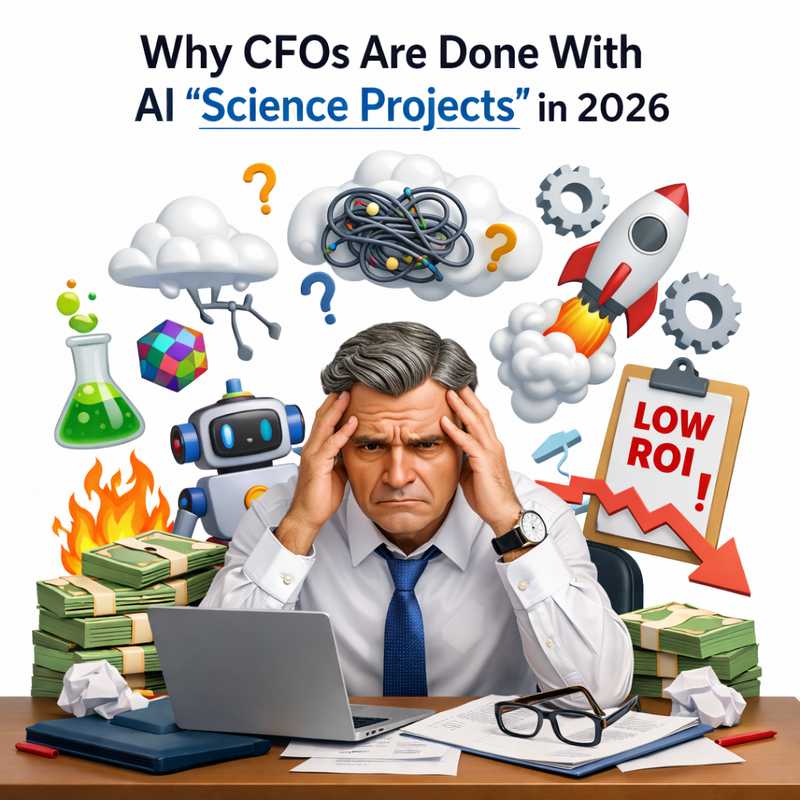
In 2026, CFOs are moving away from AI “science projects” because these initiatives rarely deliver measurable financial outcomes. While many organizations invested in AI pilots and experimental models over the past few years, a large number failed to scale into production or generate clear returns. As cost pressures rise and margins tighten, CFOs are increasingly expected to justify every technology investment based on its impact on revenue, cost reduction, or operational efficiency.
Another key driver of this shift is the lack of financial control and predictability associated with experimental AI initiatives. AI science projects often involve escalating cloud infrastructure costs, ongoing maintenance, complex integrations, and dependence on specialized talent. Without clearly defined KPIs, ownership, and budget constraints, these projects create ongoing financial risk. In 2026, CFOs are prioritizing AI initiatives that can be forecasted, governed, and managed like any other enterprise investment.
Finally, board-level accountability and regulatory expectations have raised the bar for AI investments. CFOs must now consider governance, auditability, compliance, and risk exposure when approving AI initiatives. Projects that lack transparency or clear value creation are increasingly difficult to defend. As a result, finance leaders are shifting focus from experimental AI efforts to outcome-driven, agentic AI systems that deliver measurable ROI and align with enterprise financial objectives.
What Agentic AI Really Means for Finance Leaders

For finance leaders, agentic AI represents a shift from AI systems that assist with analysis to systems that take action within defined financial controls. Unlike traditional AI or generative tools that provide insights or recommendations, agentic AI is designed to autonomously execute tasks such as reconciliations, invoice matching, exception handling, forecasting updates, and compliance checks. For CFOs, this means AI that directly impacts operational efficiency and financial outcomes, rather than simply supporting decision-making.
From a financial perspective, the value of agentic AI lies in measurable productivity and cost improvements. Agentic systems can operate continuously, reduce manual intervention, and standardize finance processes across the organization. This translates into faster close cycles, lower processing costs, improved accuracy, and better utilization of finance talent. Most importantly, these benefits can be directly tied to KPIs such as cost per transaction, days to close, working capital efficiency, and audit readiness.
Equally important, agentic AI introduces a higher level of governance and accountability than traditional AI experiments. For finance leaders, this means clear ownership, predefined rules, audit trails, and performance tracking. When deployed correctly, agentic AI behaves like a controllable enterprise system rather than an experimental tool. In 2026, this alignment with financial discipline is what makes agentic AI relevant—and defensible—for CFOs and finance teams.
Agentic AI vs Traditional Automation vs GenAI
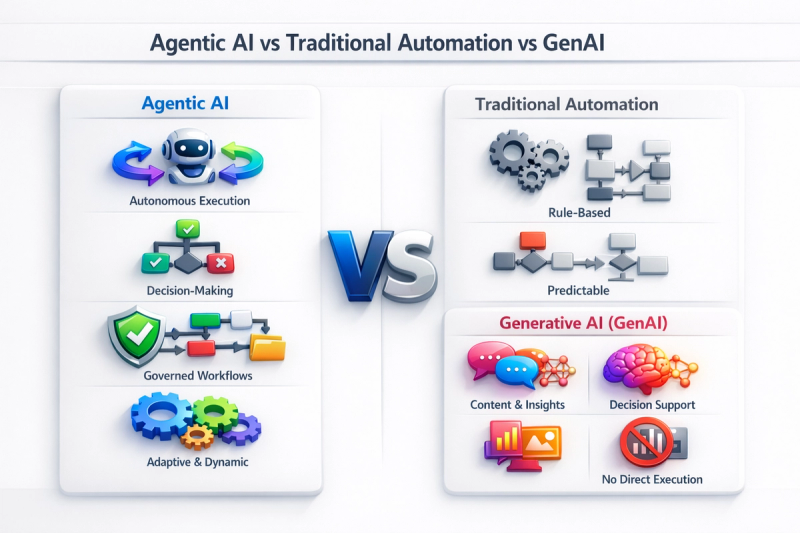
From a finance leader’s perspective, the difference between agentic AI, traditional automation, and generative AI comes down to decision-making authority, accountability, and financial impact. Traditional automation relies on predefined rules to execute repetitive tasks, making it predictable but limited when conditions change. It performs well in stable processes such as fixed workflow approvals or scheduled reconciliations but struggles when exceptions or judgment-based decisions are required.
Generative AI, by contrast, is primarily designed to create content and insights rather than execute business processes. In finance, GenAI is commonly used for reporting narratives, variance explanations, forecasting commentary, or scenario analysis. While it improves speed and analysis quality, it typically stops short of taking action. For CFOs, this means GenAI enhances decision-making but does not directly deliver operational ROI unless paired with downstream execution systems.
Agentic AI bridges this gap by combining intelligence with controlled autonomy. It can analyze data, make decisions within predefined guardrails, and execute finance workflows end to end—such as resolving invoice discrepancies, updating forecasts, or triggering compliance actions. For finance leaders in 2026, agentic AI offers a middle ground: more adaptive and outcome-driven than traditional automation, yet more governed and ROI-focused than open-ended AI experiments. This balance is what makes agentic AI increasingly attractive to CFOs focused on measurable business value.
What CFOs Mean by “Real ROI” From Agentic AI
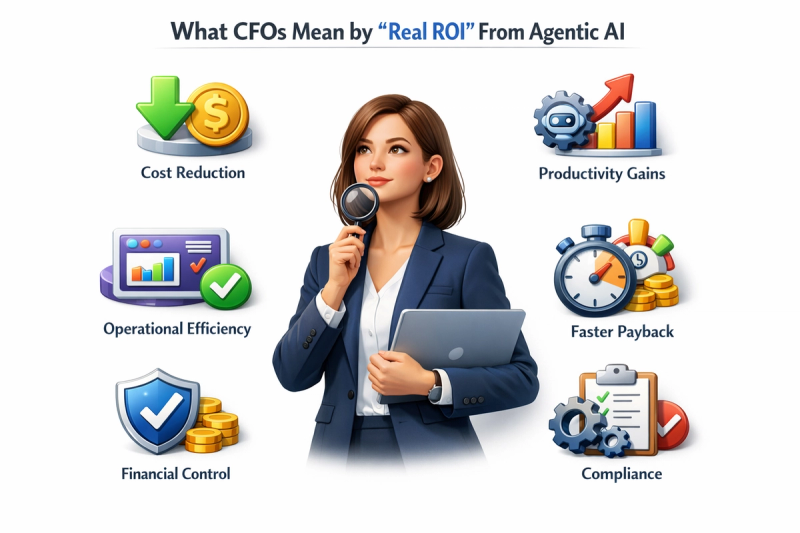
For CFOs, “real ROI” from agentic AI is not defined by innovation metrics or technical performance—it is defined by measurable financial impact. In 2026, finance leaders evaluate agentic AI the same way they evaluate any enterprise investment: through cost reduction, productivity improvement, and speed to value. AI initiatives that cannot demonstrate these outcomes are increasingly deprioritized, regardless of their technical sophistication.
Cost Reduction KPIs
Cost reduction is often the first and most defensible ROI signal CFOs look for. Agentic AI can lower operating costs by automating high-volume finance processes such as invoice processing, reconciliations, exception handling, and compliance monitoring. CFOs typically track KPIs such as cost per transaction, headcount cost avoidance, reduction in error-related rework, and lower audit and compliance expenses. These metrics allow finance leaders to clearly attribute savings to agentic AI deployment rather than general process improvements.
Productivity & Efficiency Gains
Beyond direct cost savings, CFOs focus on how agentic AI improves overall finance productivity. By handling routine and judgment-based tasks autonomously rather than just creating AI Agents and , agentic systems enable finance teams to process higher volumes of work without proportional increases in staff or operating costs. Productivity KPIs often include faster financial close cycles, reduced manual intervention, improved forecast accuracy, and better utilization of senior finance talent. These gains are especially valuable because they support scalability while maintaining financial control.
Payback Period Expectations
Payback period is a critical factor in CFO approval decisions for agentic AI investments. In 2026, most CFOs expect agentic AI initiatives to demonstrate a clear path to breakeven within a defined timeframe, often within 6 to 18 months depending on scope and complexity. This requires disciplined scoping, clear success metrics, and phased deployment strategies. Agentic AI projects that lack a realistic payback model are increasingly viewed as high-risk and are unlikely to receive sustained funding.
Where Agentic AI Delivers Measurable ROI Today
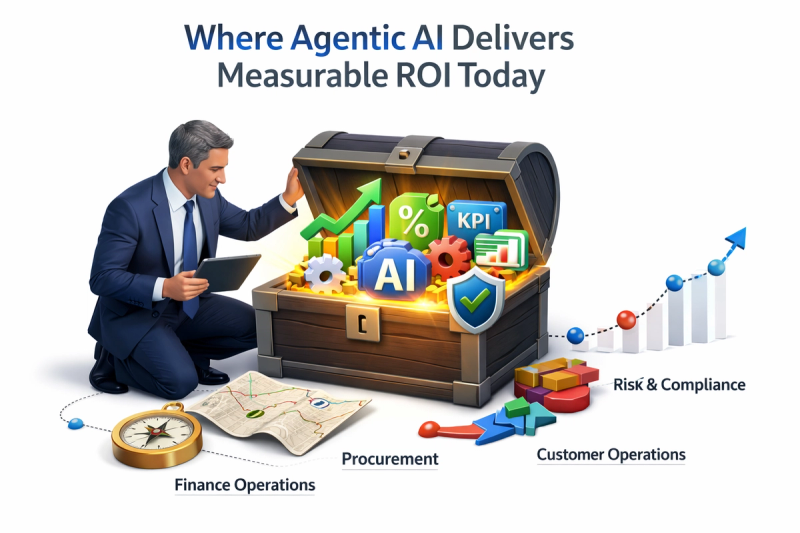
In 2026, agentic AI delivers measurable ROI in areas where processes are high-volume, rule-guided, and financially material. Finance leaders see the strongest returns when agentic systems are deployed directly into core workflows rather than isolated analytics tools. These deployments generate value by reducing manual effort, improving accuracy, and accelerating decision cycles—all outcomes that can be tracked through standard financial KPIs.
One of the most proven areas of ROI is finance and accounting operations. Agentic AI can autonomously manage tasks such as invoice validation, reconciliation, exception resolution, and close activities.
Agentic AI also delivers strong returns in procurement, customer operations, and risk monitoring. In procurement, agentic systems optimize spend by identifying pricing anomalies, enforcing contract compliance, and managing approvals without manual intervention. In customer operations, they resolve routine issues end-to-end, lowering service costs while maintaining quality. For risk and compliance, agentic AI continuously monitors transactions and policy adherence, reducing financial exposure and compliance overhead. Across these domains, ROI is measurable because outcomes tie directly to cost savings, efficiency gains, and risk reduction—metrics CFOs already track.
A CFO-Approved Framework to Evaluate Agentic AI ROI
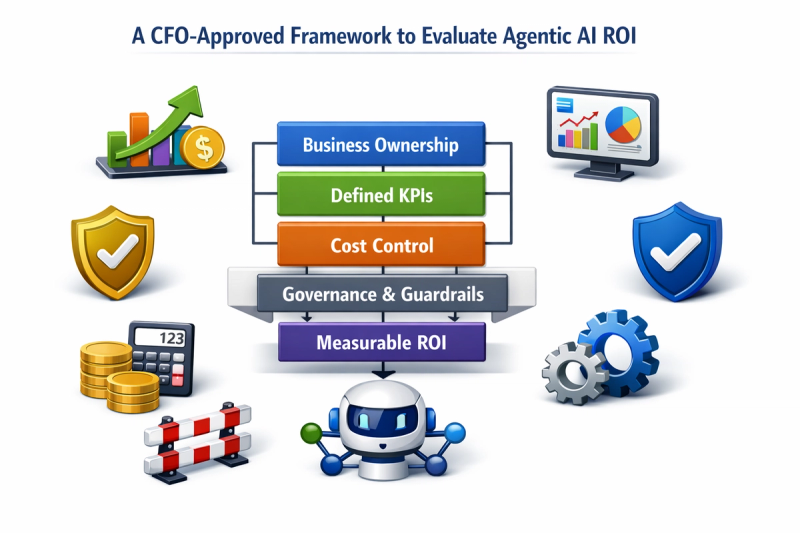
For CFOs, evaluating agentic AI ROI requires the same financial discipline applied to any capital or operating investment. The goal is to move beyond technical capability and assess whether the system can deliver predictable, measurable, and governable financial outcomes. A CFO-approved framework focuses on ownership, metrics, and risk control from the outset—before funding is approved.
The first step is to define a clear business owner and value driver. Every agentic AI initiative should have a named operational owner and a specific financial objective, such as reducing cost per transaction, accelerating close cycles, or improving working capital efficiency. Without a clear value driver, ROI becomes difficult to measure and accountability weakens. CFOs typically require these outcomes to be tied to existing financial KPIs to ensure transparency and comparability.
Next, CFOs insist on establishing ROI metrics and guardrails before deployment. This includes defining baseline performance, target improvements, and acceptable cost thresholds. Agentic AI systems should operate within predefined rules, approval limits, and audit trails to control financial risk. Finally, CFOs favor a phased deployment approach, starting with narrowly scoped use cases that can demonstrate value quickly. Only after ROI is proven at a small scale should investment be expanded, ensuring agentic AI evolves from an experiment into a financially accountable enterprise asset.
Conclusion
In 2026, CFOs are redefining how AI earns its place in the enterprise by demanding measurable ROI, financial accountability, and disciplined governance. The shift away from AI science projects reflects a broader move toward outcome-driven investments that directly impact cost efficiency, productivity, and risk control. When evaluated and deployed correctly, agentic AI aligns advanced automation with CFO expectations by operating within clear guardrails, delivering predictable returns, and scaling only after value is proven. For finance leaders, the path forward is not less AI, but smarter, financially accountable AI that functions as a true enterprise asset rather than an experimental expense.