

what is Agentic AI & How does it work
Table of Contents
What if an AI system could think about a task, decide the next steps, and complete the work on its own? That’s the idea behind Agentic AI. Unlike regular AI tools that only respond when you ask something, agentic AI can work independently, set goals, make decisions, and take actions without constant human input. It behaves more like a digital worker than a simple chatbot.
Agentic AI works by combining AI agents, large language models (LLMs), memory, and decision-making logic. These parts help the system understand a situation, plan what to do next, use software tools, and learn from results. Because of this, agentic AI is being used in business automation, customer support, software development, and research, helping organizations save time and work more efficiently.
What is agentic AI?
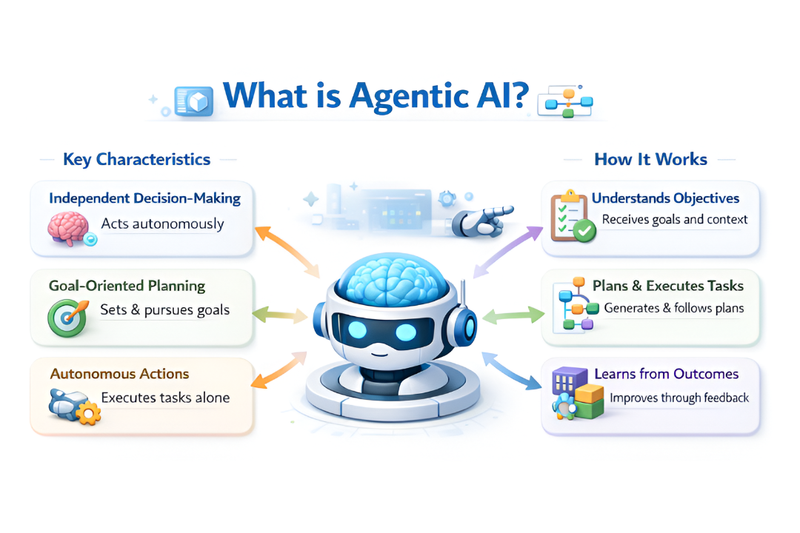
Agentic AI is a type of artificial intelligence that can work independently to achieve a goal, rather than waiting for constant instructions. Unlike traditional AI systems that only respond to user commands, agentic AI can understand objectives, plan actions, and make decisions on its own. It behaves like an intelligent digital agent that can handle tasks from start to finish, making it more practical for real-world applications.
What makes agentic AI different is its ability to take action, not just generate content. While generative AI focuses on producing text, images, or code, agentic AI goes a step further by executing tasks, such as interacting with software tools, calling APIs, managing workflows, or coordinating with other AI agents. This allows agentic AI systems to solve complex problems that require multiple steps and ongoing decision-making.
Behind the scenes, agentic AI uses a combination of AI agents, large language models (LLMs), memory, and reasoning and planning mechanisms. The system analyzes a goal, breaks it into smaller tasks, chooses the best actions, and learns from outcomes to improve over time. Because of this, agentic AI is widely used in enterprise automation, customer support, software development, and data-driven decision-making, helping organizations operate more efficiently.
Difference between Agentic Ai and Generative Ai
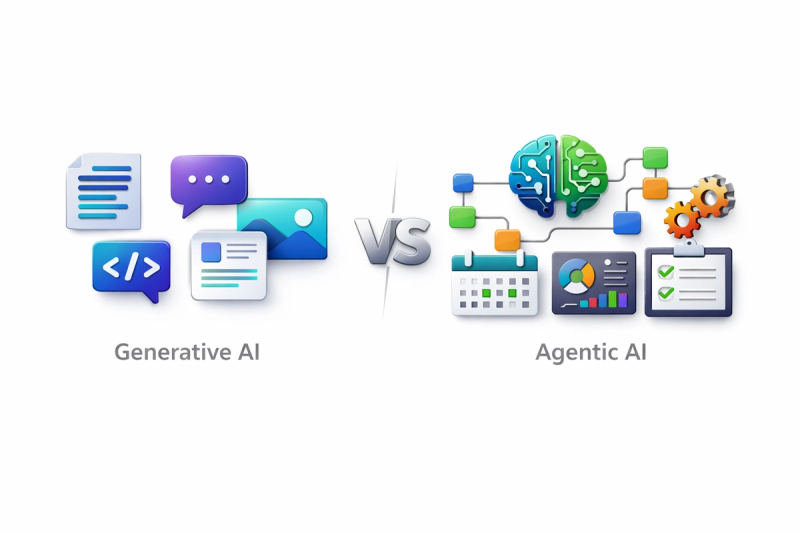
Generative AI and Agentic AI differ mainly in how they function and what role they play in solving problems. Generative AI is focused on creating content based on user input, such as generating text, images, code, or audio by learning patterns from large amounts of data. It works in a reactive manner, meaning it responds when a prompt is given but does not act on its own or make decisions beyond producing the requested output. Its primary strength lies in creativity, communication, and content generation, making it useful for tasks like writing, designing, and answering questions.
Agentic AI goes a step further by being goal-oriented and autonomous in nature. Instead of only generating responses, it can plan actions, make decisions, and execute tasks across multiple steps to achieve a specific objective. Agentic AI can use tools, interact with systems, monitor outcomes, and adapt its behavior based on feedback from the environment. This allows it to handle complex workflows such as managing schedules, automating business operations, or coordinating multiple processes without constant human guidance.
In essence, Generative AI is about producing information, while Agentic AI is about taking action. Generative AI helps in thinking and expressing ideas, whereas Agentic AI focuses on deciding what to do next and actually doing it. When combined, these two approaches create powerful AI systems that can both generate intelligent content and act independently, enabling more advanced, efficient, and human-like problem-solving capabilities.
Key Advantages of Agentic AI and Why Businesses Are Adopting It
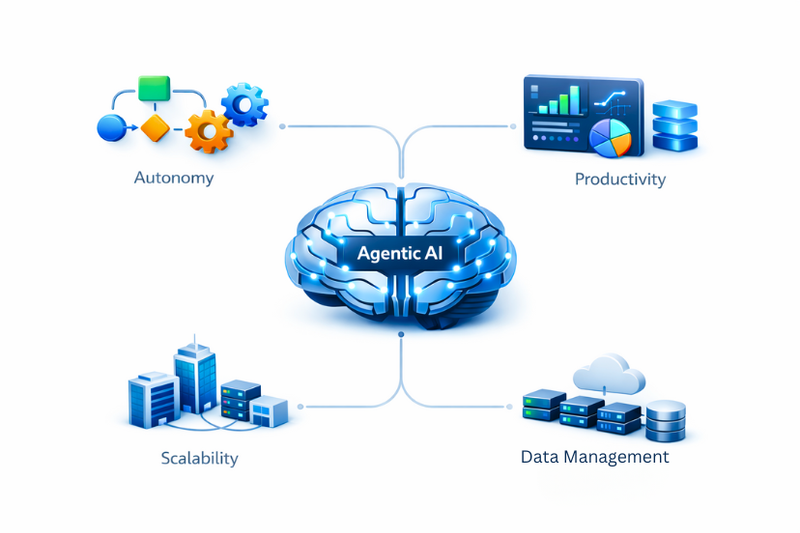
One of the biggest advantages of agentic AI is its ability to work independently and complete tasks without constant human supervision. Unlike traditional AI tools that only respond to instructions, agentic AI can understand goals, plan the required steps, and take action on its own. This helps businesses save time, reduce manual effort, and handle complex tasks more efficiently, especially in fast-moving environments.
Another key benefit is improved productivity and scalability. Agentic AI systems can manage multiple tasks at the same time, interact with different software tools, and operate continuously without fatigue. Businesses are adopting agentic AI to automate workflows such as customer support, data analysis, software operations, and internal processes. As workloads increase, agentic AI can easily scale without the need to hire additional staff, making it a cost-effective solution.
Finally, agentic AI helps organizations make better and faster decisions by learning from data and past actions. With built-in memory and feedback mechanisms, these systems continuously improve performance over time. This ability to adapt and optimize results is why many businesses see agentic AI as the future of intelligent automation, enabling smarter operations, faster responses, and long-term competitive advantage.
How Agentic AI Works
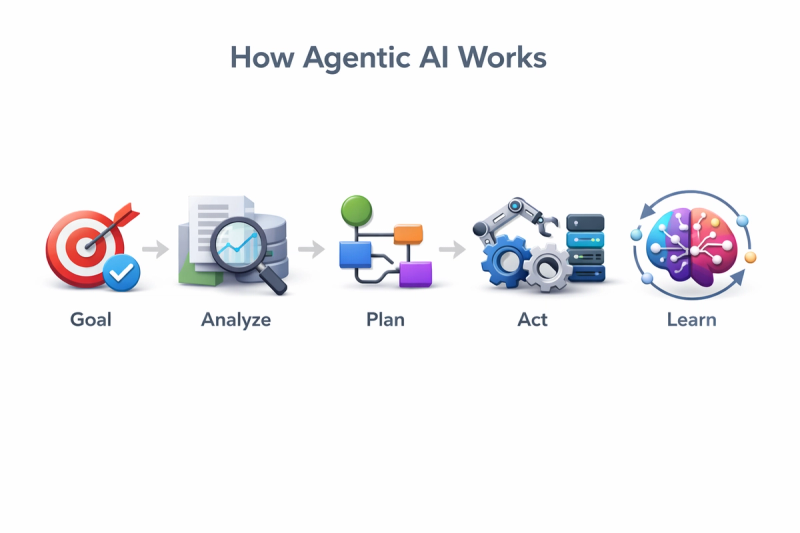
Agentic AI works by first understanding a goal or objective given by a user or system. Instead of executing a single command, the AI analyzes the task, understands the context, and determines what needs to be done to achieve the desired outcome. This step involves interpreting input data, identifying constraints, and deciding the overall direction of action, which allows the system to operate independently rather than relying on continuous human guidance.
Once the goal is clear, agentic AI plans and executes a series of actions to complete the task. It breaks the main objective into smaller steps, selects the right tools or software, and performs actions such as calling APIs, running processes, or interacting with other systems. During execution, the AI continuously monitors results and adjusts its actions if something doesn’t work as expected, enabling it to handle complex, multi-step workflows efficiently.
Finally, agentic AI learns from feedback and improves over time. By storing memory of past actions and outcomes, the system refines its decision-making and planning abilities. This feedback-driven loop allows agentic AI to adapt to changing conditions, improve accuracy, and deliver better results with repeated use, making it highly effective for real-world business applications.
Agentic AI Use Cases: Real-World Applications and Examples
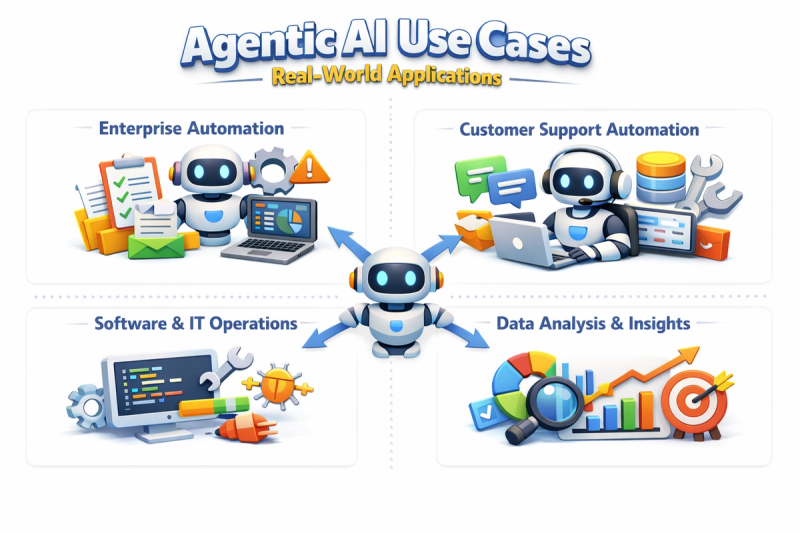
Agentic AI is already being used across industries because of its ability to work autonomously, make decisions, and complete complex tasks end to end. Unlike traditional AI systems that only assist users, agentic AI systems actively execute workflows, interact with tools, and adapt based on results. Below are some of the most impactful real-world applications of agentic AI.
1. Enterprise Workflow Automation
In enterprises, agentic AI is used to automate repetitive and complex workflows such as document processing, approval management, reporting, and system monitoring. For example, an agentic AI can detect a business issue, analyze data, trigger the right process, notify stakeholders, and track resolution without manual intervention. This helps organizations reduce operational costs and improve efficiency.
2. Customer Support and Service Automation
Agentic AI systems are transforming customer support by handling tickets from start to finish. Instead of only answering questions, these systems can analyze customer issues, access databases, update records, escalate problems, and follow up automatically. This results in faster response times, improved customer satisfaction, and reduced workload for human agents.
3. Software Development and IT Operations
In software development, agentic AI assists with tasks such as code generation, debugging, testing, deployment, and system monitoring. For example, an agentic AI can identify a bug, propose a fix, test the solution, and deploy updates with minimal human involvement. In IT operations, it can monitor systems, detect failures, and take corrective actions automatically.
4. Data Analysis and Business Intelligence
Agentic AI is widely used in data-driven decision-making. These systems can collect data from multiple sources, analyze trends, generate insights, and recommend or execute business actions. For instance, an agentic AI can monitor sales performance, identify patterns, and adjust pricing or marketing strategies in real time.
Challenges for Agentic AI Systems
One of the biggest challenges for agentic AI systems is control and reliability. Because these systems can act autonomously, there is a risk that they may take unintended actions if goals are unclear or data is incomplete. Ensuring that agentic AI behaves as expected requires strong guardrails, clear goal definitions, and continuous monitoring to prevent errors or undesired outcomes.
Another major challenge is data quality, security, and privacy. Agentic AI systems rely on large amounts of data to make decisions and learn over time. If the data is inaccurate, biased, or outdated, the AI’s decisions can also be flawed. Additionally, since agentic AI often interacts with multiple systems and tools, protecting sensitive data and maintaining compliance with regulations becomes more complex for organizations.
Finally, ethical concerns and system complexity present ongoing difficulties. Agentic AI systems can be hard to explain, making it difficult to understand why certain decisions were made. This lack of transparency can reduce trust and raise ethical concerns, especially in industries like finance or healthcare. Building, managing, and maintaining agentic AI systems also requires advanced technical expertise, making implementation costly and challenging for many businesses.
How to Start a Career in Agentic AI in 2026: A Step-by-Step Guide
Step 1: Learn Strong AI and Programming Basics
Start by building a solid foundation in Python programming, as it is the core language used in AI and agentic AI development. Along with Python, learn the basics of artificial intelligence, machine learning, data structures, and algorithms. Understanding how data is processed and how models learn will help you grasp how agentic AI systems make decisions and act independently.
Step 2: Understand Agentic AI and AI Agents
Once the basics are clear, focus on learning what agentic AI is and how AI agents work. Study concepts like goal setting, task planning, decision-making, memory, feedback loops, and multi-agent systems. This step helps you understand how agentic AI differs from traditional and generative AI, and why it can operate autonomously in real-world environments.
Step 3: Learn Agentic AI Tools and Frameworks
Practical skills are essential in 2026. Learn popular agentic AI tools and frameworks such as LangChain, AutoGen, CrewAI, OpenAI APIs, vector databases, and orchestration tools. These technologies allow you to build AI agents that can interact with external systems, use tools, and complete tasks end to end.
Step 4: Build Real-World Agentic AI Projects
Hands-on projects are the most important part of your career journey. Start with simple projects like task automation agents or AI assistants, then move to advanced systems that can plan, execute, and learn from feedback. Real-world projects show employers that you can apply agentic AI concepts to solve practical business problems.
Step 5: Gain Experience and Prepare for Job Roles
Finally, gain real-world exposure through internships, freelancing, open-source contributions, or hackathons. Prepare for roles such as Agentic AI Engineer, AI Agent Developer, or AI Automation Specialist by highlighting your skills, tools, and projects on your resume. Continuous learning and staying updated with agentic AI trends will help you stay competitive in 2026 and beyond.
Conclusion
Agentic AI represents a major shift in how artificial intelligence is designed and used—from systems that simply respond to instructions to intelligent agents that can plan, decide, and act independently. By combining large language models, memory, reasoning, and tool integration, agentic AI enables end-to-end task execution across complex, real-world scenarios. This makes it especially valuable for businesses seeking higher efficiency, scalability, and smarter decision-making.
As seen across enterprise automation, customer support, software development, and data analytics, agentic AI is already delivering measurable impact by reducing manual effort and accelerating outcomes. While challenges such as control, data quality, security, and ethics remain, these can be addressed through proper governance, monitoring, and responsible design. Looking ahead to 2026 and beyond, agentic AI is set to become a core pillar of intelligent automation. For professionals and organizations alike, understanding and adopting agentic AI is no longer optional—it is a strategic step toward staying competitive in an increasingly autonomous, AI-driven world.