
Workday Extend Explained: Core Modules, Architecture, Use Cases & Real-World Examples

Modern enterprises are no longer satisfied with one-size-fits-all systems—and that’s exactly where Workday Extend steps in. As organizations push beyond standard configurations to solve unique business challenges, the need for secure, scalable, and Workday-native custom applications has grown rapidly. Workday Extend empowers businesses to build tailored solutions directly on the Workday platform without compromising security, compliance, or performance, making it a game-changer for digital transformation in 2026 and beyond.
In this guide, Workday Extend Explained: Core Modules, Architecture, Use Cases & Real-World Examples, we break down how Workday Extend works, the key modules that power custom development, and the architecture that keeps extensions tenant-safe and future-ready. You’ll also explore practical use cases and real-world examples that show how organizations extend Workday beyond out-of-the-box functionality—helping HR, finance, and IT teams innovate faster while staying fully aligned with the Workday ecosystem.
What is Workday Extend?
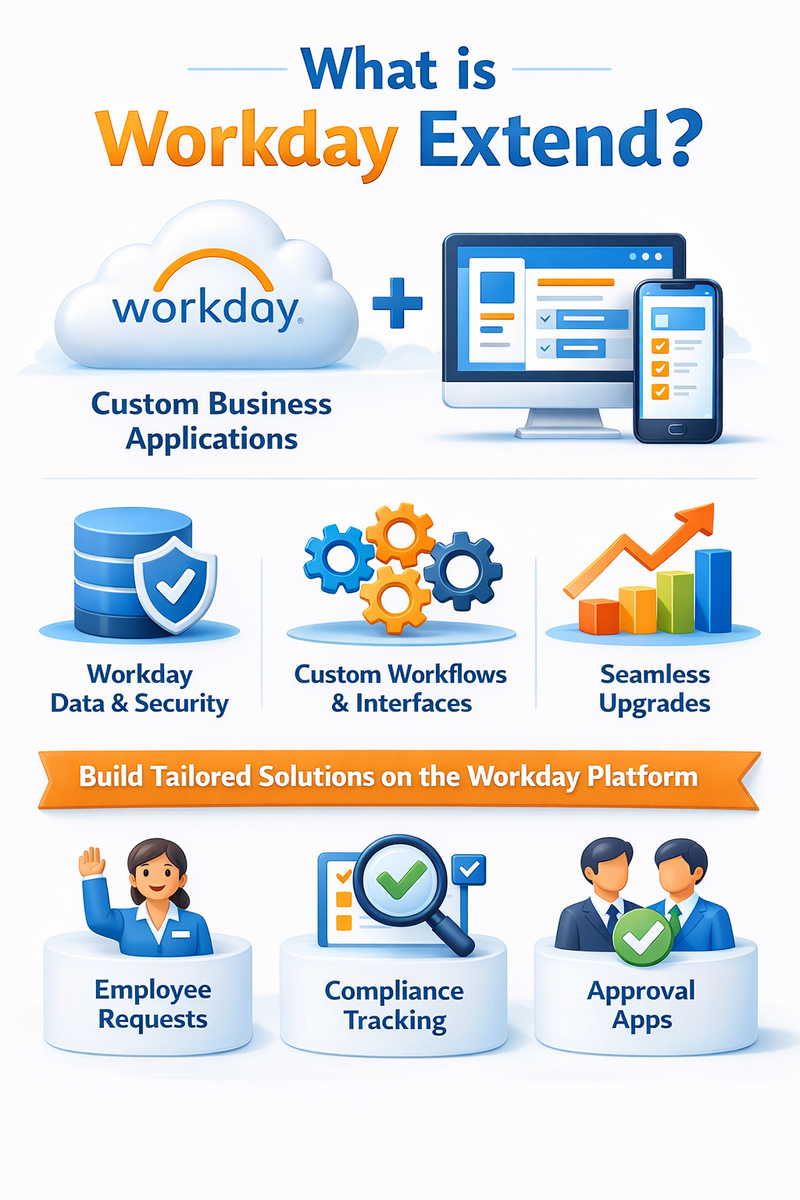
Workday Extend is a secure, cloud-native application development platform that allows organizations to build custom business applications directly on the Workday ecosystem. Instead of relying on external tools or heavy integrations, Workday Extend enables companies to create tailored solutions that use Workday’s data model, security framework, and business processes, ensuring tenant safety and seamless upgrades.
In simple terms, Workday Extend is used when standard Workday configuration is not enough. It helps organizations design custom workflows, user interfaces, and applications—such as employee request systems, compliance trackers, or approval apps—while maintaining the same security, scalability, and compliance standards as core Workday. This makes Workday Extend ideal for enterprises that need flexibility without sacrificing control, governance, or long-term platform stability.
Who should use Workday Extend (enterprises, developers, partners)
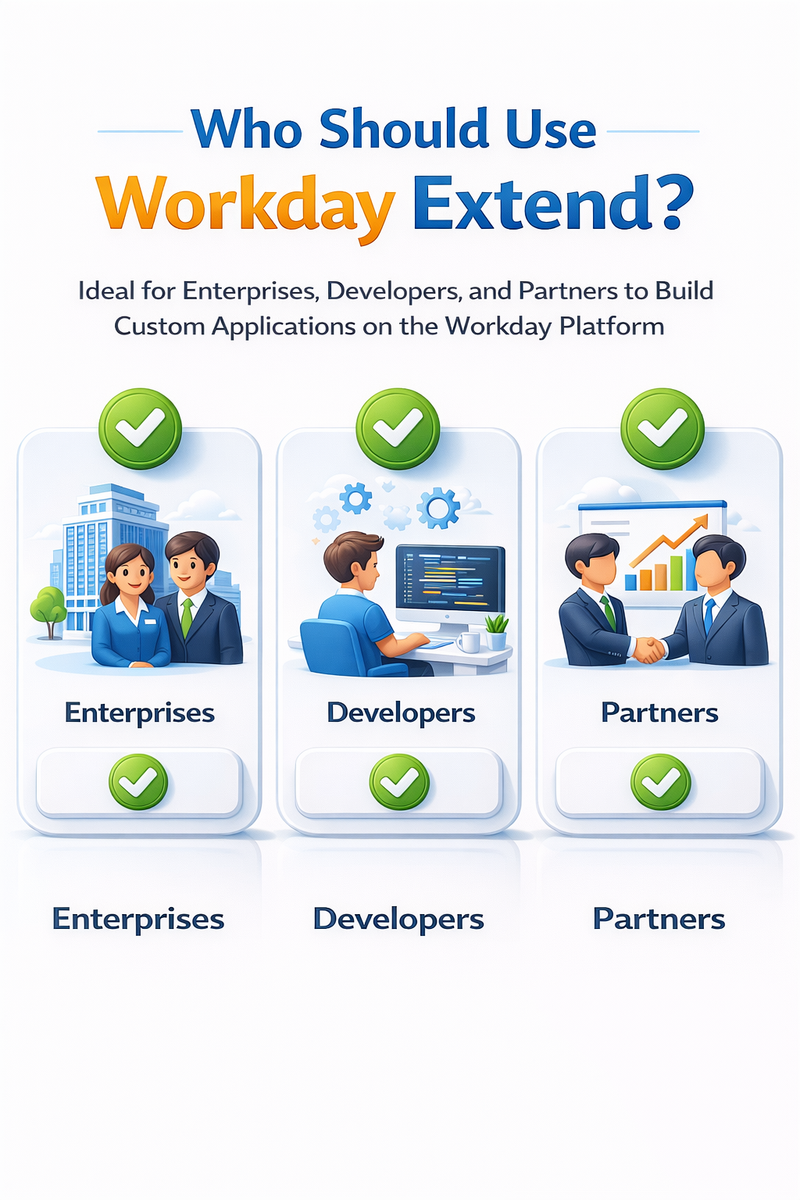
Workday Extend is best suited for enterprises that need to go beyond standard Workday configuration to address unique business requirements. Large and mid-sized organizations often face complex workflows, compliance needs, or industry-specific processes that cannot be fully handled with out-of-the-box features. By using Workday Extend, enterprises can build secure, scalable, and tenant-safe custom applications that run natively on Workday, ensuring seamless upgrades, consistent security, and long-term platform stability while supporting digital transformation initiatives.
For developers, Workday Extend is ideal for professionals who want to design and deploy custom applications within the Workday ecosystem. Technical consultants, Workday developers, and integration specialists can use Extend to create custom user interfaces, business logic, and event-driven workflows without relying on third-party platforms. Since Extend follows Workday’s architecture, data model, and security framework, developers can build solutions that are enterprise-ready, compliant, and easier to maintain—making Workday Extend a high-demand skill for 2026 and beyond.
Workday partners and consulting firms should also leverage Workday Extend to deliver advanced, value-added solutions to their clients. Implementation partners can use Extend to build reusable industry accelerators, compliance tools, and specialized applications that enhance standard Workday deployments. For partners, Workday Extend opens opportunities to differentiate services, reduce dependency on external systems, and provide clients with custom solutions that are fully supported within the Workday platform—strengthening both client trust and long-term engagement.
Workday Extend Architecture Overview
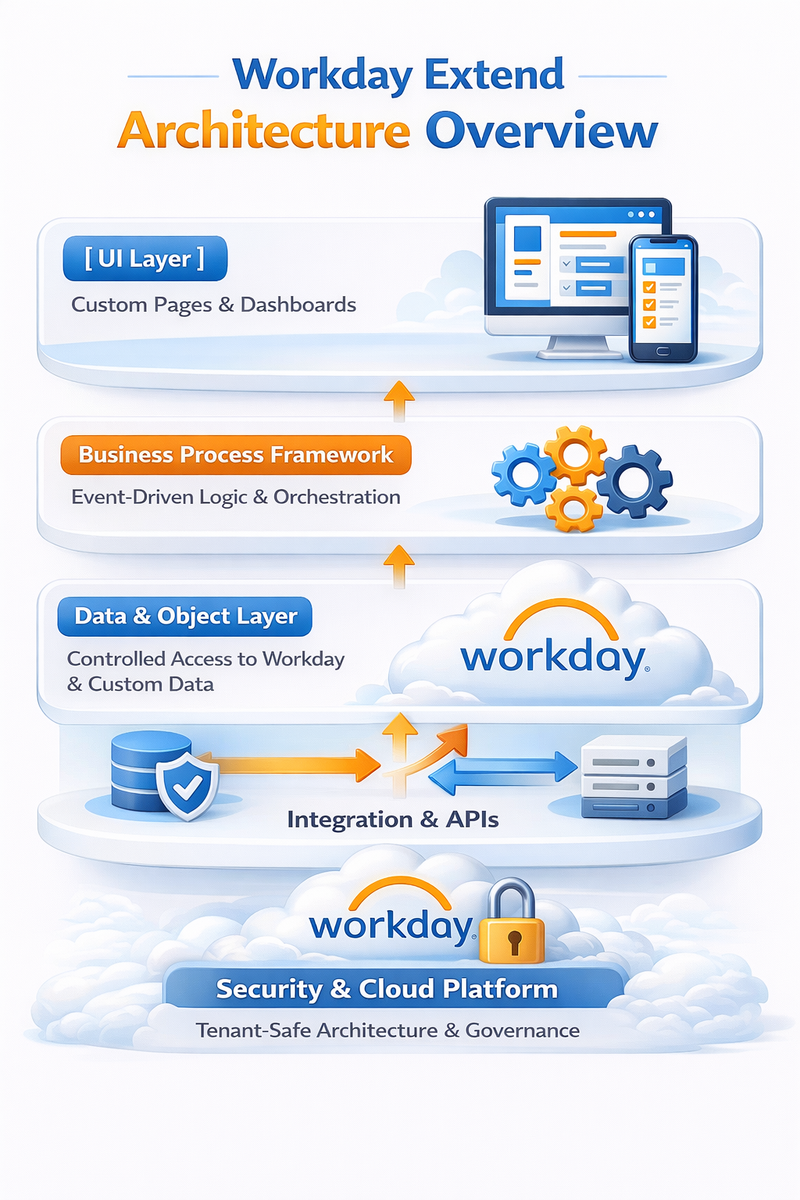
The Workday Extend architecture is designed to enable secure, scalable, and tenant-safe application development directly within the Workday ecosystem. Built as a cloud-native framework, Workday Extend allows custom applications to run alongside core Workday functionality while inheriting the same data model, security policies, and business process controls. This architecture ensures that Extend applications automatically remain compatible with Workday updates, eliminating the risks typically associated with custom code and external platforms.
At a high level, Workday Extend architecture consists of a presentation layer for user interfaces, a business logic layer powered by the Business Process Framework, and a data and integration layer that securely interacts with Workday objects and APIs. Event-driven processing, role-based security, and controlled data access are embedded into the platform, allowing organizations to extend functionality without compromising compliance or performance. As a result, Workday Extend provides a future-ready architecture that supports innovation while maintaining the reliability and governance enterprises expect from Workday.
Core Modules of Workday Extend (MOST IMPORTANT)
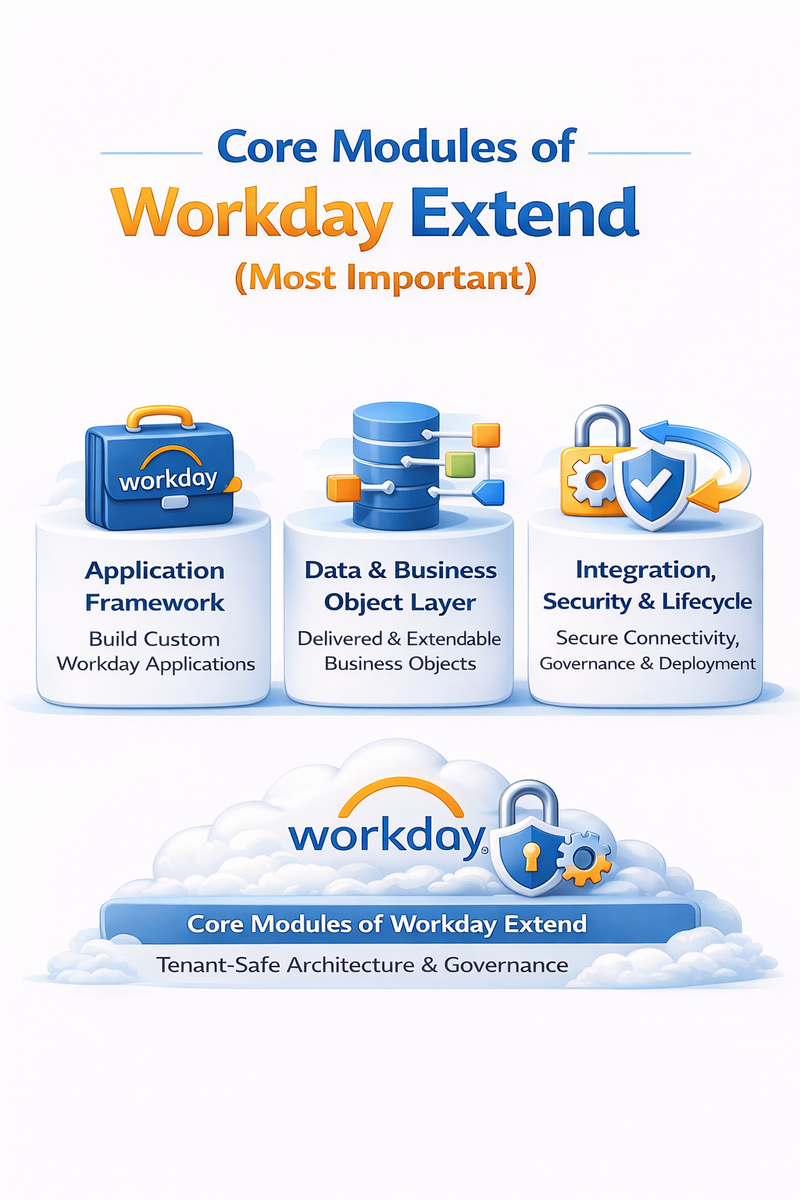
The core modules of Workday Extend form the foundation that allows organizations to build secure, scalable, and Workday-native applications within the Workday ecosystem. These modules are designed to work seamlessly together, ensuring that every custom application follows the same architectural standards, security controls, and data governance as core Workday functionality. By using these built-in modules, enterprises can extend Workday without relying on external platforms or custom code that could introduce long-term maintenance risks.
One of the most critical modules is the Business Process Framework (BPF), which enables the creation of event-driven workflows, approvals, and orchestration logic. Alongside BPF, the User Interface (UI) framework allows developers to design intuitive, responsive pages and dashboards that align with the Workday user experience. The data and object model module ensures controlled access to Workday objects and custom Extend objects, allowing applications to read, write, and manage data securely while maintaining data integrity and compliance.
Another essential component is the security and integration module, which governs role-based access, domain security policies, and authentication across Extend applications. This module also supports seamless integration through Workday web services and APIs, enabling secure communication with both internal Workday features and external systems. Together, these core modules make Workday Extend a powerful platform for building enterprise-grade applications that are upgrade-safe, compliant, and ready to support evolving business needs in 2026 and beyond.
Workday Extend Development Tools & Technologies
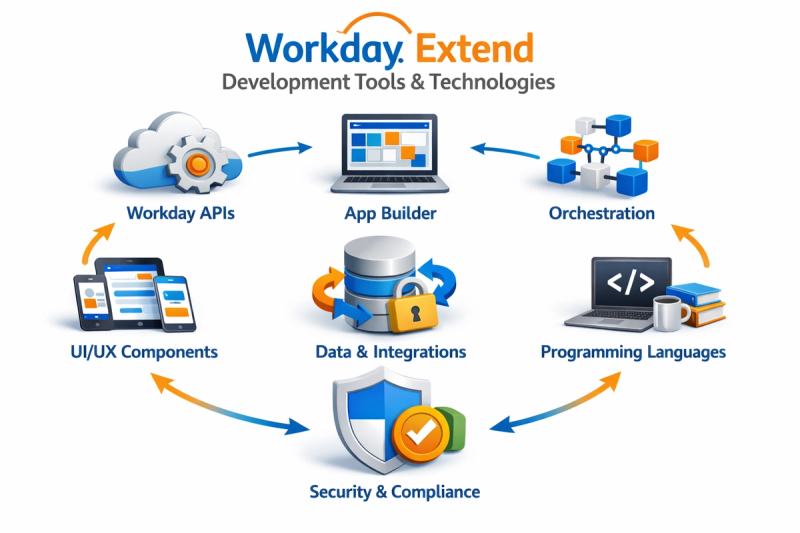
Workday Extend development tools and technologies are designed to help developers build, test, and deploy custom applications efficiently while staying fully aligned with the Workday platform. Workday Extend provides a dedicated development environment with platform-native tooling that supports application modeling, business logic design, and user interface creation. These tools allow developers to work within Workday’s secure framework, ensuring that all custom applications automatically comply with Workday’s security, data governance, and upgrade standards.
From a technology perspective, Workday Extend supports modern, cloud-native development concepts such as event-driven processing, API-based integrations, and reusable components. Developers can leverage Workday objects, REST-based services, and business process frameworks to create scalable and maintainable applications. With built-in deployment and version control capabilities, Workday Extend enables teams to move custom solutions from development to production smoothly, reducing risk while accelerating innovation across enterprise use cases.
Common Workday Extend Use Cases
Common Workday Extend use cases focus on solving business problems that cannot be fully addressed through standard Workday configuration while still staying native to the Workday platform. Organizations often use Workday Extend to build custom HR applications such as employee request portals, onboarding extensions, and internal case management systems. These applications streamline processes, reduce manual effort, and provide a consistent user experience without relying on external tools or complex integrations.
Beyond HR, Workday Extend is widely used for finance, procurement, and compliance-driven applications. Enterprises build custom approval workflows, vendor onboarding tools, policy acknowledgment systems, and audit tracking applications using Extend. Industry-specific solutions—such as healthcare credential tracking or education compliance workflows—are also common. By leveraging Workday Extend for these use cases, organizations gain flexibility to innovate while maintaining enterprise-grade security, scalability, and long-term support within the Workday ecosystem.
Workday Extend Career Scope & Skills Required

The career scope for Workday Extend professionals is expanding rapidly as more enterprises adopt custom, platform-native applications on the Workday ecosystem. Organizations increasingly look for developers and consultants who can design secure extensions beyond standard Workday configuration without relying on third-party tools. Roles such as Workday Extend Developer, Workday Technical Consultant, Integration Consultant, and Solution Architect are in high demand, with strong growth expected through 2026 as companies prioritize scalable and upgrade-safe customization.
To succeed in Workday Extend roles, professionals need a blend of functional Workday knowledge and technical skills. Key skills include understanding Workday architecture, Business Process Framework (BPF), security and domain policies, data modeling, and REST-based integrations. Familiarity with event-driven workflows, UI design principles, and enterprise application development best practices is also essential. Professionals who combine Workday Extend expertise with real-world implementation experience position themselves as high-value resources in the evolving Workday job market.
conclusion
Workday Extend has emerged as a powerful solution for organizations that need flexibility beyond standard Workday configuration while maintaining enterprise-grade security and governance. By leveraging its robust architecture, core modules, and cloud-native development capabilities, businesses can build scalable, tenant-safe applications that address real-world HR, finance, compliance, and industry-specific needs. As adoption continues to grow across global enterprises using Workday, Workday Extend not only enables smarter customization but also creates strong career opportunities for developers and consultants—making it a future-ready platform for innovation, efficiency, and long-term digital transformation.