
Workday Pro Certification: How to Get Certified, Eligibility Rules, and Why It’s the "Golden Ticket" for Your Career
Everyone talks about Workday Certification, but very few truly understand the difference between Workday Pro, Partner, and third-party training programs. This confusion leads many professionals to waste months chasing the wrong certification path or trying to “buy” an exam they are not even eligible for. Among all certification types, Workday Pro Certification is the most misunderstood — yet it is also one of the most valuable credentials for professionals who want to build a long-term, client-side career in Workday HCM.
Workday Pro Certification is an official accreditation designed exclusively for employees of organizations that use Workday, not for consultants, freelancers, or the general public. It validates deep, real-world expertise in managing and optimizing Workday from within a company, making it a powerful career differentiator for HR, HRIS, and Workday administrators. However, earning this certification is not as simple as enrolling in a course or booking an exam — it requires a specific career strategy. In this guide, you’ll learn exactly what Workday Pro is, who is eligible, and the step-by-step roadmap to get certified the right way.
What Is Workday Pro Certification?
Workday Pro Certification is an official certification program created by Workday to recognize professionals who manage and support Workday applications from within a customer organization. The Workday Pro meaning goes beyond basic system knowledge—it represents proven, hands-on capability to configure business processes, manage data, build reports, and maintain Workday in a live production environment. This certification is exclusively available to employees of Workday customer companies and cannot be obtained through public enrollment or independent exam registration.
The program was designed by Workday to address a critical skills gap faced by many organizations after implementation. While consulting partners handle deployments and major projects, companies need trained internal experts to run Workday efficiently on a day-to-day basis. Workday Pro Certification helps organizations develop this internal capability by validating that their HR, HRIS, payroll, security, and reporting professionals can independently manage system changes, ensure compliance, and optimize workflows without constant external support.
The most important distinction lies in client-side versus consultant-side certification. Workday Pro is a client-side credential intended for long-term system owners and administrators, and it generally remains valid as long as the professional stays with a Workday customer organization. In contrast, Workday Partner Certification is designed for consultants working at implementation partners and is often tied to the partner firm rather than the individual. For professionals aiming for a stable, high-impact career within an organization, Workday Pro Certification is considered the most valuable credential in the Workday ecosystem
Workday Pro Certification Types
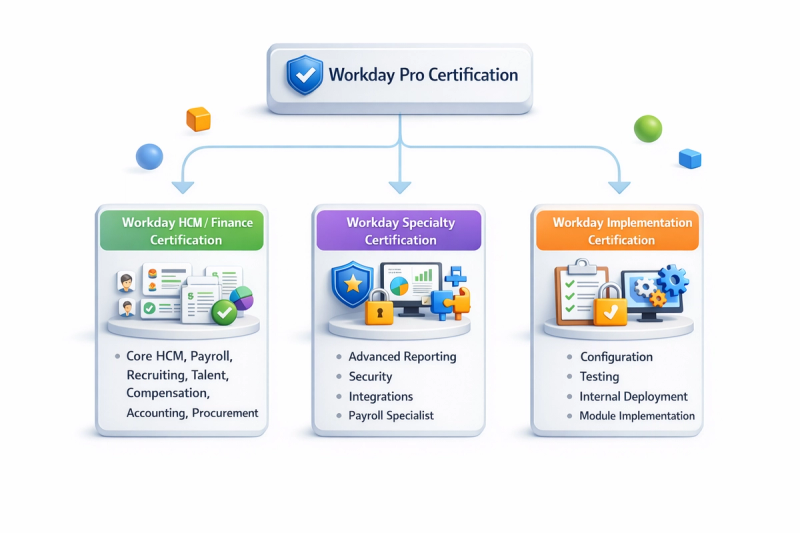
Workday Pro Certification is a role-based credential designed to recognize professionals with hands-on experience managing Workday applications from a client-side perspective. Workday offers multiple certification tracks, depending on the functional area and specialization of the professional. Understanding these types helps you choose the path that aligns with your career goals.
1. Workday HCM/Finance Certification
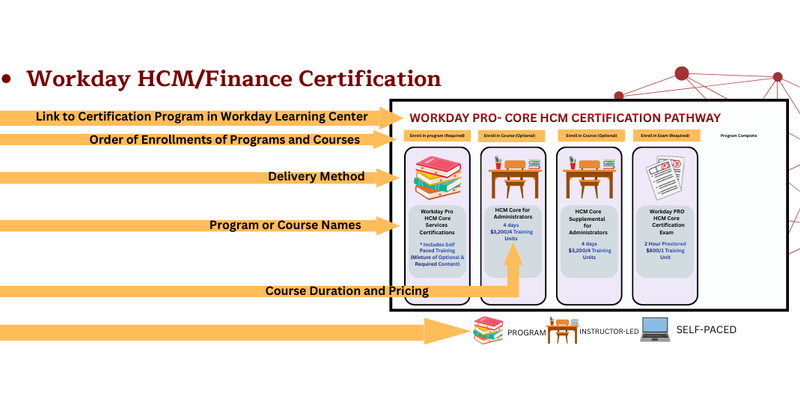
This certification is aimed at professionals working with Human Capital Management (HCM) or Finance modules within a Workday customer organization. HCM certifications cover areas like Core HCM, Payroll, Recruiting, Talent Management, and Compensation, while Finance certifications focus on Accounting, Procurement, Expenses, and Financial Reporting. These certifications validate that you can manage daily operations, configure business processes, and create reports relevant to your module.
2. Workday Specialty Certification
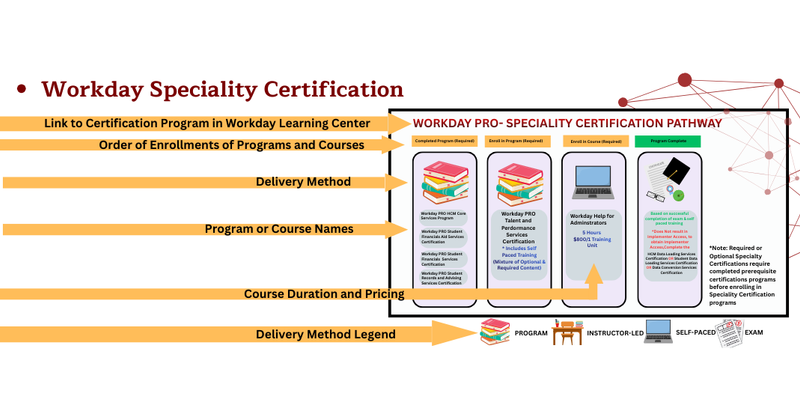
Workday Specialty Certifications target professionals with expertise in specific functional areas or advanced topics. Examples include Advanced Reporting, Workday Security, Integrations, or Payroll Specialist tracks. These certifications allow you to demonstrate deep knowledge in niche areas of Workday, making you an indispensable internal resource for your organization. Specialty certifications are ideal for professionals who want to focus on a particular module or technical area rather than general administration.
3. Workday Pro with Implementor ID Certification
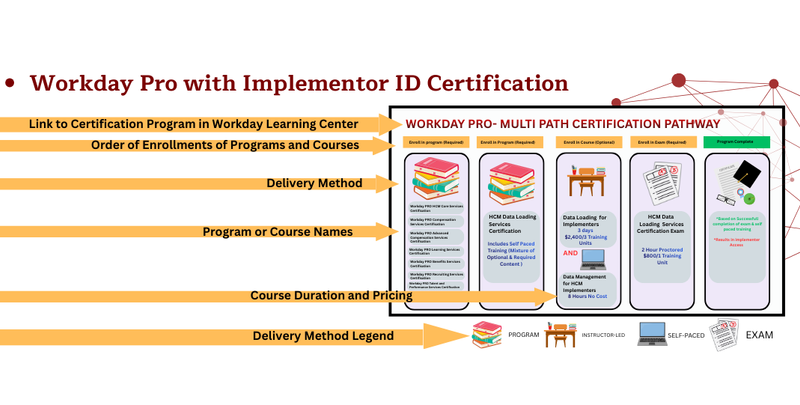
Workday Implementation Certification is intended for employees involved in system setup, process design, or internal project deployment within their organization. While Workday Partner Certification covers external consulting, the internal implementation track is for client-side professionals who are responsible for configuring modules, testing workflows, and managing rollouts. This certification proves that you can successfully lead implementation tasks and ensure smooth adoption of Workday modules internally.
Why You Cannot Directly Buy the Workday Pro Exam
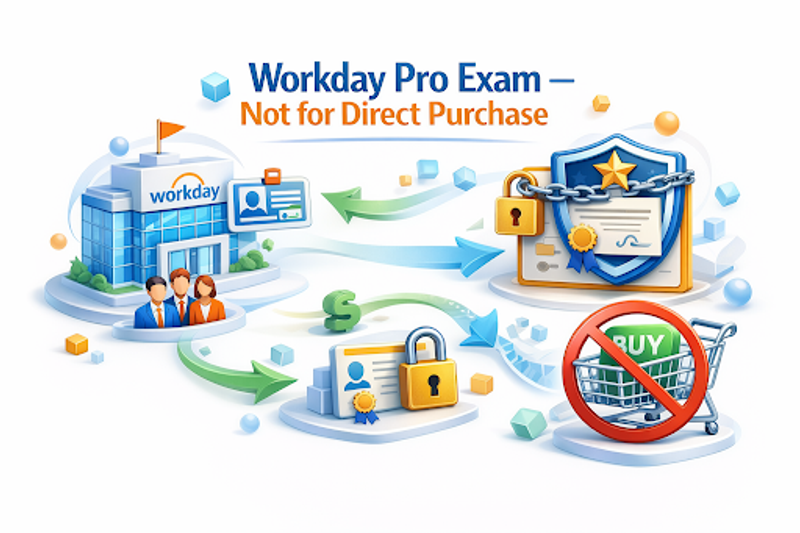
Many professionals exploring Workday careers ask, “Can I buy the Workday Pro exam directly?” Unlike most IT or HR certifications, the answer is no. The Workday Pro exam is not available for public purchase, and there is no direct registration or payment option for individuals. This is because Workday Pro Certification is not designed as a commercial exam, but as a validation of real, job-based experience within a Workday customer organization.
Workday restricts access to the Pro exam to ensure that certified professionals have hands-on exposure to a live Workday environment. The certification confirms that a candidate can manage real employee data, configure business processes, build reports, and follow enterprise-level security and compliance standards. Allowing open exam purchases would weaken the credibility of the certification and create a gap between certification and real-world capability.
Another critical reason is customer governance and data responsibility. handle sensitive HR, payroll, and financial information. By limiting Pro certification to employees of Workday customer companies, Workday ensures that only trusted internal professionals—who understand company policies, audits, and controls—earn the credential. This is why Workday Pro exam access is granted only through a company’s internal training coordinator after the candidate is hired.
Common Myths About Workday Certification (Explained Clearly)
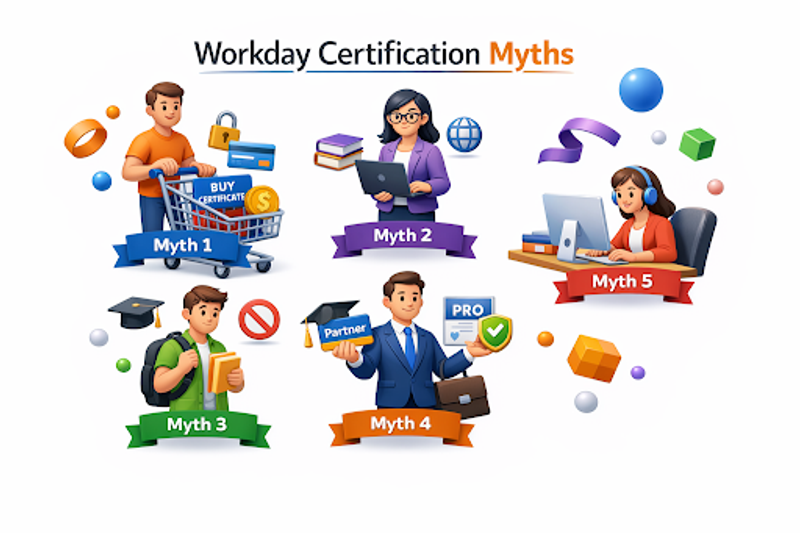
Myth 1: You can buy Workday Pro certification like other exams Reality: Workday Pro exams are not sold publicly and cannot be purchased by individuals under any circumstances.
Myth 2: Third-party training providers can give you Workday Pro exam access Reality: Independent training programs can teach Workday concepts, but they cannot provide Pro certification or exam enrollment. Only Workday customer organizations can do that.
Myth 3: Students or unemployed professionals can get Workday Pro certified Reality: Eligibility requires active employment with a company that uses Workday. Students and job seekers must first get hired.
Myth 4: Partner certification and Pro certification are interchangeable Reality: Partner certifications are for consultants at implementation firms, while Workday Pro is strictly a client-side credential.
Myth 5: Learning Workday is useless without certification Reality: Learning Workday skills first is often what helps candidates get hired, which then makes Pro certification possible.
Workday Pro vs Workday Partner Certification (Comparison)
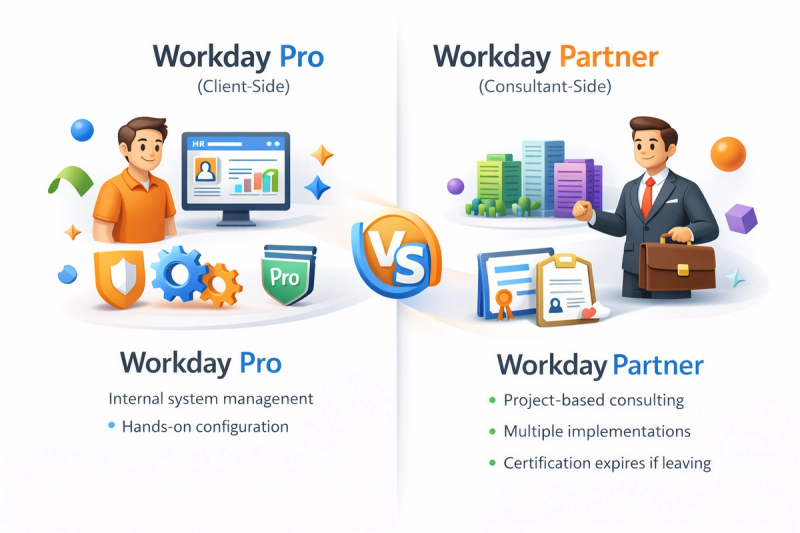
Workday Pro Certification and Workday Partner Certification are both official credentials issued by Workday, but they are designed for completely different career paths. Workday Pro is a client-side certification meant for professionals who work internally at organizations that use Workday. It validates hands-on expertise in managing, configuring, and optimizing Workday on an ongoing basis and is available only to employees of Workday customer companies. The certification remains valuable as long as the professional stays within a Workday customer organization and typically requires only periodic updates rather than full re-certification.
In contrast, Workday Partner Certification is a consultant-side credential intended for professionals employed by certified Workday implementation partners. These consultants focus on deploying Workday for multiple clients, handling implementation projects, and supporting go-live activities. Partner certification is tied to the consulting firm rather than the individual, meaning it often expires if the consultant leaves the partner organization and must be re-earned under a new employer.
In simple terms, Workday Pro is about long-term internal ownership and system stability, while Workday Partner certification is about project-based consulting and implementations. Professionals seeking a stable, in-house Workday career typically pursue Workday Pro, whereas those interested in consulting, client projects, and frequent system deployments choose the Partner certification path.
Is Workday Pro Certification Worth It for Your Career?
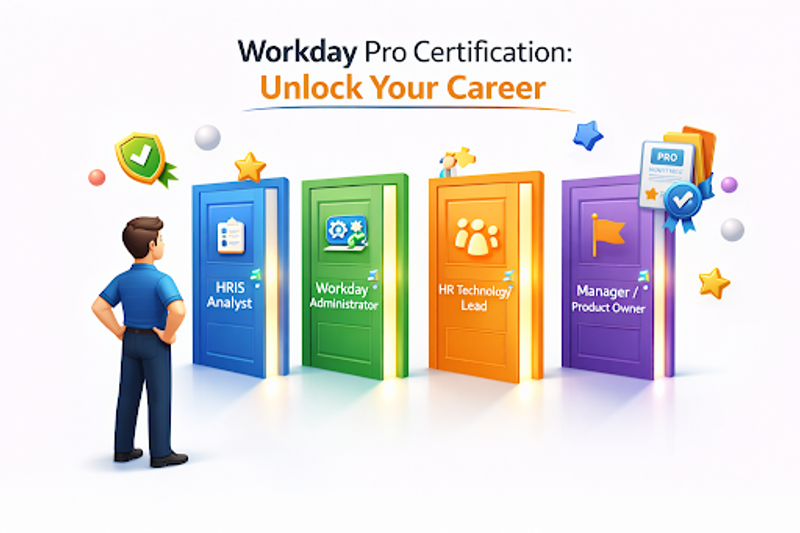
Workday Pro Certification is worth it for professionals who are serious about building a long-term, client-side career in the Workday ecosystem. Unlike publicly available or third-party certifications, Workday Pro validates real, hands-on experience gained within a live enterprise environment. It demonstrates that a professional can independently manage Workday business processes, reporting, security, and system optimization—skills that employers value far more than theoretical knowledge. Because Workday Pro certified professionals reduce reliance on external consultants, they are often trusted with greater system ownership, visibility, and responsibility.
From a career perspective, Workday Pro Certification offers strong salary potential, job stability, and long-term growth. Certified professionals are in high demand for roles such as HRIS Analyst, Workday Administrator, and HR Technology Lead, and they often progress into managerial or product-owner positions over time. In addition to financial benefits, Workday Pro holders gain access to exclusive Workday Community groups and a verified digital badge that strengthens their professional credibility. While it is not a quick or shortcut certification, for those willing to follow the correct path, Workday Pro becomes a powerful and lasting career investment.
Workday Pro Exam Details: Format, Questions & Passing Score
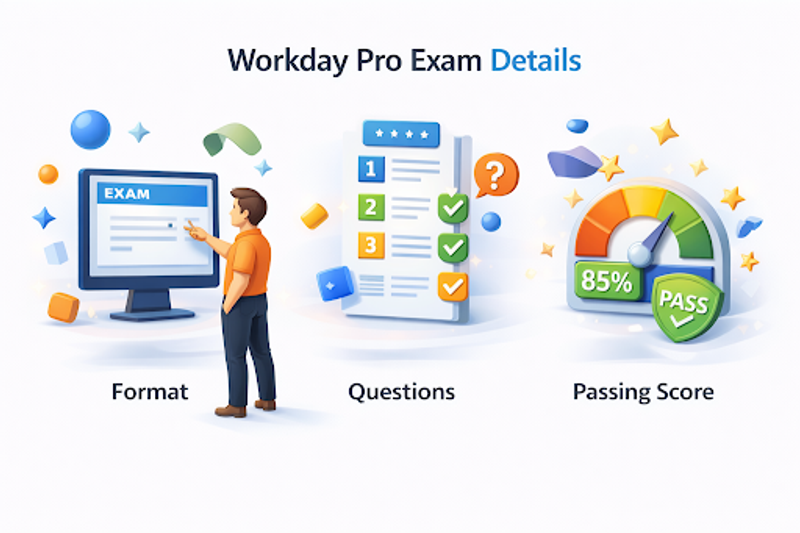
The Workday Pro exam is designed to validate a professional’s understanding of Workday concepts and real-world functional usage. The exam follows a multiple-choice question (MCQ) format and includes scenario-based, conceptual, and configuration-oriented questions. It is structured to test practical knowledge rather than just theoretical understanding. The total exam score is 50 marks, with approximately 50 questions (1 mark each), and the total duration of the exam is 2 hours, allowing sufficient time to carefully analyze business scenarios and choose the most appropriate answers.
To successfully pass the exam, candidates must achieve a minimum score of 80%, which means 40 out of 50 marks. If a candidate does not clear the exam on the first attempt, a re-attempt is permitted with a re-exam fee of USD 80. The exam focuses on core Workday functional concepts, business process understanding, system behavior, and practical application of features. Successfully clearing this exam earns the Workday Pro certification, which reflects a strong level of professional competency and hands-on knowledge of the Workday platform.
Step-by-Step Roadmap to Get Workday Pro Certified
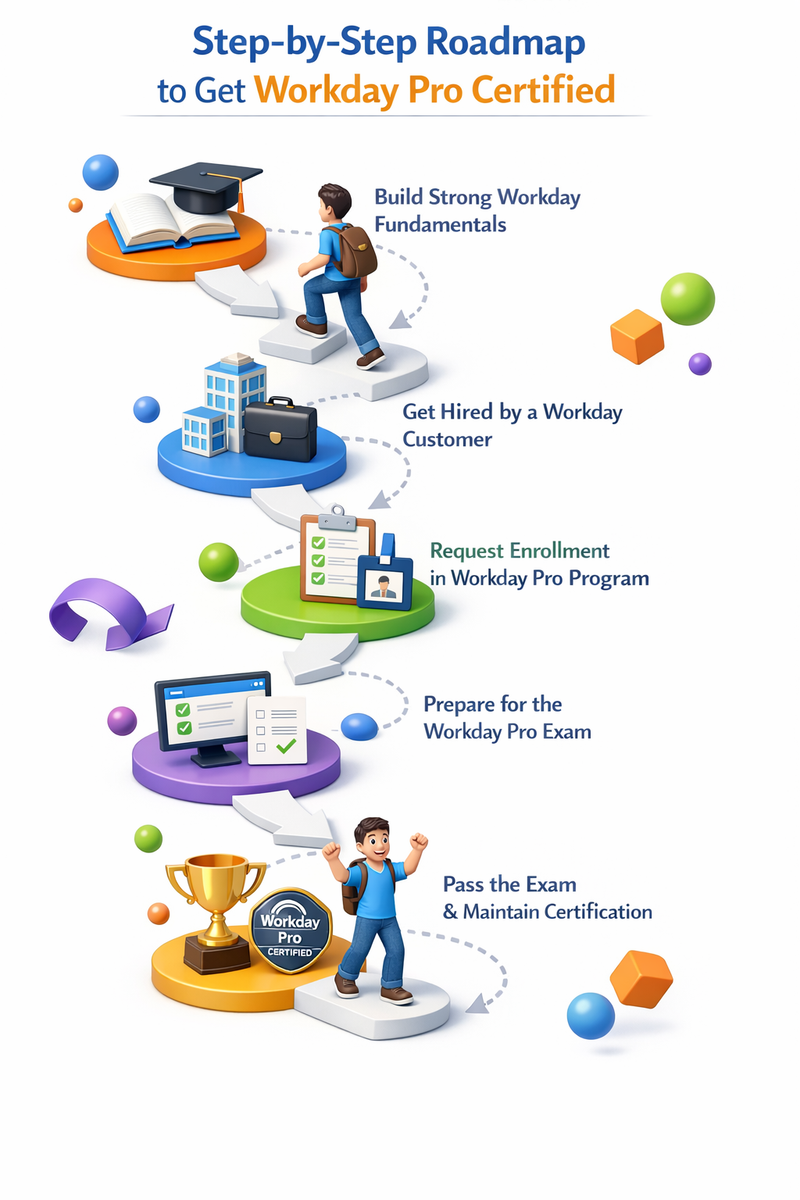
Because Workday Pro Certification cannot be purchased or accessed publicly, it must be earned through a specific career path. Many professionals fail simply because they try to start at the certification step instead of following the correct sequence. The roadmap below explains how to get Workday Pro certified the right way, from skill development to exam completion.
Step 1: Build Strong Workday Fundamentals First
Before you can be hired by a Workday customer, you must demonstrate foundational Workday knowledge. Most companies will not hire candidates who have zero exposure to Workday, even for junior HRIS or analyst roles. This is where structured, independent training becomes essential.
At this stage, you should focus on understanding:
- Workday Core HCM concepts (organizations, jobs, business processes)
- Security and role-based access
- Reporting basics (simple, advanced, and matrix reports)
- High-level exposure to integrations and data flows
This foundational knowledge helps you speak confidently in interviews and proves that you can be trained further once hired.
Step 2: Get Hired by a Workday Customer Organization
The most important requirement for Workday Pro exam access is employment with a company that already uses Workday. This could be a multinational enterprise, a mid-size organization, or a global services firm running Workday internally.
Common roles that lead to Workday Pro certification include:
- HRIS Analyst or HR Systems Analyst
- Workday Administrator
- HR Operations or Payroll Analyst
- Reporting or Security Analyst
Once you are part of a Workday customer organization, you become eligible for the Pro certification pathway, which is not available to external job seekers.
Step 3: Request Enrollment in the Workday Pro Program
After joining a Workday customer, you cannot self-enroll in the Pro certification. Enrollment is handled internally through your company’s Workday Training Coordinator or system administrator.
Your organization will:
- Identify the relevant Workday Pro track (HCM, Payroll, Reporting, Security, etc.)
- Enroll you in Workday-approved training materials
- Grant official access to the Workday Pro exam
This ensures the certification aligns with the modules your company actually uses.
Step 4: Prepare for the Workday Pro Exam
Once enrolled, you will receive access to Workday’s official learning resources, including documentation, guided labs, and practice materials. The exam is designed to test practical knowledge, not memorization.
Typically, the Workday Pro exam:
- Is conducted online
- Consists of around 50 multiple-choice questions
- Requires a minimum passing score of approximately 80%
Because the exam reflects real system usage, professionals with hands-on experience usually perform better than those relying only on theory.
Step 5: Pass the Exam and Maintain Your Certification
After passing the exam, you earn the Workday Pro digital badge, which can be shared on LinkedIn and internal company profiles. Unlike partner certifications, Workday Pro does not expire when you change roles within a customer organization, though periodic updates or refreshers may be required when Workday releases major platform changes.
Maintaining your certification demonstrates ongoing expertise and positions you as a trusted internal Workday expert.