
The Impact of AI on Data Analytics: Opportunities, Challenges, and Future Trends in 2026
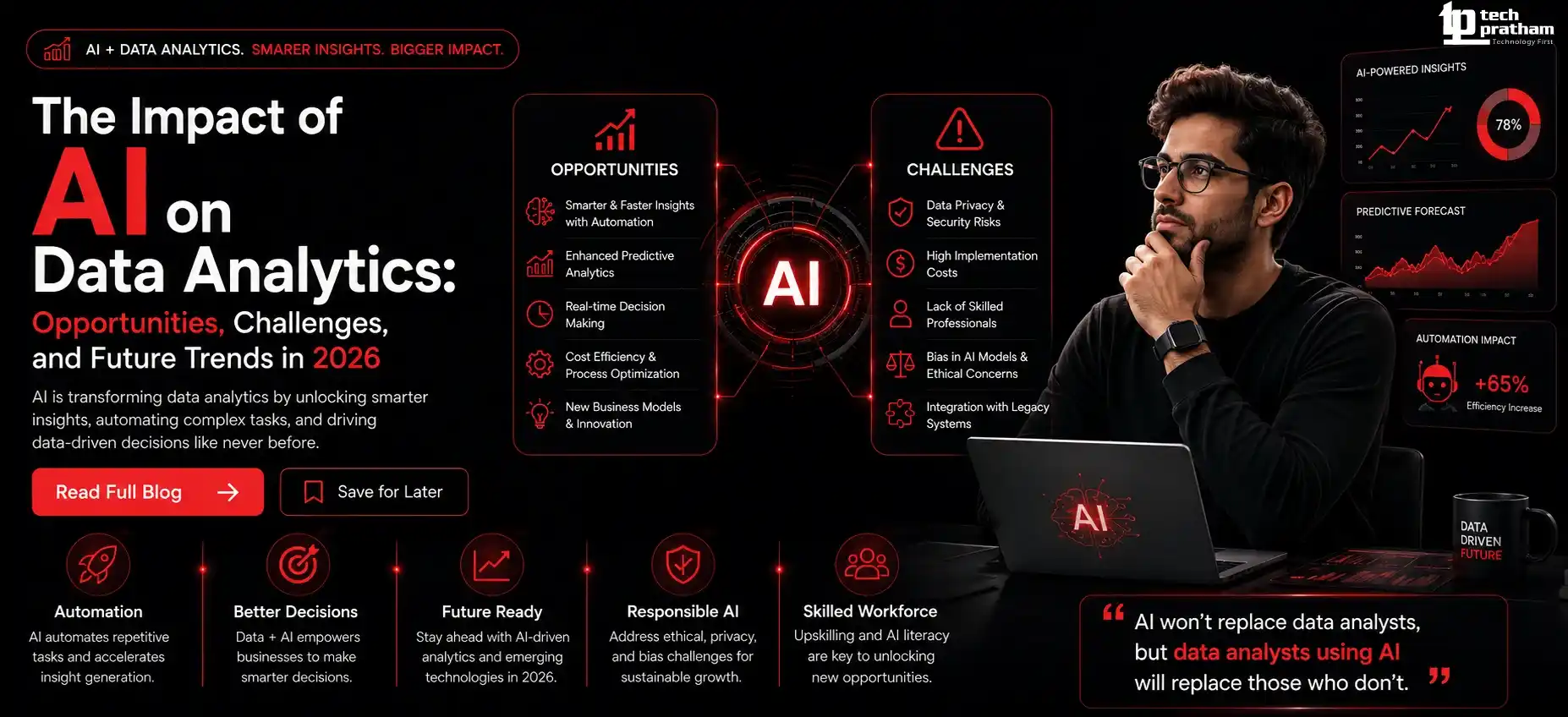
AI is changing data analytics by automating repetitive tasks, accelerating data preparation, improving predictive analytics, detecting patterns and anomalies, and helping businesses generate insights faster. From AI-assisted data analysis to natural-language queries and automated reporting, organizations can now analyze large volumes of data more efficiently. AI is also changing the role of data analysts. Instead of replacing human expertise, AI can reduce repetitive analytical work and allow analysts to focus more on interpreting results, validating insights, understanding business context, and supporting strategic decision-making. This article explores how AI is changing data analytics, its benefits and challenges, its impact on data analyst jobs, and the key trends shaping data analytics in 2026 and beyond.
What Is AI in Data Analytics?
AI in data analytics refers to the use of artificial intelligence, machine learning, generative AI, and intelligent automation to collect, prepare, analyze, interpret, and visualize data. AI can help analysts identify patterns, generate insights, automate repetitive tasks, detect anomalies, and support faster data-driven decisions.
However, this does not mean AI replaces data analysts. Instead, it acts as a powerful assistant that allows analysts to spend more time solving business problems, interpreting results, and communicating insights to decision-makers.
For example, an e-commerce company receives millions of customer transactions every day. Manually analyzing this data would take weeks. AI-powered analytics tools can instantly identify buying trends, recommend products, predict customer behavior, and detect unusual activities, allowing businesses to make faster and more informed decisions.
Why AI Is Becoming Essential in Data Analytics
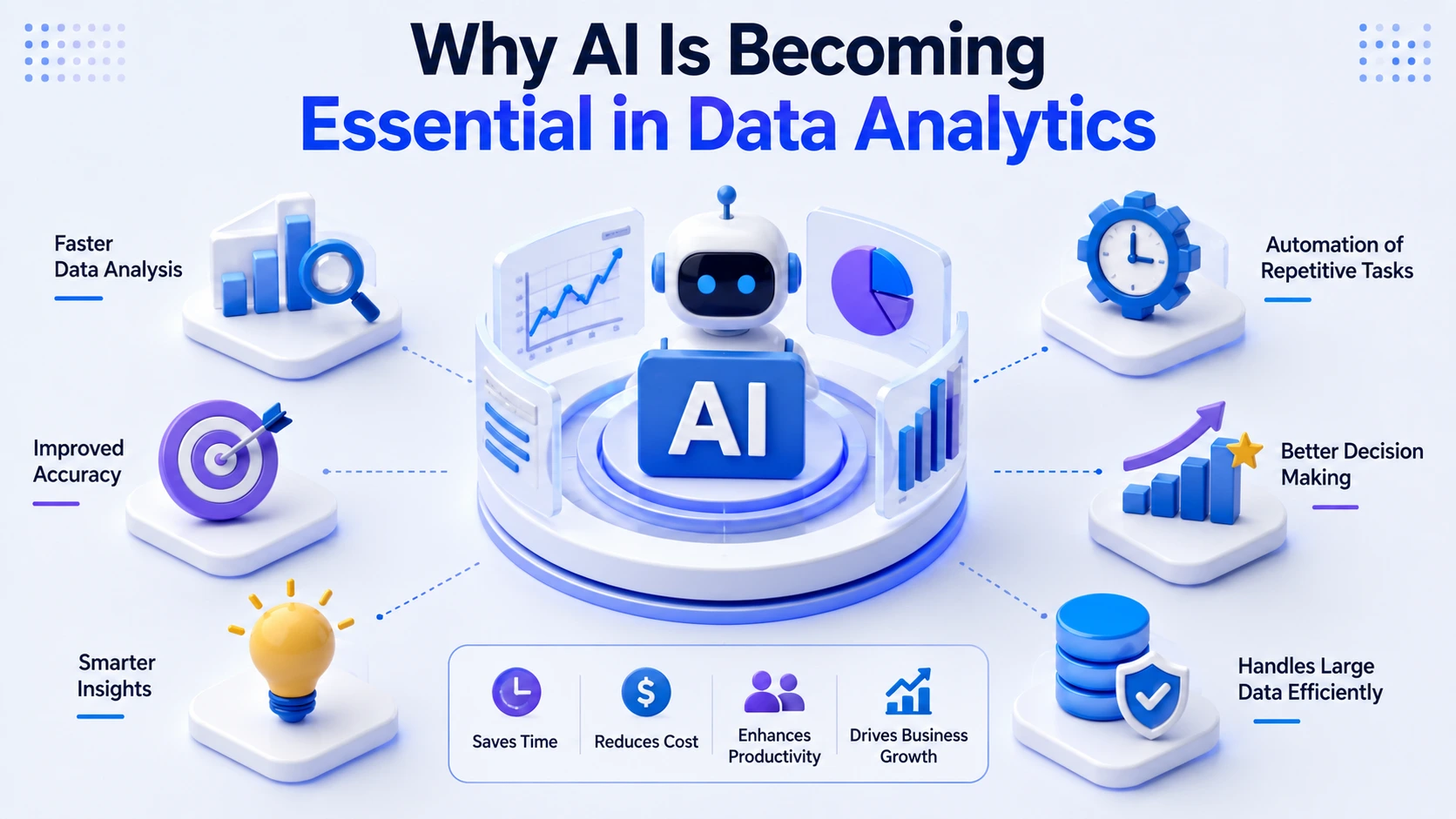
The amount of data generated worldwide is growing at an extraordinary pace. Businesses collect information from websites, mobile applications, social media platforms, IoT devices, online transactions, customer feedback, and many other sources. Managing such enormous datasets manually is no longer practical.
AI enables organizations to:
- Process millions of records within seconds.
- Detect hidden patterns that humans may overlook.
- Predict future business outcomes using historical data.
- Automate repetitive analytical tasks.
- Improve decision-making with real-time insights.
- Reduce operational costs through intelligent automation.
How Is AI Changing Data Analytics?
Artificial Intelligence is revolutionizing data analytics by automating data processing, improving prediction accuracy, uncovering hidden patterns, and enabling real-time insights. From smarter decision-making to faster business intelligence, AI helps organizations analyze massive datasets more efficiently while reducing manual effort and increasing operational productivity.
1. Faster Data Collection and Integration
One of the biggest challenges in analytics is collecting data from multiple sources. Businesses often store information across CRM systems, ERP software, cloud databases, spreadsheets, APIs, and third-party applications. AI simplifies this process by automatically gathering, organizing, and integrating data from different systems without extensive manual intervention.
- Minimizes human errors
- Improves data accuracy
- Increases analyst productivity
- Accelerates decision-making
- Enables faster business insights
2. Automated Data Cleaning
Data cleaning has traditionally been one of the most time-consuming parts of every analytics project. Missing values, duplicate records, inconsistent formatting, and incorrect entries can negatively impact analysis.
- Detecting duplicate records.
- Filling missing values intelligently.
- Standardizing inconsistent formats.
- Identifying unusual data entries.
- Correcting common data quality issues.
For learners enrolled in a Data Analyst Course, understanding data preparation remains important because AI assists the process but still requires human validation.
3. Smarter Data Analysis
AI enhances this process by automatically discovering relationships between variables, identifying hidden trends, and suggesting valuable insights that analysts might otherwise miss.
- A specific marketing campaign performed exceptionally well.
- Customers purchased more products during evening hours.
- Mobile app users spent more than website visitors.
- Discounts influenced repeat purchases.
4. Predictive Analytics
One of AI's most valuable contributions is predictive analytics. Rather than simply explaining what happened in the past, AI helps organizations estimate what is likely to happen in the future.
- Predicting customer churn.
- Forecasting future sales.
- Estimating product demand.
- Detecting fraudulent transactions.
- Identifying equipment failures before they occur.
5. Real-Time Decision Making
Businesses can no longer afford to wait days or weeks for reports. AI-powered analytics platforms process streaming data continuously, enabling organizations to make immediate decisions.
- Detecting fraudulent banking transactions instantly.
- Monitoring hospital patient conditions in real time.
- Tracking delivery vehicles across multiple locations.
- Identifying cybersecurity threats before systems are compromised.
- Monitoring inventory levels to prevent stock shortages.
6. Natural-Language Data Queries
AI allows users to interact with data using natural-language questions instead of relying entirely on complex queries. AI-assisted analytics tools can help generate queries, explore datasets, summarize results, and make data analysis more accessible to both technical and non-technical users. Analysts should still review AI-generated queries and results to ensure accuracy and alignment with business requirements.
7. Automated Reporting and Data Visualization
AI can assist with generating reports, summarizing key findings, identifying important trends, and explaining dashboard results. These capabilities can reduce repetitive reporting work and allow analysts to spend more time interpreting insights and communicating recommendations to stakeholders.
8. AI-Powered Anomaly Detection
AI can identify unusual patterns and deviations in large datasets that may be difficult to detect manually. For example, businesses can use AI-assisted analytics to identify unusual transactions, sudden changes in sales, unexpected customer behavior, or operational issues that require further investigation.
Impact of AI on Data Analyst Jobs
AI is changing data analyst jobs by automating repetitive analytical tasks and increasing the importance of business understanding, data validation, critical thinking, communication, and AI-assisted analysis. AI can handle parts of data preparation, reporting, pattern detection, and routine analysis, while data analysts remain responsible for interpreting results, understanding business context, validating insights, and supporting strategic decisions.
- Interpret AI-generated insights in a business context
- Ask the right business questions before analyzing data
- Validate the accuracy and reliability of AI outputs
- Communicate findings to stakeholders in simple language
- Build data-driven strategies for business growth
- Solve complex business problems using critical thinking
The Future Outlook
Rather than replacing data analysts, AI is transforming the role into a more strategic profession. Analysts who combine technical expertise with AI tools, business knowledge, critical thinking, and strong communication skills will remain highly valuable. In 2026 and beyond, the most successful professionals will be those who use AI as a productivity partner while focusing on solving real business challenges and delivering actionable insights.
Will AI Replace Data Analysts?
AI is more likely to automate repetitive data analytics tasks than completely replace data analysts. Organizations still need professionals who can understand business objectives, validate AI-generated results, identify inaccurate or misleading insights, communicate findings, and make decisions that require human judgment. As AI adoption grows, data analysts who combine analytics fundamentals with AI skills and business understanding can remain valuable in the evolving workplace.
Challenges of AI in Data Analytics
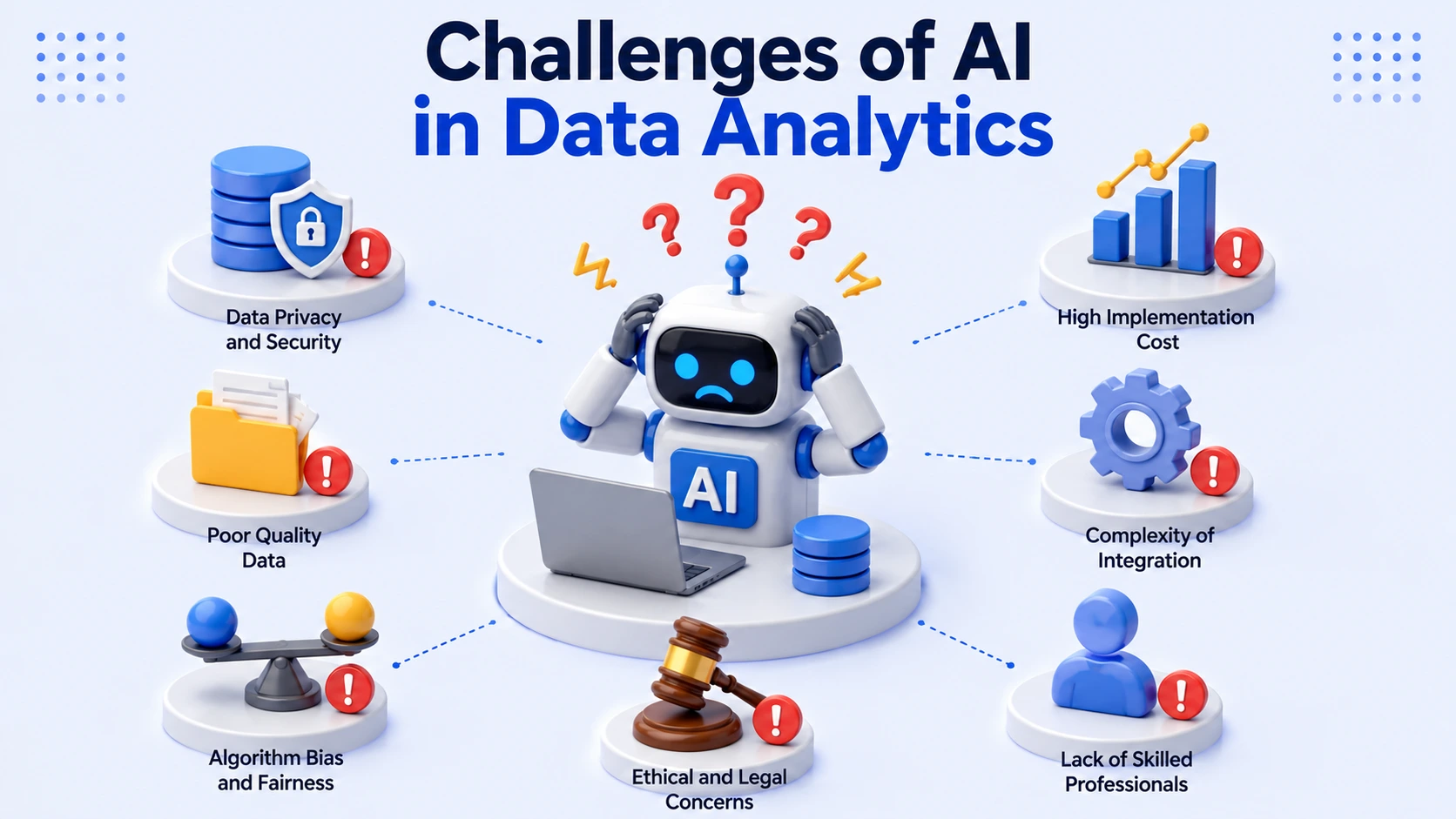
While AI offers tremendous advantages, it also introduces new challenges that organizations and professionals must address. Understanding these challenges is essential because successful data analytics is not just about using advanced tools—it's about using them responsibly and effectively.
1. Data Quality Still Determines the Results
A common misconception is that AI can fix every data problem automatically. In reality, AI models are only as good as the data they receive. If a dataset contains incomplete records, outdated information, duplicate entries, or biased data, the AI system may produce inaccurate insights.
- AI cannot automatically fix every data problem
- AI models are only as accurate as the data they receive
- Incomplete data leads to unreliable insights
- Outdated information reduces prediction accuracy
- Duplicate records can distort analysis
2. Privacy and Data Security
Organizations collect sensitive information such as customer details, financial transactions, healthcare records, and employee information. AI systems processing this data must comply with privacy regulations and security standards.
- Data privacy principles
- Secure data handling practices
- Ethical use of AI
- Compliance with organizational policies
3. AI Cannot Replace Human Judgment
Imagine an airline notices a sudden drop in ticket bookings. AI might suggest lowering ticket prices based on historical trends. However, a data analyst may discover the real reason is severe weather forecasts or airport maintenance affecting travel plans.
- Interpret AI-generated insights
- Validate recommendations
- Understand business objectives
- Communicate findings to stakeholders
4. Bias in AI Models
Modern data analysts play a crucial role in identifying and minimizing these biases to ensure fair and reliable decision-making. AI learns from historical data. If that data contains bias, AI may unintentionally reinforce it.
- A hiring model trained on biased recruitment data may favor certain candidates.
- A loan approval model could unintentionally disadvantage specific customer groups.
- Marketing recommendations may ignore valuable customer segments.
5. AI Accuracy and Hallucinations
AI-generated analysis can sometimes contain inaccurate assumptions, incorrect interpretations, or unsupported conclusions. Data analysts should validate AI-generated outputs against reliable data, business rules, and domain knowledge before using them for important business decisions.
Essential Skills Every Data Analyst Needs in the AI Era
The role of a data analyst is evolving. Instead of spending most of their day preparing reports manually, analysts are increasingly expected to interpret AI-driven insights and solve complex business problems. Here are the skills that matter most in 2026.
SQL Remains the Foundation
Even with AI tools capable of generating SQL queries, professionals still need to understand how databases work and how to validate AI-generated queries. SQL helps analysts retrieve, filter, join, aggregate, and analyze data accurately.
- Retrieve and query data
- Filter and transform datasets
- Join data from multiple tables
- Aggregate business metrics
- Validate AI-generated SQL queries
Excel Is Still Highly Relevant
Many businesses continue to rely on Excel for reporting, budgeting, forecasting, and operational analysis. Modern Excel now includes AI-powered features that improve productivity, but professionals still need strong spreadsheet skills for everyday business tasks.
- Widely used across industries and organizations
- Ideal for data cleaning and preparation
- Supports formulas, PivotTables, and charts
- Helps create interactive dashboards and reports
- Integrates with Power BI, SQL, and other analytics tools
Python for Advanced Analytics
AI makes coding easier, but understanding Python allows analysts to customize solutions and solve unique business problems. Python enables analysts to:
- Automate repetitive work
- Analyze large datasets
- Build predictive models
- Perform statistical analysis
- Work with machine learning libraries
Power BI and Data Visualization
With AI-powered features such as natural language queries and automated insights, Power BI has become an even more powerful analytics platform. Businesses make decisions faster when information is presented visually. Power BI allows analysts to:
- Build interactive dashboards
- Monitor KPIs
- Create executive reports
- Share insights across teams
Business Understanding
The best analysts combine technical expertise with business knowledge to deliver recommendations that create measurable value. Technical skills alone are no longer enough. Organizations value professionals who understand:
- Business processes
- Customer behavior
- Financial metrics
- Marketing performance
Communication and Storytelling
As AI automates technical tasks, communication skills are becoming even more important. Data only becomes valuable when decision-makers understand it. A skilled analyst knows how to:
- Present findings clearly
- Explain trends in simple language
- Recommend actionable solutions
- Build compelling dashboards and presentations
AI Literacy for Data Analysts
Data analysts increasingly need to understand how AI tools can support analytics workflows, where these tools should be used, and how to validate AI-generated outputs. AI literacy helps analysts use AI-assisted analysis responsibly while maintaining data quality, accuracy, and business context.
AI Agents and Automated Analytics Workflows
AI agents are increasingly being explored for multi-step analytics workflows, such as retrieving data, preparing datasets, running analysis, generating visualizations, and summarizing insights. Human review remains important for accuracy, governance, and business decisions.
Career Opportunities in the AI-Driven Analytics Industry
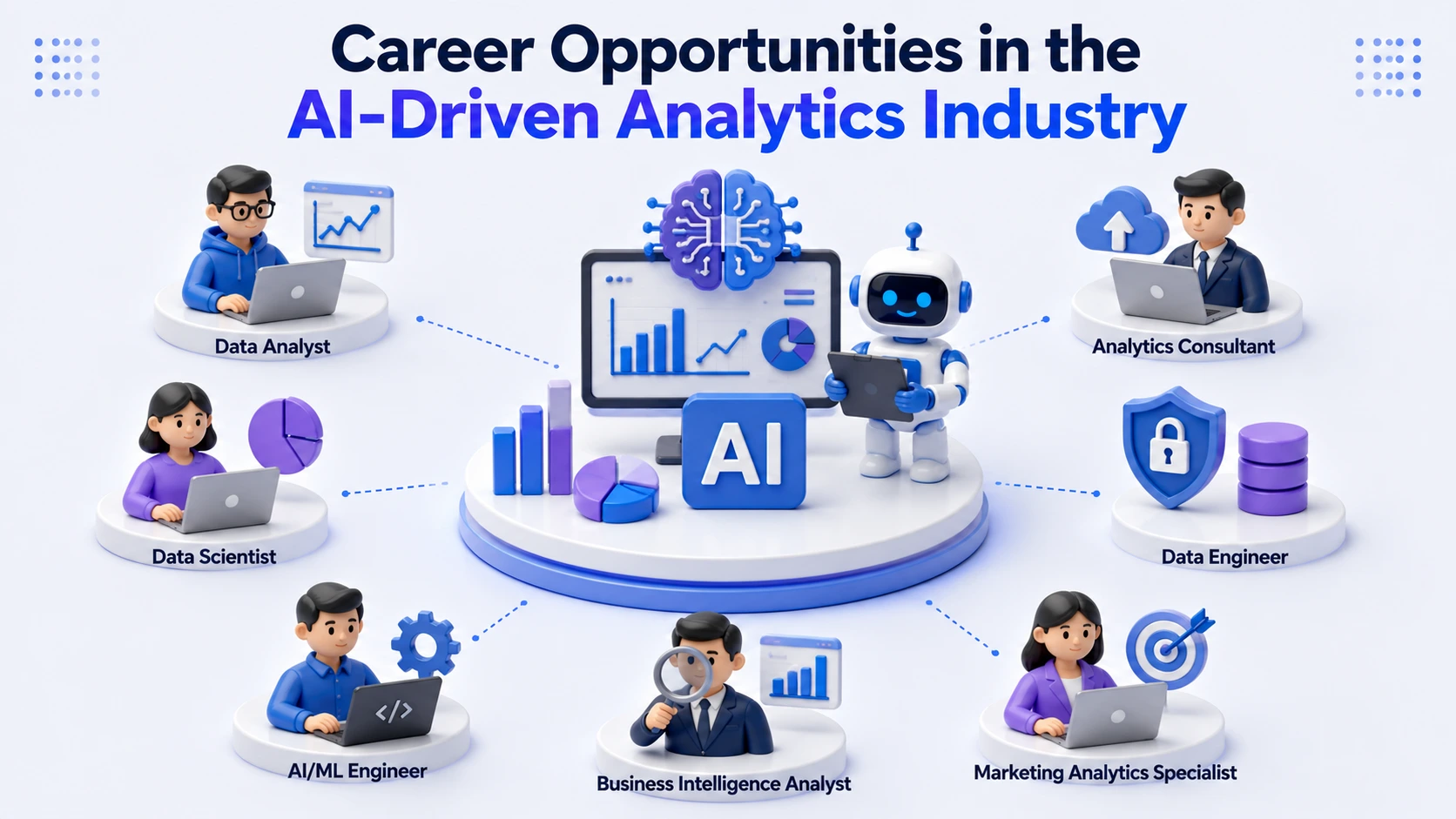
AI is creating new opportunities rather than reducing demand for analytics professionals. Today's organizations require experts who can work with both traditional analytics tools and AI-powered platforms. Some of the fastest-growing career paths include:
- Data Analyst
- Business Intelligence Analyst
- Product Analyst
- Marketing Analyst
- Financial Analyst
Future Trends Shaping Data Analytics Beyond 2026
The future of data analytics is not about replacing professionals with AI—it's about enabling them to make faster and smarter decisions. Here are the trends expected to shape the industry over the coming years.
Conversational Analytics
Instead of writing complex SQL queries, users can simply ask questions like
- Enables faster data exploration and analysis
- Automatically creates charts, graphs, and visualizations
- Helps non-technical users access data insights easily
- Reduces dependency on advanced SQL skills
Predictive and Prescriptive Analytics
Organizations are moving beyond understanding past performance. Future analytics platforms will increasingly answer questions such as:
- What is likely to happen next?
- Why will it happen?
- What action should the business take?
Automated Data Storytelling
AI is becoming capable of generating business summaries, executive reports, and dashboard explanations automatically.
- Creates dashboard explanations without manual effort
- Reduces time spent on repetitive reporting tasks
- Helps analysts focus on strategic business challenges
- Improves reporting speed and efficiency
Cloud-Based Analytics
Platforms such as Microsoft Fabric, Google Cloud, and Snowflake are making enterprise analytics faster, more scalable, and easier to collaborate on.
- Enables seamless data storage, processing, and analysis
- Improves collaboration across teams and departments
- Supports real-time data access and decision-making
- Reduces dependency on traditional infrastructure
Human-AI Collaboration
The future workplace will combine AI efficiency with human expertise.
- Process data faster
- Detect hidden trends
- Automate repetitive analysis
- Generate reports
Choosing the Right Learning Path
The Best Data Analytics Course is one that not only teaches technical concepts but also helps you understand how AI is applied in real business scenarios. A comprehensive Data Analytics Course in India should prepare you to work confidently with intelligent analytics platforms while strengthening your problem-solving and decision-making skills.
- Learn analytics with modern AI tools
- Gain hands-on experience with Excel, SQL, Python, and Power BI
- Practice AI-assisted analytics and real-world projects
- Choose industry-focused Data Analytics courses
- Build job-ready technical and problem-solving skills
- Learn to use intelligent analytics platforms
- Improve decision-making with data-driven insights
Conclusion
AI is transforming data analytics by automating repetitive tasks, improving predictive insights, accelerating reporting, and enabling new ways to interact with data. However, human judgment, business understanding, critical thinking, and data validation remain essential.
As AI continues to evolve, successful data analysts will be those who combine strong analytics fundamentals with AI-assisted tools and business expertise. Learning how to work effectively with AI can help professionals adapt to the changing analytics landscape and make faster, more reliable data-driven decisions.
Frequently Asked Questions (FAQs)
1. Will AI replace data analysts in the future?
No. AI is designed to automate repetitive tasks such as data cleaning, report generation, and pattern detection. However, businesses still need data analysts to understand business problems, validate AI-generated insights, communicate findings, and recommend strategic actions. AI is changing the role of analysts rather than replacing them.
2. Which AI tools should aspiring data analysts learn?
Some of the most valuable AI-powered tools include ChatGPT, Microsoft Copilot, Power BI Copilot, Microsoft Fabric, Google Gemini, and Tableau AI. These tools help automate reporting, generate SQL queries, summarize data, and accelerate dashboard creation. Learning how to use them alongside traditional analytics tools gives professionals a competitive advantage.
3. What skills are most important for data analysts in 2026?
A successful data analyst should have strong knowledge of Excel, SQL, Python, Power BI, statistics, data visualization, and business intelligence. In addition, understanding AI-assisted analytics, communication, and problem-solving skills has become increasingly important in today's workplace
4. Is coding mandatory to become a data analyst?
Basic coding knowledge, especially SQL, is highly recommended because it is used to retrieve and manage data. Python is valuable for automation and advanced analytics, but many entry-level analytics roles also rely heavily on Excel and Power BI. AI tools can simplify coding tasks, but understanding the underlying concepts remains essential.
5. How can beginners prepare for an AI-driven data analytics career?
Beginners should start by learning Excel, SQL, Python, and Power BI before exploring AI-powered analytics tools. Building real-world projects, practicing with business datasets, and enrolling in a Data Analytics Certification Training in India that includes practical learning and AI integration can significantly improve job readiness.
6. How is AI used in data analytics?
AI is used in data analytics for tasks such as data preparation, pattern detection, predictive analytics, anomaly detection, natural-language queries, automated reporting, and insight generation. AI can reduce repetitive work and help analysts process and interpret large datasets more efficiently.
7. What are the benefits of AI in data analytics?
The key benefits of AI in data analytics include faster data processing, automation of repetitive tasks, improved pattern detection, predictive insights, anomaly detection, faster reporting, and better support for data-driven decision-making. Human validation remains important to ensure AI-generated insights are accurate and relevant.
8. How will AI change data analyst jobs?
AI will change data analyst jobs by automating more repetitive tasks such as basic data preparation, reporting, and routine analysis. Analysts will increasingly focus on interpreting AI-assisted insights, validating results, understanding business requirements, communicating findings, and making strategic recommendations.
Related Articles

How to Switch Your Career to Data Science: A Pathway to a New Career
Learn how to switch your career to Data Science with the right skills, projects, AI knowledge, portfolio and career guidance.

Is Data Science a Good Career? A Complete Guide for Beginners
Is Data Science a good career? Explore career opportunities, skills, roadmap, AI impact, and practical guidance for beginners.

Best Data Science Courses in India: A Complete Guide
Explore the Best Data Science Courses in India and build in-demand skills with industry-focused training and certification.





 +91-8882178896
 +1 (343) 477-0926