Table of Contents
End-to-End Workday Financial Management: Procure-to-Pay, Order-to-Cash, and Beyond
End-to-end financial management in Workday provides organizations with a unified platform to streamline core business processes such as Procure-to-Pay (P2P), Order-to-Cash (O2C), and Record-to-Report (R2R). By integrating procurement, accounting, revenue management, and reporting into a single cloud-based system, Workday enables real-time visibility, improved accuracy, and faster decision-making. Businesses can automate tasks like supplier management, invoice processing, billing, and cash collection, reducing manual effort and operational costs while enhancing compliance and financial control.
For professionals looking to build expertise in modern ERP systems, enrolling in Workday Finance training for beginners is a strategic step toward understanding these end-to-end workflows. This training helps learners grasp how financial data flows seamlessly across processes, ensuring efficiency from procurement to revenue realization. With growing demand for Workday professionals, gaining knowledge of these financial cycles not only boosts career opportunities but also equips individuals to support digital transformation initiatives in finance departments across industries.
Understanding End-to-End Financial Cycles in Workday
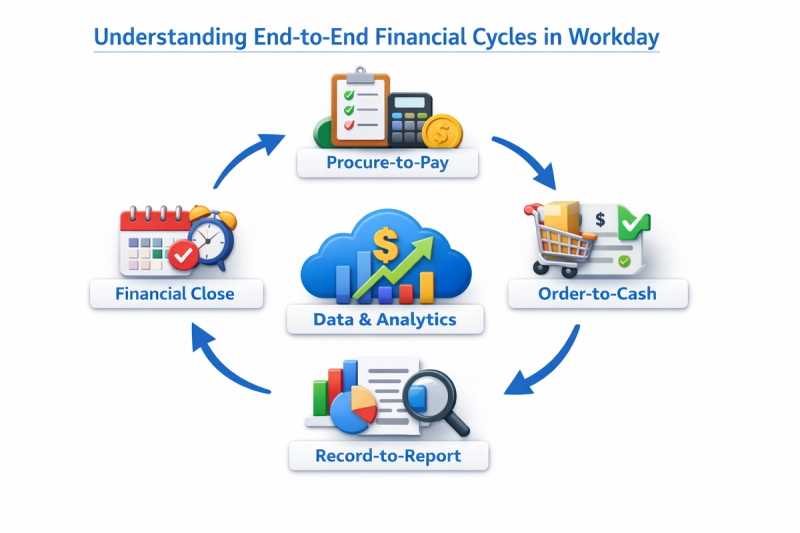
Understanding end-to-end financial cycles in Workday is essential for organizations aiming to achieve seamless financial operations and real-time visibility. These cycles represent the complete flow of financial activities—from procurement and expense management to revenue generation and financial reporting. Unlike traditional systems that operate in silos, Workday unifies processes such as Procure-to-Pay (P2P), Order-to-Cash (O2C), and Record-to-Report (R2R) within a single cloud platform. This integrated approach helps businesses eliminate data inconsistencies, improve accuracy, and gain a holistic view of their financial health.
One of the key advantages of Workday’s end-to-end financial cycles is automation and real-time data processing. Tasks like invoice matching, payment processing, revenue tracking, and financial consolidation are streamlined through intelligent workflows. This not only reduces manual intervention but also accelerates decision-making with up-to-date insights. As companies increasingly adopt cloud ERP solutions, professionals are actively upgrading their skills through programs like workday online training in chennai, where they can learn how these interconnected financial processes function in real-world business scenarios.
Moreover, Workday’s flexible and scalable architecture allows organizations to adapt their financial processes as they grow. With built-in analytics, compliance tools, and customizable reporting, finance teams can ensure better control and transparency across all operations. Learning how these end-to-end cycles work is crucial for anyone looking to build a career in modern finance systems. By gaining practical expertise in managing financial workflows and position themselves for high-demand roles in today’s competitive job market.
Procure-to-Pay (P2P) Process in Workday
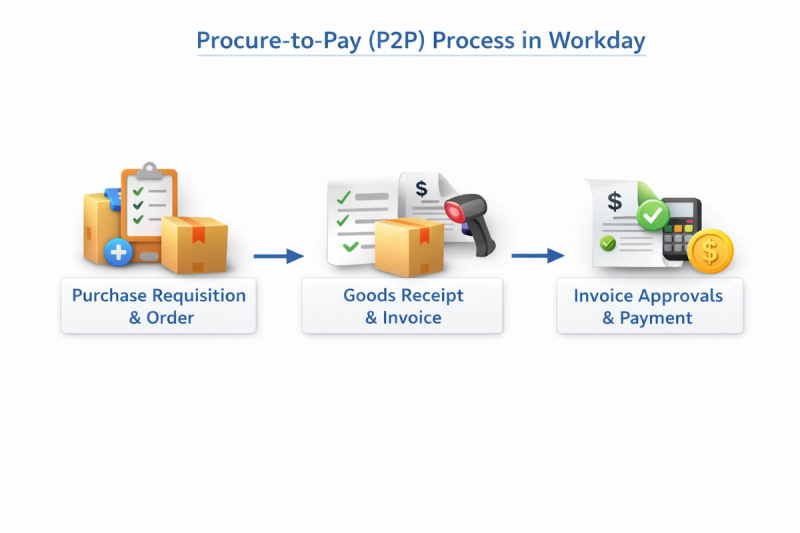
The Procure-to-Pay (P2P) process in Workday is a comprehensive financial workflow that manages the entire lifecycle of purchasing goods and services, from initial requisition to final payment. It begins with employees or departments creating purchase requisitions, which are then routed through approval workflows based on organizational policies. Once approved, purchase orders are generated and sent to suppliers, ensuring clear communication and accurate tracking. This streamlined approach helps organizations maintain control over spending while improving procurement efficiency.
Workday enhances the P2P process through automation and real-time data visibility. Key steps such as supplier onboarding, invoice matching, and payment processing are integrated within a single system, reducing manual errors and delays. The platform supports three-way matching between purchase orders, receipts, and invoices, ensuring accuracy and compliance before payments are made. Additionally, finance teams can monitor transactions in real time, enabling better cash flow management and quicker decision-making.
Another significant advantage of Workday’s Procure-to-Pay process is its ability to provide insights and improve strategic sourcing. With built-in analytics and reporting tools, organizations can evaluate supplier performance, track spending patterns, and identify cost-saving opportunities. This not only enhances operational efficiency but also strengthens supplier relationships. By leveraging Workday’s cloud-based capabilities, businesses can standardize procurement processes, ensure compliance, and achieve greater financial transparency across the organization.
Order-to-Cash (O2C) Process in Workday
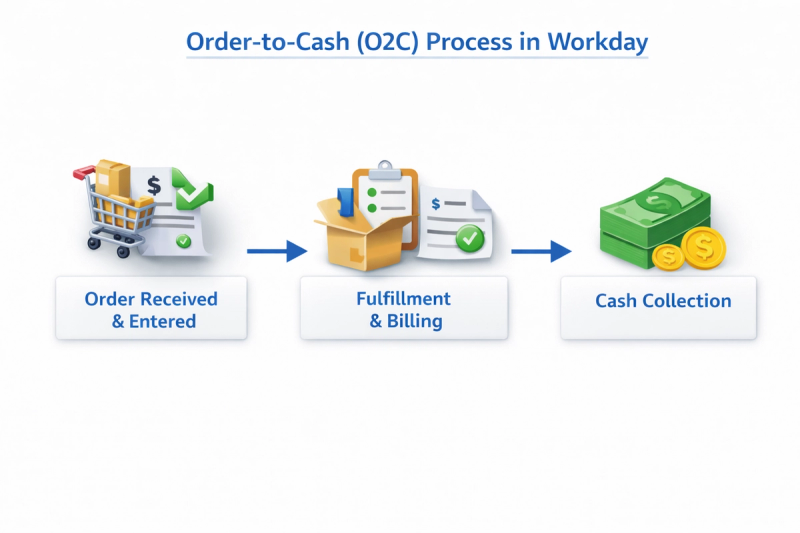
The Order-to-Cash (O2C) process in Workday is a critical financial cycle that manages the complete journey from customer order placement to final payment collection. It begins with customer setup and sales order creation, followed by product or service delivery and invoice generation. Workday streamlines this process by integrating billing, revenue recognition, and accounts receivable into a single platform, ensuring accuracy and consistency across all stages. This unified approach helps organizations improve customer experience while maintaining better control over financial transactions.
One of the key strengths of Workday’s O2C process is its real-time visibility and automation capabilities. Businesses can track outstanding invoices, monitor cash inflows, and automate collections more efficiently. The system also supports compliance with accounting standards through automated revenue recognition and detailed reporting. By reducing manual intervention and enhancing transparency, Workday enables finance teams to optimize cash flow, minimize delays in payments, and make faster, data-driven decisions that support overall business growth.
Workday Financial Reporting and Analytics
Workday Financial Reporting and Analytics in Workday empowers organizations with real-time insights and data-driven decision-making capabilities. Unlike traditional reporting systems that rely on static data, Workday provides dynamic dashboards and customizable reports that update instantly as transactions occur. This enables finance teams to monitor key performance indicators (KPIs), track financial performance, and respond quickly to changing business needs, all within a unified cloud platform.
A key advantage of Workday’s reporting capabilities is its flexibility and ease of use. Finance professionals can create ad-hoc reports, drill down into detailed transactions, and visualize financial trends through interactive dashboards. The platform also supports advanced analytics such as forecasting, budgeting, and scenario planning, helping organizations make informed strategic decisions. Gaining practical exposure to these tools is often a core part of a workday course in bangalore, where learners understand how to transform raw financial data into meaningful insights.
Additionally, Workday ensures data consistency and transparency by maintaining a single source of truth across all financial operations. This simplifies audit processes, enhances compliance, and improves collaboration between departments. With anytime, anywhere access to financial data, organizations can operate more efficiently and stay agile in a competitive environment, while professionals equipped with reporting and analytics expertise can significantly contribute to business growth.
Automation and AI in Workday Finance
Automation and AI in Workday Finance are transforming how organizations manage their financial operations by reducing manual effort and increasing efficiency. Workday leverages intelligent automation to handle repetitive tasks such as invoice processing, expense approvals, and reconciliations, allowing finance teams to focus on more strategic activities. By automating routine workflows, businesses can minimize human errors, accelerate processing times, and ensure greater consistency across financial transactions.
Artificial intelligence further enhances Workday Finance by providing predictive insights and intelligent recommendations. AI-powered features can analyze historical financial data to forecast trends, detect anomalies, and identify potential risks before they impact the business. For example, machine learning algorithms can improve cash flow forecasting, optimize payment cycles, and even suggest cost-saving opportunities. This level of intelligence enables organizations to move from reactive financial management to a more proactive and strategic approach.
Additionally, the combination of automation and AI supports better compliance, audit readiness, and decision-making. Workday maintains continuous monitoring of financial activities, ensuring that processes align with regulatory standards and internal policies. Real-time analytics and automated reporting provide finance leaders with accurate, up-to-date information to guide business strategies. As a result, organizations can achieve greater agility, improved financial control, and a competitive advantage in today’s rapidly evolving digital landscape.
Benefits of End-to-End Workday Financial Management
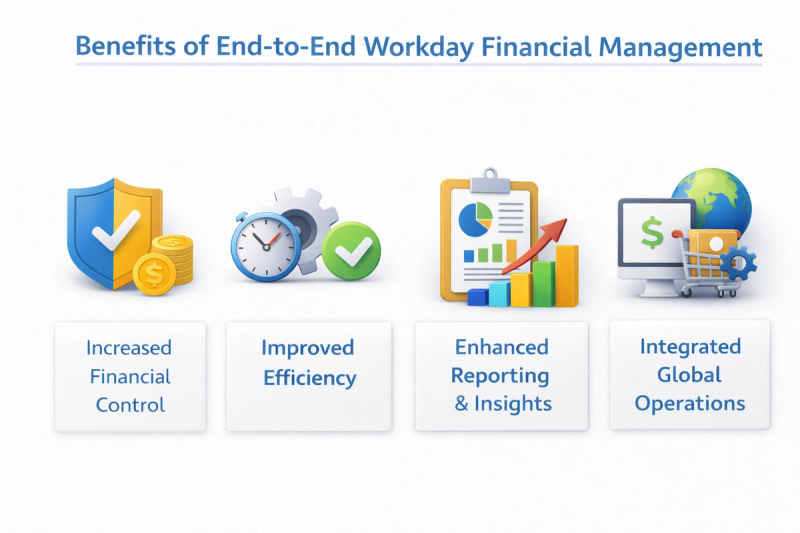
End-to-end financial management in Workday offers organizations a unified and streamlined approach to handling all financial processes within a single platform. By integrating key functions such as Procure-to-Pay (P2P), Order-to-Cash (O2C), and Record-to-Report (R2R), Workday eliminates data silos and ensures seamless information flow across departments. This integration improves accuracy, reduces duplication of efforts, and provides a comprehensive view of financial operations, enabling businesses to operate more efficiently.
One of the major benefits of Workday’s end-to-end financial management is real-time visibility and enhanced decision-making. Finance teams can access up-to-date financial data, monitor performance metrics, and generate reports instantly without waiting for manual consolidation. This real-time insight allows organizations to respond quickly to market changes, manage cash flow effectively, and make informed strategic decisions. Additionally, automation of routine tasks such as invoicing, reconciliations, and reporting reduces manual workload and minimizes the risk of errors.
Another key advantage is improved compliance, scalability, and overall business agility. Workday’s cloud-based architecture ensures that organizations can easily adapt to changing business needs, regulatory requirements, and growth demands. Built-in audit trails, security controls, and standardized processes help maintain compliance and transparency across all financial activities. As a result, businesses can achieve better financial control, optimize costs, and position themselves for long-term success in an increasingly competitive and digital-driven environment.
Common Challenges in Workday Financial Implementation
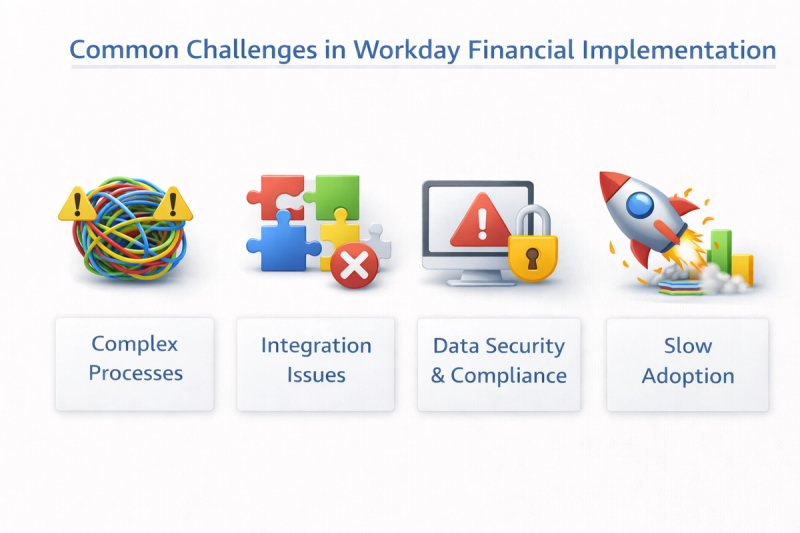
Implementing Workday Financial Management can bring significant advantages, but organizations often face several challenges during the process. One of the most common issues is data migration, where transferring data from legacy systems to Workday requires careful planning and validation. Inaccurate or incomplete data can lead to reporting errors and operational disruptions. Additionally, aligning existing business processes with Workday’s standardized framework can be complex, especially for organizations with highly customized legacy systems.
Another major challenge is change management and user adoption. Employees who are accustomed to traditional financial systems may find it difficult to adapt to Workday’s modern, cloud-based interface and workflows. Without proper training and communication, resistance to change can slow down implementation and reduce overall efficiency. Organizations must invest in structured training programs and continuous support to ensure that users understand the system and can effectively perform their roles within the new environment.
Integration with other enterprise systems is also a critical hurdle during Workday Financial implementation. Businesses often rely on multiple third-party applications for payroll, CRM, or supply chain management, and ensuring seamless integration with Workday can be technically demanding. Poor integration can result in data inconsistencies and process delays. To overcome these challenges, organizations should adopt a well-defined implementation strategy, involve experienced consultants, and focus on testing and optimization to ensure a smooth and successful deployment.
Future Trends in Workday Financial Management
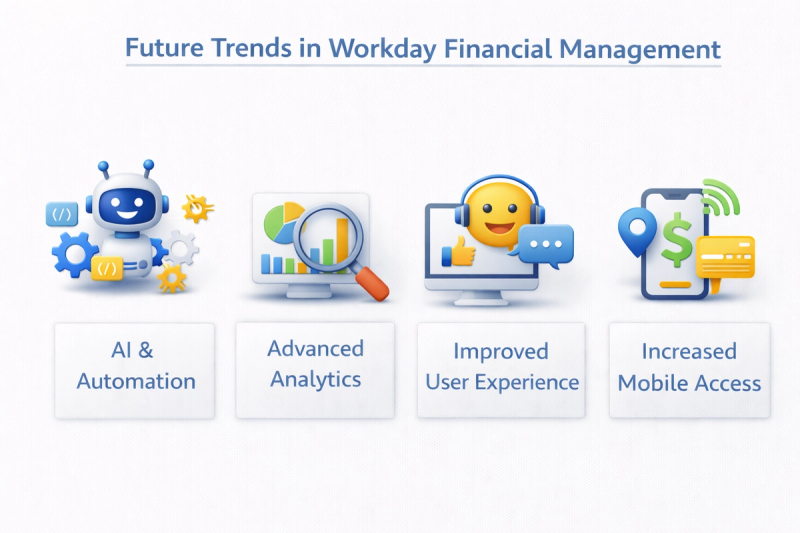
The future of Workday Financial Management in Workday is being driven by advancements in artificial intelligence and automation, transforming how finance teams operate. Organizations are moving beyond traditional accounting processes toward intelligent systems that can predict trends, automate complex workflows, and provide real-time financial insights. AI-powered capabilities are expected to enhance forecasting accuracy, detect anomalies, and support proactive decision-making, allowing finance professionals to focus more on strategic initiatives rather than routine tasks.
Another key trend is the continued evolution of cloud-based and unified ERP systems. Workday’s cloud-native architecture enables seamless integration across finance, HR, and operational functions, creating a connected ecosystem of data and processes. This integration allows businesses to access real-time information, improve collaboration across departments, and respond quickly to changing market conditions. As companies scale, the flexibility and accessibility of cloud platforms will play a crucial role in maintaining efficiency and supporting global operations.
Looking ahead, emerging technologies such as predictive analytics and hyperautomation will further redefine financial management in Workday. These innovations will enable organizations to automate end-to-end financial cycles, strengthen compliance, and improve overall efficiency with minimal manual intervention. With continuous advancements in digital finance, businesses adopting Workday will be better equipped to stay agile, reduce risks, and drive long-term growth in an increasingly competitive and data-driven environment.
Conclusion
In conclusion, end-to-end financial management in Workday provides organizations with a powerful, unified platform to manage critical financial processes such as Procure-to-Pay, Order-to-Cash, and Record-to-Report. By integrating these workflows into a single cloud-based system, businesses can achieve greater efficiency, real-time visibility, and improved accuracy across all financial operations. This holistic approach not only simplifies complex processes but also enables better control and transparency.
As organizations continue to embrace digital transformation, Workday stands out as a future-ready solution that leverages automation, analytics, and AI to drive smarter financial decision-making. From streamlining daily transactions to enabling strategic planning, Workday empowers finance teams to adapt quickly to changing business needs. Adopting such modern financial systems is no longer optional but essential for companies looking to stay competitive, scalable, and resilient in today’s dynamic business environment.