
Salesforce Business Analytics: How It Works, Key Features, Tools and Benefits
Businesses generate large amounts of customer, sales, marketing, and service data every day. Salesforce Business Analytics helps organizations turn this CRM data into useful insights through reports, dashboards, visualizations, and analytics tools. Businesses can use these insights to track sales performance, understand customer behavior, monitor marketing results, identify service trends, and make better decisions. Instead of relying only on spreadsheets or manual reports, teams can analyze important business information in a more structured and accessible way.
Salesforce Business Analytics also helps connect business data with everyday CRM activities. By analyzing information across sales, marketing, service, and customer interactions, organizations can gain a clearer view of business performance and make more informed decisions. For professionals, this area also creates opportunities to develop skills in Salesforce, data analysis, reporting, requirements gathering, and business processes. These skills are particularly relevant for people planning a career as a Salesforce Business Analyst.
What Is Salesforce Business Analytics?
Salesforce Business Analytics refers to the use of Salesforce data and analytics capabilities to understand business performance and support data-driven decision-making. It combines CRM information with reports, dashboards, visualizations, and analytics capabilities to help teams identify trends and business opportunities. Instead of depending only on spreadsheets or manually prepared reports, organizations can analyze information available within their Salesforce environment and present it in a more useful format.
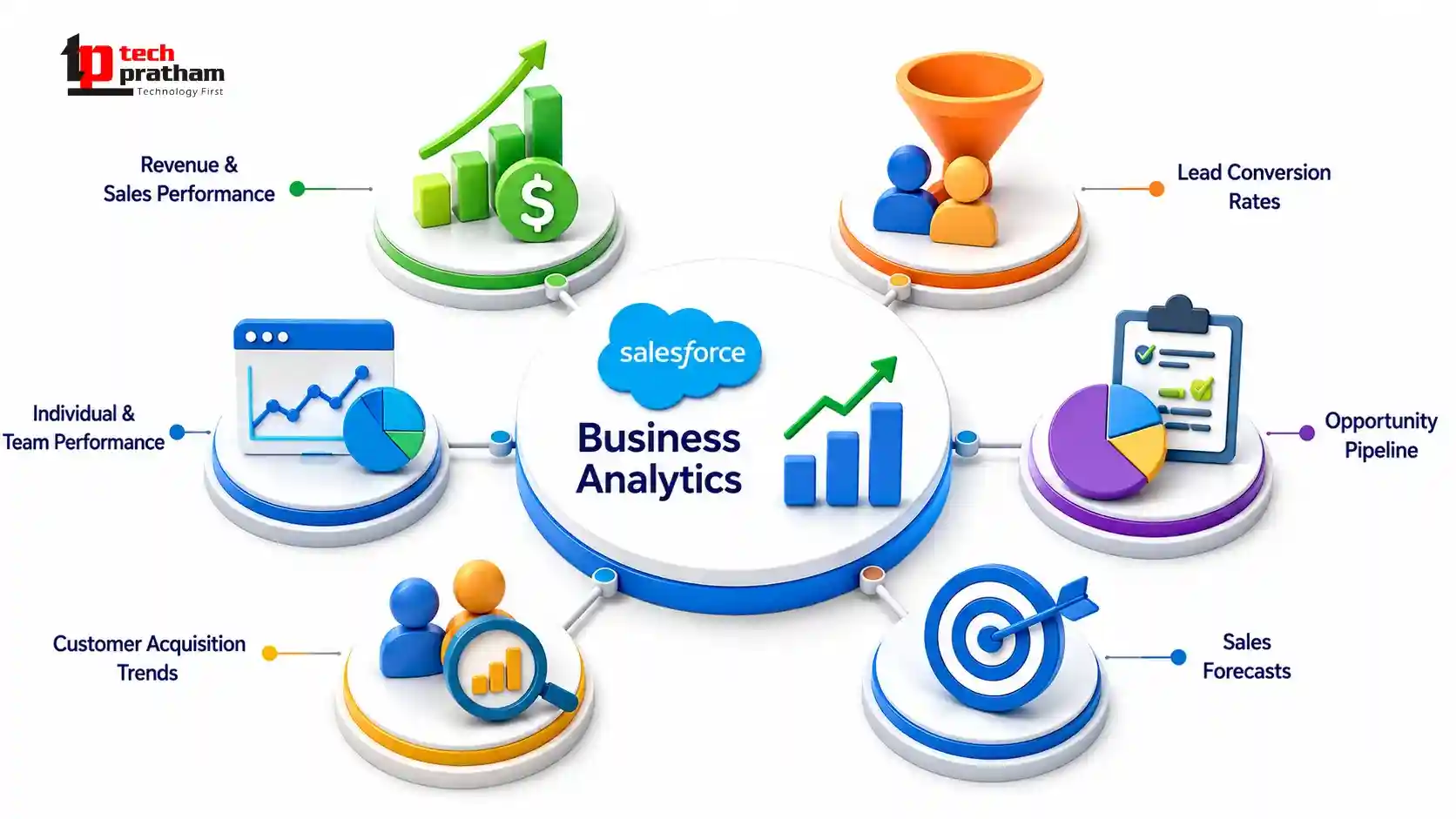
For example, a sales team can analyze:
- Revenue and sales performance
- Lead conversion rates
- Opportunity pipeline
- Sales forecasts
- Customer acquisition trends
- Individual and team performance
Similarly, service teams can analyze case volumes, response times, customer satisfaction, and resolution trends.
How Does Salesforce Business Analytics Work?
1. Data Collection
2. Data Organization
3. Data Analysis
4. Data Visualization
5. Business Decision-Making
Key Features of Salesforce Business Analytics
Data Visualization
Real-Time Business Insights
KPI and Performance Monitoring
Forecasting and Performance Analysis
Custom Analytics
Salesforce Business Analytics Tools
Salesforce Reports
Salesforce Reports allow users to filter, group, summarize, and analyze CRM records according to specific requirements. They can be used to answer practical business questions such as:
- Which sales representatives are meeting their targets?
- Which leads have the highest conversion rate?
- How many opportunities are currently open?
- Which products are generating the most revenue?
Salesforce Dashboards
CRM Analytics
Data Cloud
Einstein and AI-Powered Capabilities
Benefits of Salesforce Business Analytics
Salesforce Business Analytics can help organizations make better use of their CRM data and improve decision-making across different departments. By turning business information into clear insights, teams can understand performance, identify opportunities, and respond to changing customer and market conditions more effectively.
- Better Decision-Making: Teams can use relevant data to understand performance and make informed decisions.
- Improved Sales Performance: Sales teams can monitor revenue, conversion rates, opportunities, and overall sales results.
- Better Customer Understanding: Customer data and interactions can be analyzed to understand needs and improve customer experiences.
- Improved Operational Efficiency: Analytics helps identify process gaps and areas where workflows can be improved.
- Faster Reporting: Reports and dashboards make business information easier to access and reduce manual reporting work.
- Data-Driven Strategy: Businesses can identify trends, measure progress, and use data to support future planning.
Salesforce Business Analytics Use Cases
Salesforce Business Analytics can be used across different business functions to understand performance, identify trends, and support everyday decision-making. The type of data analyzed depends on the goals and requirements of each department.
Sales Analytics
Marketing Analytics
Customer Service Analytics
Management Reporting
Customer Analytics
Role of a Salesforce Business Analyst
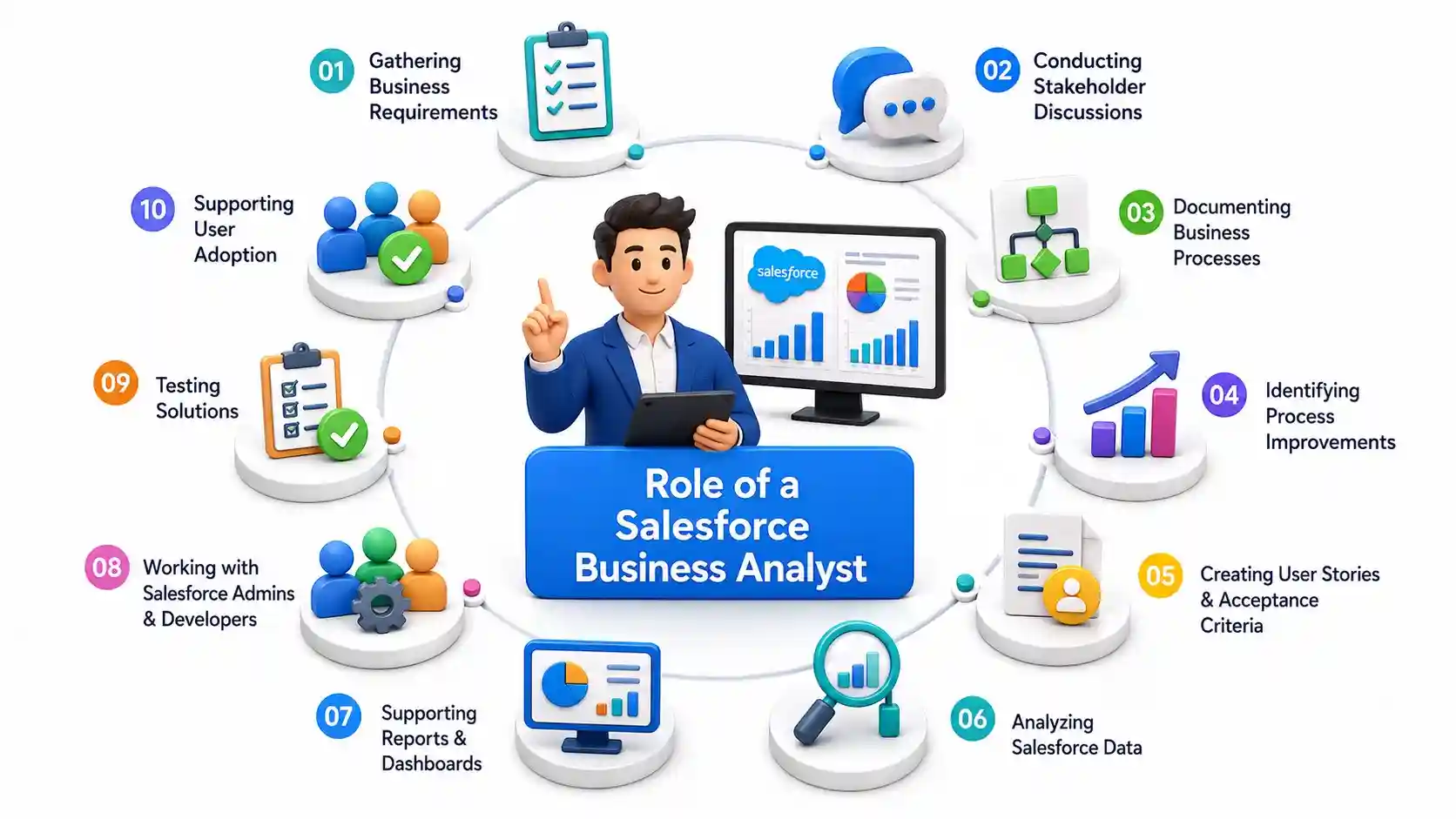
A Salesforce Business Analyst works between business stakeholders and Salesforce teams. The role involves understanding business problems, gathering requirements, analyzing processes, and helping teams design appropriate Salesforce solutions. Typical responsibilities may include:
- Gathering business requirements
- Conducting stakeholder discussions
- Documenting business processes
- Identifying process improvements
- Creating user stories and acceptance criteria
- Analyzing Salesforce data
- Supporting reports and dashboards
- Working with Salesforce administrators and developers
- Testing solutions
- Supporting user adoption
A Salesforce Business Analyst does not necessarily need to be a full-time developer. However, understanding Salesforce functionality, CRM concepts, data, automation, and business processes can be highly valuable.
Skills Required to Become a Salesforce Business Analyst
A Salesforce Business Analyst needs a combination of business, technical, analytical, and communication skills to understand business needs and translate them into effective Salesforce solutions. They should also be able to work with stakeholders, analyze processes, document requirements, interpret data, and collaborate with Salesforce administrators and developers.
- Business Analysis: Requirements gathering, process mapping, documentation, stakeholder management, and solution evaluation.
- Salesforce Knowledge: Understanding Salesforce objects, relationships, security, reports, dashboards, automation, and platform features.
- Data Analysis: Ability to work with business data, identify trends, compare metrics, and draw useful insights.
- Requirements Management: Ability to understand stakeholder needs and convert them into clear requirements and user stories.
- Communication: Clear communication with business users, managers, developers, administrators, and other stakeholders.
- Problem-Solving: Ability to identify business challenges and suggest practical Salesforce-based solutions.
Salesforce Business Analyst Training
Structured learning can help beginners and working professionals develop the skills required for Salesforce business analysis. Salesforce Training in India can provide a strong foundation in Salesforce CRM, platform functionality, administration, reporting, data management, and business processes before learners move into business analysis. A Salesforce Business Analyst Training in India program can then focus on requirements gathering, stakeholder communication, process analysis, user stories, business documentation, reporting, dashboards, and practical Salesforce scenarios.
A Salesforce Business Analyst Course can be useful for learners who want a structured path from Salesforce fundamentals to business analysis concepts. Practical exercises, case studies, and project-based learning can help learners understand how Salesforce is applied to real business requirements. For learners who prefer flexible study, Salesforce BA Online Training can provide access to live instructor-led sessions, recorded learning resources, practical exercises, and certification preparation without requiring classroom attendance.
Salesforce Business Analyst Certification
Certification can help professionals validate their Salesforce Business Analyst knowledge and demonstrate familiarity with business analysis concepts within the Salesforce ecosystem. Preparation for Salesforce Business Analyst Certification should focus on areas such as:
- Discovery and stakeholder engagement
- Business requirements
- Process mapping
- User stories
- Solution design
- Salesforce capabilities
- Data and reporting
- Testing and validation
- Communication and collaboration
Salesforce BA Certification Training can provide structured preparation through guided lessons, practice questions, case-based scenarios, and revision activities. Certification should ideally complement practical experience rather than replace it. Working on projects and understanding real business requirements can help learners apply what they study.
Salesforce Business Analyst Career Opportunities
Salesforce skills can open career opportunities in roles related to business analysis, CRM, consulting, implementation, and Salesforce operations. Depending on experience and specialization, professionals may explore roles such as:
- Salesforce Business Analyst
- CRM Business Analyst
- Salesforce Consultant
- Salesforce Administrator
- Salesforce Functional Consultant
- Business Systems Analyst
- CRM Analyst
The exact role and career progression depend on experience, Salesforce knowledge, industry background, communication skills, and specialization.
Salesforce Business Analytics vs Traditional Business Reporting
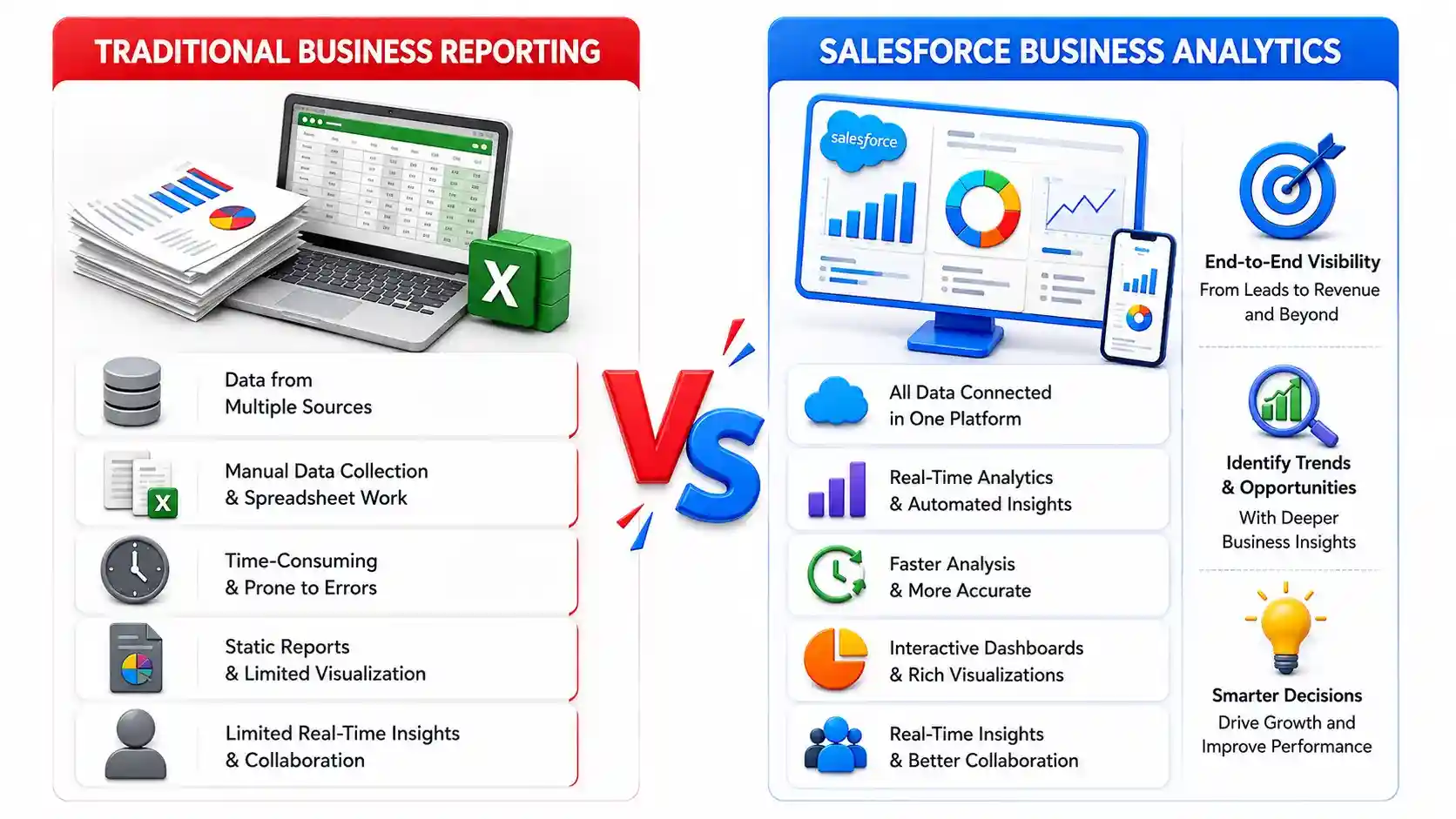
Traditional business reporting often involves collecting information from different sources and preparing spreadsheets or static reports. While this approach can provide useful information, it may require more manual effort and can make it difficult to get a complete view of changing business performance. Salesforce Business Analytics provides a more connected approach by allowing organizations to analyze CRM information through reports, dashboards, analytics tools, and visualizations. Teams can monitor important metrics and explore business information without depending entirely on manually prepared reports.
The main difference is not only how data is presented but also how it can be connected with everyday business processes. Salesforce analytics can bring customer, sales, marketing, and service information together to provide more meaningful business insights. For example, traditional reporting may show monthly sales figures, while Salesforce Business Analytics can help a business examine the complete sales process, including leads, opportunities, conversion rates, sales stages, representatives, regions, and customer segments.
Why Salesforce Business Analytics Matters for Modern Businesses
Modern businesses generate large amounts of customer and operational data, but data is valuable only when it can be understood and used effectively. Salesforce Business Analytics helps organizations turn CRM information into practical insights that support faster and more informed decisions. It can help teams understand sales performance, customer behavior, marketing results, service trends, and operational activities from a more connected perspective. By identifying patterns and measuring important business metrics, organizations can find opportunities for improvement and respond more effectively to changing business needs.
Frequently Asked Questions
1. What does a Salesforce Business Analyst do?
2. Is Salesforce Business Analyst Certification worth it?
3. Is Salesforce BA Online Training available?
4. What skills are important for a Salesforce Business Analyst?
Conclusion
Salesforce Business Analytics helps organizations transform CRM data into meaningful business insights. From sales and marketing performance to customer service and management reporting, analytics can help teams understand what is happening across their business and make more informed decisions. For professionals, learning Salesforce along with business analysis can create a strong foundation for careers in CRM, consulting, and business systems.
Related Articles

How Salesforce Developers Can Switch to a MuleSoft Career
Learn how Salesforce Developers can transition to MuleSoft, build integration skills, work with APIs, and explore new career opportunities.
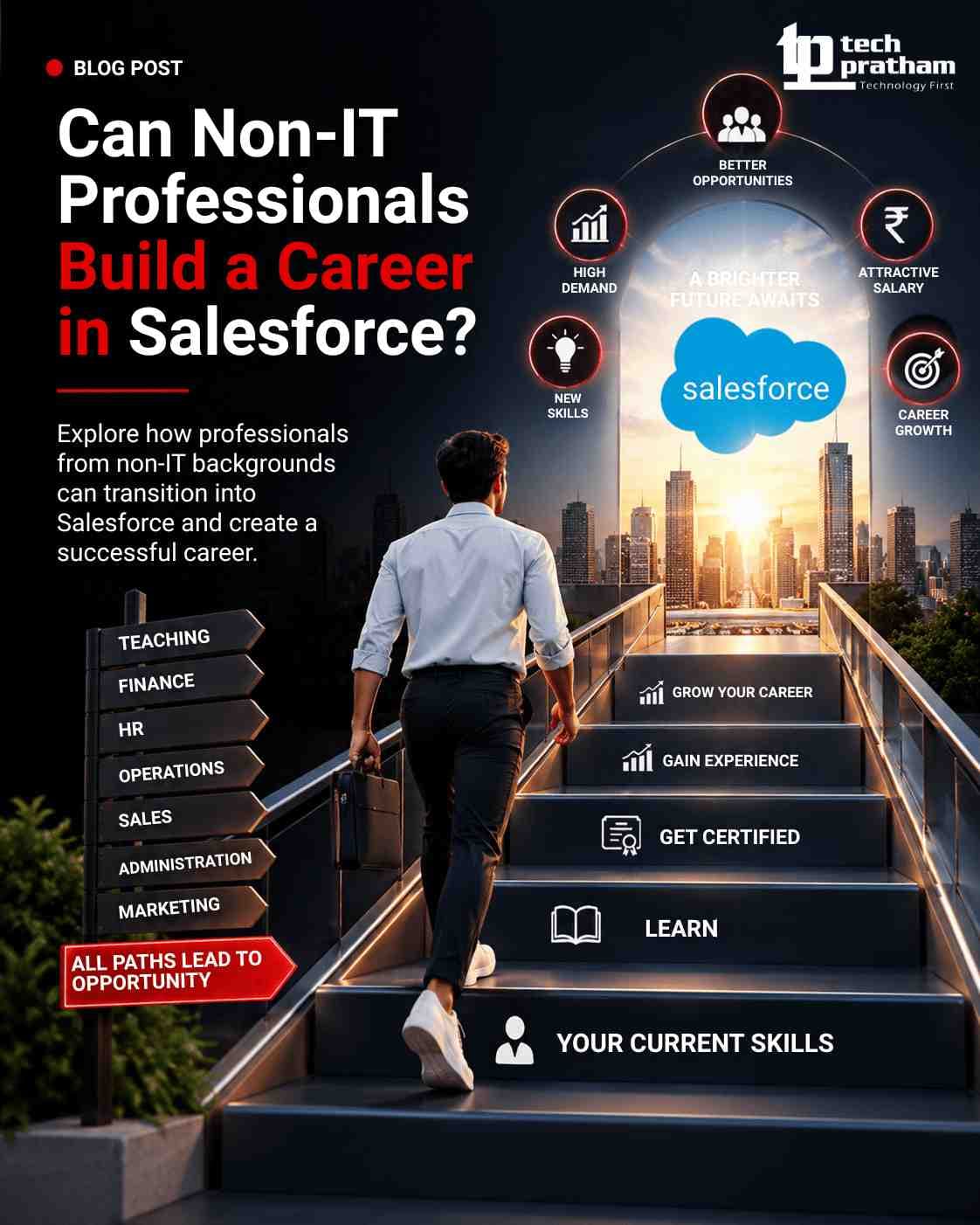
Can Non-IT Professionals Build a Career in Salesforce?
Can non-IT professionals build a career in Salesforce? Learn about Salesforce roles, coding requirements, AI impact, skills, certification, and career




 +91-8882178896
 +1 (343) 477-0926