
Software Testing Training
147 min read271 viewsBest Software Testing Course for Non-IT Graduates in India
By TechPratham TeamPublished August 31, 2026Updated September 1, 2026
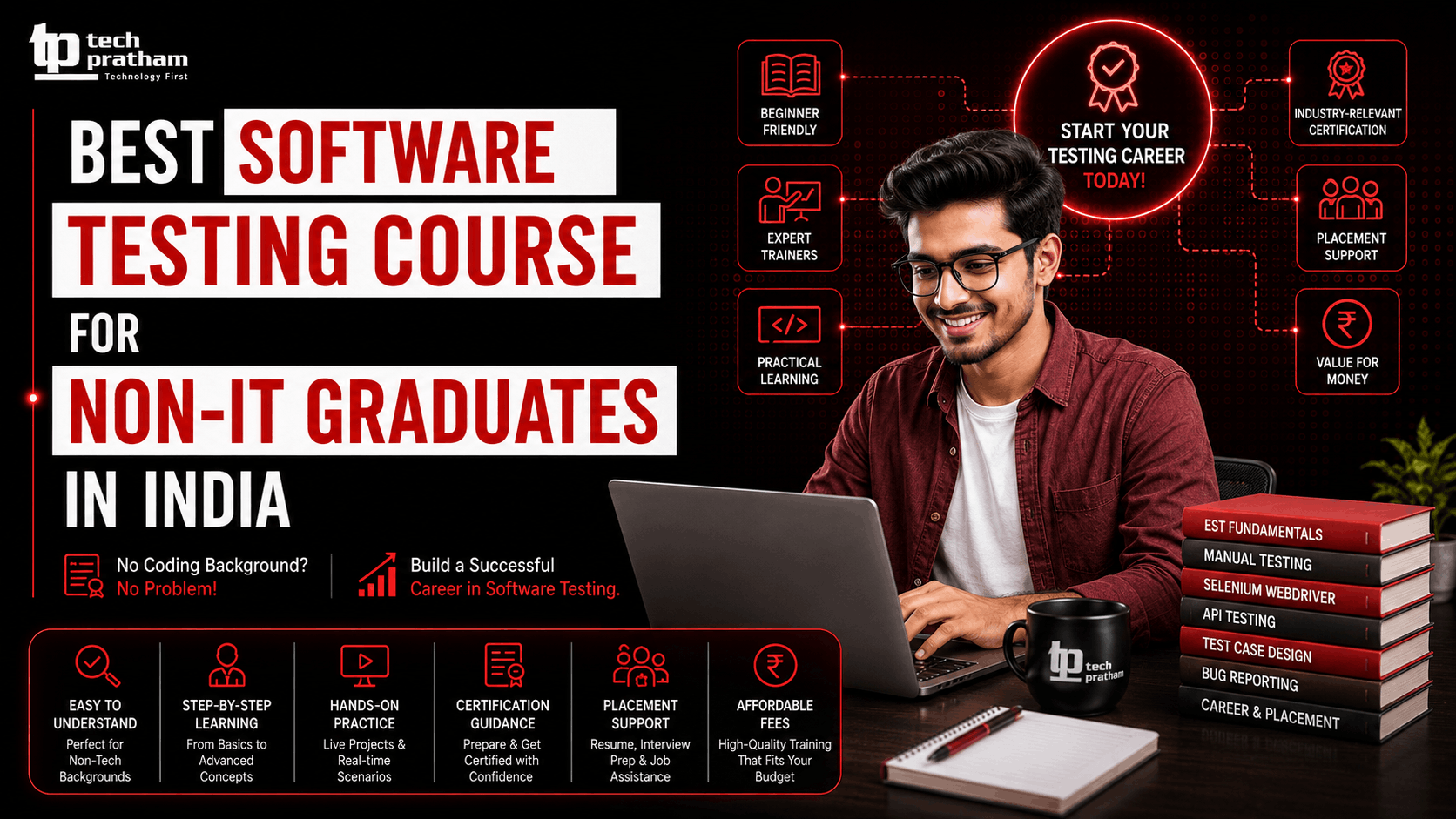
Starting a career in the IT industry after completing a non-IT degree can feel difficult at first. Many graduates from commerce, science, arts, management, and other backgrounds believe that software testing is only for computer science or IT graduates. However, this is not true.
Software testing is one of the IT career options where a person can start without having an advanced programming background. With the right knowledge, practical training, and consistent practice, non-IT graduates can develop the skills needed to enter the software testing field.
The key is to choose a learning program that starts with the basics and gradually introduces technical concepts such as SQL, API testing, automation, and testing tools.
If you are searching for the best software testing course for non-IT graduates in India, this guide will help you understand what to look for, what you should learn, and how you can prepare for a career in QA and software testing.
Can Non-IT Graduates Learn Software Testing?
Yes, non-IT graduates can learn software testing and build a career in the field.
A software tester needs more than programming knowledge. Testing also requires logical thinking, attention to detail, communication skills, problem-solving ability, and an understanding of how applications work.
For example, imagine you are testing an online shopping website. You may need to check:
- Does the login page work correctly?
- What happens if the user enters an incorrect password?
- Can a customer add and remove products from the cart?
- Is the payment process working properly?
- What happens if the internet connection is interrupted?
- Is the order confirmation generated correctly?
These activities require a testing mindset. Programming can become important later, especially when you move into automation testing, but you do not need to be an expert programmer on your first day.
This makes software testing a possible career path for graduates from different educational backgrounds.
Why Choose Software Testing as a Career?
The software industry depends on applications, websites, mobile apps, and digital platforms. Before these products reach users, they need to be tested for functionality, usability, performance, security, and reliability.
This creates opportunities for QA testers and software testing professionals.
Another advantage is that testing has different career paths. You can start with manual testing and gradually learn technical skills such as automation and API testing.
A typical learning journey can look like this:
Manual Testing → SQL → API Testing → Programming Basics → Automation Testing → Advanced QA Skills
You don't have to learn everything at once. A structured Software Testing Training Certification can help you build your knowledge step by step.
What Should a Software Testing Course for Non-IT Graduates Include?
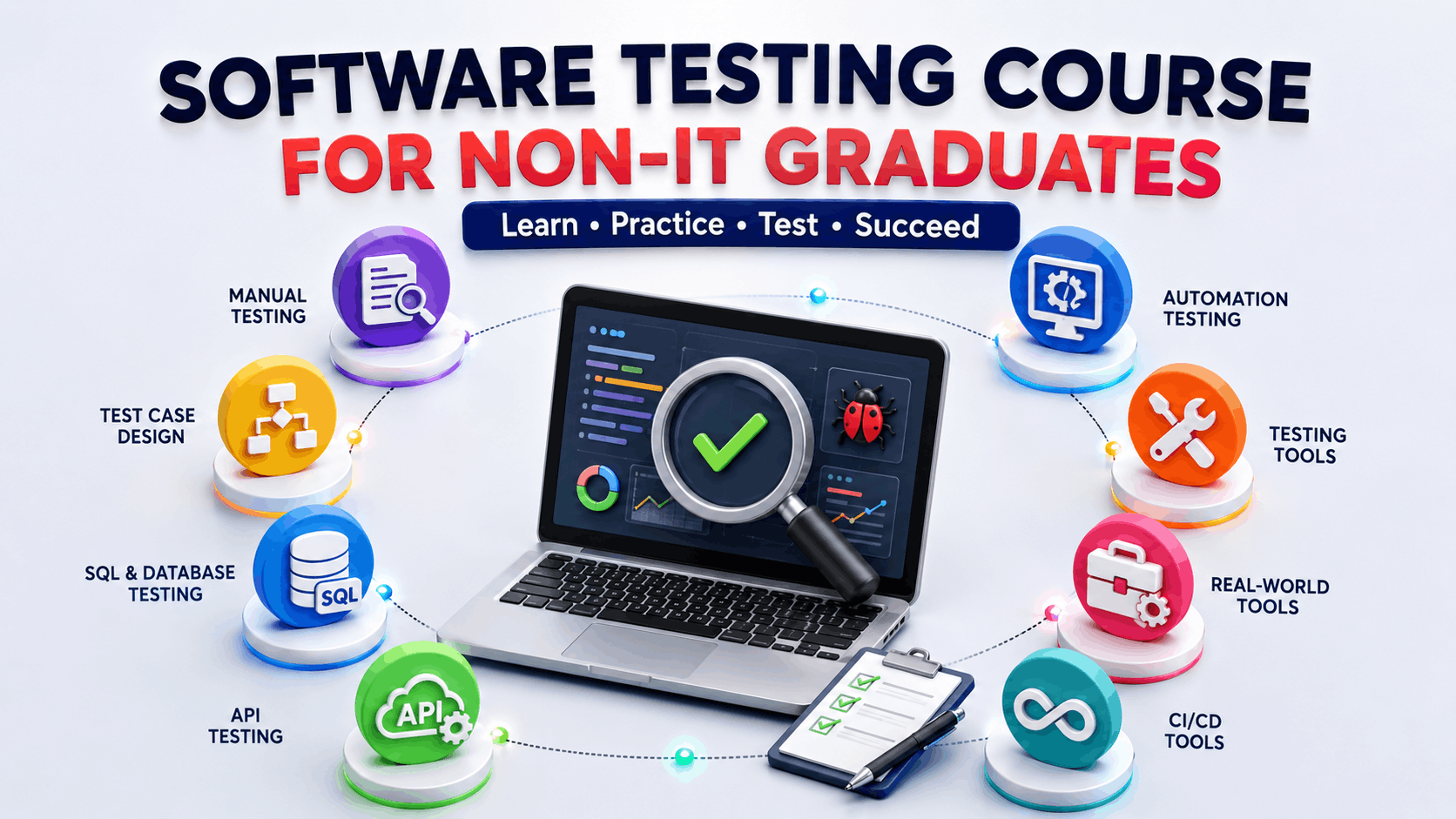
Not every course is suitable for beginners from a non-IT background. When comparing a Software Testing Course in India, look for a curriculum that begins with fundamentals and gradually moves toward advanced concepts.
Here are the important areas you should consider.
1. Manual Testing Fundamentals
Manual testing should be your starting point. You should learn concepts such as:
- Software Development Life Cycle (SDLC)
- Software Testing Life Cycle (STLC)
- Test scenarios
- Test cases
- Test data
- Defect reporting
- Defect life cycle
- Functional testing
These concepts help you understand how professional testing teams work.
2. Test Case Design
Writing good test cases is an important skill for beginners. You should learn techniques such as:
- Boundary Value Analysis
- Equivalence Partitioning
- Decision Table Testing
- State Transition Testing
- Error Guessing
Instead of simply checking whether a feature works, these techniques help you think about different situations and possible failures.
3. SQL and Database Testing
SQL is another useful skill for software testers.
Applications store large amounts of information in databases. Testers often need to verify whether the data displayed on the application matches the information stored in the database.
A beginner should understand SQL commands such as:
- SELECT
- WHERE
- ORDER BY
- GROUP BY
- JOIN
4. API Testing
Modern applications depend heavily on APIs.
API testing allows testers to verify communication between different software components without always using the application's user interface.
Beginners should understand:
- REST APIs
- HTTP methods
- GET, POST, PUT, DELETE
- Status codes
- JSON
- Request and response
- Authentication
- Basic API validation
Tools such as Postman can also be introduced during training.
5. Automation Testing
After understanding manual testing, you can start learning automation.
Automation helps testers execute repetitive test cases using scripts and testing frameworks.
Depending on the course, you may learn tools such as Selenium or Playwright along with a programming language such as Java, Python, or JavaScript/TypeScript.
Non-IT graduates should not be afraid of this stage. You don't need to master programming immediately. Start with basic concepts such as variables, conditions, loops, functions, and object-oriented programming.
Then gradually move toward automation frameworks.
What Skills Do Non-IT Graduates Need?
Your degree is only one part of your career profile. As a beginner, focus on developing skills that are directly useful in testing.
Technical Skills
- Manual testing
- SQL
- API testing
- Basic programming
- Automation testing
- Git
- Testing frameworks
- Agile methodology
Soft Skills
Technical knowledge alone isn't enough. A good tester should also have:
- Attention to detail
- Analytical thinking
- Problem-solving skills
- Communication skills
- Curiosity
- Teamwork
Communication is especially important because testers regularly communicate with developers, business analysts, project managers, and other stakeholders.
How to Choose the Best Software Testing Course?
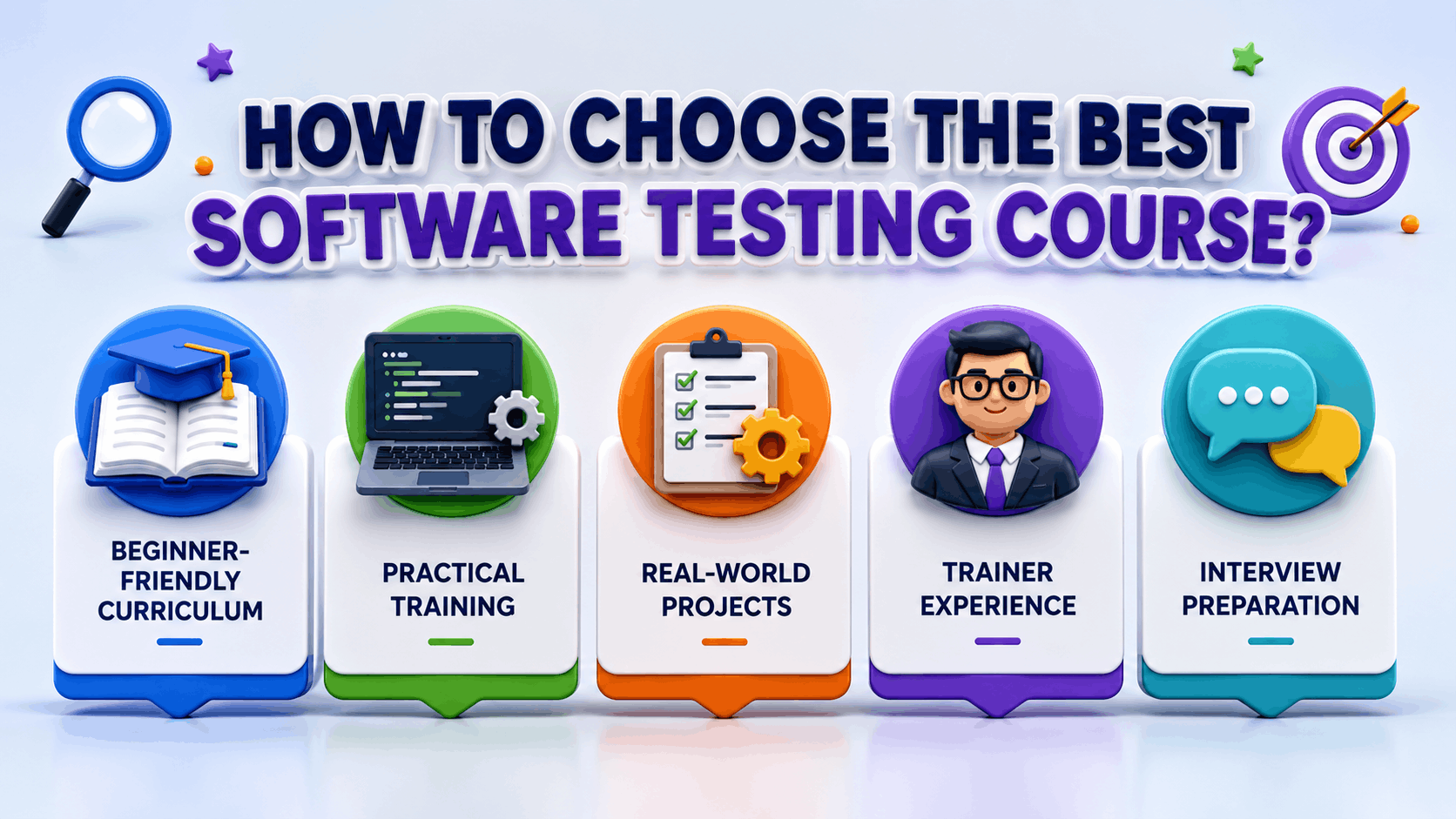
When searching for the best software testing course for non-IT graduates in India, don't choose a program only because it has a low fee or a large number of students.
Consider the following factors.
Beginner-Friendly Curriculum
The course should explain concepts from the beginning. Avoid programs that assume you already understand programming or software development.
Practical Training
Look for hands-on exercises instead of only recorded lectures and theoretical explanations.
You should get opportunities to write test cases, report bugs, test APIs, work with databases, and practice automation.
Real-World Projects
Projects help you understand how testing works in an actual software environment.
A good project can include requirements analysis, test planning, test case creation, execution, defect reporting, regression testing, and automation.
Trainer Experience
Check whether the trainers have practical industry experience. Someone who has worked on real testing projects can often explain concepts more clearly using practical examples.
Interview Preparation
If your goal is to get a job, interview preparation is also important.
The training should ideally include mock interviews, resume guidance, testing interview questions, and practical problem-solving exercises.
Software Testing Classes in India: Online or Classroom?
Non-IT graduates can choose between online and classroom learning depending on their requirements.
Classroom training can be useful if you prefer direct interaction with trainers and other learners.
Online training can be convenient if you have a job, live in another city, or prefer learning at your own pace.
The format is less important than the quality of the training. A good program should provide structured learning, practical exercises, trainer support, and opportunities to ask questions.
Therefore, when comparing Software Testing Classes in India, focus on the curriculum and practical exposure rather than simply choosing between online and offline classes.
Is Software Testing Certification Important?
Certification can help demonstrate that you have completed structured learning, especially when you are a fresher or career changer.
However, certification alone will not guarantee a job.
Employers may also look at your practical knowledge, projects, communication skills, problem-solving ability, and understanding of testing concepts.
A good Software Testing Certification Training in India should therefore combine certification preparation with practical learning.
Instead of focusing only on passing an examination, use the certification as an additional part of your overall career profile.
Can Non-IT Graduates Get Software Testing Jobs?
Yes, but you should have realistic expectations.
Your first job may require you to start with junior or entry-level responsibilities. The exact opportunities depend on your skills, educational background, location, experience, and the requirements of individual employers.
Building practical knowledge can improve your chances.
For example, a fresher profile can become stronger by demonstrating:
Manual Testing + SQL + API Testing + Basic Automation + Projects + Good Communication
You can also create a small portfolio containing sample test cases, bug reports, API testing examples, and automation projects.
This gives recruiters something more concrete to evaluate than a certificate alone.
A Simple Roadmap for Non-IT Graduates
If you are completely new to testing, you can follow this learning roadmap:
Step 1: Understand Software Basics
Learn how websites, mobile applications, and software products generally work.
Step 2: Learn Manual Testing
Understand testing concepts, test cases, defects, test execution, and different testing types.
Step 3: Practice Test Case Writing
Choose a familiar website or application and create test scenarios and test cases.
Step 4: Learn SQL
Practice basic database queries and learn how testers validate data.
Step 5: Learn API Testing
Understand APIs, HTTP methods, JSON, responses, and tools such as Postman.
Step 6: Learn Programming Basics
Choose one language and learn the fundamentals before moving into automation.
Step 7: Learn Automation Testing
Start with one automation framework and practice creating automated test cases.
Step 8: Work on Projects
Apply everything you have learned to realistic projects.
Step 9: Prepare for Interviews
Practice common testing questions, scenario-based questions, SQL queries, API testing questions, and basic automation problems.
Common Mistakes Non-IT Graduates Should Avoid
Many beginners make the same mistakes while learning software testing.
Trying to learn everything at once:
Don't jump between multiple programming languages and automation tools. Learn one skill properly before moving forward.
Only watching videos:
Testing is a practical skill. You need to write test cases, execute tests, report defects, and practice automation.
Ignoring SQL and API testing:
These skills can make your profile more technically strong.
Focusing only on certification:
A certificate is useful, but practical knowledge matters too.
Being afraid of programming:
You don't need advanced programming skills on day one. Start with the basics and practice regularly.
Final Thoughts
A non-IT degree does not automatically prevent you from entering software testing. What matters is how well you understand testing concepts and how effectively you can demonstrate your practical skills.
If you are starting from zero, look for a Software Testing Training in India program that begins with manual testing and gradually moves into SQL, API testing, automation, and real-world projects.
Take time to compare the syllabus, practical assignments, trainers, projects, certification, and career support before enrolling.
Most importantly, don't compare yourself with someone who already has years of IT experience. Start with the basics, practice consistently, and build your technical skills step by step.
With the right learning approach and practical experience, software testing can be a worthwhile career option for non-IT graduates who want to move into the technology industry.
Frequently Asked Questions
Can a non-IT graduate learn software testing?
Yes, a non-IT graduate can learn software testing. You do not need an engineering or computer science degree to start with manual testing. Beginners can first learn software testing fundamentals, test case design, defect reporting, and testing types. After building a strong foundation, they can learn SQL, API testing, and automation tools such as Selenium or Playwright. Good Software Testing Training in India should start from the basics and gradually introduce technical concepts.
Which software testing course is best for non-IT graduates in India?
The best course depends on your current knowledge, career goal, and preferred learning format. For a non-IT graduate, choose a course that covers manual testing first and then moves into SQL, API testing, automation testing, and real-world projects. The course should also provide practical assignments, interview preparation, and guidance from experienced trainers. A beginner-friendly Software Testing Course in India can make the transition into the IT industry easier.
Is coding required for software testing?
Coding is not required to start learning manual testing. However, basic programming knowledge becomes useful when you move toward automation testing. Beginners can start with simple programming concepts such as variables, conditions, loops, functions, and basic object-oriented programming. You do not need to become an expert developer. Learning programming gradually along with testing can help you understand automation frameworks and write better automated test scripts.
What should non-IT graduates learn first in software testing?
Non-IT graduates should begin with software testing fundamentals. Start by understanding SDLC, STLC, test cases, test scenarios, defect life cycle, functional testing, regression testing, smoke testing, and other basic testing concepts. Once you are comfortable with manual testing, move to SQL, API testing, programming basics, and automation. Following this order can make Software Testing Training easier to understand and prevent beginners from feeling overwhelmed.
Is software testing certification useful for non-IT graduates?
Yes, a software testing certification can be useful, particularly for beginners and career changers. It can demonstrate that you have completed structured learning and understand important testing concepts. However, certification should not be your only focus. Practical skills, projects, testing knowledge, communication, and interview preparation are also important. Good Software Testing Certification Training in India should combine certification preparation with practical testing experience.
How long does it take for a non-IT graduate to learn software testing?
The time required depends on your learning schedule and previous technical knowledge. A beginner can start understanding manual testing fundamentals within a few weeks with consistent practice. Becoming comfortable with SQL, API testing, programming, and automation will require additional time and hands-on practice. Instead of focusing only on completing a course quickly, focus on understanding concepts and working on practical projects..
Related Articles
Software Testing Training
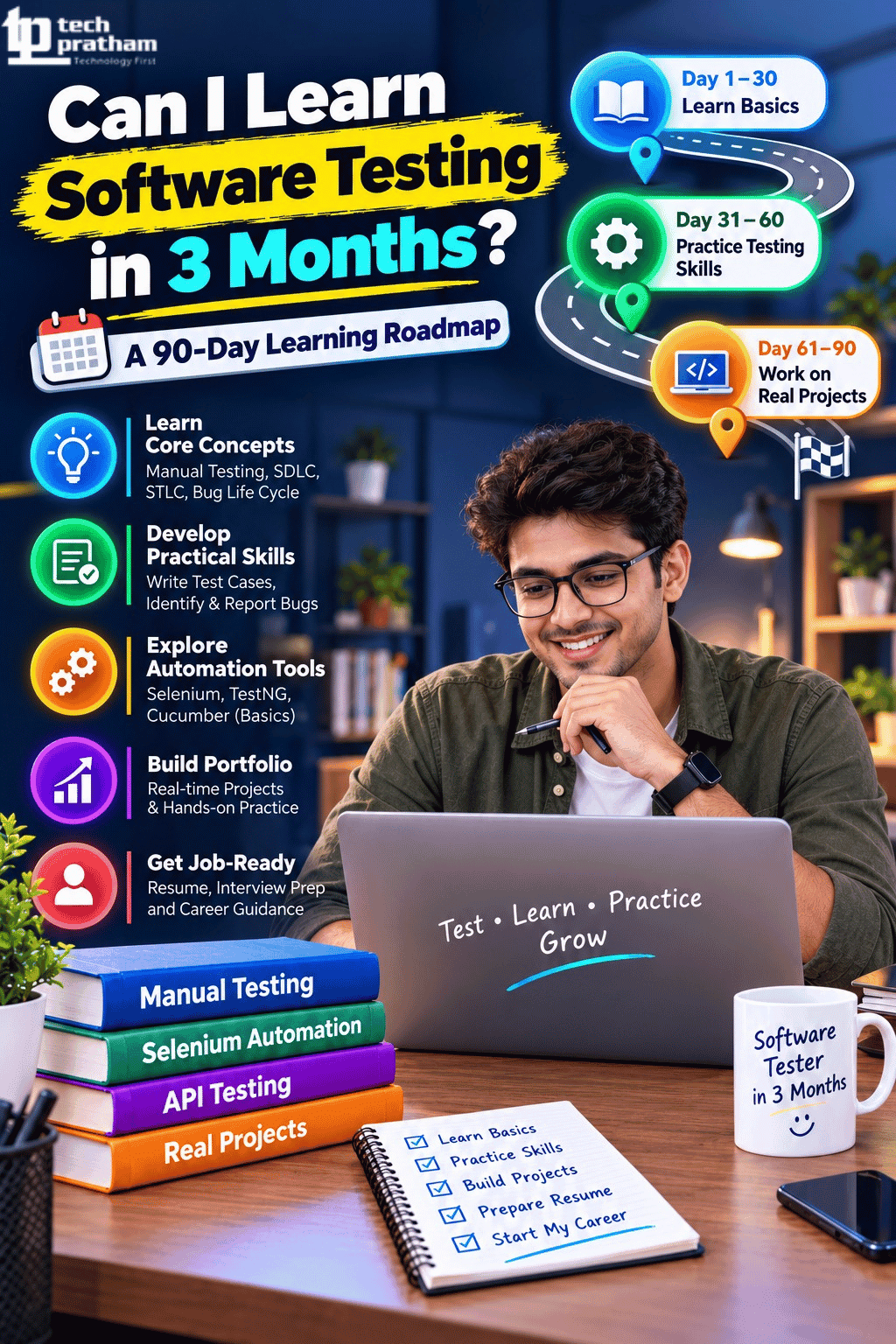
Can I Learn Software Testing in 3 Months? A 90-Day Learning Roadmap
Learn software testing in 3 months with a 90-day roadmap covering manual testing, test cases, SQL, API testing and automation tools.
Software Testing Training
Is Software Testing Easy to Learn for Beginners in India
Learn whether software testing is easy for beginners in India, explore essential skills, course modules and career opportunities.
Software Testing Training
How Can Software Testers Stay Relevant with AI in Testing
Software testers can stay relevant with AI by learning AI tools, automation, prompt skills, data analysis, and modern testing practices.





 +91-8882178896
 +1 (343) 477-0926