
Software Testing Training
133 min read17 viewsHow Can Software Testers Stay Relevant with AI in Testing
By TechPratham TeamPublished October 8, 2026Updated October 8, 2026
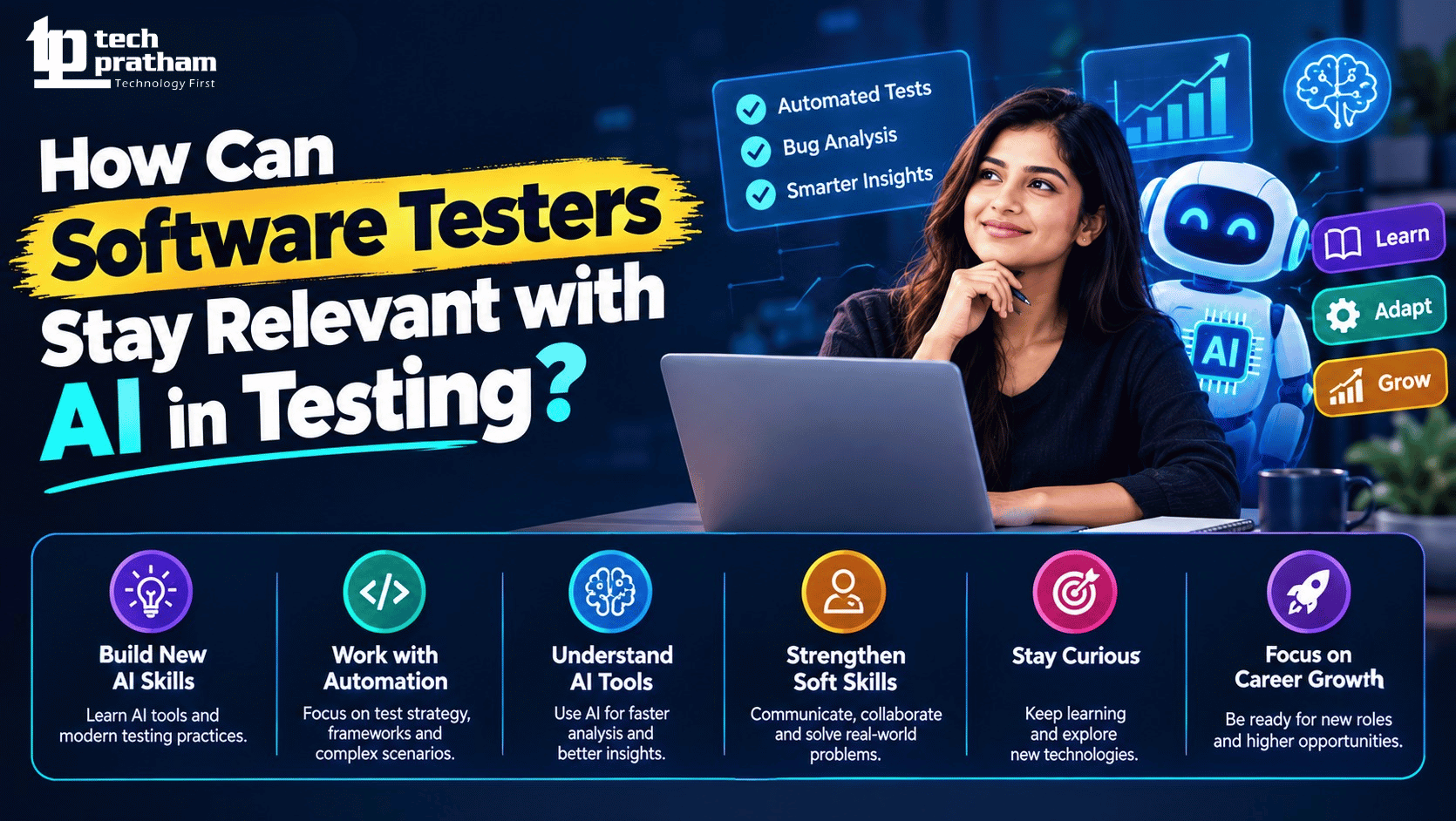
Artificial intelligence is changing the way software is developed and tested. AI can help testers create test cases, identify defects, analyze test results, generate test data, and automate repetitive testing tasks. Because of these changes, many software testers are asking an important question: Will AI replace software testers?
The answer is no. AI is changing the role of software testers, but it does not remove the need for human testers. Instead, testers who understand AI and know how to use it effectively can become more valuable in the software development process.
The future of software testing will involve a combination of human skills, test automation, artificial intelligence, and business understanding. Testers who continue learning and adapt to new technologies can stay relevant and build strong careers.
Why Is AI Becoming Important in Software Testing?
Traditional software testing can involve many repetitive activities. Testers may need to create test cases, execute tests, check results, report defects, and repeat the same tests after every application change.
AI can help with several of these activities. AI-powered testing tools can analyze large amounts of testing data and identify patterns much faster than humans. They can also help testers generate test scenarios, identify possible risk areas, and reduce repetitive work.
However, AI does not understand every business requirement or user expectation. A human tester is still needed to decide whether the application actually works as expected.
For this reason, testers should look at AI as a testing assistant rather than a replacement.
1. Learn How AI Is Used in Testing
The first step for testers is to understand the basic use of AI in software testing.
You do not necessarily need to become an AI engineer. You should understand how AI can support common testing activities.
For example, AI can be used for:
- Test case generation
- Test data generation
- Test script creation
- Defect analysis
- Test result analysis
- Regression testing support
- Visual testing
A tester who understands these applications can identify where AI can save time and improve testing quality.
Start with basic concepts such as machine learning, generative AI, natural language processing, and AI-powered automation. You can then explore how these technologies are being used in real testing workflows.
2. Improve Your Test Automation Skills
Test automation remains an important skill for modern software testers.
AI does not make automation skills unnecessary. In fact, AI is making automation more powerful.
Testers should become comfortable with automation frameworks and understand how automated tests are designed, executed, maintained, and analyzed.
Popular automation technologies include Selenium, Playwright, Cypress, Appium, and API testing tools.
For example, a tester can use AI to generate an initial automation script. However, the tester still needs to review the script, understand the application workflow, validate the selectors, handle test data, and maintain the script when the application changes.
Therefore, the valuable skill is not simply knowing how to generate code with AI. It is knowing whether the generated code is correct and useful.
3. Learn to Use Generative AI as a Testing Assistant
Generative AI can become a useful assistant for software testers.
A tester can use AI tools to brainstorm test scenarios, create sample test data, explain technical errors, generate basic code, or improve existing test cases.
For example, instead of manually starting every test case from scratch, a tester can provide a requirement and ask an AI tool to suggest positive, negative, boundary, and edge-case scenarios.
The tester should then review those suggestions.
This human review is important because AI-generated content can contain incorrect assumptions or miss important business conditions.
The best approach is:
AI generates ideas → Tester reviews them → Tester validates them → Final testing is performed.
This approach can improve productivity without depending completely on AI.
4. Strengthen Your Manual Testing Skills
The growth of AI does not mean that manual testing is no longer important.
Strong manual testing knowledge is actually useful when working with AI-powered testing tools.
A good tester should understand:
- Functional testing
- Regression testing
- Integration testing
- System testing
- Exploratory testing
- Usability testing
- Boundary value analysis
AI can suggest test cases, but testers need testing knowledge to determine whether those test cases are meaningful.
Exploratory testing is another area where human thinking remains important. Testers can use their experience, curiosity, and understanding of user behavior to discover unexpected problems.
5. Develop Strong Analytical and Problem-Solving Skills
AI can process information quickly, but testers still need to understand what the information means.
For example, an AI tool may identify that a particular test case has failed multiple times. The tester needs to investigate the reason.
Is the application actually defective?
Is the test script incorrect?
Is the test data invalid?
Is the environment unavailable?
Is there a temporary network issue?
Strong analytical skills help testers answer these questions.
Therefore, testers should focus on developing problem-solving skills rather than depending only on testing tools.
6. Learn API Testing and Data Validation
Modern applications depend heavily on APIs and data. This makes API testing and data validation valuable skills for testers.
Testers should understand how APIs work, how requests and responses are structured, and how to validate API behavior.
Knowledge of JSON, HTTP methods, status codes, authentication, databases, and SQL can also be useful.
AI can help testers generate API test scenarios or explain responses, but testers still need to understand whether the response is logically correct.
A tester who combines AI knowledge with API testing and database knowledge can handle more complex testing tasks.
7. Understand Application and Business Requirements
One of the most important skills for a tester is understanding what the application is supposed to do.
AI can analyze requirements, but testers need to connect those requirements with real business processes and user expectations.
For example, consider an online shopping application.
A tester should understand the complete user journey:
Product search → Product selection → Cart → Address → Payment → Order confirmation
Testing is not only about checking whether buttons work. The tester should also understand what should happen when payment fails, an item becomes unavailable, a discount expires, or the customer enters incorrect information.
Business knowledge helps testers identify scenarios that automated tools may not understand correctly.
8. Learn AI-Powered Testing Tools
Testers should gradually explore AI-powered testing solutions available in the market.
Different tools provide different capabilities. Some tools focus on test generation, while others support self-healing automation, visual testing, defect analysis, or test maintenance.
Instead of trying to learn every AI tool, testers should understand the problem each tool solves.
For example:
- Does it reduce test maintenance?
- Can it generate test cases?
- Can it identify failed tests?
- Can it analyze application changes?
- Can it improve regression testing?
- Can it reduce repetitive work?
Learning tools based on real testing problems is more useful than collecting tool names on a resume.
9. Improve Your SQL and Data Skills
Data is an important part of modern applications and AI systems.
Testers who understand SQL and databases can validate whether data is correctly stored, updated, and retrieved.
For example, after a customer completes an order, a tester may need to verify whether the correct order information is stored in the database.
SQL knowledge can help testers investigate problems instead of depending completely on developers.
Basic knowledge of data analysis can also help testers understand large test datasets and identify unusual patterns.
10. Learn How to Validate AI-Based Applications
AI is not only being used to test software. Many applications themselves now contain AI features.
This creates a new area of testing.
For example, applications may include chatbots, recommendation systems, AI-generated content, voice assistants, or intelligent search features.
Testing these systems can require different approaches.
Testers may need to check:
- Accuracy
- Consistency
- Response quality
- Bias
- Security
- Data privacy
This creates new opportunities for testers who understand both traditional software testing and AI systems.
11. Develop Better Communication Skills
Technical skills are important, but communication is also a major part of a tester's job.
Testers need to communicate with developers, business analysts, product managers, and other team members.
When a defect is found, the tester should clearly explain:
- What happened
- Where the problem occurred
- How to reproduce it
- What result was expected
- What result was received
- How serious the issue is
AI can help improve the wording of a defect report, but testers need to provide accurate technical information.
Strong communication skills can therefore help testers remain valuable even as AI takes over repetitive tasks.
12. Build a Continuous Learning Habit
Technology changes quickly. A skill that is valuable today may become less important in the future.
Testers should therefore develop a continuous learning habit.
You do not need to learn everything at once. A practical learning path can be:
Manual Testing → Automation → API Testing → SQL → AI Tools → AI-Based Application Testing
You can also practice by creating small testing projects and experimenting with AI tools.
Hands-on practice is usually more valuable than simply watching tutorials.
What Skills Should Software Testers Focus on in the AI Era?
The future tester will need a combination of technical and human skills.
Important skills include:
- Manual testing fundamentals
- Test automation
- API testing
- SQL and database testing
- AI testing tools
- Generative AI
- Test case design
- Exploratory testing
- Analytical thinking
The combination of these skills can help testers move from repetitive testing work to more valuable quality engineering activities.
Will AI Replace Software Testers?
AI may automate some tasks that testers currently perform manually. Repetitive test execution, basic test generation, test data creation, and some types of analysis can become faster with AI.
But software quality involves more than executing test cases.
Someone still needs to understand the business requirement, identify risks, question unexpected behavior, evaluate user experience, investigate defects, and make decisions about product quality.
This is why AI is more likely to change the role of software testers than completely replace it.
Testers who refuse to learn new technologies may find some traditional tasks becoming less valuable. Testers who learn to work with AI can take on more advanced responsibilities.
How Can a Tester Start Learning AI?
A tester does not need to start with advanced mathematics or machine learning algorithms.
A simple approach is to begin with the practical use of AI.
Start by learning how generative AI can help with test case creation, test data, automation scripts, defect analysis, and documentation.
Then learn how AI-powered testing tools work. After that, explore testing methods for AI-based applications.
The most important part is practice. Take a small application and try to use AI at different stages of the testing process. Compare the AI-generated results with your own testing approach.
This will help you understand both the benefits and limitations of AI.
Final Thoughts
AI is changing software testing, but it is also creating new opportunities for software testers.
The most important thing for testers is not to compete with AI. Instead, they should learn how to work with it.
A tester who understands manual testing, automation, APIs, databases, AI tools, business requirements, and analytical thinking can provide much more value to a software development team.
The future of software testing will likely involve human expertise supported by AI-powered tools. Testers who continuously improve their skills, experiment with new technologies, and understand how AI can support their work can stay relevant in this changing industry.
If you are planning to build a career in software testing, start with strong testing fundamentals and gradually add automation, API testing, SQL, and AI skills. With continuous practice and learning, you can prepare yourself for the changing requirements of modern software testing.
Frequently Asked Questions
1. Will AI replace software testers in the future?
AI is unlikely to completely replace software testers. It can automate repetitive tasks such as test case generation, test execution, and test data creation. However, human testers are still needed for exploratory testing, business understanding, risk analysis, user experience evaluation, and decision-making.
2. How can software testers learn AI for testing?
Software testers can start by learning the practical uses of AI in testing. They can use generative AI to create test scenarios, test data, automation scripts, and defect reports. Testers can then explore AI-powered testing tools and learn how they support test automation, test maintenance, and result analysis.
3. What skills should software testers learn to stay relevant with AI?
Testers should develop a combination of testing, technical, and AI-related skills. Important skills include manual testing, test automation, API testing, SQL, test case design, generative AI, AI-powered testing tools, analytical thinking, problem-solving, and business understanding. Communication and exploratory testing skills are also valuable because these areas still require strong human judgment.
4. How is AI used in software testing?
AI can support many software testing activities. It can help generate test cases, create test data, analyze test results, identify possible defects, generate automation scripts, prioritize tests, analyze logs, and support regression testing.
5. Is manual testing still important in the age of AI?
Yes, manual testing remains important. AI and automation can handle many repetitive testing activities, but they cannot fully replace human judgment. Manual testers are important for exploratory testing, usability testing, business validation, and identifying unexpected user behavior.
Related Articles
Software Testing Training
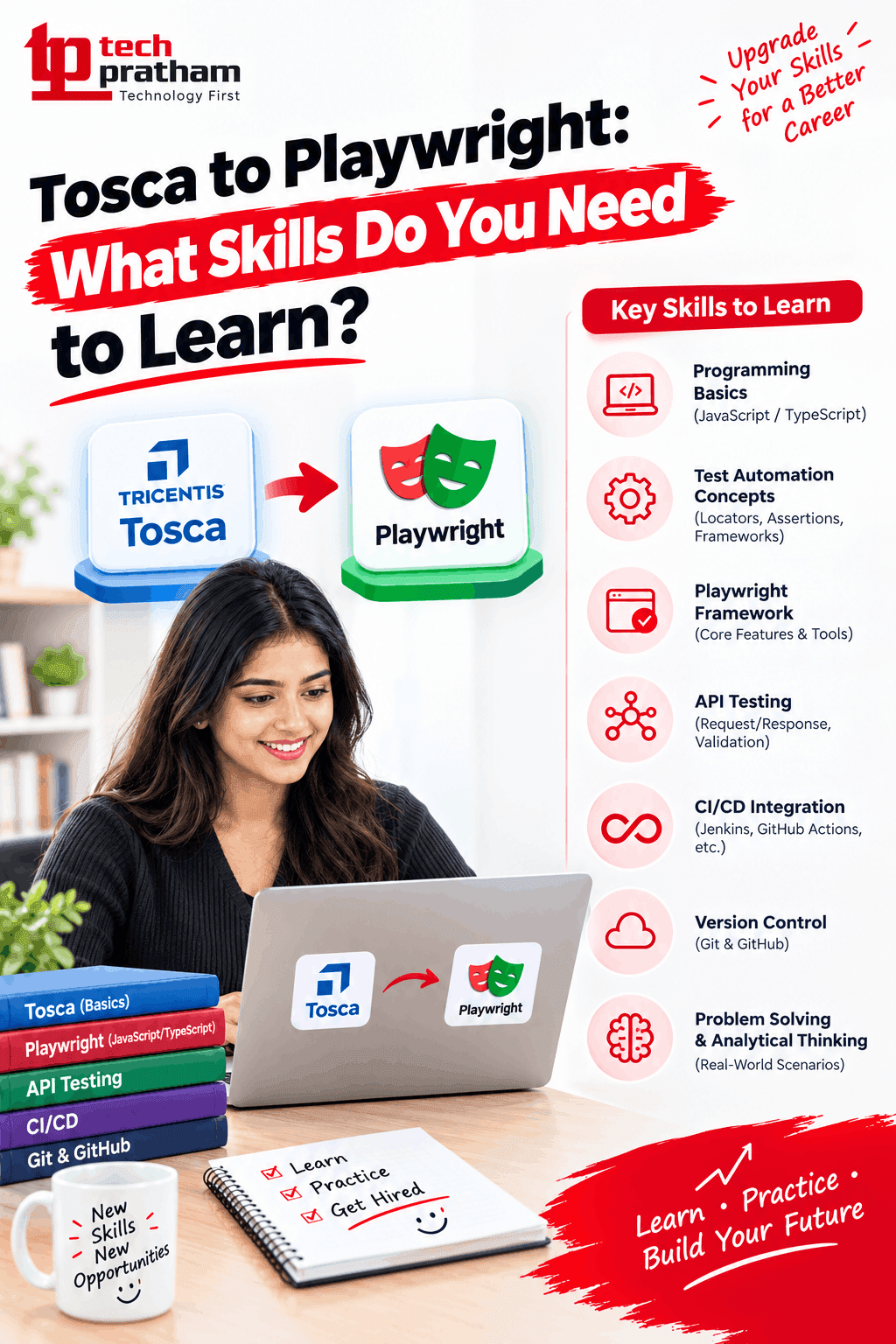
Tosca to Playwright: What Skills Do You Need to Learn
Learn the key skills needed to move from Tosca to Playwright, including coding, automation, API testing, frameworks, and CI/CD.

Software Testing Training
What Should an Experienced Software Tester Learn in 2026
Learn what experienced software testers should master in 2026, from automation and AI testing to APIs, cloud, and modern QA tools.





 +91-8882178896
 +1 (343) 477-0926