
Software Testing Training
180 min read305 viewsHow to Choose the Best Automation Testing Training in India: A Complete Beginner’s Guide
By TechPratham TeamPublished September 8, 2026Updated September 8, 2026
.png)
Choosing the right training program can make a big difference when you are planning to build a career in software testing. With many institutes, online programs, and learning platforms available today, beginners often find it difficult to understand which Automation Testing Training in India is actually worth their time and money.
A good training program should not only teach you how to use automation tools. It should help you understand software testing fundamentals, programming concepts, automation frameworks, API testing, real-world project scenarios, and the practices followed by QA teams.
Modern automation programs commonly include tools such as Selenium and Playwright, while some programs also cover API testing, CI/CD, frameworks, and tools such as Tosca. Current training curricula in India reflect this broader approach.
This guide explains the important factors you should consider before choosing an Automation Testing Course in India, especially if you are a fresher, manual tester, or professional looking to move into automation.
Understanding Automation Testing
Automation testing is the process of using software tools and scripts to execute test cases automatically instead of performing every test manually.
For example, imagine that you need to test the login functionality of an application. A manual tester may repeatedly:
- Open the application
- Enter a username
- Enter a password
- Click the login button
- Verify the result
- Record any defect
With automation, a test script can perform these actions automatically and verify whether the expected result is received.
Automation can be especially useful for repetitive testing, regression testing, cross-browser testing, and large applications where the same scenarios need to be executed frequently.
However, Automation Testing Training in India is not simply about learning one tool. A strong tester also needs knowledge of testing concepts, programming, test design, debugging, frameworks, and application behavior.
Why Is Automation Testing a Good Career Skill?
Software development teams release applications more frequently, and testing needs to keep pace with these release cycles. Automation can help teams execute repeatable tests efficiently and integrate testing into development and CI/CD workflows.
Modern automation learning paths increasingly combine UI automation with API testing, programming, frameworks, version control, and CI/CD.
Learning automation can help you move toward roles such as:
- Automation Test Engineer
- QA Automation Engineer
- Software Test Engineer
- SDET
- Quality Assurance Engineer
- Test Automation Consultant
- QA Analyst
For this reason, learning automation can be a useful next step for manual testers as well as beginners interested in software quality engineering.
How to Choose the Best Automation Testing Training in India
Not every course provides the same learning experience. Before enrolling, evaluate the program using the following factors.
1. Check the Course Curriculum
The first thing you should check is the syllabus. Avoid choosing a course only because it mentions popular tools such as Selenium or Playwright. A good curriculum should provide a structured learning path from fundamentals to practical automation.
A comprehensive curriculum may include:
- Software testing fundamentals
- SDLC and STLC
- Test case and test scenario design
- Defect life cycle
- Programming fundamentals
- Selenium WebDriver
- Playwright
For example, current Selenium and Playwright-focused programs can include browser automation, locators, assertions, synchronization, Page Object Model, cross-browser execution, debugging, and CI-ready execution.
2. Look at the Automation Tools Covered
The automation tool you learn should match your career goals and the type of applications you want to test.
Selenium
Selenium is widely used for web application automation and is an important tool to understand if you are entering automation testing. A good Selenium module should cover:
- WebDriver
- Locators
- XPath and CSS selectors
- Browser interactions
- Alerts
- Frames
- Windows and tabs
Playwright
Playwright is another important modern web automation framework. It supports major browser engines and includes features such as auto-waiting, debugging and trace capabilities. A good course should ideally teach:
- Playwright architecture
- Locators
- Assertions
- Browser and page handling
- Authentication
- Popups and frames
- Screenshots and videos
Tosca
If you are interested in model-based or low-code enterprise test automation, Tosca can also be considered. Training programs may cover Tosca Commander, test case design, API testing, integrations, and automation workflows.
The important point is not to choose a course simply because it teaches the maximum number of tools. Choose a course that teaches the tools properly and gives you enough practice to use them confidently.
3. Make Sure Programming Is Included
One common mistake beginners make is searching for an Automation Testing Course that focuses entirely on tools while ignoring programming.
Programming knowledge is important because many automation frameworks require you to write, understand, debug, and maintain test scripts.
Depending on the course and technology stack, you may learn:
- Java
- Python
- JavaScript
- TypeScript
You do not necessarily need to be an expert programmer before starting. A beginner-friendly Automation Testing Training program should gradually introduce the programming concepts required for automation.
Important topics can include:
- Variables and data types
- Operators
- Conditional statements
- Loops
- Functions and methods
- Arrays and collections
If you are completely new to coding, check whether the institute teaches these concepts from the beginning.
4. Give Importance to Hands-On Practice
Watching an instructor write automation scripts is different from writing those scripts yourself.
This is why practical exposure should be one of the most important factors when comparing training programs.
Look for a course that provides:
- Regular coding exercises
- Assignments
- Test automation tasks
- Framework development
- Debugging practice
Some current automation programs specifically combine instructor-led learning with hands-on projects and real-world scenarios.
Why projects matter
Why projects matter
Projects help you understand how different skills work together.
For example, a project might require you to:
- Understand application requirements
- Create test scenarios
- Design test cases
- Automate important test cases
- Build a framework
- Execute tests
- Generate reports
This is much closer to how automation skills are applied in professional environments.
5. Check Whether API Testing Is Included
Automation testing is not limited to browser testing.
Modern QA teams often test APIs because APIs connect different application components and services. Learning API testing can therefore complement UI automation skills.
A well-rounded course may introduce:
- REST APIs
- HTTP methods
- GET, POST, PUT and DELETE
- Status codes
- Headers
- Authentication
- JSON
Some current QA automation curricula combine UI automation with API testing and CI/CD rather than treating automation as browser testing alone.
6. Look for Framework Development
Learning to write individual scripts is only the beginning.
Professional automation projects usually require a structured framework that makes tests easier to maintain and execute.
Therefore, your Automation Testing Course in India should ideally explain concepts such as:
- Page Object Model
- Data-driven testing
- Keyword-driven testing
- Hybrid frameworks
- Reusable functions
- Configuration management
Framework knowledge can help you move from simply writing automation scripts toward understanding how automation projects are organized.
7. Check the Trainer's Industry Experience
The trainer can significantly affect your learning experience.
Instead of looking only at the number of years someone has been teaching, check whether they have practical experience with software testing and automation projects.
An experienced trainer should be able to explain:
- Real project challenges
- Framework architecture
- Common automation failures
- Debugging techniques
- Coding standards
- Best practices
You should also check whether the trainer encourages questions and practical problem-solving rather than simply completing the syllabus.
8. Compare Live Training and Self-Paced Learning
Both learning methods have advantages.
Live instructor-led training
This can be useful if you:
- Are completely new to automation
- Prefer structured learning
- Need regular doubt-clearing
- Want guided practical sessions
- Need accountability
Self-paced learning
This may work well if you:
- Already understand software testing
- Have programming experience
- Prefer learning independently
- Have limited or irregular availability
Some programs now combine live classes, recorded sessions, assignments, and hands-on projects to provide flexibility.
Before enrolling, choose the learning format that matches your learning style and schedule.
9. Check the Duration of the Training
Do not choose a course simply because it promises to teach automation in a very short period.
Automation involves several layers of knowledge:
Testing fundamentals → Programming → Automation tools → Frameworks → API testing → Projects → CI/CD → Interview preparation
The actual learning time depends on your background, study hours, and practical practice.
A beginner may need more time than an experienced manual tester who already understands test cases, defects, regression testing, and Agile processes.
The most important question is not:
"How quickly can I finish the course?"
"How quickly can I finish the course?"
Instead, ask:
"Will I have enough time to understand and practice the concepts?"
10. Look for Real-World Project Experience
Projects should not be included only as a certificate requirement.
Ask what type of projects you will actually work on.
Good projects may simulate applications such as:
- E-commerce
- Banking
- Healthcare
- Travel
- Insurance
- CRM
The project should ideally involve realistic scenarios such as login, registration, search, checkout, payments, user management, API validation, and regression testing.
The goal should be to understand how automation is planned, developed, executed, maintained, and reported.
11. Check Certification and Career Support
Certification can be useful as an additional credential, but it should not be the main reason for selecting a course.
Your practical knowledge, projects, programming ability, testing concepts, and interview performance are also important.
If career support is offered, check what it actually includes.
For example:
- Resume preparation
- Interview preparation
- Mock interviews
- Technical interview questions
- Job-search guidance
- Profile improvement
Be careful with courses that make unrealistic employment promises. A good Automation Testing Course in India can provide knowledge, practical skills, and career support, but getting a job ultimately depends on your skills, preparation, interview performance, and the opportunities available.
Compare Institutes Before Enrolling
Do not select an institute only because it appears first in search results or offers the lowest price.
Create a simple comparison based on:
This approach makes it easier to identify a program that matches your actual learning goals.
Is Automation Testing Suitable for Beginners?
Yes. Beginners can learn automation testing, but they should not expect to become job-ready simply by watching a few videos or completing a short course.
If you have no previous testing or programming experience, start with the basics.
A practical learning path can look like this:
Step 1:
Learn software testing fundamentalsStep 2:
Understand manual testing conceptsStep 3:
Learn programming fundamentalsStep 4:
Learn Selenium or PlaywrightStep 5:
Learn automation frameworksStep 6:
Learn API testing and SQL basicsStep 7:
Understand Git and CI/CDStep 8:
Work on real-world projectsStep 9:
Practice interview questions and coding problemsThis step-by-step approach can make automation easier to understand, particularly for beginners.
Common Mistakes to Avoid When Choosing Automation Training
Choosing only based on price
The cheapest course may not provide sufficient practical exposure, while the most expensive course is not automatically the best.
Learning too many tools at once
Knowing the basics of ten tools is not necessarily better than becoming confident with two or three relevant technologies.
Ignoring programming
Automation requires technical understanding. Do not avoid programming because you are looking for a testing career.
Choosing a course without projects
Theory alone will not give you enough experience to build confidence.
Focusing only on certification
A certificate cannot replace practical skills.
Believing unrealistic job promises
Avoid programs that suggest that completing a course automatically guarantees a job.
Not practicing outside class
Regular practice is essential. Even a good Automation Testing Training in India will not be effective if you do not spend time writing and debugging your own scripts.
FAQs
1). What should I look for when choosing Automation Testing Training in India?
Look for training that covers automation fundamentals, programming basics, Selenium or Playwright, API testing, frameworks, real-time projects, testing tools, and interview preparation. Practical learning and hands-on projects are especially important for beginners.
2). Is Automation Testing Training suitable for beginners?
Yes. Beginners can learn automation testing if they have a basic understanding of software testing and are willing to learn programming concepts. A structured course can help learners progress from testing fundamentals to automation tools and frameworks.
3). Which tools should I learn in an Automation Testing Course in India?
Commonly useful tools include Selenium, Playwright, TestNG, Cucumber, Postman, and API testing tools. The right tools depend on the type of projects and career role you want to pursue.
4). How long does it take to complete Automation Testing Training in India?
The duration depends on the course structure, your prior knowledge, and the time you can dedicate to learning. A structured training program may take a few months to cover concepts, tools, frameworks, projects, and interview preparation.
5). Does an Automation Testing Course include real-time projects?
A good course should include practical projects because they help learners understand how automation testing is applied in real software projects. Projects can also help demonstrate practical skills during job interviews.
6). Can non-IT graduates learn automation testing?
Yes. Non-IT graduates can learn automation testing with proper guidance. However, they may need additional time to understand software testing concepts, programming basics, and development workflows before moving into advanced automation.
7). Can Automation Testing Training help me prepare for automation testing jobs?
Yes, comprehensive training can help build the technical skills required for automation testing roles. Along with technical training, learners should practice projects, problem-solving, and common interview questions to improve their job readiness.
Final Thoughts
Choosing the best automation training is less about finding the course with the longest syllabus and more about finding a program that provides the right combination of fundamentals, tools, programming, practical work, frameworks, projects, and career preparation.
Before selecting an Automation Testing Course in India, carefully evaluate the curriculum, trainers, practical exposure, projects, tools, learning format, certification, and career support.
For beginners, a structured learning path is especially important. Start with software testing fundamentals, build your programming knowledge, learn a major automation framework such as Selenium or Playwright, and then move toward API testing, framework development, CI/CD, and real-world projects.
Most importantly, remember that automation testing is a practical skill. The value of your Software Testing Training in India depends not only on what the institute teaches, but also on how much you practice and how well you can apply those skills to real testing problems.
With the right Automation Testing Training, consistent practice, and a clear learning plan, beginners can build a strong foundation for moving toward automation-focused QA roles.
Related Articles

Software Testing Training
How to Become an AI Software Tester: Skills, Tools, and Career Roadmap
Learn how to become an AI software tester with essential skills, testing tools, practical projects, and a step-by-step career roadmap.

Software Testing Training
What Is the Best Software Testing Training in India?
Explore the best Software Testing Training in India with practical projects, expert guidance, certification, and career support.
Software Testing Training
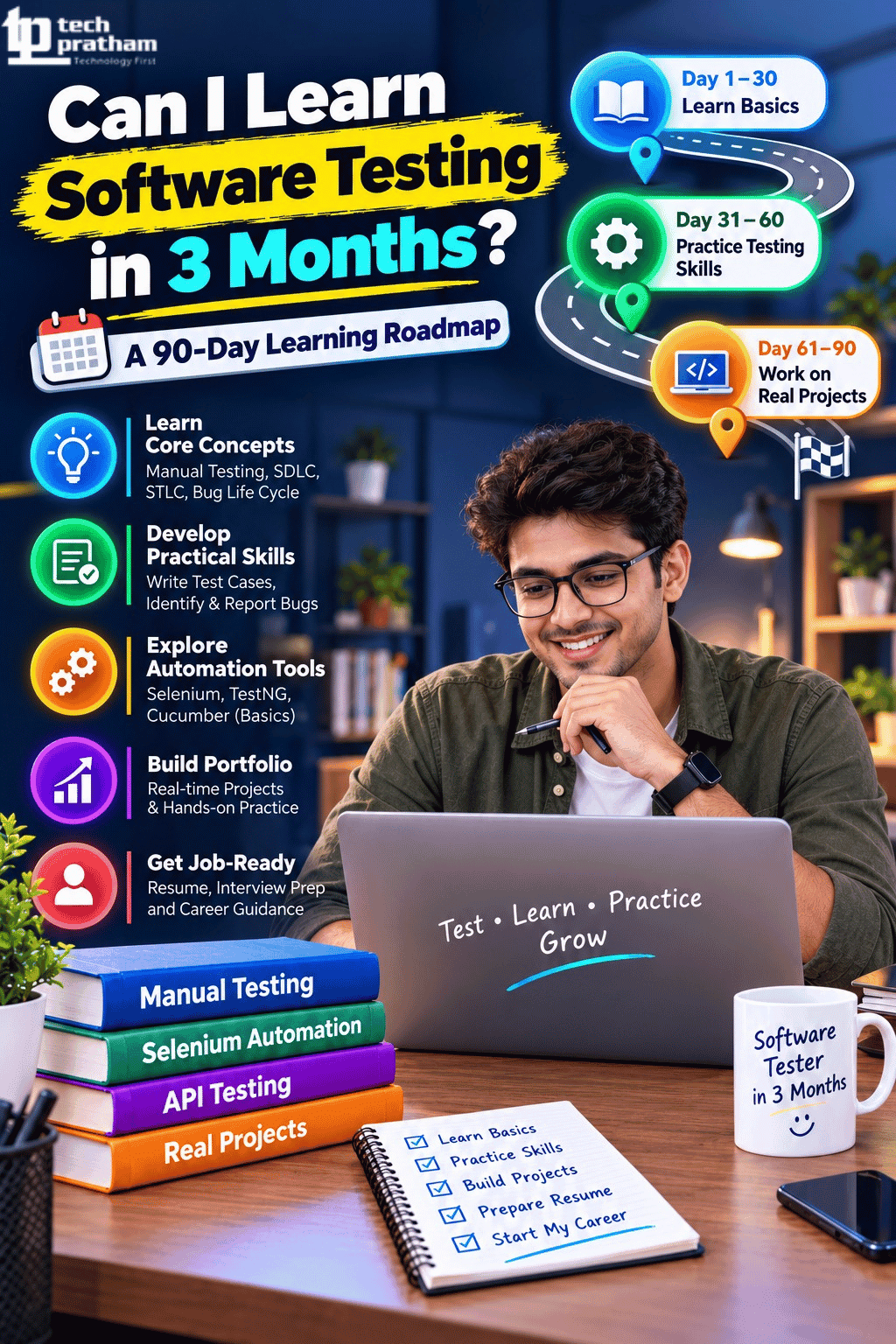
Can I Learn Software Testing in 3 Months? A 90-Day Learning Roadmap
Learn software testing in 3 months with a 90-day roadmap covering manual testing, test cases, SQL, API testing and automation tools.





 +91-8882178896
 +1 (343) 477-0926