Software Testing Training
180 min read5 viewsTosca to Playwright: What Skills Do You Need to Learn
By TechPratham TeamPublished October 5, 2026Updated October 5, 2026
.png)
Software testing is changing quickly, and automation testers are increasingly expected to work with modern tools and programming-based frameworks. If you already have experience with Tosca, you may be wondering whether you can move to Playwright and, more importantly, what skills you need to learn to make the transition successfully.
The good news is that moving from Tosca to Playwright does not mean starting your testing career from zero. Your existing knowledge of test cases, test scenarios, regression testing, defect reporting, test data, and automation concepts can provide a strong foundation.
However, Playwright requires a different approach because it is a code-based automation framework. You will need to develop programming skills, understand modern web automation concepts, work with APIs and test frameworks, and learn how automated tests are integrated into CI/CD pipelines.
This guide explains the key skills you should learn when moving from Tosca to Playwright.
Why Are Tosca Testers Considering Playwright?
Tosca is widely used for model-based test automation and allows testers to automate applications with relatively less programming. It is particularly useful for enterprise testing environments where teams need reusable and maintainable automation assets.
Playwright takes a different approach. It is a modern browser automation framework designed for end-to-end testing of web applications. It supports multiple browsers and provides features for reliable browser interaction, parallel execution, debugging, tracing, and test automation.
For a Tosca tester, learning Playwright can be a valuable way to add programming-based automation skills to an existing testing profile.
Instead of replacing your Tosca knowledge, Playwright can complement it.
What Skills Do You Need to Learn From Tosca to Playwright?
The transition mainly involves moving from a low-code or model-based automation approach to a programming-oriented testing approach, which is an important skill covered in Software Testing Training in India.
The most important skills include:
- Programming fundamentals
- Playwright framework concepts
- Web automation concepts
- Locators and element handling
- Test framework knowledge
- API testing
- Test data management
Let's understand each skill in detail.
1. Learn Programming Fundamentals
The first major skill you need when moving from Tosca to Playwright is programming.
Playwright supports multiple programming languages, including JavaScript, TypeScript, Python, Java, and .NET. However, JavaScript or TypeScript is commonly used for modern Playwright automation projects.
If you have primarily worked with Tosca and have limited coding experience, start with programming fundamentals rather than immediately jumping into advanced automation.
You should understand:
- Programming fundamentals
- Playwright framework concepts
- Web automation concepts
- Locators and element handling
- Test framework knowledge
- API testing
- Test data management
You do not need to become a full-stack developer. Your goal is to become comfortable enough with programming to create, maintain, debug, and improve automation scripts.
Which Language Should Tosca Testers Learn?
For most beginners, TypeScript is a practical choice for Playwright because it provides strong typing while retaining the flexibility of JavaScript.
If your organization already uses JavaScript, you can start with JavaScript and later move to TypeScript.
2. Understand Playwright Architecture
After learning programming basics, the next step is understanding how Playwright works.
A Tosca tester is already familiar with automation concepts, but Playwright introduces a different technical structure.
You should understand concepts such as:
- Browser
- Browser context
- Page
- Test
- Locator
- Assertion
- Fixtures
Understanding these components will help you write tests that are easier to maintain.
For example, instead of simply thinking about automating a business process, you need to understand how a Playwright test interacts with a browser, creates an isolated context, locates elements, performs actions, and validates results.
3. Strengthen Your Web Automation Knowledge
Your Tosca experience already gives you a good understanding of application testing. However, Playwright requires deeper knowledge of how web applications work.
You should become familiar with:
- HTML
- CSS
- DOM
- Web elements
- Attributes
- Forms
- Buttons
- Links
Understanding the DOM is particularly important because Playwright interacts with web elements through locators.
If you understand how a web page is structured, identifying reliable elements becomes much easier.
4. Master Locators
Locators are one of the most important Playwright skills.
In Tosca, you may be accustomed to identifying application objects through its scanning and object recognition capabilities. In Playwright, you need to understand how to identify elements using suitable locators.
You should learn:
- Role-based locators
- Text-based locators
- Labels
- Placeholders
- IDs
- CSS selectors
- XPath
However, simply knowing different locator types is not enough.
You should learn how to choose stable locators.
A good automation tester avoids creating scripts that break whenever a developer changes an unrelated part of the page.
5. Learn Playwright Test and Assertions
Playwright is more than browser interaction. You need to understand how tests are structured and validated.
Learn how to create:
- Test cases
- Test suites
- Hooks
- Assertions
- Fixtures
- Setup and teardown
You should also understand different types of assertions.
For example, you may need to verify:
- A button is visible
- A page contains specific text
- A URL has changed
- A form contains expected data
- A particular element is enabled
Your existing testing knowledge from Tosca will be useful here because you already understand the importance of expected results and validation.
6. Learn Synchronization and Handling Dynamic Applications
Modern web applications frequently contain dynamic elements.
Pages may load content asynchronously, buttons may become available after API responses, and elements may change based on user actions.
Therefore, you need to understand how Playwright handles synchronization.
Learn about:
- Auto-waiting
- Explicit waits when necessary
- Navigation handling
- Network activity
- Dynamic elements
One important mindset change is that you should avoid unnecessarily adding fixed delays to your scripts.
Reliable automation should wait for the required condition rather than simply waiting for a predetermined number of seconds.
7. Learn API Testing
API testing is another valuable skill for someone moving from Tosca to Playwright.
Modern automation frameworks are increasingly used for both UI and API validation.
You should learn:
- HTTP methods
- GET
- POST
- PUT
- PATCH
- DELETE
- Status codes
You should also understand how API testing can support UI automation.
For example, you might use an API to create test data before starting a UI test and then validate the resulting information through the application interface.
This can make your test automation faster and more reliable.
8. Understand Test Data Management
Tosca testers are often familiar with test data concepts, which gives them an advantage when moving to Playwright.
However, you need to learn how test data is managed in a code-based framework.
You may work with:
- JSON files
- CSV files
- Environment variables
- Database data
- API-generated data
You should also learn how to separate test data from test logic.
This becomes especially important when the same automation framework needs to run against development, testing, staging, and production-like environments.
9. Learn Page Object Model and Framework Design
If you want to work professionally with Playwright, learning how to build a maintainable automation framework is essential.
One commonly used design approach is the Page Object Model (POM).
Instead of writing every action directly inside test cases, application-specific elements and actions can be organized into reusable page classes or components.
You should learn:
- Page objects
- Reusable functions
- Common utilities
- Base classes
- Fixtures
This is an important transition from simply creating automated test cases to designing an automation framework.
10. Learn Debugging and Reporting
Automation failures are inevitable. A good Playwright tester needs to understand how to investigate them.
Playwright provides useful debugging capabilities that can help identify why a test failed.
You should learn how to use:
- Page objects
- Reusable functions
- Common utilities
- Base classes
- Fixtures
This debugging mindset is valuable regardless of which automation tool you use.
11. Learn Git and Version Control
If you are moving toward Playwright-based automation jobs, Git is an important supporting skill.
Unlike many low-code automation environments, code-based frameworks are generally maintained through version-control systems.
Learn basic Git operations such as:
- Clone
- Pull
- Commit
- Push
- Branch
- Merge
You should also understand how testers collaborate with developers and other automation engineers using Git-based workflows.
Having Playwright knowledge without understanding basic version control can limit your ability to work effectively in a professional development environment.
12. Understand CI/CD
CI/CD is another major skill that can improve your Playwright profile.
Modern automation suites are often executed automatically whenever code is committed or a deployment takes place.
You should understand the basic concepts of:
- Continuous Integration
- Continuous Delivery
- Build pipelines
- Automated test execution
- Environment variables
You do not need to become a DevOps engineer, but you should know how a Playwright test suite can be executed as part of a CI/CD pipeline.
13. Learn Cross-Browser Testing
One of Playwright's useful capabilities is cross-browser testing.
You should understand how to execute tests across browsers such as:
- Chromium
- Firefox
- WebKit
You should also learn how browser configuration, projects, viewport sizes, devices, and execution settings can affect your tests.
This helps you build automation that validates applications across different browser environments rather than focusing on only one browser.
14. Build Real-Time Projects
Reading documentation and watching tutorials is not enough to become confident in Playwright.
A Tosca tester transitioning to Playwright should work on practical projects.
For example, you could automate an e-commerce application involving:
- User registration
- Login
- Product search
- Product filtering
- Shopping cart
You can then extend the project with API testing, test data management, reporting, parallel execution, and CI/CD.
Working on such scenarios helps you understand how individual Playwright concepts come together in a real automation framework.
Tosca Skills You Can Reuse in Playwright
The transition is easier because many of your existing testing skills remain valuable.
You can carry forward your knowledge of:
The biggest change is not your testing mindset. It is the technical implementation approach.
Tosca vs Playwright: What Changes?
The biggest difference is how automation is created and maintained.
With Tosca, testers can use a model-based approach and graphical interfaces to build automation. With Playwright, you generally write and maintain code.
Therefore, a Tosca tester moving to Playwright should shift from:
Tool-focused automation → Code-focused automation
You should become comfortable reading code, writing functions, debugging scripts, managing dependencies, and understanding framework architecture.
How Long Does It Take to Learn Playwright After Tosca?
The learning time depends on your programming background and current testing experience.
If you already understand software testing well but have limited coding knowledge, spend more time on programming fundamentals before moving into advanced Playwright concepts.
A practical learning sequence can be:
Phase 1: JavaScript/TypeScript fundamentals
Phase 1: JavaScript/TypeScript fundamentals
Phase 2: HTML, CSS, DOM and web concepts
Phase 3: Playwright fundamentals
Phase 4: Locators, assertions and synchronization
Phase 5: API and test data management
Phase 6: Framework design and Page Object Model
Phase 7: Git and CI/CD
Phase 8: Real-time project implementation
The objective should not simply be to complete a Playwright course. The goal should be to become capable of designing, executing, debugging, and maintaining automation frameworks.
Is Playwright Difficult for Tosca Testers?
Playwright may feel challenging initially, particularly if you have little programming experience.
The biggest learning curve is usually not testing itself. Tosca testers already understand concepts such as test scenarios, validation, regression testing, defects, and test execution.
The challenge is learning to express those testing concepts through code.
Once you become comfortable with programming, locators, assertions, debugging, and framework design, the transition becomes much easier.
Should Tosca Testers Learn Playwright?
Yes, if you want to expand your automation skill set and become comfortable with code-based testing.
Tosca remains useful for enterprise automation, while Playwright can add modern web automation and programming capabilities to your profile.
Learning both can give you a broader understanding of automation approaches.
You do not necessarily need to abandon Tosca. Instead, think of Playwright as an additional skill that can help you handle projects where coding-based automation is required.
Final Thoughts
Moving from Tosca to Playwright is less about starting over and more about adding a new technical layer to your existing testing experience.
Your knowledge of test cases, business scenarios, regression testing, test data, and defect management gives you a strong foundation. The main skills you need to develop are programming, Playwright architecture, web technologies, locators, API testing, framework design, Git, debugging, and CI/CD.
Here’s a natural way to include your keyword Software Testing Course in India without making the sentence feel stuffed:
> If you approach the transition step by step and practice through real-world projects, **Software Testing Training in India** can help you move from a Tosca-focused tester to a more versatile automation professional.
For testers planning a career transition, Tosca + Playwright + strong testing fundamentals can be a useful combination, particularly when supported by practical project experience and the ability to explain how you designed and maintained your automation framework.
Related Articles
Software Testing Training
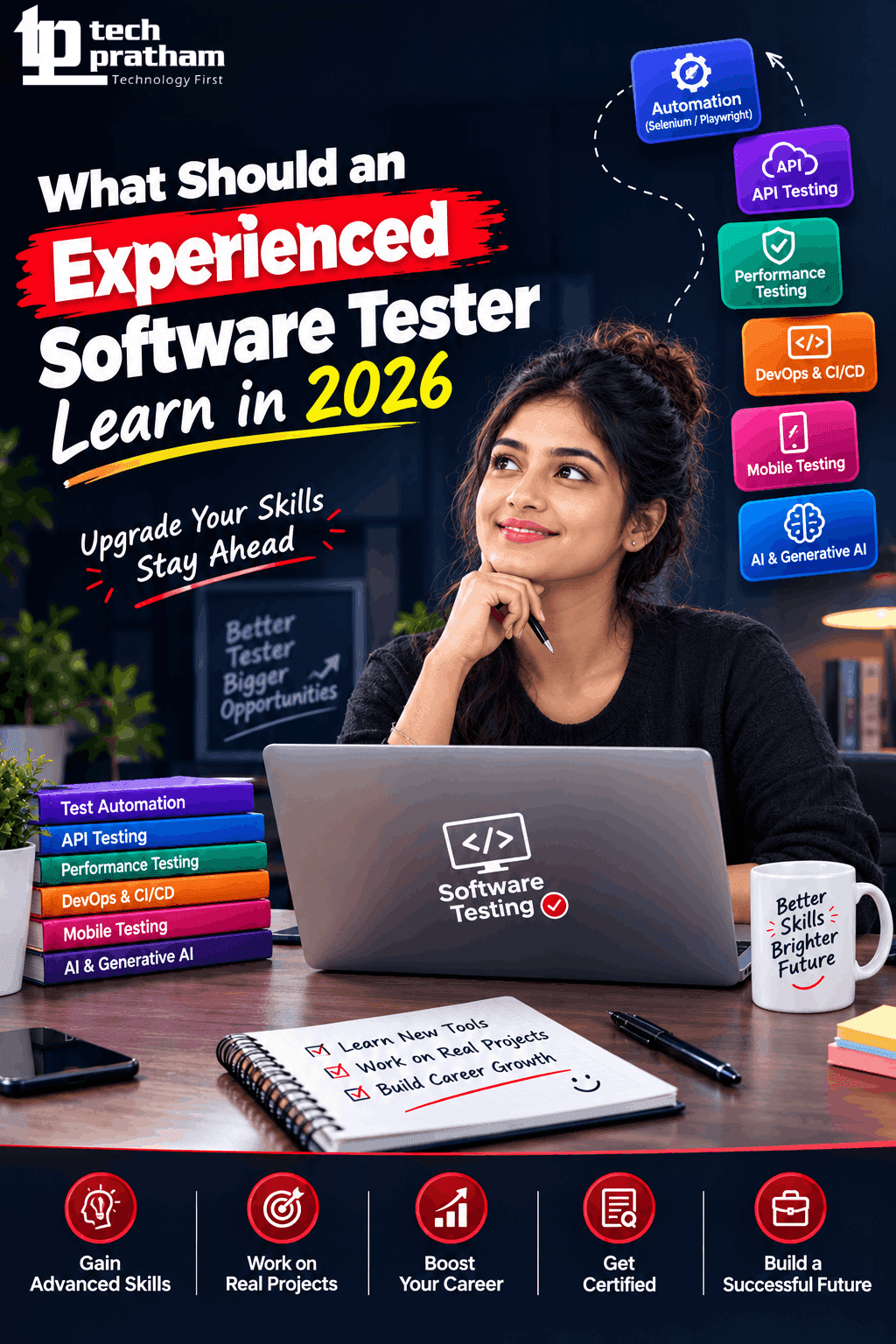
What Should an Experienced Software Tester Learn in 2026
Learn what experienced software testers should master in 2026, from automation and AI testing to APIs, cloud, and modern QA tools.

Software Testing Training
How Can Career Gap Candidates Build a Career in Software Testing
Career gap candidates can build a software testing career by learning practical skills, gaining experience, and preparing for QA jobs.




 +91-8882178896
 +1 (343) 477-0926