
Software Testing Training
147 min read30 viewsWhat Should an Experienced Software Tester Learn in 2026
By TechPratham TeamPublished October 3, 2026Updated October 3, 2026
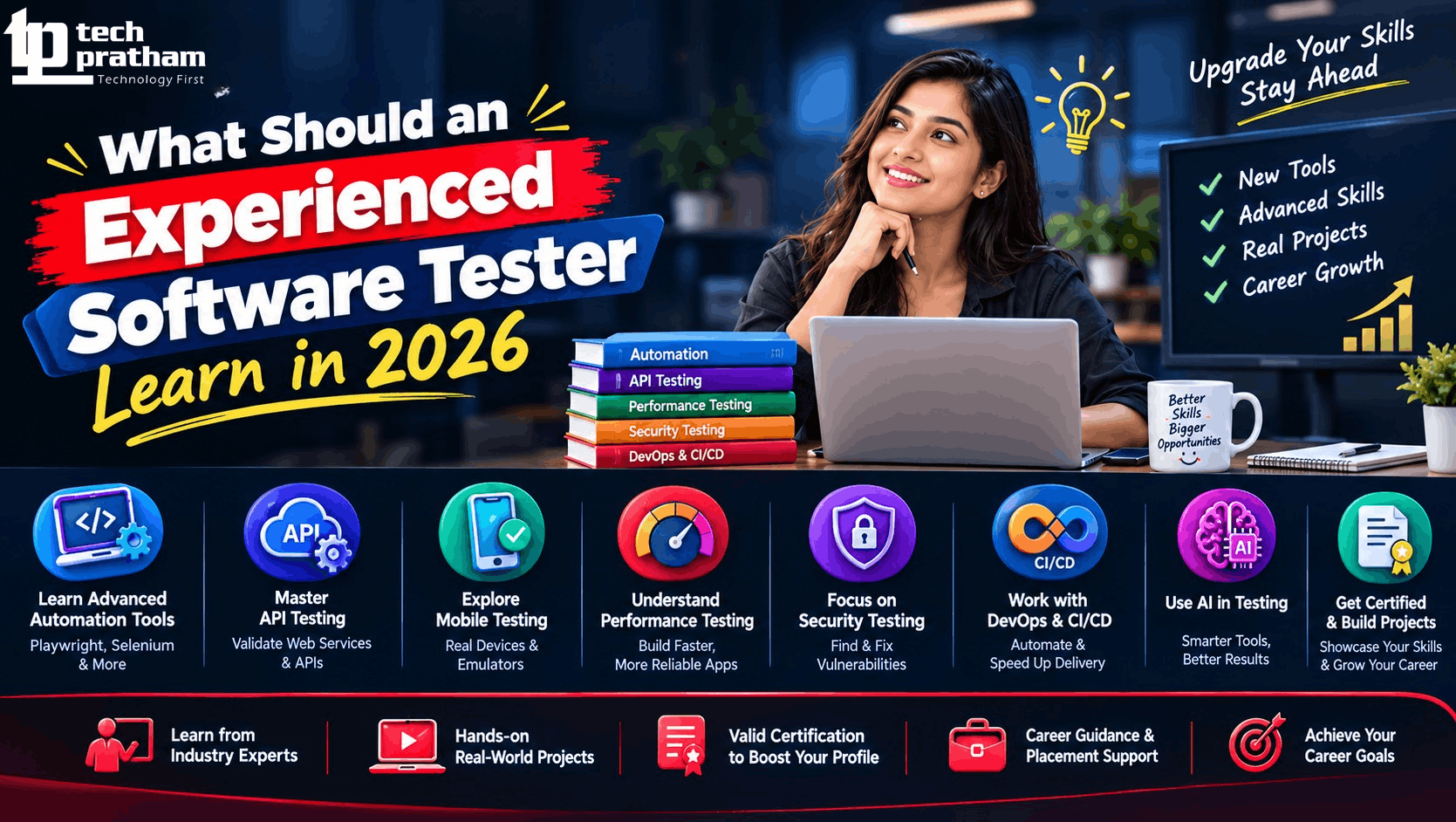
Software testing is no longer limited to executing test cases, reporting bugs, and performing regression testing. Modern software development involves automation, APIs, cloud platforms, CI/CD pipelines, mobile applications, data-driven systems, and increasingly, AI-assisted development and testing.
For an experienced software tester, this means that simply having several years of testing experience may not be enough to remain competitive. The more important question is: What should an experienced software tester learn next?
In 2026, testers can strengthen their careers by developing a combination of testing fundamentals, automation skills, API testing, programming knowledge, CI/CD understanding, cloud awareness, and practical knowledge of AI-assisted testing.
This guide explains the important skills experienced software testers can consider learning in 2026 and how these skills can help them move toward senior QA, automation, SDET, QA lead, and specialized testing roles.
Why Should Experienced Software Testers Upgrade Their Skills?
Technology and software development practices continue to change. Testing teams are expected to identify defects earlier, automate repetitive scenarios, validate APIs and data, work with development and DevOps teams, and contribute to overall software quality.
An experienced tester who continues learning can expand beyond traditional testing responsibilities.
Upskilling can help you:
- Move from manual testing toward automation
- Handle API and backend testing
- Understand modern development workflows
- Work with CI/CD pipelines
- Improve programming and scripting skills
- Participate in cloud-based testing
- Use AI-assisted tools effectively
- Work on complex real-world applications
- Prepare for senior and specialized QA roles
The goal is not to learn every available tool. Instead, testers should identify their current skill gaps and build a focused learning path.
1. Strengthen Your Advanced Manual Testing Skills
Automation is important, but strong manual testing knowledge remains essential.
Experienced testers should go beyond basic test case execution and consider Software Testing Training in India to strengthen their knowledge of advanced testing techniques, modern tools, automation practices, and industry-focused testing approaches.
- Risk-based testing
- Exploratory testing
- Regression testing strategies
- Integration testing
- System testing
- End-to-end testing
A tester with strong domain knowledge and analytical skills can design better test scenarios and identify issues that automated scripts may not detect easily.
For experienced professionals, the focus should shift from simply executing tests to understanding what should be tested, why it should be tested, and what risks are involved.
2. Learn Test Automation
Automation is one of the most important areas for testers who want to expand their technical skills.
If you are still primarily working with manual testing, learning automation can open the door to more technical testing responsibilities.
An automation learning path can include:
- Automation concepts
- Test framework design
- Locators and synchronization
- Reusable test components
- Data-driven testing
- Page Object Model
Experienced testers can choose an automation technology based on their project requirements and career goals.
The important point is not just learning how to create individual automated scripts. You should also understand how to design, maintain, debug, and scale an automation framework.
3. Improve Your Programming Skills
Programming knowledge has become increasingly useful for modern testers.
You do not necessarily need to become a full-time software developer, but you should be comfortable reading and writing code related to testing.
Depending on your chosen automation ecosystem, you may learn languages such as:
- Java
- Python
- JavaScript
- TypeScript
Programming skills help testers understand application logic, create better automation scripts, work with test frameworks, process test data, and troubleshoot failures.
For example, someone moving into Selenium automation may benefit from Java or another supported programming language, while testers working with modern browser automation tools may consider JavaScript or TypeScript.
4. Learn API Testing
Modern applications depend heavily on APIs. Therefore, API testing is an important skill for testers who want to move beyond UI-focused testing.
API testing allows you to validate application functionality at the service or backend level without depending entirely on the user interface.
Important areas to learn include:
- HTTP methods
- Request and response structure
- Status codes
- Headers
- Authentication
- JSON and XML
Tools such as Postman and automation frameworks can be used to practice API testing.
Understanding APIs can also make UI automation more effective because testers can create or validate test data through backend services rather than relying only on the application interface.
5. Understand Database Testing and SQL
Experienced testers working on data-driven applications can benefit from stronger SQL and database testing skills.
You should be able to write queries to validate whether data is correctly stored, updated, retrieved, and related across different tables.
Important areas include:
- SELECT queries
- WHERE conditions
- JOINs
- GROUP BY
- Subqueries
- Data validation
You do not necessarily need advanced database administration knowledge. The objective is to understand how application data behaves and how to validate it during testing.
6. Learn CI/CD and DevOps Concepts
Testing is increasingly integrated into development and deployment pipelines.
Experienced testers should understand how testing fits into CI/CD workflows.
You can start by learning concepts such as:
- Continuous Integration
- Continuous Delivery
- Build pipelines
- Automated test execution
- Version control
- Environment management
Tools and platforms may vary from organization to organization, but the underlying concepts are transferable.
A tester who understands how automated tests run inside a pipeline can collaborate more effectively with developers and DevOps teams.
7. Understand Cloud-Based Testing
Cloud platforms have become an important part of modern application development and testing.
Testers do not necessarily need to become cloud architects. However, understanding basic cloud concepts can be valuable.
You can learn:
- Cloud environments
- Virtual machines
- Storage
- Databases
- Application deployment
Cloud testing knowledge becomes particularly useful when applications are distributed across multiple environments and services.
8. Learn AI-Assisted Software Testing
AI is an important area for testers to understand in 2026.
AI-assisted testing can support activities such as generating test scenarios, analyzing test data, creating test cases, identifying patterns, summarizing defects, and assisting with automation development.
However, AI should be treated as a productivity tool rather than a replacement for testing expertise.
Experienced testers should learn how to:
- Use AI to generate testing ideas
- Review AI-generated test cases
- Improve prompts for testing tasks
- Analyze AI-generated automation code
- Identify incorrect or incomplete AI outputs
The key skill is not simply knowing how to use an AI tool. It is knowing when AI-generated output is useful and when it requires human validation.
9. Explore Modern Automation Frameworks
Experienced testers should also stay familiar with modern automation approaches.
Depending on the type of application and organization, this could include browser automation, mobile automation, API automation, or specialized enterprise testing platforms.
For web application testing, testers may explore modern tools such as Playwright alongside established automation technologies.
The objective should be to understand the strengths, limitations, architecture, and practical use cases of the tools rather than collecting certifications or tools without hands-on experience.
10. Learn Mobile Application Testing
If your current experience is mainly in web application testing, mobile testing can be another useful specialization.
Mobile testing includes areas such as:
- Functional testing
- UI testing
- Device compatibility
- Screen sizes
- Network conditions
Testers can also explore mobile automation technologies when their career path requires it.
11. Develop Performance Testing Knowledge
Performance testing becomes particularly important for applications that need to support large numbers of users or transactions.
Experienced testers can learn the fundamentals of:
- Load testing
- Stress testing
- Endurance testing
- Scalability testing
- Response time analysis
Understanding performance testing can help testers collaborate with development and infrastructure teams when applications experience slow response times or high traffic.
12. Build Strong Test Automation Framework Knowledge
Learning an automation tool is different from understanding automation architecture.
Experienced testers who want to move toward senior automation or SDET positions should understand how frameworks are structured.
Important concepts include:
- Framework architecture
- Reusable components
- Configuration management
- Test data management
- Logging
- Reporting
- Exception handling
This knowledge helps you move from writing scripts to designing maintainable automation solutions.
13. Strengthen Domain Knowledge
Technical skills are only one part of becoming a strong tester.
Domain knowledge can make your testing more effective because you understand the business risks behind the application.
Depending on your industry, you might develop expertise in domains such as:
- Healthcare
- E-commerce
- Insurance
- Telecom
- Enterprise applications
A tester who understands both technology and business processes can identify meaningful scenarios that may be missed by someone who only understands the technical side.
14. Work on Real-World Projects
One of the biggest differences between learning a tool and becoming job-ready is practical experience.
Instead of only watching tutorials, experienced testers should work on projects that simulate real testing environments.
A project can include:
- Understanding requirements
- Preparing test scenarios
- Creating test cases
- Executing functional testing
- Reporting defects
Projects help you understand how different testing activities connect with one another.
15. Improve Soft Skills and Test Leadership
As testers progress toward senior positions, technical knowledge is only part of the role.
Senior testers often need to communicate with developers, business analysts, project managers, product teams, and other stakeholders.
Important skills include:
- Communication
- Requirement analysis
- Documentation
- Defect communication
- Problem solving
These skills can become particularly important when moving toward Senior QA, QA Lead, Test Lead, or similar responsibilities.
What Should a Manual Tester Learn in 2026?
If you are an experienced manual tester, you do not need to learn everything at once.
A practical progression could be:
Manual Testing → SQL → API Testing → Programming → Automation → Framework Design → CI/CD → AI-Assisted Testing
Your exact path can depend on your existing experience and target role.
For example, someone with strong manual testing experience may first focus on API testing and programming before moving into automation.
What Should an Automation Tester Learn in 2026?
If you already work in automation, your next step can be deeper technical expertise rather than simply learning another automation tool.
Consider developing skills in:
- Advanced framework architecture
- API automation
- Database validation
- CI/CD integration
- Parallel execution
The objective is to become capable of designing and maintaining a complete testing solution.
How Can Software Testing Training Help Experienced Testers?
Structured software testing training can provide a defined learning path for professionals who want to upgrade their skills.
When evaluating Software Testing Training in India, experienced professionals should look beyond the number of tools included in the curriculum.
Consider whether the training provides:
- Updated testing concepts
- Practical assignments
- Real-world projects
- Automation practice
- API testing
- Framework development
- Programming practice
The right learning path should match your current experience and your intended career direction.
A Practical Software Testing Upskilling Roadmap for 2026
A simple roadmap for an experienced tester could look like this:
Stage 1: Strengthen fundamentals
Advanced manual testing, test planning, risk analysis, and defect management.
Stage 2: Add technical testing skills
SQL, API testing, database validation, and basic programming.
Stage 3: Learn automation
Choose an appropriate automation technology and learn framework development.
Stage 4: Understand modern delivery
Learn Git, CI/CD, cloud concepts, and automated test execution.
Stage 5: Explore advanced areas
Performance, mobile, security basics, or specialized enterprise testing depending on your career goals.
Stage 6: Add AI-assisted testing
Learn how AI can support test creation, analysis, documentation, and automation while validating its output.
Stage 7: Build projects
Apply your knowledge to realistic applications and document your testing approach.
Final Thoughts
For an experienced software tester, 2026 is less about learning as many testing tools as possible and more about developing a balanced technical and analytical skill set.
Manual testing expertise remains valuable, but combining it with automation, programming, API testing, SQL, CI/CD, cloud concepts, and AI-assisted testing can broaden your capabilities.
The best learning path depends on your current experience, project requirements, and target role. Instead of trying to master everything simultaneously, identify your biggest skill gap and build your next learning stage around it.
If you are considering Software Testing Course in India, choose a learning path that gives you opportunities to practice concepts through assignments and real-world projects rather than focusing only on theoretical knowledge.
The goal of upskilling is not simply to add another tool to your resume. It is to become a tester who can understand applications more deeply, identify risks effectively, automate appropriate scenarios, work with modern development teams, and contribute to overall software quality.
Related Articles

Software Testing Training
How Can Career Gap Candidates Build a Career in Software Testing
Career gap candidates can build a software testing career by learning practical skills, gaining experience, and preparing for QA jobs.

Software Testing Training
How Working Professionals Can Switch to a Career in Software Testing
Learn how working professionals can switch to a career in software testing, build the right skills, choose tools, and start a successful Career.





 +91-8882178896
 +1 (343) 477-0926