
Software Testing Training
127 min read358 viewsWhy AI Applications Require Specialized Quality Assurance
By TechPratham TeamPublished August 24, 2026Updated August 24, 2026
.png)
Artificial intelligence is rapidly becoming part of everyday software. From chatbots and recommendation engines to AI-powered healthcare platforms, financial systems, coding assistants, search tools, and business automation, organizations are increasingly relying on AI to make decisions, generate content, and interact with users. However, testing an AI application is fundamentally different from testing traditional software.
Conventional software generally follows predefined rules: the same input is expected to produce the same output. AI systems, particularly those based on machine learning and generative AI, can produce different results for similar inputs. Their behavior may depend on training data, context, model configuration, prompts, external information, and continuous updates.
This makes specialized quality assurance (QA) essential for AI applications. Testing AI is not simply about checking whether a button works or whether an application produces the expected output. It requires evaluating accuracy, reliability, fairness, security, robustness, explainability, and the overall quality of AI-generated results.
What Makes AI Applications Different from Traditional Software?
Traditional software is usually deterministic. Developers define business rules, conditions, and expected outcomes, and testers verify whether the system follows those rules correctly.For example, if an application calculates a discount of 10% on a ₹1,000 purchase, the expected result is ₹900. A tester can easily define the correct output and verify it repeatedly.
AI applications are different. An AI model may interpret the same question in multiple ways and generate different responses. A recommendation engine may change its suggestions based on user behavior. A machine-learning model may perform well on one dataset but poorly on another.
Generative AI introduces another layer of complexity because the output can be open-ended. A tester cannot always define one single correct answer. Instead, QA teams need to evaluate whether the response is relevant, accurate, safe, consistent, and appropriate for the intended use case.
Therefore, Software Testing Training in India provides learners with the practical skills and knowledge needed to build a strong career in software testing.
Why Specialized QA Is Necessary for AI
The purpose of specialized QA is not only to identify technical defects. It is also to determine whether an AI system behaves responsibly and reliably in real-world situations.Several factors make specialized testing particularly important.
1. AI Outputs Are Not Always Predictable
I models can generate different outputs for similar inputs. This does not automatically indicate a defect, but it creates challenges for conventional testing approaches.Testers need to evaluate acceptable ranges of behavior rather than relying exclusively on fixed expected results. For example, a chatbot might provide different but equally valid explanations for the same question.
QA professionals therefore need to define evaluation criteria such as relevance, factual accuracy, completeness, tone, and safety.
2. Data Quality Directly Affects AI Quality
AI systems depend heavily on data. If training or testing data is incomplete, outdated, duplicated, inaccurate, or biased, the resulting model may produce unreliable outcomes.Specialized QA must therefore include data validation. Testers may need to examine whether datasets contain missing values, inconsistent formats, unexpected patterns, or demographic imbalances.
Data testing becomes especially important in applications where AI influences financial decisions, hiring, healthcare, security, or customer services.
3. AI Models Can Develop Bias
One of the most important concerns with AI is bias. A model can unintentionally produce different outcomes for different groups because of patterns present in its training data.For example, an AI-based recruitment system could favor certain candidate profiles if historical hiring data contains biases. A facial recognition system might perform differently across demographic groups if its training data is not sufficiently representative.
Specialized QA can help identify such problems by testing the model across diverse datasets and user scenarios. The objective is to determine whether the application behaves consistently and fairly.
4. AI Systems Can Be Vulnerable to New Types of Attacks
Traditional software security testing focuses on vulnerabilities such as authentication problems, injection attacks, insecure configurations, and unauthorized access.
AI applications require these tests as well as AI-specific security testing.
For example, generative AI systems can be exposed to prompt injection, where carefully designed instructions attempt to manipulate the model into ignoring its intended behavior. Models can also be affected by malicious or misleading input.
QA teams need to test how AI applications respond to adversarial inputs, unexpected instructions, sensitive information requests, and attempts to bypass safety controls.
Key Areas of AI Quality Assurance
A strong AI testing strategy should cover multiple dimensions of quality rather than concentrating only on functional correctness.Functional Testing
Functional testing verifies whether the AI application performs the tasks it was designed to perform.For example, if an AI customer-support assistant is designed to answer questions about product returns, testers should verify whether it understands customer queries and provides appropriate information.
Functional testing should include normal scenarios, edge cases, invalid inputs, ambiguous questions, and unexpected user behavior.
Accuracy and Model Performance Testing
Accuracy is particularly important for AI systems that classify, predict, recommend, or make decisions.Testers can evaluate metrics such as precision, recall, F1 score, accuracy, false positives, and false negatives depending on the application's purpose.
However, the right metric depends on the use case. For some systems, minimizing false negatives may be more important than maximizing overall accuracy.
Generative AI Testing
Generative AI requires specialized evaluation because outputs are often subjective and variable.Testers may evaluate responses based on:
- Relevance to the user's request
- Factual correctness
- Completeness
- Clarity
- Consistency
- Toxicity and harmful content
- Hallucinations
- Instruction following
- Appropriate tone
- Protection of sensitive information
.png)
Prompt testing is another important component. QA teams can create different prompt variations to understand how the model behaves when users phrase questions differently.
Robustness Testing
AI applications must work reliably even when inputs are unusual or imperfect.Robustness testing can include misspelled words, incomplete questions, unexpected formats, noisy data, contradictory information, unusual combinations of inputs, and deliberately misleading prompts.
The goal is to determine whether the AI system fails safely instead of producing harmful or misleading results.
Security and Privacy Testing
AI systems may process large amounts of sensitive information. Security testing should therefore evaluate access controls, data protection, API security, model exposure, prompt manipulation, and information leakage.
Security and Privacy Testing
AI systems may process large amounts of sensitive information. Security testing should therefore evaluate access controls, data protection, API security, model exposure, prompt manipulation, and information leakage.
Privacy testing is equally important. QA teams should verify that an AI system does not unnecessarily reveal confidential information through generated responses.
Performance Testing
AI applications can require substantial computational resources. Response time and scalability can therefore become important quality factors.Performance testing should examine how the application behaves under different workloads, concurrent users, large inputs, and peak traffic.
For generative AI applications, testers may also evaluate response latency and resource consumption.
Testing AI Hallucinations
Hallucination is one of the most widely discussed challenges in generative AI. An AI model may generate information that appears convincing but is incorrect, unsupported, or fabricated.For example, a chatbot might provide a fictional reference, incorrect statistic, or inaccurate explanation while presenting it confidently.
Testing for hallucinations requires carefully designed test cases. QA teams can compare AI responses against trusted information, introduce questions with incomplete context, and evaluate whether the model appropriately communicates uncertainty.
For high-risk applications, human review may remain necessary for important decisions or outputs.
Continuous Testing Is Essential
AI applications should not be considered permanently tested after a single QA cycle.Models, prompts, datasets, APIs, and supporting systems can change over time. Even a small modification can affect the model's behavior.
This makes continuous testing important. Automated regression tests can be executed whenever a model or application component changes. Teams can compare new model versions against previous versions to identify unexpected performance degradation.
Monitoring should also continue after deployment. Real-world users may interact with an AI system in ways that were not anticipated during development.
The Role of Automation in AI Testing
Automation can make AI quality assurance more scalable, but it does not eliminate the need for human testers.Automated testing can handle repetitive checks such as API validation, regression testing, response-time measurements, data validation, and model-performance comparisons.
For AI applications, automation can also be used to execute large numbers of prompts and evaluate outputs against predefined criteria.
However, human judgment remains valuable when evaluating nuanced responses, contextual relevance, ethical concerns, and user experience.
This is why a Software Testing Course in India should cover manual testing, automation, analytical thinking, and modern AI-specific testing skills.
Skills Required for Testing AI Applications
As AI becomes more common, testers need to expand their technical skill sets.A modern QA professional can benefit from understanding:
- Software testing fundamentals
- Manual and automation testing
- API testing
- Programming and scripting
- Test automation frameworks
- Data validation
- Machine-learning concepts
- AI model evaluation
- Prompt testing
Professionals beginning their testing careers can build these skills through structured learning. A Software Testing Course in India can provide foundational knowledge of testing methodologies, while more advanced programs can introduce automation and modern AI testing concepts.
Similarly, Software Testing Training in India can help learners understand how testing practices are applied to real-world software projects. As organizations adopt AI-driven applications, having broader testing knowledge can help professionals adapt to new QA responsibilities.
How AI Is Changing Software Testing Careers
AI is not necessarily replacing software testers. Instead, it is changing the nature of their work.AI tools can assist testers by generating test cases, identifying potential edge cases, creating test data, analyzing logs, and supporting automation development. However, testers still need to determine whether the generated tests are meaningful and whether the application behaves correctly.
This creates demand for professionals who understand both traditional software testing and AI-related quality challenges.
A structured Software Testing Certification Training in India can be useful for learners who want to establish a strong foundation and demonstrate their understanding of testing principles. Certification alone, however, should not be treated as a substitute for practical experience. Hands-on projects, automation practice, debugging, and real-world test scenarios are equally important.
For beginners, Software Testing Classes in India can also provide a structured environment for learning concepts such as test planning, test-case design, defect life cycles, automation, API testing, and performance testing. The most valuable learning path is one that combines theory with practical implementation.
Challenges QA Teams May Face When Testing AI
.png)
Despite the importance of AI testing, organizations face several challenges.
The first is the difficulty of defining expected results. Unlike traditional applications, AI systems may have multiple acceptable answers.
The second is the lack of standardized evaluation methods for certain generative AI applications. Teams may need to create customized quality criteria based on the business context.
Another challenge is the rapid evolution of AI technology. Models and tools change quickly, which means testing strategies must also evolve.
There is also a shortage of professionals who understand both conventional QA practices and AI concepts. This creates an opportunity for testers who are willing to develop additional skills.
Building an Effective AI Testing Strategy
Organizations can approach AI quality assurance through a structured process. First, they should clearly define the purpose and risks of the AI application. A customer-support chatbot and an AI system used for financial decision-making should not have identical testing requirements.- Define AI purpose and risks. Set clear quality standards.
- Test diverse datasets.
- Automate regression testing.
- Monitor AI after deployment.
Finally, organizations should monitor AI behavior after deployment and continuously improve their testing processes based on real-world results.
The Future of AI Quality Assurance
AI quality assurance is likely to become an increasingly specialized area within software engineering. As organizations use AI for more critical tasks, simply verifying whether an application works will no longer be sufficient.
Future QA teams are likely to focus more heavily on model behavior, data quality, responsible AI, security, explainability, continuous monitoring, and human-AI interaction.
Testing professionals who understand these areas can play an important role in ensuring that AI applications remain reliable and trustworthy.
The growth of AI also means that software testing education will need to evolve. Traditional testing fundamentals will continue to be important, but learners will increasingly benefit from exposure to automation, APIs, data, machine learning concepts, and AI-specific testing techniques.
Frequently Asked Questions (FAQs)
1. Why do AI applications require specialized quality assurance?
AI applications can produce variable and unpredictable outputs, making traditional testing approaches insufficient. Specialized QA evaluates accuracy, reliability, bias, security, hallucinations, robustness, and overall AI behavior.
2. How is AI testing different from traditional software testing?
Traditional testing usually verifies predefined inputs against expected outputs. AI testing must also evaluate model behavior, data quality, probabilistic results, bias, hallucinations, and performance across diverse and unexpected scenarios.
3. What are the key areas covered in AI quality assurance?
Important areas include functional testing, data validation, model performance testing, generative AI testing, robustness testing, security and privacy testing, performance testing, and continuous monitoring.
4. Can automation be used for testing AI applications?
Yes. Automation can help with regression testing, API testing, test-data generation, prompt testing, performance checks, and large-scale model evaluations. However, human judgment is still important for assessing context, relevance, safety, and complex AI responses.
5. What skills should software testers develop for AI testing?
Testers should have a strong foundation in software testing along with skills in automation, API testing, programming, data validation, AI and machine-learning concepts, prompt testing, security testing, and model evaluation.
6. How can Software Testing Training help professionals prepare for AI testing?
Software Testing Training can build strong foundations in testing methodologies, automation, API testing, and practical QA processes. Professionals can then expand these skills with AI-specific testing concepts to work with modern AI-powered applications.
Conclusion
AI applications require specialized quality assurance because their outputs can be unpredictable and affected by data quality, bias, security risks, and hallucinations. Effective AI testing combines functional, performance, security, data, and model testing. For QA professionals, this creates opportunities to develop modern testing skills. Software Testing Training can help learners build strong testing fundamentals while preparing them to work with evolving AI-powered applications.
Related Articles
Software Testing Training
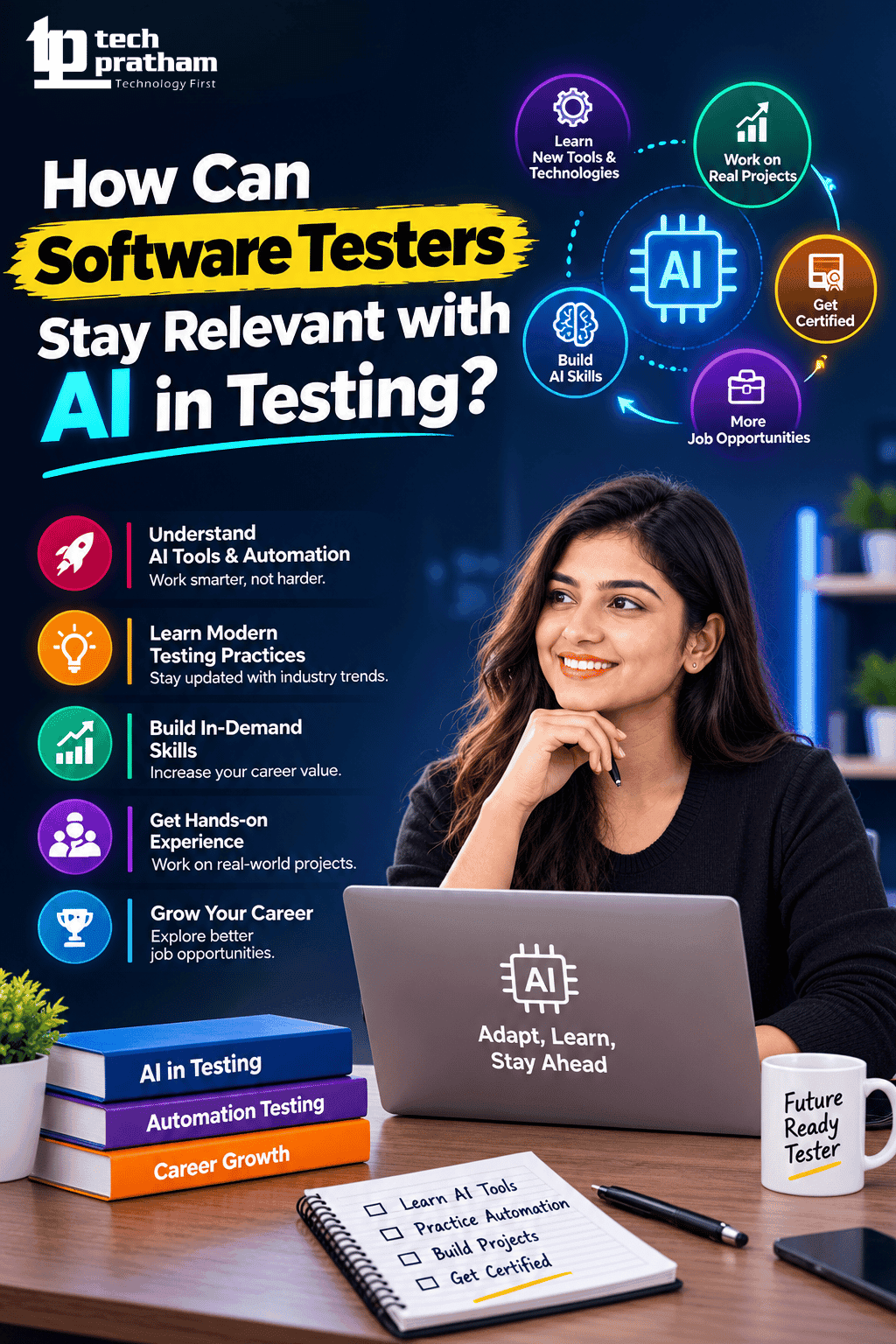
How Can Software Testers Stay Relevant with AI in Testing
Software testers can stay relevant with AI by learning AI tools, automation, prompt skills, data analysis, and modern testing practices.

Software Testing Training
Tosca to Playwright: What Skills Do You Need to Learn
Learn the key skills needed to move from Tosca to Playwright, including coding, automation, API testing, frameworks, and CI/CD.

Software Testing Training
What Should an Experienced Software Tester Learn in 2026
Learn what experienced software testers should master in 2026, from automation and AI testing to APIs, cloud, and modern QA tools.





 +91-8882178896
 +1 (343) 477-0926