
Why Playwright Is the Future of Software Testing
_11zon (2).webp)
The software industry is evolving faster than ever before. Modern applications are no longer simple websites with a few static pages. Today’s applications are highly interactive, cloud-based, API-driven, mobile-friendly, and continuously updated through Agile and DevOps practices. As software complexity increases, the demand for faster, smarter, and more reliable testing solutions has also grown. Traditional testing tools that worked well a decade ago often struggle to keep up with modern web technologies and rapid release cycles. This is where Playwright has emerged as one of the most important automation testing tools in the software testing industry. Developed by Microsoft, Playwright is rapidly becoming the preferred choice for QA Engineers, Automation Testers, SDETs, and Quality Engineering teams worldwide.
Understanding the Evolution of Software Testing
Before understanding why Playwright is the future, it is important to understand how software testing has evolved.
Phase 1: Manual Testing Era
- Open applications manually
- Execute test cases
- Compare actual and expected results
- Report defects
While Manual Testing is still important today, it became difficult to manage as applications grew larger.
Phase 2: Traditional Automation Testing
To reduce repetitive work, automation tools were introduced. Popular tools included:
- Selenium
- QTP/UFT
- TestComplete
- Watir
These tools helped automate repetitive testing tasks and improved testing efficiency.
Phase 3: Modern Testing Era
However, as modern applications became more dynamic, automation scripts became harder to maintain. Today's applications use:
- React
- Angular
- Vue.js
- Next.js
- Microservices
- APIs
- Cloud Platforms
These technologies require more intelligent automation frameworks capable of handling dynamic content, asynchronous loading, and complex user interactions. This is exactly where Playwright excels.
What Is Playwright?
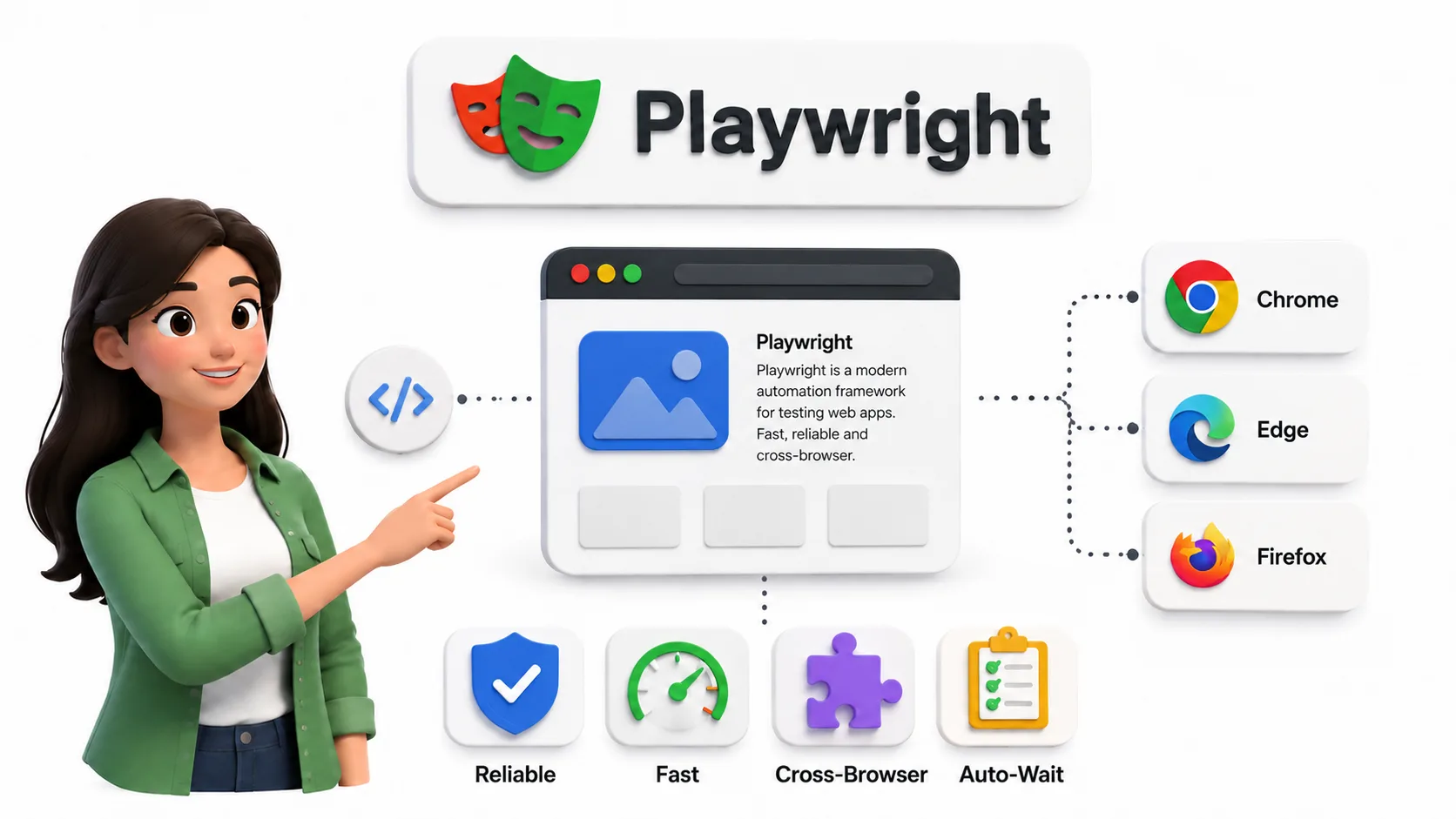
Playwright is a modern open-source test automation framework developed by Microsoft that allows developers and software testers to automate web browsers and test web applications with high speed, reliability, and accuracy. In simple terms, Playwright can simulate real user actions inside a browser. Instead of manually testing every feature after each software update, teams use Playwright to automate these checks and ensure that applications continue working correctly. It enables testers and developers to automate:
- Web applications
- APIs
- Cross-browser testing
- Mobile web testing
- End-to-end testing
Playwright supports multiple browsers using a single automation framework. Supported browsers include (Chromium Google Chrome Microsoft Edge Firefox Safari (WebKit)) This allows teams to write one test and execute it across multiple browsers.
Why Companies Are Moving Toward Playwright
Over the last few years, Playwright has evolved from being a new automation framework into one of the most preferred testing solutions for modern software teams. Companies are not adopting Playwright simply because it is a new tool—they are adopting it because it solves many real-world problems that older automation frameworks struggle with. Companies are adopting Playwright because it provides:
- Faster execution
- More reliable tests
- Better browser support
- Easier maintenance
- Modern framework architecture
As a result, many organizations are gradually shifting from older automation tools to Playwright.
Playwright vs Selenium: Why Many Teams Are Switching
Selenium Challenges
- Frequent synchronization issues
- Complex framework setup
- More maintenance effort
- External dependencies
Playwright Advantages
- Auto-waiting
- Faster execution
- Better handling of dynamic elements
- Easier setup
- Built-in reporting
- Native API testing
In 2026, Selenium remains important, but Playwright is becoming the preferred choice for many new automation projects because it offers faster execution, fewer flaky tests, simpler code, and features that align with modern software development practices.
How Playwright Supports AI-Powered Testing
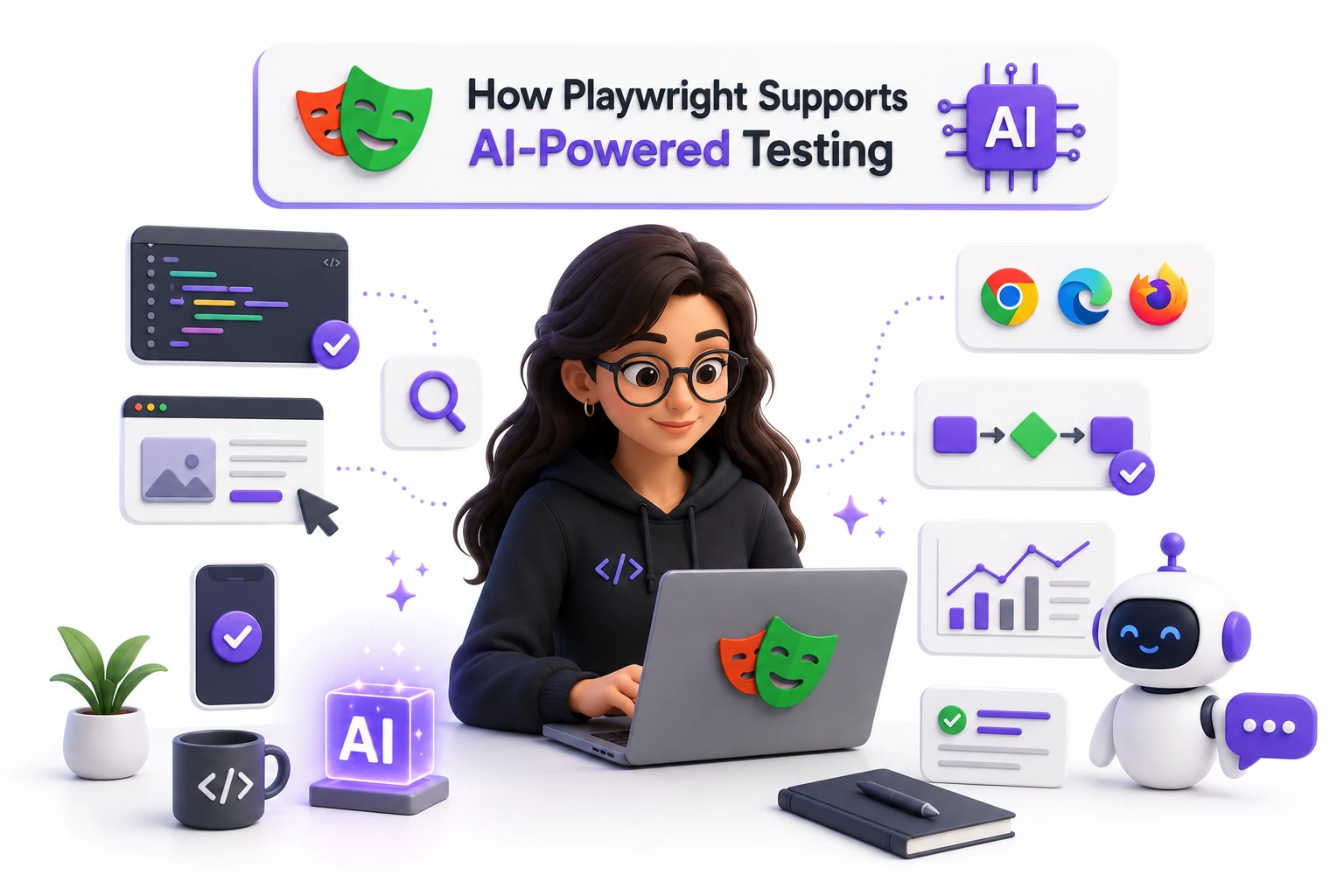
Artificial Intelligence (AI) is transforming software development, and software testing is no exception. Modern testing teams are increasingly using AI to generate test cases, identify bugs, analyze test results, optimize test execution, and even create automation scripts automatically. While Playwright itself is not an AI testing tool, it provides a modern foundation that works exceptionally well with AI-powered testing solutions. This is one of the key reasons why many experts believe Playwright will play a major role in the future of software quality engineering.
1. AI-Powered Test Case Generation with Playwright
Learn how AI tools can analyze requirements, user stories, and application workflows to automatically generate Playwright test cases, helping teams reduce manual effort and improve test coverage.
2. How Playwright Enables Smarter Test Automation
Explore how Playwright's modern architecture, reliable execution engine, and rich debugging capabilities make it an ideal framework for integrating AI-driven testing solutions.
3. Self-Healing Automation: AI and Playwright Working Together
Discover how AI can automatically detect locator changes, repair broken test scripts, and reduce automation maintenance while leveraging Playwright's robust locator strategies.
4. AI-Assisted Bug Detection and Test Analysis
Understand how AI can analyze Playwright screenshots, logs, trace files, and test reports to identify defects faster, determine root causes, and improve software quality.
5. The Future of Software Testing: AI + Playwright
Learn why the combination of artificial intelligence and Playwright is shaping the future of quality engineering through autonomous testing, natural language automation, and intelligent test execution.
Major Reasons Why Playwright Is the Future of Software Testing
Modern applications are no longer simple websites with a few pages and buttons. They are dynamic ecosystems built with JavaScript frameworks, APIs, cloud services, microservices, and real-time data. Yet many testing approaches were designed for a much simpler era. Playwright entered the market with a different mindset. Instead of adapting old testing concepts to modern applications, it was built specifically for the way software is developed today.
a) Debugging Without the Headache
When tests fail, Playwright provides screenshots, videos, logs, and trace files that show exactly what happened. Finding the root cause becomes much faster and easier.
b) One Framework, Multiple Possibilities
From UI testing and API testing to visual validation and cross-browser testing, Playwright brings multiple testing capabilities into a single framework, reducing tool dependency.
c) Designed for CI/CD Workflows
Modern software development relies on continuous integration and continuous delivery. Playwright integrates seamlessly into these pipelines, helping teams catch issues before they reach production.
d) Cross-Browser Testing Made Simple
Users don't all use the same browser. Playwright allows teams to test Chrome, Edge, Firefox, and Safari-compatible browsers using the same test suite.
e) Built for the Future of Quality Engineering
As software becomes more complex and release cycles become faster, organizations need automation that is scalable, reliable, and intelligent. Playwright checks all these boxes, making it a strong candidate for the future of software testing.
Learning Roadmap for Playwright in 2026
Before writing a single automation script, it's important to understand how software testing works. Manual testing teaches you how to think like a tester and identify issues from a user's perspective.
.webp)
Step 1: Learn Manual Testing First
Start by learning how to create effective test cases that cover both positive and negative scenarios. Understand how defects are reported, tracked, prioritized, and resolved throughout the defect lifecycle.
- Test cases
- Bug reporting
- Defect lifecycle
Step 2: Learn Web Technologies
Learn HTML to understand page structure, elements, forms, tables, buttons, links, and input fields. Study CSS to understand selectors, classes, IDs, styling, and element positioning.
- HTML
- CSS
- JavaScript
Step 3: Learn Programming Basics
Start with fundamental concepts such as variables, data types, operators, loops, conditions, arrays, functions, and exception handling.
- Variables
- Loops
- Functions
- OOP Concepts
Step 4: Learn Playwright Fundamentals
Begin by understanding how to install Playwright and configure your testing environment. Learn how Playwright launches browsers, navigates between pages, performs user actions, and validates application behavior.
- Installation
- Browser interactions
- Locators
- Assertions
Step 5: Learn Automation Framework Development
Learn the Page Object Model (POM), one of the most widely used design patterns in automation testing. It helps separate test logic from page elements, making scripts easier to maintain.
- Page Object Model
- Data-driven testing
- Reporting
- Logging
Step 6: Explore AI-Powered Testing
Modern AI tools can assist with generating test cases, creating Playwright scripts, identifying defects, analyzing failures, and optimizing test execution. AI can also help with self-healing automation by automatically adapting to application changes.
Career Opportunities for Playwright Professionals
As more companies adopt Playwright for modern test automation, the demand for professionals with Playwright skills continues to grow. From startups to large enterprises, organizations are looking for experts who can build reliable automation frameworks, integrate testing into CI/CD pipelines, and support high-quality software delivery.
- QA Engineer
- Software Test Engineer
- Automation Test Engineer
- Senior Automation Engineer
- Playwright Automation Engineer
- Quality Assurance (QA) Analyst
- Quality Engineer (QE)
These are some of the most in-demand career opportunities available for professionals with Playwright automation skills in today's software testing industry. As Playwright adoption continues to grow, these roles are becoming some of the most sought-after positions in Quality Assurance and Test Automation.
Why Choose a Career in Playwright Automation Testing in 2026?
The demand for Playwright professionals is growing rapidly as companies modernize their automation testing strategies. Organizations are increasingly adopting Playwright because it offers faster execution, better reliability, cross-browser support, and seamless integration with modern development practices. For aspiring QA Engineers, Automation Testers, and SDETs, Playwright represents one of the most valuable skills to learn in 2026. As businesses continue to embrace Agile, DevOps, CI/CD, and AI-driven quality engineering, professionals with Playwright expertise are becoming highly sought after.
Benefits of Building a Career in Playwright Testing
- High demand among modern software companies
- Growing adoption across startups and enterprises
- Strong opportunities in Automation Testing and SDET roles
- Future-ready skill aligned with AI-powered testing
- Better support for modern web applications compared to many traditional tools
- Opportunities to work with CI/CD, DevOps, and TestOps environments
- Competitive salary packages for skilled professionals
Conclusion
Playwright is not just another automation tool—it represents the next generation of software testing. Its ability to support modern web applications, provide reliable automation, enable cross-browser testing, integrate with DevOps pipelines, and support future AI-driven testing initiatives makes it one of the strongest testing technologies available in 2026. For beginners entering the software testing industry, learning Playwright can provide a significant career advantage. For experienced automation engineers, adopting Playwright can help future-proof their skills and remain competitive in a rapidly evolving technology landscape.
Related Articles

Can I Learn Software Testing in 3 Months? A 90-Day Learning Roadmap
Learn software testing in 3 months with a 90-day roadmap covering manual testing, test cases, SQL, API testing and automation tools.

Is Software Testing Easy to Learn for Beginners in India
Learn whether software testing is easy for beginners in India, explore essential skills, course modules and career opportunities.

How Can Software Testers Stay Relevant with AI in Testing
Software testers can stay relevant with AI by learning AI tools, automation, prompt skills, data analysis, and modern testing practices.





 +91-8882178896
 +1 (343) 477-0926