

Top 10 Financial Management Skills for CFOs in a Workday-Driven Finance Environment
Table of Contents
I speak with CFOs weekly who are desperate to be "strategic," but are shackled by legacy ERPs, fragmented data silos, and "Excel hell." They spend 80% of their time gathering data and only 20% analyzing it.
Enter the Workday-driven environment. When an organization moves to Workday, it isn’t just swapping software; it’s adopting a "Power of One" data model that fundamentally changes how finance operates. To survive and thrive in this ecosystem, modern CFOs need a specific set of hybrid skills—part financial acumen, part digital fluency.
The Evolving Role of the Modern CFO
The role of the Chief Financial Officer (CFO) has transformed significantly over the last decade. Today’s CFO is no longer limited to book keeping, audits, and compliance. With the rise of cloud-based finance platforms like Workday, CFOs are expected to act as strategic business partners, driving growth, managing risk, and enabling data-driven decision-making.
Modern finance leaders must balance financial accuracy with gracefulness, long-term planning with real-time insights, and compliance with innovation. This blog explores the top 10 financial management skills every CFO needs to succeed in a Workday-driven finance ecosystem and explains how cloud finance technology strengthens these capabilities.
1. Strategic Financial Planning
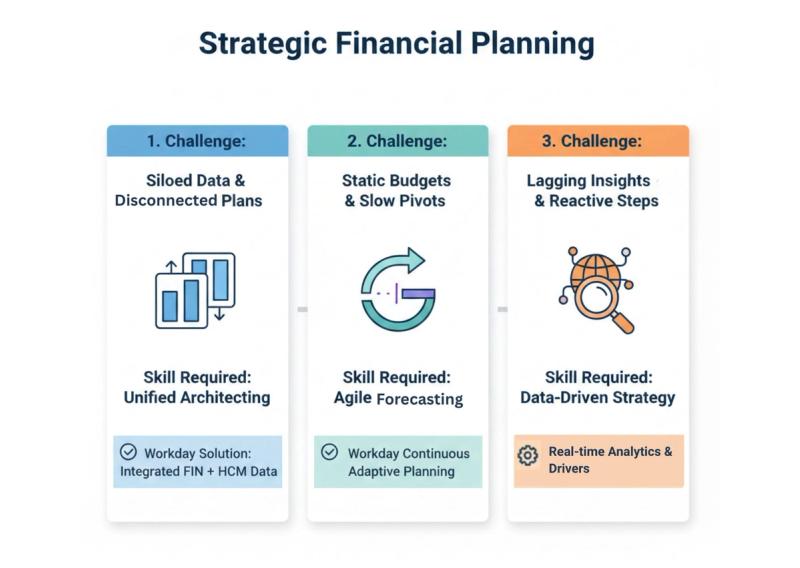
In a cloud-native finance environment, strategic planning transcends annual cycles to become a continuous, pulse-check on corporate health. For the modern CFO, this shift requires a departure from traditional static modeling toward a more fluid, integrated approach that aligns operational drivers with long-term enterprise value.
- The Challenge of Siloed Planning: Finance leaders often struggle with fragmented data sets where headcount planning in HR and capital expenditure in Finance are disconnected, leading to inconsistent forecasts and sluggish strategic pivots.
- The Skill Required: Unified Architecting: CFOs must possess the ability to architect a unified planning model that treats human capital and financial capital as a single, interdependent ecosystem rather than isolated line items.
- The Workday Solution: Workday Financial Management utilizes a unified data core that bridges FIN and HCM data in real-time. This allows CFOs to apply their architecting skills within Workday Adaptive Planning, ensuring that every strategic shift is immediately reflected across all functional dimensions, from cash flow to workforce capacity.
2. Budgeting and Cost Control
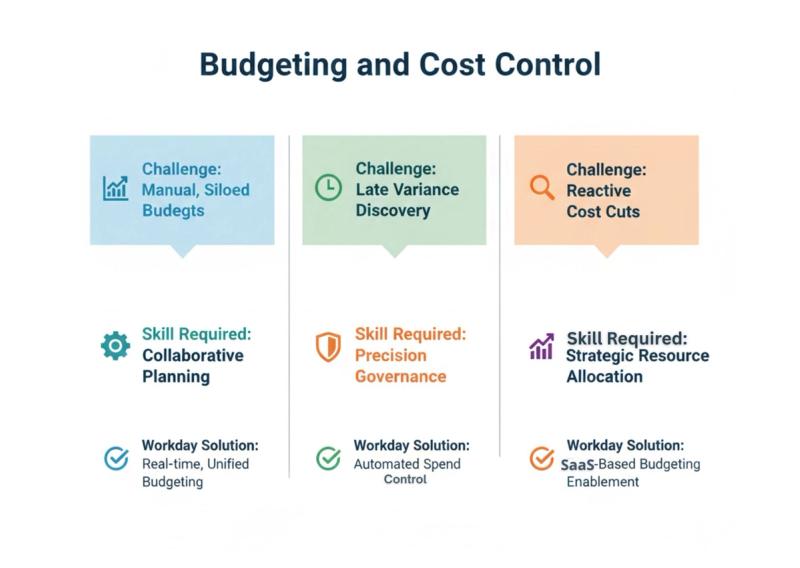
In high-velocity cloud environments, budgeting transitions from a static annual exercise to a dynamic governance framework. For the modern CFO, maintaining fiscal discipline requires shifting from reactive oversight to a proactive, data-driven approach that safeguards margins without stifling operational agility.
- The Challenge of Budget Variance: CFOs frequently face "lagging visibility," where significant overspending is only discovered during month-end reconciliations, making it impossible to implement corrective measures mid-cycle.
- The Skill Required: Precision Governance: Leaders must move beyond high-level monitoring to master the art of granular, real-time fiscal control, allowing them to detect and mitigate spending anomalies before they impact the bottom line.
- The Workday Solution: Workday Financial Management enables this through automated "Spend Control" guardrails. By configuring real-time alerts and hard-stops against live budget data, CFOs empower the system to enforce policy at the point of transaction, ensuring that every dollar spent aligns with the approved financial plan.
3. Financial Forecasting and Predictive Analysis
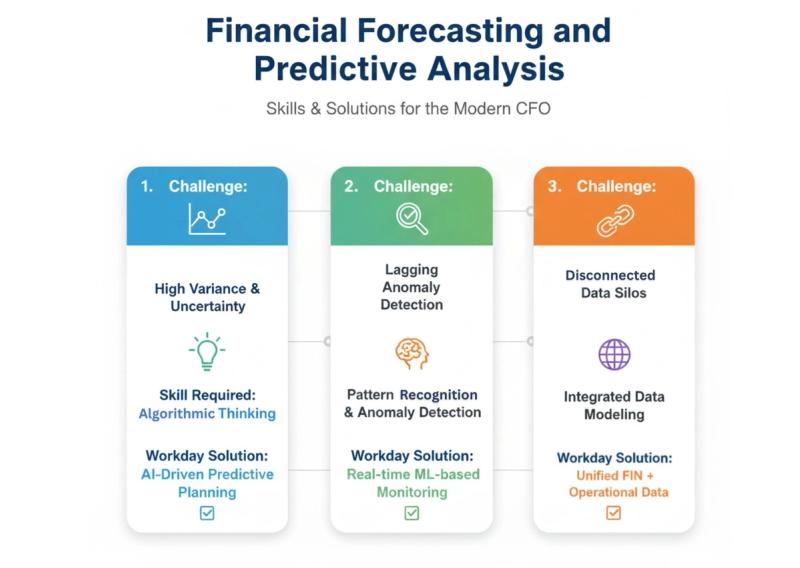
In an era of market volatility, static forecasts have become obsolete. Modern CFOs must leverage cloud-based predictive capabilities to transform financial planning from a reactive historical exercise into a forward-looking strategic compass that anticipates market shifts in real-time.
Challenge: High Variance in Volatile Markets: Traditional forecasting often relies on linear assumptions that fail to account for non-linear market disruptions, leading to significant budget-to-actual variances and missed performance targets.
Skill Required: Algorithmic Thinking: CFOs must develop the ability to interpret machine-learning outputs, moving beyond simple trend lines to understand how complex, multi-dimensional variables influence future financial outcomes.
Workday Solution: Workday Financial Management, integrated with Workday Adaptive Planning, utilizes AI-driven forecasting engines. These tools analyze historical patterns and external drivers to generate automated, high-confidence baseline forecasts, allowing the finance team to focus on investigating anomalies rather than manual data entry.
4. Data-Driven Decision Making
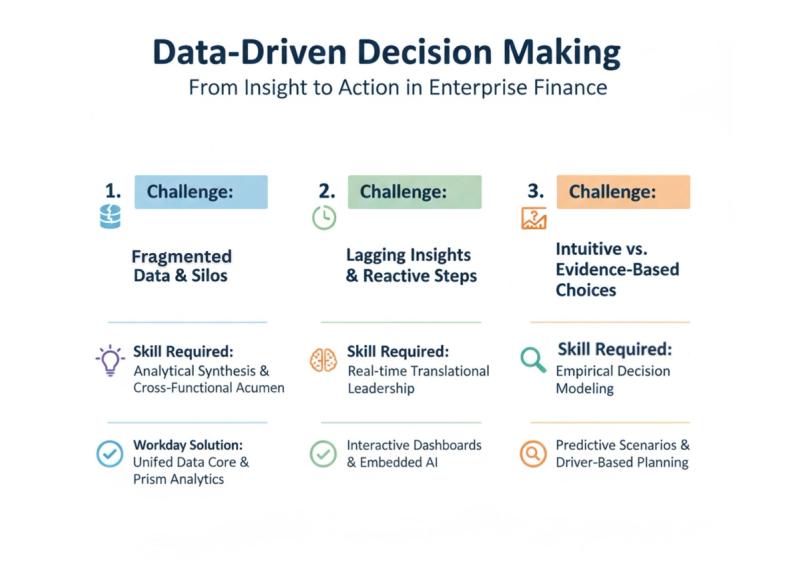
In a cloud-native finance ecosystem, the CFO’s value is defined by the ability to convert vast streams of raw data into executable strategy. Moving beyond intuition, data-driven decision making ensures that capital allocation and operational pivots are backed by empirical evidence and real-time enterprise visibility.
Challenge: Fragmentation of "The Truth" – CFOs often face conflicting reports from Finance, Sales, and HR, leading to decision paralysis or strategic misalignments caused by disconnected data silos and manual reconciliation lags.
Skill Required: Analytical Synthesis – Finance leaders must develop the capability to synthesize cross-functional data points, identifying the underlying financial implications of operational shifts across the entire value chain.
Workday Solution: The Unified Data Core – Workday Financial Management utilizes a single architectural ribbon that joins financial and worker data. This allows CFOs to use Workday Prism Analytics to blend external market data with internal ledgers, providing a comprehensive, real-time basis for high-stakes decisions.
5. Risk Management and Compliance
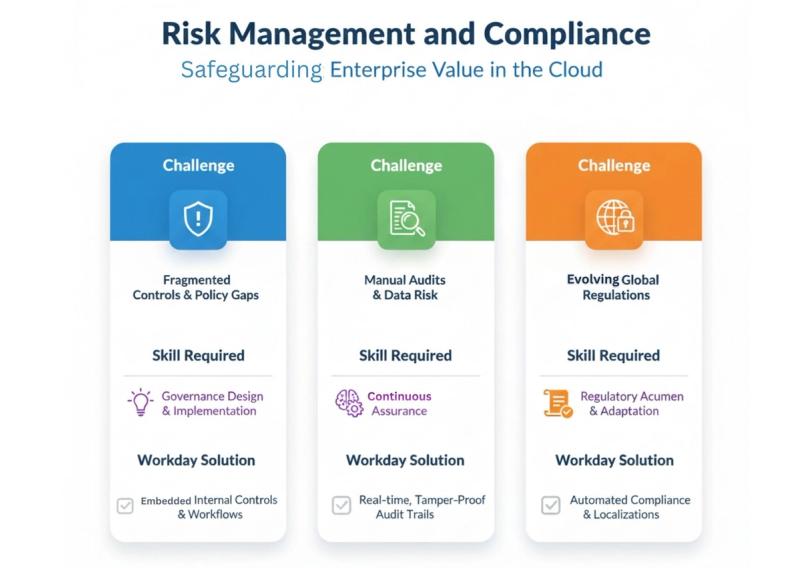
In a decentralized cloud landscape, the CFO’s role as the guardian of enterprise integrity is more complex than ever. Effective risk management now requires a shift from periodic audits to continuous, systemic oversight that embeds compliance directly into the financial operational fabric.
Challenge: Control Gaps in Global Operations – CFOs managing multinational entities often struggle with inconsistent internal controls and "shadow" manual processes that increase the risk of financial misstatements and regulatory non-compliance.
Skill Required: Governance Design – Leaders must possess the expertise to design and implement automated, role-based control frameworks that provide preventive oversight without hindering organizational velocity or cross-border collaboration.
Workday Solution: Embedded Internal Controls – Workday Financial Management facilitates a "closed-loop" audit environment where business processes are hard-wired with segregation of duties. This provides the CFO with a real-time, tamper-proof audit trail, ensuring that global compliance standards are enforced automatically at every transaction level.
6. Cash Flow and Liquidity Management
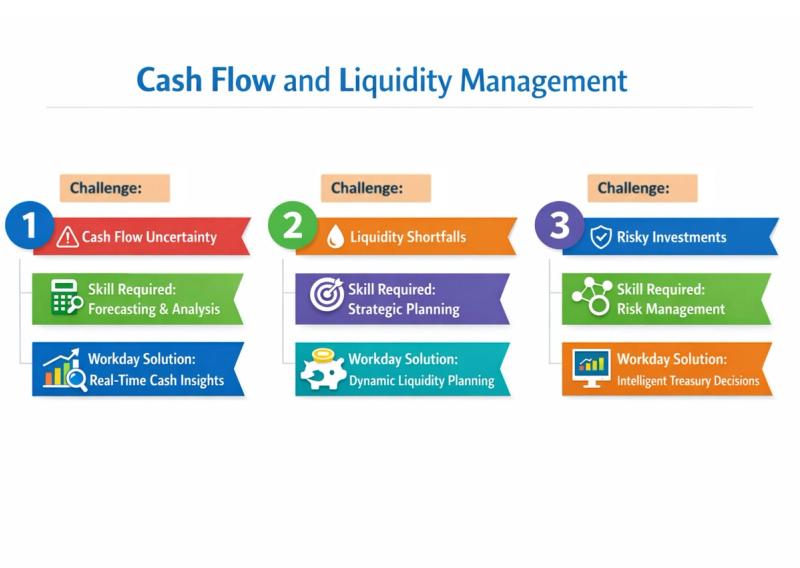
In a volatile global economy, liquidity is the ultimate arbiter of corporate resilience. For CFOs operating in cloud-native environments, moving beyond periodic cash reporting to real-time liquidity orchestration is essential for maintaining the agility needed to fund innovation while mitigating insolvency risks.
Challenge: Fragmentation of Global Cash Positions – CFOs managing international entities often struggle with "trapped cash" and delayed visibility into bank balances, leading to inefficient borrowing costs and missed opportunities for short-term investment.
Skill Required: Dynamic Capital Mobilization – Finance leaders must possess the treasury expertise to analyze real-time liquidity ratios and velocity, allowing them to optimize working capital across diverse currencies and jurisdictions.
Workday Solution: Integrated Cash Hub – Workday Financial Management provides a direct API-based connection to global banking partners, offering a "single pane of glass" view of liquidity. This enables CFOs to use Workday Cash Management to automate settlement processes and forecast daily cash positions with surgical precision.
7. Accurate Financial Reporting
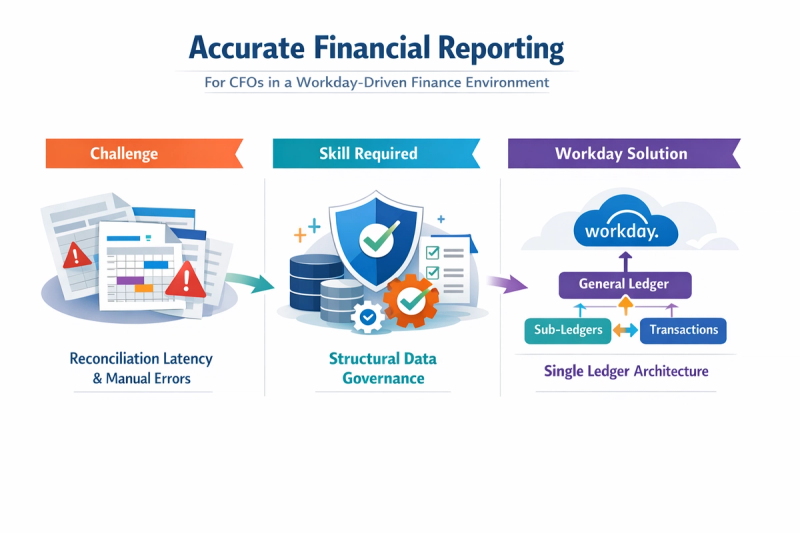
In a cloud-driven finance ecosystem, reporting accuracy is the cornerstone of market trust and regulatory compliance. Modern CFOs must transition from manual reconciliation to a "continuous accounting" mindset, ensuring that financial statements are not just periodic snapshots but a real-time, high-fidelity reflection of enterprise performance.
Challenge: Reconciliation Latency and Manual Errors – Organizations often face "reporting lag" due to disconnected sub-ledgers, forcing teams to perform manual spreadsheet reconciliations that increase the risk of material misstatements during the month-end close.
Skill Required: Structural Data Governance – CFOs need the expertise to design standardized accounting rules and dimensional frameworks that ensure data integrity at the point of entry, eliminating the need for downstream cleanup.
Workday Solution: The Single Ledger Architecture – Workday Financial Management utilizes a unified data model where transactions, sub-ledgers, and the general ledger coexist. This eliminates the need for external reconciliations and provides a "drill-back" capability from any consolidated report directly to the source transaction, ensuring absolute audit-readiness.
8. Cross-Functional Collaboration
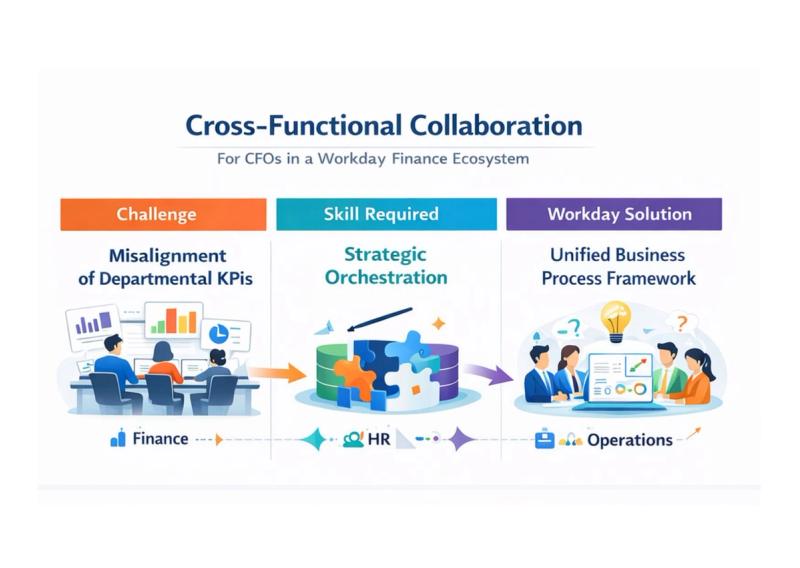
In a cloud-native finance environment, the CFO acts as a strategic navigator, requiring seamless alignment between disparate business units. Effective collaboration ensures that financial guardrails are not viewed as roadblocks but as shared intelligence that drives collective performance across the entire enterprise.
Challenge: Misalignment of Departmental KPIs – Finance and operational leaders often operate with conflicting data sets, leading to friction during budget cycles—such as HR planning for growth that the current financial forecast cannot support.
Skill Required: Strategic Orchestration – CFOs must possess the ability to align functional leaders around a unified financial narrative, translating complex fiscal targets into operational drivers that resonate with non-finance stakeholders.
Workday Solution: Unified Business Process Framework – Workday Financial Management breaks down silos by integrating Finance, HCM, and Operations on a single platform. This allows for collaborative "self-service" dashboards where department heads see the real-time financial impact of their operational decisions, fostering a culture of shared accountability.
9. Technology and Cloud Finance Expertise
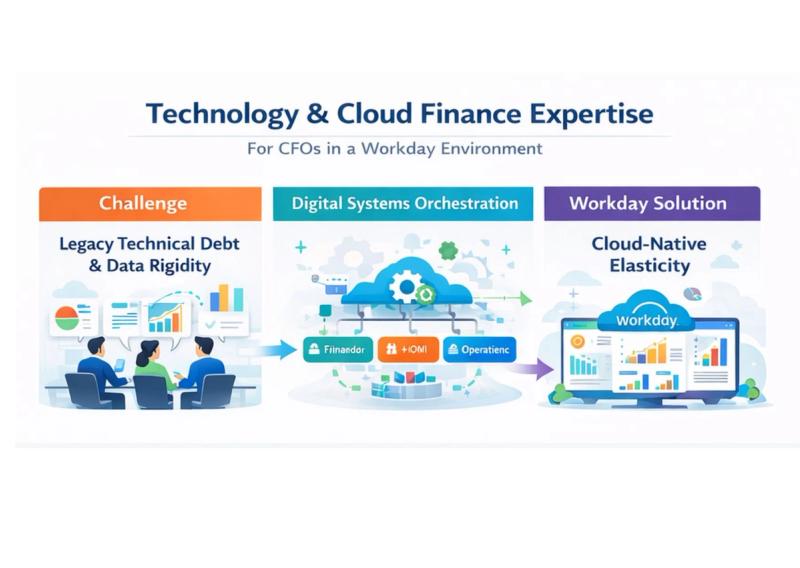
In the digital-first era, the CFO is no longer just a financial custodian but a key architect of the enterprise technology stack. Mastery of cloud-native finance is essential to move beyond legacy maintenance costs and embrace a scalable infrastructure that supports rapid growth and real-time operational visibility.
Challenge: Legacy Technical Debt and Data Rigidity – Many CFOs are burdened by on-premise systems that require manual patches, expensive hardware maintenance, and lack the flexibility to integrate with modern third-party fintech ecosystems.
Skill Required: Digital Systems Orchestration – Finance leaders must understand how cloud architecture facilitates "continuous innovation," allowing them to design a modular finance stack that scales without increasing technical complexity or headcount.
Workday Solution: Cloud-Native Elasticity – Workday Financial Management operates on a true multi-tenant cloud architecture. This provides the CFO with automatic twice-yearly updates, ensuring the organization always has access to the latest AI and security features without the need for manual, disruptive upgrades.
10. Leadership and Financial Communication
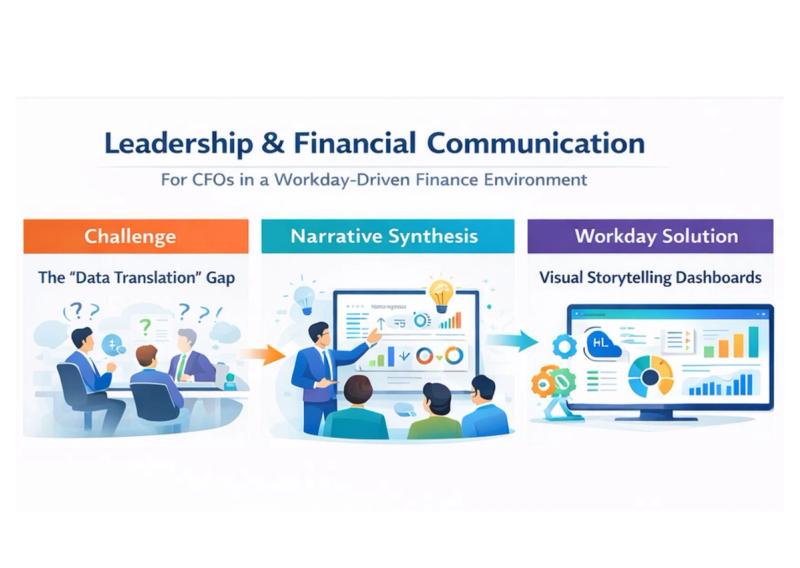
In a digital-first economy, the CFO’s primary role has pivoted from "data provider" to "strategic storyteller." In a Workday-driven environment, leadership effectiveness is defined by the ability to translate real-time financial transparency into a compelling narrative that aligns diverse stakeholders with the organization’s long-term value creation goals.
Challenge: The "Data Translation" Gap – Finance leaders often struggle to communicate complex fiscal metrics to non-finance department heads, leading to a lack of strategic buy-in and a disconnect between corporate targets and operational behavior.
Skill Required: Narrative Synthesis – CFOs must possess the ability to distill vast quantitative insights into actionable business stories, explaining the "why" behind the numbers to drive cross-functional alignment and rapid organizational response.
Workday Solution: Visual Storytelling Dashboards – Workday Financial Management empowers leaders with interactive, persona-based discovery boards. This allows the CFO to present live, visual data to the Board and Business Unit heads, fostering a culture of "self-service" transparency where stakeholders can see the direct impact of their decisions on the P&L.
The Role of TechPratham as an Online Workday Training Institute
As demand for Workday-skilled finance professionals continues to grow globally, structured and practical online training has become essential. TechPratham is an online training institute that specializes in Workday training, helping finance professionals and CFO aspirants build relevant, job-ready skills without geographical limitations.
Why TechPratham Is Relevant in the Workday Ecosystem
TechPratham focuses on delivering online Workday training that aligns with real enterprise finance requirements. The training approach is designed to help learners understand not only how Workday works, but also how CFOs and finance teams actually use Workday in real business scenarios.
Instead of limited theoretical explanations, TechPratham emphasizes:
- Practical understanding of Workday Finance concepts
- Exposure to real-time reporting, planning, and analytics use cases
- Skill development aligned with modern CFO responsibilities
As an online Workday training institute, TechPratham offers several advantages for working professionals:
- Flexible online learning, suitable for finance professionals and managers
- Training focused on cloud-based finance processes used in Workday
- Emphasis on financial planning, forecasting, reporting, and analytics
- Learning structure aligned with current industry expectations
Conclusion:
CFO Success in the Cloud Finance Era
In today’s competitive and technology-driven environment, CFO success depends on a combination of strong financial management skills and the effective use of cloud platforms like Workday. From strategic planning and forecasting to risk management and leadership communication, each skill plays a vital role in organizational growth.
Finance professionals who invest in developing these skills—and enhance them through structured learning platforms like TechPratham—are better positioned to lead confidently in a Workday-driven finance ecosystem.