Top 65 ServiceNow IT Asset Management (ITAM) Interview Questions and Answers for 2026
Table of Contents
Preparing for ServiceNow IT Asset Management (ITAM) interviews requires a strong understanding of asset lifecycle processes, software compliance, cloud optimization, CMDB relationships, and real-time business scenarios. As organizations continue to adopt ServiceNow to improve operational efficiency, the demand for skilled ITAM professionals is rapidly increasing. This guide covers the most important ITAM, HAM, and SAM interview questions and answers that help candidates demonstrate practical knowledge, technical expertise, and hands-on experience. Whether you are a fresher or an experienced asset manager, these answers will help you confidently crack interviews and excel in ServiceNow ITAM roles.
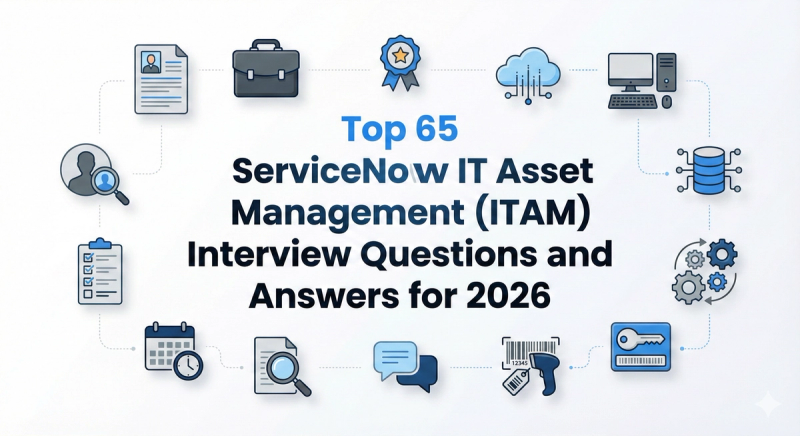
Top 65 ServiceNow IT Asset Management (ITAM) Interview Questions and Answers for 2026
1. What is IT Asset Management (ITAM) in ServiceNow?
IT Asset Management (ITAM) in ServiceNow is a centralized solution for tracking, controlling, and optimizing IT assets across their lifecycle. It manages hardware, software, cloud, and mobile assets from procurement to retirement. ITAM improves visibility, reduces costs, and ensures compliance. It enables organizations to make data-driven asset decisions.
2. How does ITAM integrate with IT Service Management (ITSM)?
ServiceNow ITAM integrates with ITSM by linking asset records with incidents, requests, and changes. This ensures accurate asset details during issue resolution and service delivery. It improves troubleshooting efficiency and reduces downtime. The integration enhances service quality and operational transparency.
3. Can ITAM help in tracking software license compliance?
Yes, ITAM plays a crucial role in tracking and managing software license compliance. It monitors license usage versus entitlement to prevent under-licensing and over-purchasing. Automated compliance reporting reduces audit risks and penalties. ITAM ensures organizations stay legally compliant and cost-efficient.
4. What is the role of CMDB in IT Asset Management?
The CMDB stores configuration and relationship details of assets managed by ITAM. It acts as a single source of truth for asset status, ownership, and dependencies. With accurate data, organizations can assess impacts, manage risks, and plan effectively. CMDB drives better decision-making across IT operations.
5. How does ITAM handle hardware asset management?
ITAM manages hardware assets from purchasing, deployment, maintenance, and repair to final disposal. It keeps real-time visibility of location, status, and ownership. Automated workflows track lifecycle actions and improve accountability. Accurate asset tracking prevents loss, theft, and unnecessary purchases.
6. What is the significance of Software Asset Management (SAM)?
Software Asset Management (SAM) optimizes software usage by analyzing consumption, licenses, and contracts. It reduces overspending and minimizes compliance violations. SAM improves vendor negotiations with accurate data insights. It supports digital transformation and strategic IT planning.
7. How does ITAM help in cloud cost management?
ITAM tracks cloud usage, spending patterns, and resource allocation across environments. It identifies unused or oversized resources to reduce operational costs. ITAM ensures cloud assets align with business needs and budgets. It improves financial predictability and governance.
8. What are Publisher Packs in Software Asset Management?
Publisher Packs provide predefined rules, normalization data, and license models for major software vendors. They automate compliance calculations and entitlement mapping. These packs simplify complex licensing structures. They improve accuracy and speed for software audit readiness.
9. How does ServiceNow normalize software assets?
ServiceNow normalizes software assets by standardizing product names, versions, and manufacturers. It removes duplicates and organizes messy raw discovery data. Normalization improves license reconciliation accuracy. It ensures precise reporting and compliance visibility.
10. What are the key phases in the IT asset lifecycle?
The key phases include planning, procurement, receipt, deployment, maintenance, and retirement. Each phase tracks financial, contractual, and physical details of assets. This lifecycle management improves transparency and cost control. It ensures assets deliver maximum value throughout usage.
11. How does ITAM help in handling software audits?
ITAM automates audit preparation by providing accurate license, usage, and entitlement data. It identifies compliance gaps early to prevent penalties and security risks. Centralized reporting supports faster and stress-free audit responses. It increases transparency and builds trust with software vendors.
12. What is the Hardware Asset Workspace?
The Hardware Asset Workspace is a unified interface in ServiceNow to manage physical asset lifecycle activities. It offers dashboards, tasks, and workflows for tracking hardware performance. It improves visibility into stock, allocations, and costs. The workspace supports real-time decisions and operational efficiency.
13. How does ITAM automate hardware lifecycle management?
ITAM automates lifecycle stages such as request, procurement, deployment, maintenance, and retirement. Automated workflows trigger updates, tasks, and notifications. This eliminates manual tracking errors and increases productivity. Automation ensures every asset is accounted for from start to end.
14. How does ServiceNow track SaaS subscription usage?
ServiceNow tracks SaaS usage by integrating with identity providers and usage APIs. It monitors user activity, subscription counts, and feature consumption. This helps identify unused or redundant licenses. ITAM reduces SaaS wastage and improves cost optimization.
15. How does ITAM improve IT operations management (ITOM)?
ITAM supports ITOM by providing accurate asset data and lifecycle visibility. It enables proactive monitoring and reduces service outages. CMDB and discovery integrations reveal asset relationships and impacts. ITOM decisions become faster, more reliable, and data-driven.
16. What is the role of ITAM in vulnerability management?
ITAM identifies vulnerable assets by linking lifecycle and configuration data with security findings. It helps prioritize remediation based on asset criticality and usage. Integration with SecOps accelerates risk resolution. Strong asset visibility reduces exposure to cyber threats.
17. Can ITAM predict future software costs?
Yes, ITAM uses usage data, renewal cycles, and trend analytics to forecast software spending. Predictive insights help plan budgets more accurately. It prevents overspending and unexpected cost spikes. Forecasting supports strategic procurement and optimization.
18. How does ITAM help with contract management?
ITAM tracks software and hardware contracts, including renewals, warranties, and performance. Automated alerts prevent missed renewals and financial penalties. It ensures vendor compliance and negotiation advantage. Centralized contract records improve transparency and governance.
19. What are Asset Tasks in ServiceNow?
Asset Tasks are workflow-driven actions assigned during asset lifecycle processes. They include receiving, deploying, repairing, or retiring assets. Tracking tasks increases accountability and operational accuracy. Asset tasks improve efficiency and ensure proper governance.
20. How does ServiceNow handle asset inventory audits?
ServiceNow automates audit scheduling, assignment, physical verification, and reconciliation. It compares actual versus recorded asset data to detect discrepancies. Real-time audit reports improve decision-making. Automated audits ensure compliance and accurate inventory tracking.
21. What is the License Workbench?
The License Workbench is a centralized area to manage license consumption, entitlements, and compliance status. It provides real-time alerts and reconciliation results. The tool supports optimization and reduction of unnecessary license costs. It strengthens audit readiness and financial accountability.
22. How does ITAM contribute to IT risk management?
ITAM reduces risks by tracking asset ownership, location, utilization, and compliance. It identifies unauthorized or unsupported assets that pose threats. Integration with SecOps accelerates remediation. Strong asset governance reduces business and security risk.
23. What is the benefit of automating asset retirement?
Automated retirement ensures obsolete assets are securely wiped, tracked, reclaimed, or disposed. It prevents data leakage and unnecessary maintenance spending. The process recovers reusable components and reduces waste. Automation ensures audit trails and regulatory compliance.
24. How does ServiceNow normalize hardware assets?
ServiceNow standardizes hardware model names, categories, and manufacturers. Normalization eliminates duplicates and improves CMDB consistency. It enhances reporting accuracy and asset planning. Clear visibility reduces confusion and management delays.
25. Can ITAM integrate with financial management?
Yes, ITAM integrates with financial management to track asset cost, depreciation, and budgeting. It improves financial planning and cost transparency across IT operations. Integration supports chargeback and cost allocation models. Organizations gain complete financial visibility across asset lifecycles.
26. What are the risks of unmanaged IT assets?
Unmanaged IT assets lead to wasted spending, security vulnerabilities, and shadow IT. They create compliance failures due to unknown licensing and ownership. Visibility gaps increase operational and financial risk. Poor tracking results in unexpected outages and audit penalties.
27. How does ITAM support cloud governance?
ITAM establishes control over cloud usage, spending, and security by tracking resource allocation. It prevents unauthorized cloud services and overspending. Governance improves compliance with corporate and regulatory policies. It ensures cloud adoption is safe, optimized, and accountable.
28. What are some real-time scenarios where ITAM is useful?
ITAM helps when onboarding new employees, performing software audits, or recovering assets after employee exits. It supports cost reduction by identifying unused licenses. ITAM assists during hardware refresh cycles and warranty claims. Real-time visibility prevents service disruption.
29. How does ServiceNow automate software procurement?
Software procurement workflows automate requests, approvals, purchasing, and delivery. ITAM validates entitlements and ensures licenses are available before purchase. Integration with vendors reduces manual processing and delays. This improves forecast accuracy and spend control.
30. How does ITAM help in sustainability?
ITAM promotes sustainability by optimizing equipment reuse and extending asset lifecycle. It prevents unnecessary purchasing and reduces electronic waste. Accurate tracking supports recycling compliance. Sustainability contributes to cost efficiency and corporate responsibility.
31. How does ITAM ensure software entitlements are managed properly?
ITAM compares entitlement contracts against actual usage to maintain compliance. Automated reconciliation highlights gaps and savings opportunities. Centralized entitlement records prevent overspending and legal penalties. It ensures transparency during vendor negotiations.
32. What is the role of Software Spend Detection in ITAM?
Software Spend Detection analyzes financial data to identify hidden or unmanaged software expenses. It discovers shadow IT and redundant subscriptions. The insights help reduce waste and optimize budgets. Organizations gain full visibility of license spending.
33. How does ITAM assist in aligning end-of-life (EOL) hardware with business goals?
ITAM identifies assets approaching end-of-life and plans replacements proactively. It reduces failures, downtime, and compatibility issues. Strategic refresh cycles support capacity and performance requirements. EOL planning aligns with budget and project strategy.
34. What challenges do organizations face in cloud asset management?
Organizations struggle with tracking consumption, cost unpredictability, and resource sprawl. Lack of visibility causes overspending and governance issues. Complex pricing models make budgeting difficult. ITAM solves these challenges with automated monitoring and optimization.
35. How does ITAM automate software normalization?
ITAM standardizes product names, versions, and vendors using automated rules. It cleans raw discovery data to enable accurate reporting. Normalization supports compliance and license reconciliation. Automation ensures scalable and repeatable asset control.
36. What is the benefit of integrating ITAM with HR Service Delivery (HRSD)?
Integration automates device and access assignment during onboarding and offboarding. It ensures employees receive required hardware and software quickly. Returned assets are tracked efficiently during exits. This improves productivity, security, and lifecycle visibility.
37. What is a major cost-saving benefit of ITAM in cloud environments?
ITAM identifies unused instances, oversized resources, and redundant subscriptions. Optimization significantly reduces monthly cloud bills. Automated rightsizing aligns spending with usage. Better visibility prevents budget overruns.
38. What security benefits does ITAM provide?
ITAM detects unauthorized or outdated assets that may contain vulnerabilities. It supports rapid remediation through asset ownership tracking. Visibility reduces risks from lost or stolen devices. Secure asset governance strengthens cyber-resilience.
39. How does ITAM support asset lifecycle visibility?
ITAM provides end-to-end tracking from procurement to retirement. Dashboards show status, performance, and financial details. Visibility enables smarter decision-making and resource planning. It eliminates guesswork and operational blind spots.
40. How does ServiceNow’s Hardware Asset Management improve asset tracking?
HAM automates asset updates, location tracking, and assignment changes. Scanning and stockroom management improve accuracy. Real-time data prevents asset loss and duplication. It increases accountability and operational efficiency.
41. What happens when an IT asset is retired in ServiceNow?
The asset status is changed to retired and removed from active inventory. It triggers tasks like data wiping, reclaiming parts, or disposal. Financial and compliance records are updated automatically. Retirement ensures secure and responsible closure.
42. How does ITAM integrate with SecOps?
ITAM shares asset ownership, lifecycle stage, and configuration data with SecOps. It helps prioritize vulnerabilities based on business criticality. Integration accelerates threat response and root cause analysis. Security and asset teams collaborate more effectively.
43. What is the purpose of the Software Asset Workspace?
The Software Asset Workspace provides a unified view of compliance, usage, and optimization actions. It simplifies reconciliation and license decision-making. Automated dashboards highlight savings opportunities. It improves audit readiness and governance.
44. How does ITAM improve employee onboarding?
ITAM automates provisioning of required devices and software on day one. Standardized workflows ensure fast setup and productivity. It tracks assigned assets and ownership records. Efficient onboarding boosts user satisfaction and reduces delays.
45. What is the significance of asset normalization?
Normalization standardizes naming and classification of hardware and software assets. It removes inconsistencies and duplicates in inventory data. It improves CMDB accuracy and reporting reliability. Normalization strengthens compliance and lifecycle management.
46. How does ITAM integrate with Change Management?
ITAM links assets to change requests to assess impact and risk. Accurate relationships prevent failures during system updates. Integration ensures proper approvals and documentation. It improves change success rates and service stability.
47. Can ITAM be used for non-IT assets?
Yes, ITAM can manage facilities, furniture, lab equipment, and industrial machines. It extends lifecycle tracking and cost reporting beyond IT. Organizations gain centralized visibility across all critical assets. It supports enterprise-wide governance.
48. What are the key ITAM dashboards available in ServiceNow?
Dashboards include hardware usage, software compliance, cost insights, cloud consumption, and audit readiness. Real-time analytics improve operational decisions. They highlight risks, savings, and lifecycle progress. Dashboards provide data-driven visibility.
49. What is the importance of an ITAM self-service portal?
A self-service portal allows users to request hardware, software, replacements, and returns. It reduces support workload and speeds delivery. Automated approvals improve efficiency and transparency. It enhances employee experience and governance.
50. How does ITAM help in reducing IT costs?
ITAM reduces costs by optimizing asset usage and eliminating duplicates and unused resources. License and cloud optimization prevent overspending. Visibility improves budgeting and resource planning. Cost control becomes predictable and strategic.
Interview Experience & Practical Skill Questions
51. Can you describe your experience and responsibilities as an asset coordinator?
As an asset coordinator, I managed hardware and software lifecycle tracking, inventory accuracy, and procurement support. I handled onboarding/offboarding and coordinated audits with cross-functional teams. Ensured compliance and optimized resource utilization. Supported automation projects to improve operational control.
52. How do you track and manage hardware assets in an organization?
Hardware assets are tracked using barcode scanning, discovery tools, and lifecycle workflows. Regular audits validate location and ownership accuracy. CMDB integration provides relational visibility. Reporting helps control costs and reduce asset loss.
53. Can you explain the integration of ServiceNow with procurement systems?
ServiceNow integrates with procurement systems through APIs and workflow automation. Purchase orders, receipts, and financial data sync automatically. Integration accelerates purchasing and prevents duplicate orders. It improves accuracy and cost control.
54. Can you explain the importance of the CMDB in ServiceNow?
CMDB stores configuration items and relationships that support ITAM, ITSM, and ITOM processes. It improves decision-making during incidents, changes, and audits. Accurate data reduces risk and service downtime. CMDB is the foundation of visibility and governance.
55. How do you handle asset compliance?
Compliance is managed by tracking entitlements, contractual terms, and usage data. Automated reconciliation identifies gaps and violations. Regular audits and reporting ensure adherence to policies. Compliance reduces legal and financial risk.
56. What methods do you use to ensure accurate asset tracking?
Methods include automated discovery, barcode scanning, stockroom updates, and periodic audits. Ownership assignment improves accountability. Real-time reporting ensures accuracy and visibility. Data governance rules maintain reliability.
57. How do you handle discrepancies in asset inventory?
Discrepancies are investigated through audit comparison, reassignment checks, and physical verification. Missing assets trigger incident or recovery tasks. Root cause analysis prevents repeat issues. Final adjustments ensure accurate system records.
58. Describe your experience with ServiceNow workflows and automation for asset management.
I have used automation for procurement, assignment, transfers, repairs, and retirement workflows. Automated tasks reduce manual effort and errors. Integration with CMDB enhances lifecycle tracking. Workflow automation increases efficiency and transparency.
59. How do you ensure compliance with asset management policies?
Compliance is ensured through documented standards, lifecycle processes, and system-based controls. Audits verify accuracy and policy adherence. Automated alerts prevent violations and policy gaps. Training and reporting reinforce governance.
60. What tools and software have you used for asset management?
Tools include ServiceNow HAM/SAM, SCCM, Intune, JAMF, Lansweeper, and barcode systems. They support discovery, license management, and lifecycle automation. Reporting tools help monitor inventory and cost performance. Integrated platforms improve visibility and control.
61. Describe a challenging situation you faced in asset management and how you resolved it.
I faced a large discrepancy during an annual hardware audit due to outdated tracking. I performed root cause analysis, cross-checked stockrooms, and implemented scanning automation. Reconciliation reduced variance by over 90%. It strengthened accuracy and process reliability.
62. Can you explain the concept of asset depreciation?
Asset depreciation is the reduction in value of hardware or equipment over its useful life. It helps calculate financial worth and replacement planning. ITAM tracks depreciation for budgeting and accounting accuracy. It supports asset lifecycle optimization.
63. How do you handle asset-related incidents or change management in ServiceNow?
Asset-related incidents and changes are linked to CI records to assess impact. Workflows track approvals, repairs, and replacements. Asset data improves resolution speed. Integration ensures ownership, history, and accountability.
64. Can you explain the concept of asset normalization?
Asset normalization standardizes manufacturer names, models, and classifications. It removes duplicate and inconsistent records. Normalization improves reporting and audit accuracy. It enhances compliance and lifecycle management reliability.
65. How do you set up and configure ServiceNow HAM/SAM?
Configuration includes enabling plug-ins, setting discovery sources, defining normalization rules, and mapping entitlements. Integration with CMDB and procurement ensures lifecycle visibility. Reconciliation rules provide compliance tracking. Dashboards support optimization and savings.
Tips to Crack ServiceNow ITAM Interviews in 2026
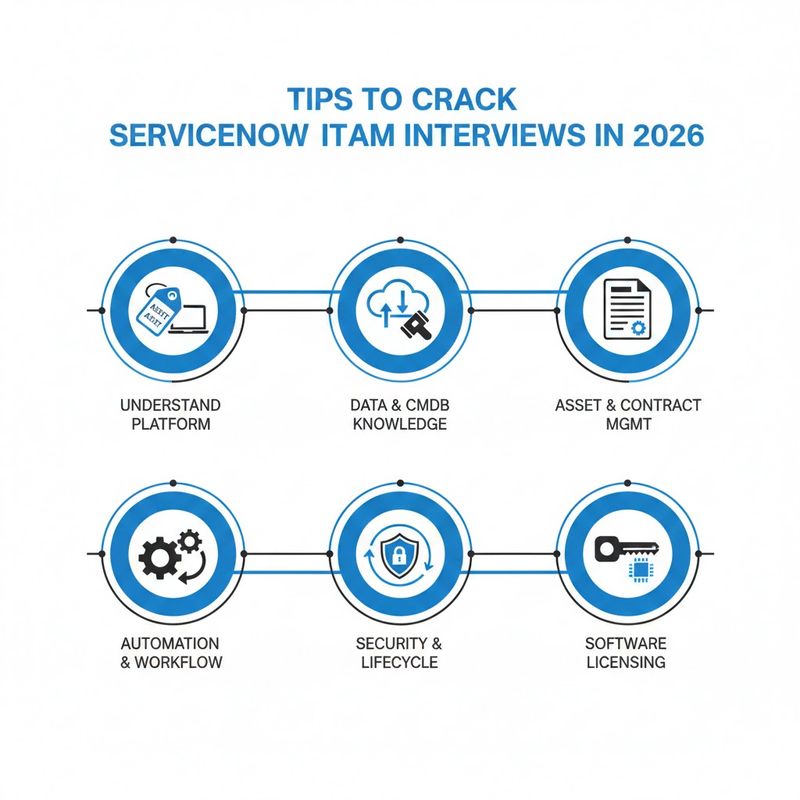
Cracking a ServiceNow ITAM interview in 2026 requires a strong combination of technical proficiency, real-world implementation knowledge, and an understanding of business outcomes. Start by building a solid foundation in ITAM processes, including asset lifecycle management, software compliance, HAM, SAM, CMDB relationships, and cloud cost optimization. Hands-on practice in the ServiceNow platform is essential—use personal instances to explore workflows, asset workspaces, discovery integration, and automation. Interviewers expect candidates to confidently explain real-time scenarios such as onboarding automation, license reconciliation, vendor audits, cloud optimization, and unused asset recovery. Strengthen communication skills to answer questions with structure and clarity, focusing on results, cost savings, and operational improvements. Staying updated with the latest ServiceNow releases, certifications, and platform innovations will help you stand out in a competitive market. With the right preparation strategy, real-world examples, and technical depth, you can successfully secure a ServiceNow ITAM role and grow your career in 2026 and beyond.
Conclusion
Mastering ServiceNow ITAM concepts is essential for building a successful career in asset lifecycle management, software optimization, cloud governance, and IT process automation. By understanding real-world use cases and adopting best-practice methodologies, professionals can contribute to reducing IT costs, improving compliance, and enhancing operational visibility. Consistent learning, platform practice, and staying updated with ServiceNow features will significantly increase your chances of success in upcoming interviews and job opportunities. With the right preparation, you can confidently secure top-level ServiceNow ITAM roles in 2026 and beyond.
Mastering ServiceNow ITAM concepts is essential for building a successful career in asset lifecycle management, software optimization, cloud governance, and IT process automation. By understanding real-world use cases and adopting best-practice methodologies, professionals can contribute to reducing IT costs, improving compliance, and enhancing operational visibility. Consistent learning, platform practice, and staying updated with ServiceNow features will significantly increase your chances of success in upcoming interviews and job opportunities. With the right preparation, you can confidently secure top-level ServiceNow ITAM roles in 2026 and beyond.
Mastering ServiceNow ITAM concepts is essential for building a successful career in asset lifecycle management, software optimization, cloud governance, and IT process automation. By understanding real-world use cases and adopting best-practice methodologies, professionals can contribute to reducing IT costs, improving compliance, and enhancing operational visibility. Consistent learning, platform practice, and staying updated with ServiceNow features will significantly increase your chances of success in upcoming interviews and job opportunities. With the right preparation, you can confidently secure top-level ServiceNow ITAM roles in 2026 and beyond.