
Workday LMS Training Guide 2026: Overview, Features, and Workflows
Table of Contents
Enterprise learning is no longer just about assigning courses—it’s about building skills at scale, tracking compliance in real time, and aligning workforce development with business goals. In 2026, organizations that fail to modernize their learning strategy risk falling behind in productivity, compliance, and employee engagement. This is where Workday Learning (LMS) plays a critical role, offering an integrated, data-driven approach to managing learning within the broader HR ecosystem.
This guide provides a comprehensive overview of Workday LMS, covering its core features, key capabilities, and end-to-end workflows that support both administrators and learners. From course management and learning campaigns to reporting, security, and user experience, this blog breaks down how Workday Learning functions in real enterprise environments and why it has become a strategic component of modern workforce development in 2026.
What is Workday Learning Management System
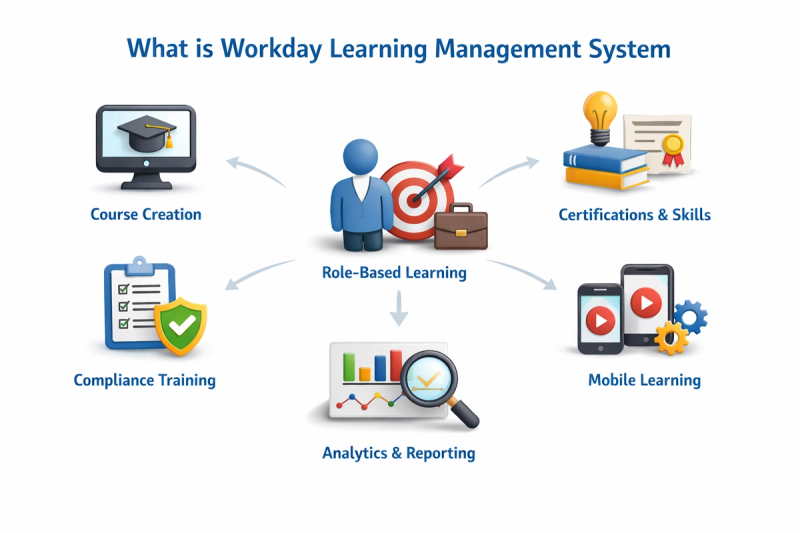
The Workday Learning Management System (Workday LMS) is a modern, cloud-based learning platform built within the Workday ecosystem to manage, deliver, and track employee learning in one centralized system. It allows organizations to create and organize courses, learning programs, and certifications while supporting structured training for onboarding, compliance, and continuous skill development. Because it is part of the Workday platform, learning data stays consistent with core HR information, eliminating the need for external LMS integrations.
A key strength of Workday LMS is its deep alignment with employee roles, job profiles, and career paths. Learning assignments can be automatically triggered based on position, department, performance goals, or regulatory requirements, ensuring employees receive relevant training at the right time. The platform supports multiple learning formats, including instructor-led training, virtual sessions, digital content, and blended learning, providing flexibility for both learners and administrators.
Workday LMS also focuses on learner experience and business insights. Employees can easily discover courses, track progress, and complete training on desktop or mobile devices, while administrators and HR teams gain access to real-time dashboards and reports. With built-in analytics, organizations can measure training effectiveness, monitor compliance, and identify skill gaps, making Workday LMS a strategic tool for workforce development in 2026 and beyond.
How Workday LMS Empowers Modern Enterprises
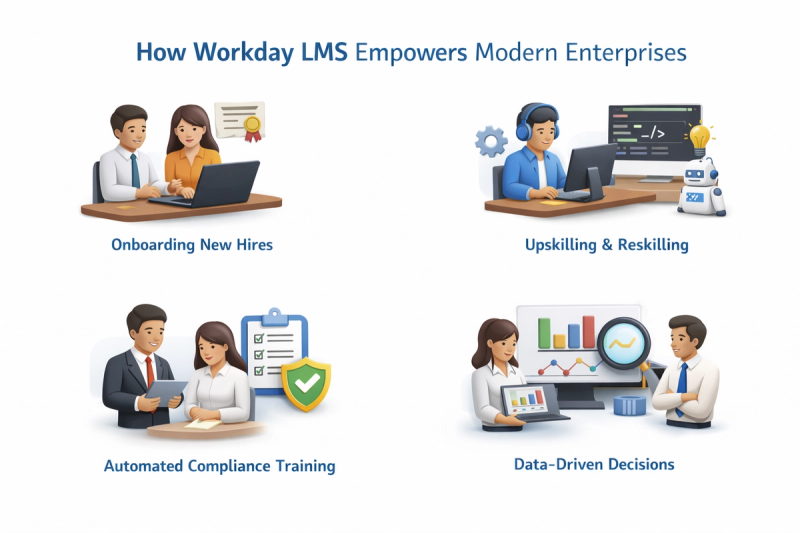
Workday Learning Management System (LMS) transforms how modern enterprises handle growth by embedding education directly into the daily flow of work rather than treating it as a separate chore. Because it is built on the same power source as Workday HCM, the system "knows" an employee’s role, their recent promotion, and their future career goals before they even click a button. This deep integration allows the platform to automatically suggest relevant courses the moment a person changes jobs or locations, creating a frictionless transition that traditional, disconnected systems simply cannot match. By unifying human resources data with learning content, companies ensure that their workforce is always prepared for the next challenge without manual data entry or complex technical bridges.
Beyond simple course hosting, the platform empowers businesses through high-level automation that protects the company from legal and operational risks. Enterprises use Workday LMS to manage complex compliance cycles, setting up automated "campaigns" that track certifications, safety training, and mandatory audits in real-time. Instead of HR managers chasing employees with emails, the system sends personalized notifications and tracks completion rates on live dashboards accessible to leadership. This shift from reactive to proactive management means that a company can prove its workforce is fully certified at any given moment, significantly reducing the administrative burden while increasing overall organizational accountability.
The true strength of Workday LMS lies in its ability to foster a modern, social learning culture that mirrors how we consume information in our personal lives. It moves away from long, boring lectures toward "bite-sized" mobile content and peer-to-peer knowledge sharing, where top performers can record and upload their own expert tips for others to see. This democratic approach to training allows a company to capture internal wisdom that is often lost when experts retire or leave. By providing a centralized, searchable repository of both professional courses and internal insights, the platform ensures that every employee, whether in the office or on the go, has the exact information they need to stay productive and competitive in a rapidly changing market.
Workday LMS vs Other LMS Platforms
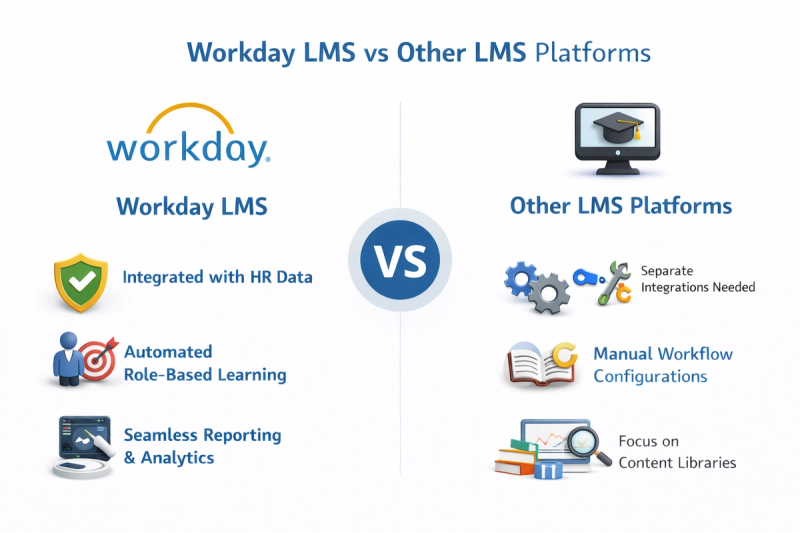
When comparing Workday LMS with other traditional learning management systems (LMS), the most significant advantage lies in its native integration within a unified HR and talent ecosystem. Unlike many standalone LMS platforms that require separate integrations with HR systems, Workday LMS shares the same data model as Workday HCM, ensuring consistent employee records, role definitions, and security permissions across the organization. This integration simplifies learning assignments, reduces data duplication, and enhances the accuracy of reporting, which can be a challenge when using LMS solutions that operate independently from core HR data.
Another differentiator is the automation and role-based learning assignments that Workday LMS offers out of the box. While many external LMS tools allow for custom workflows, they often require manual configuration or additional middleware to align training with job changes, promotions, or performance goals. In contrast, Workday LMS can automatically trigger learning assignments based on real-time HR events such as role changes or onboarding completions. This capability improves operational efficiency and ensures that employees consistently receive relevant and timely training without heavy administrative effort.
However, other LMS platforms may still hold advantages in areas like specialized learning features, marketplace content libraries, or deep learning analytics tailored for academic environments or large-scale e-learning providers. Platforms such as Moodle, Cornerstone, or SAP SuccessFactors Learning may offer robust course marketplaces, advanced instructional design tools, and community-supported extensions that cater to specific use cases. The right choice ultimately depends on organizational needs—for companies that prioritize HR-driven learning, unified data, and simplified administration, Workday LMS stands out; for those needing highly customizable or content-rich learning ecosystems, traditional LMS platforms may still be preferable.
key features of Workday LMS
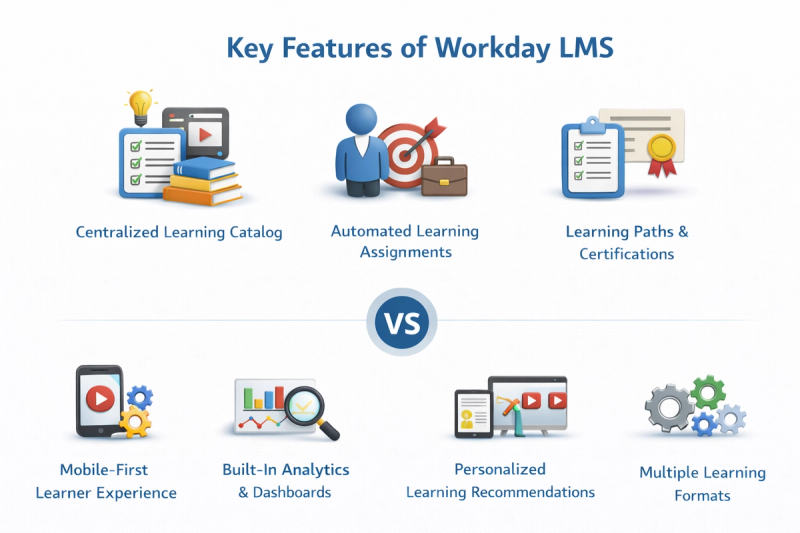
The key features of Workday LMS are built to support modern, skills-focused learning while reducing administrative complexity for HR teams. As part of the Workday ecosystem, Workday LMS allows organizations to deliver structured, role-based training that aligns directly with employee data, job profiles, and business goals. This tight integration ensures learning remains relevant, timely, and easy to manage across the entire workforce.
Workday LMS also emphasizes flexibility, automation, and insights to improve both learner experience and organizational outcomes. Employees can easily discover and complete training, while HR and learning administrators gain visibility into progress, compliance, and skill development through real-time reporting.
Key features of Workday LMS include:
- Centralized learning catalog for managing courses and programs
- Automated learning assignments based on roles and business rules
- Learning paths and certifications to support structured development
- Support for multiple learning formats (digital, virtual, instructor-led)
- Mobile-first learner experience for flexible access
- Built-in analytics and dashboards for tracking learning effectiveness
- Personalized learning recommendations to encourage continuous learning
These features make Workday LMS a strategic learning solution that helps organizations build a skilled, compliant, and future-ready workforce.
Who Should Learn Workday LMS in 2026
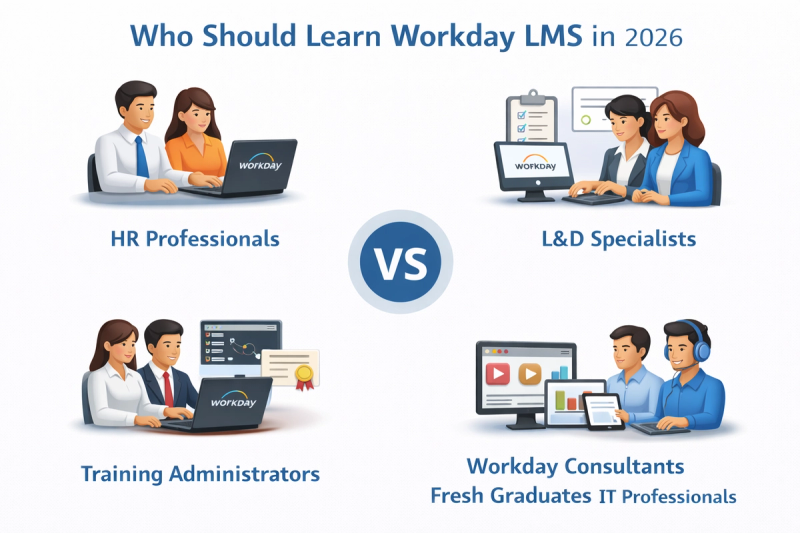
Who should learn Workday LMS in 2026 includes professionals who want to stay relevant in a skills-driven, HR-tech focused job market. HR professionals, learning and development (L&D) specialists, and training administrators benefit the most, as Workday LMS is widely used by enterprises to manage onboarding, compliance, and continuous employee development. Since the platform is tightly integrated with the Workday ecosystem, learning Workday LMS helps these professionals streamline learning operations and align training initiatives directly with workforce data.
Workday LMS is also an excellent choice for Workday functional consultants, fresh graduates, and IT professionals looking to build a career in HR technology. Understanding LMS configuration, learning workflows, and reporting adds strong value to consulting and implementation roles. In 2026, as organizations increasingly focus on upskilling and reskilling employees, professionals with Workday LMS expertise will be in high demand, making it a strategic skill for long-term career growth.
Workday LMS Architecture and Components
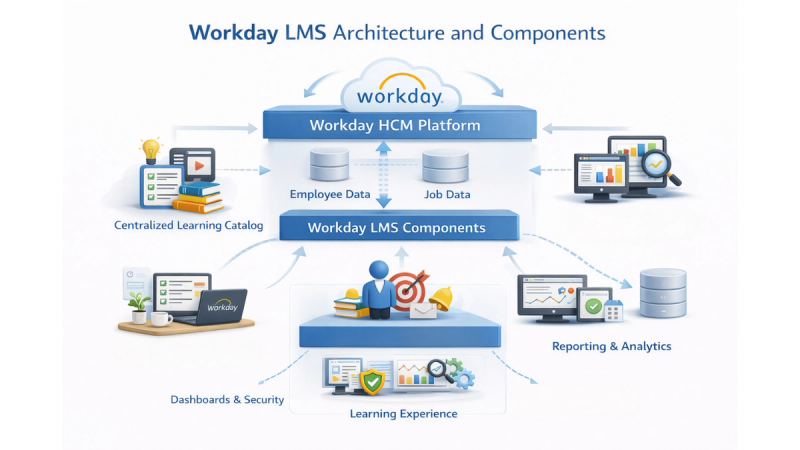
The Workday LMS architecture and components are designed to deliver a unified, scalable learning experience fully embedded within the Workday platform. Unlike standalone LMS tools, Workday LMS shares the same data model as Workday HCM, which means employee information, job roles, security, and organizational structures are all seamlessly connected to learning. This architecture ensures consistent data flow, real-time updates, and secure access while reducing integration complexity and administrative overhead.
Core components of Workday LMS include the learning catalog, course and program management, learning assignments, and notifications. Administrators can define different course types such as digital courses, instructor-led sessions, and blended programs, while automated workflows manage enrollments, approvals, and completion tracking. The reporting and analytics layer provides real-time visibility into learner progress, compliance status, and training effectiveness, enabling HR and learning teams to make data-driven decisions and continuously optimize learning strategies.
Workday LMS Workflows Explained
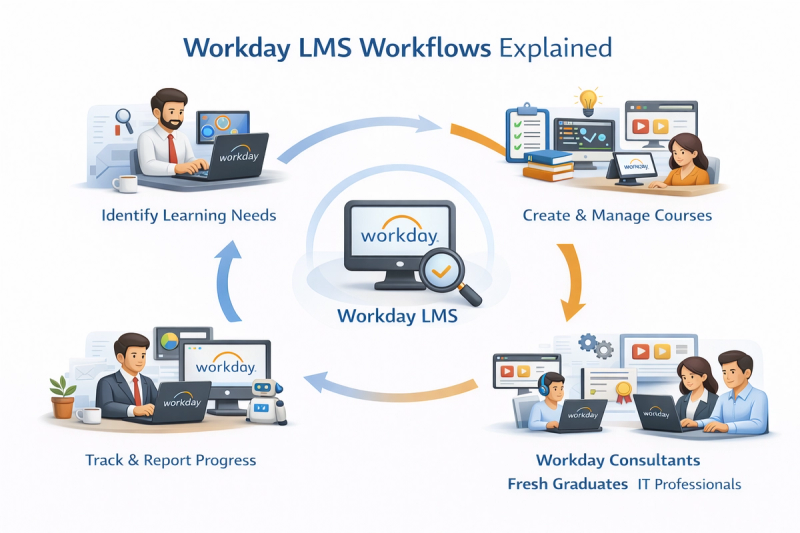
The Workday LMS workflows define how learning activities are created, assigned, completed, and tracked within the Workday ecosystem. These workflows are designed to automate the end-to-end learning lifecycle, ensuring that training is delivered consistently and efficiently across the organization. Because Workday LMS is tightly integrated with employee and job data, workflows automatically adapt to changes such as new hires, role updates, or compliance requirements.
One of the most important workflows is the course creation and assignment process. Learning administrators create courses, programs, or learning paths and define eligibility rules based on roles, departments, or locations. Once published, courses can be automatically assigned or made available in the learning catalog, with notifications sent to learners. Enrollment, approvals, and scheduling for instructor-led or virtual sessions are all managed through structured workflows, reducing manual intervention.
The learner completion and tracking workflow ensures transparency and accountability. Employees complete assigned training, track their progress, and receive certifications or credits upon completion. Workday LMS updates learning records in real time and feeds data into reports and dashboards, allowing HR teams to monitor compliance, measure learning effectiveness, and identify skill gaps. These streamlined workflows help organizations maintain continuous learning while supporting business and regulatory needs.
From Scratch to Advanced: Your Learning Path for workday LMS
Starting with the fundamentals, the Workday LMS journey begins by mastering the learner experience and core administrative functions. For beginners, this means navigating the intuitive Learner Portal to engage with diverse content types—ranging from on-demand digital videos and PDFs to scheduled Instructor-Led Training (ILT). As you progress to an intermediate level, the focus shifts toward strategic management through automated "Campaigns" and compliance tracking. These tools allow administrators to push critical training, such as new hire orientations or safety certifications, to specific groups automatically. By utilizing real-time dashboards, managers gain instant visibility into completion rates, ensuring the organization remains compliant and that no employee falls behind in their professional development.
For those aiming to reach an advanced, consultant-level proficiency, the technical configuration of Workday LMS offers deep control over organizational data and security. Experts utilize the Enterprise Interface Builder (EIB) to execute massive data migrations, seamlessly moving legacy training records into the Workday ecosystem without losing historical integrity. Advanced users also dive into sophisticated data modeling, which connects learning outcomes directly to performance reviews and talent optimization, proving the ROI of training initiatives. By implementing rigorous security best practices, technical leads ensure that sensitive or proprietary intellectual property is only accessible to authorized personnel, creating a secure, high-performance learning environment that scales with the enterprise.
Conclusion
In 2026, learning success is defined by how well organizations connect skills development, compliance, and employee growth with real business outcomes—and Workday LMS delivers exactly that. As part of the unified Workday ecosystem, it goes beyond traditional course management by embedding learning directly into HR processes, job roles, and workforce data. From automated assignments and flexible learning formats to real-time reporting and analytics, Workday LMS enables organizations to manage learning at scale with accuracy and agility.
Whether you are an HR leader modernizing your learning strategy, an organization aiming to build a future-ready workforce, or a professional looking to grow a career in HR technology, Workday LMS stands out as a strategic platform in 2026. Its integrated architecture, intelligent workflows, and focus on continuous learning make it a critical tool for driving employee engagement, ensuring compliance, and supporting long-term workforce development in an increasingly skills-driven world.