

Workday Prism Training for Beginners: Complete Step-by-Step Guide
Table of Contents
Workday Prism Analytics is a powerful data integration and analytics solution that enables organizations to combine Workday data with external sources to generate deeper, more actionable insights. In today’s data-driven environment, businesses depend on accurate and timely information to make strategic decisions across HR, finance, and operations. Through structured data pipelines and datasets, Prism transforms raw, scattered data into meaningful analytics, helping organizations gain a unified view of their business performance.
This Workday Prism Training for Beginners guide is designed to simplify complex concepts like data ingestion, transformation, and data modeling through a clear, step-by-step approach. Even if you are new to analytics, you will learn how data flows within Prism and how to apply it to real-world scenarios. By building a strong foundation, you can develop in-demand skills that open career opportunities in the Workday ecosystem, including roles such as data analyst or Workday consultant.
What is Workday Prism Analytics? and How Prism Fits into the Workday Ecosystem
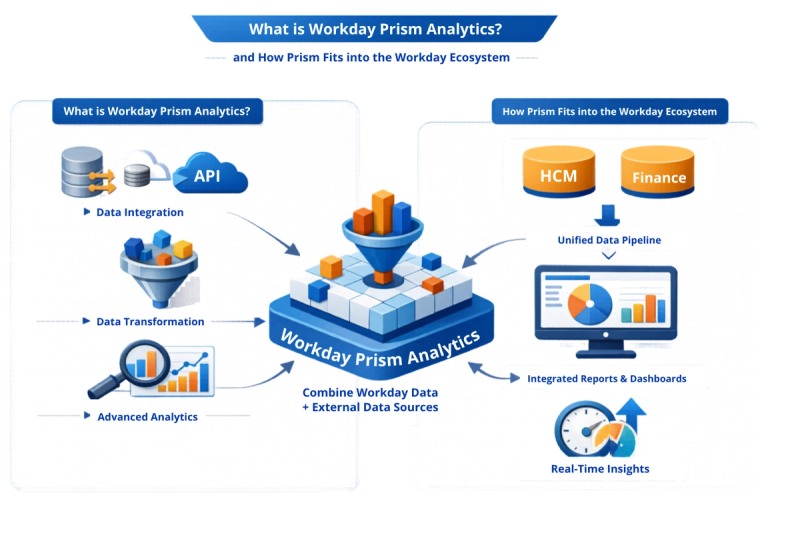
Workday Prism Analytics is a powerful data integration and analytics solution within the Workday platform that enables organizations to combine Workday data with external data sources for deeper analysis. It allows users to ingest, transform, and manage large volumes of data using structured pipelines, turning raw information into meaningful datasets. With the help of Workday Prism Analytics training, professionals can better understand how to work with complex data scenarios, making it easier for businesses to uncover trends, perform advanced analytics, and support data-driven decision-making across HR and finance functions.
Within the Workday ecosystem, Prism Analytics acts as a bridge between core Workday applications—such as Human Capital Management (HCM) and Financial Management—and external data systems. While standard Workday reports focus on internal data, Prism extends these capabilities by integrating third-party data sources like spreadsheets, cloud storage, and APIs. This unified approach enables organizations to create richer insights by combining workforce, financial, and operational data in one place, eliminating the need for multiple disconnected tools.
Prism fits seamlessly into the Workday ecosystem by enhancing existing analytics capabilities rather than replacing them. Data processed through Prism can be used in Workday Worksheets, dashboards, and reports, providing a consistent user experience. This integration ensures that decision-makers have access to accurate, real-time insights within the same platform they use for daily operations, ultimately improving efficiency, strengthening data governance, and enabling more effective strategic planning.
The Rise of Workday Prism Analytics: Replacing Legacy ERP for Smarter Insights
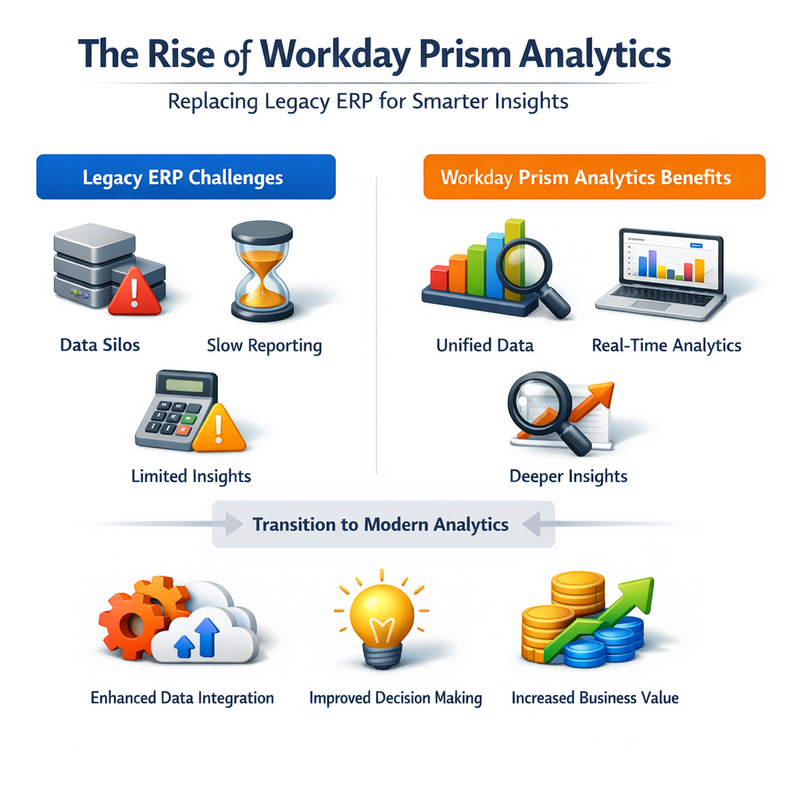
The rise of Workday Prism Analytics marks a significant shift in how organizations approach data management and decision-making, especially when compared to traditional legacy ERP systems. Legacy ERPs often operate in silos, making it difficult to combine internal data with external sources or generate real-time insights. In contrast, Workday Prism Analytics enables businesses to unify data from multiple systems into a single, structured environment, allowing for more agile and informed decision-making. This transition reflects the growing need for organizations to move beyond static reporting toward dynamic, data-driven strategies.
One of the key advantages of Workday Prism Analytics is its ability to transform raw, complex data into meaningful insights through data pipelines and datasets. Unlike legacy ERP systems that rely heavily on manual data extraction and reporting, Prism automates data ingestion, transformation, and analysis within the Workday ecosystem. This not only reduces operational inefficiencies but also empowers HR and finance teams to perform advanced analytics without depending heavily on external tools. As a result, businesses can respond faster to market changes and make more accurate forecasts.
Furthermore, Workday Prism Analytics enhances scalability, flexibility, and user experience, making it a powerful alternative to outdated ERP systems. Organizations can easily integrate new data sources, scale their analytics capabilities, and maintain data governance and security within a unified platform. As companies increasingly prioritize real-time insights and digital transformation, the adoption of Workday Prism Analytics continues to grow, positioning it as a critical tool for modern enterprises aiming to replace legacy ERP limitations with smarter, more efficient analytics solutions.
Who Should Learn Workday Prism Analytics?
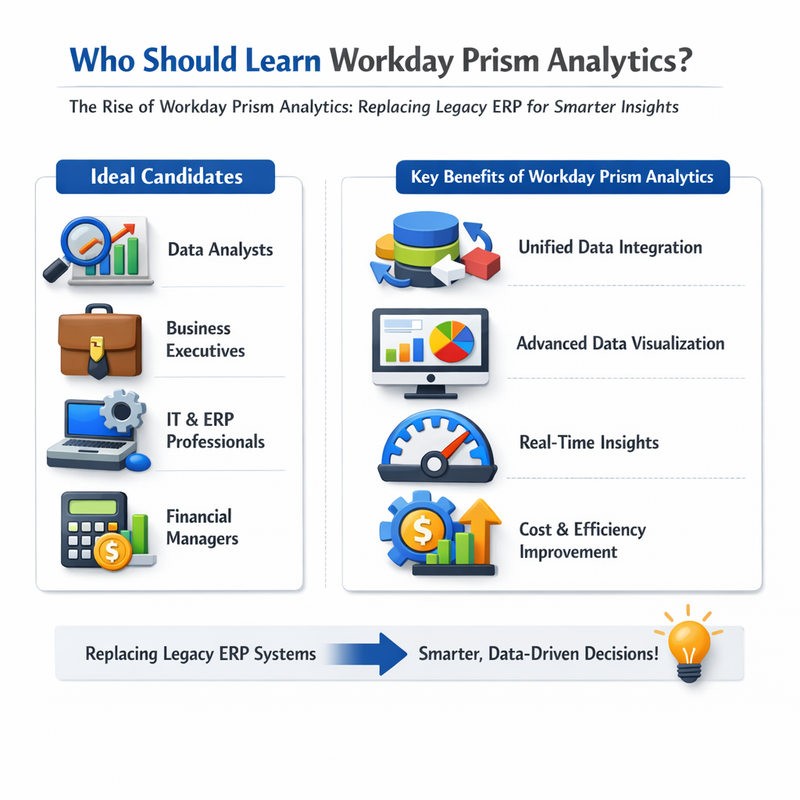
Workday Prism Analytics is ideal for professionals who work with data and want to enhance their ability to generate meaningful business insights. This includes HR professionals, finance analysts, and reporting specialists who regularly deal with workforce or financial data within the Workday ecosystem. By learning Prism, these professionals can go beyond standard reporting and gain the ability to combine internal and external data, enabling more strategic and data-driven decision-making.
It is also highly beneficial for aspiring data analysts and freshers who want to build a career in the Workday domain. Since Prism Analytics focuses on data integration, transformation, and visualization, it helps beginners develop strong analytical and problem-solving skills. Individuals with basic knowledge of Excel, databases, or reporting tools can quickly adapt to Prism concepts and use them to create datasets, pipelines, and dashboards that align with real-world business scenarios.
Additionally, Workday Prism Analytics is a valuable skill for IT professionals, consultants, and business analysts who are involved in digital transformation projects. Organizations increasingly look for experts who can bridge the gap between technical data handling and business insights. Learning Prism allows these professionals to support advanced analytics initiatives, optimize reporting processes, and contribute to smarter decision-making, making them more competitive in today’s data-driven job market.
Core Components of Workday Prism Analytics
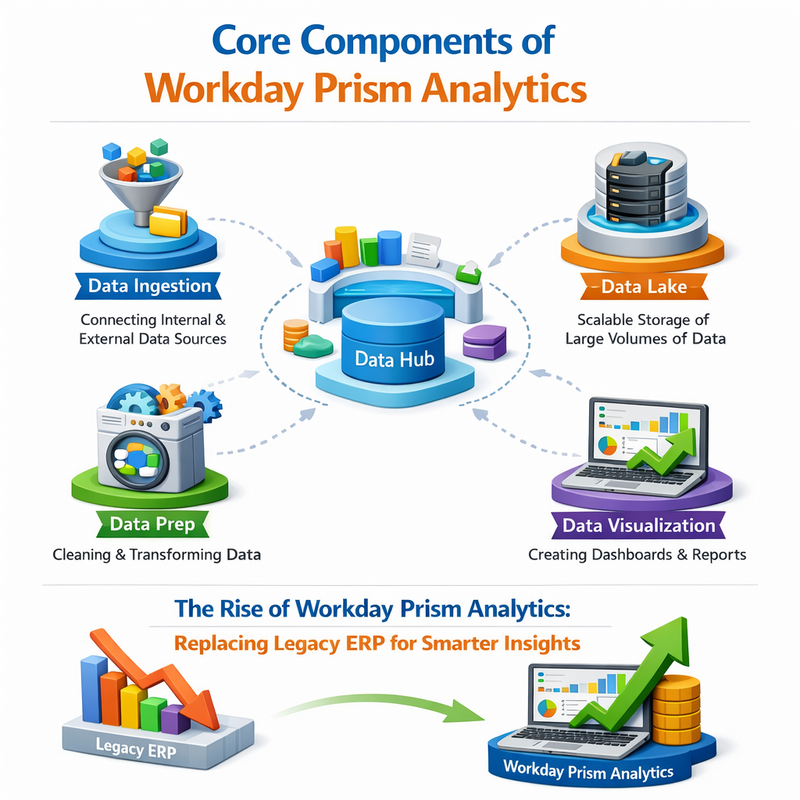
The core components of Workday Prism Analytics are designed to help organizations efficiently manage the complete data lifecycle—from ingestion to analysis—within the Workday platform. The first key component is data ingestion, which allows users to bring in data from multiple sources such as Workday applications, spreadsheets, cloud storage, APIs, and external databases. This flexibility enables businesses to unify structured and unstructured data into a single environment, forming the foundation for advanced analytics.
The second major component is data preparation and transformation, handled through Prism data pipelines. These pipelines allow users to clean, filter, join, and transform raw data into structured datasets that are ready for analysis. Users can create calculated fields, apply business logic, and perform aggregations to shape the data according to their requirements. This step is critical because it ensures data accuracy, consistency, and usability, which are essential for generating reliable insights.
The final core component is data analysis and visualization, where transformed datasets are used to create reports, dashboards, and interactive worksheets within Workday. Prism integrates seamlessly with Workday’s reporting tools, allowing users to explore data, identify trends, and make informed decisions in real time. Together, these components—data ingestion, transformation, and analysis—form a powerful analytics framework that enables organizations to move from raw data to actionable insights efficiently.
Overview of Workday Prism Analytics
Workday Prism Analytics is an advanced data integration and analytics solution offered by Workday that enables organizations to combine internal Workday data with external data sources for deeper insights. It is designed to help businesses overcome the limitations of traditional reporting by providing a unified platform where large volumes of data can be ingested, transformed, and analyzed efficiently. This capability allows organizations to move beyond basic reports and gain a more comprehensive understanding of their operations.
At its core, Workday Prism Analytics focuses on simplifying complex data processes through structured pipelines and datasets. Users can import data from various sources such as spreadsheets, cloud systems, and third-party applications, then clean and transform that data using intuitive tools. These transformed datasets can be seamlessly integrated with Workday’s existing applications, enabling users to perform advanced analytics without relying heavily on external business intelligence tools. This streamlined approach improves both accuracy and efficiency in data handling.
Another key aspect of Workday Prism Analytics is its ability to deliver real-time, actionable insights within the same environment where business processes are managed. By integrating with Workday dashboards, reports, and worksheets, it provides decision-makers with a consistent and user-friendly experience. This not only enhances data visibility and governance but also empowers organizations to make faster, more informed decisions, making Prism a critical component of modern enterprise analytics strategies.
Job roles in Workday Prism Analytics
Workday Prism Analytics offers a wide range of career opportunities for professionals who want to work at the intersection of data, business, and technology within the Workday ecosystem. One of the most common roles is a Workday Prism Consultant, who is responsible for designing data pipelines, integrating external data sources, and delivering analytics solutions tailored to business needs. These professionals work closely with stakeholders to understand requirements and translate them into actionable insights using Prism tools.
Another important role is that of a Data Analyst or Reporting Analyst, where the focus is on analyzing datasets created in Prism and generating meaningful reports and dashboards. These professionals use Prism to combine data from multiple sources, perform transformations, and support decision-making across HR, finance, and operations. Their work helps organizations identify trends, improve performance, and make data-driven strategies more effective.
Additionally, there are roles such as Workday Technical Consultant, Integration Specialist, and Business Analyst, all of which benefit from knowledge of Prism Analytics. These professionals handle tasks like data integration, system configuration, and aligning analytics with business processes. As organizations increasingly adopt advanced analytics solutions, having expertise in Workday Prism Analytics enhances career growth, making professionals more valuable in digital transformation and enterprise data projects.
Workday Prism Analytics Roadmap 2026 What to Learn First and How to Build a Career
The Workday Prism Analytics roadmap for 2026 begins with building a strong foundation in the Workday ecosystem and core data concepts. Beginners should first understand how Workday modules like HCM and Financial Management function, along with basics such as data sources, datasets, and reporting. This stage is crucial because Prism Analytics works on top of Workday and requires a clear understanding of how business data is structured and used within the platform.
The next step in the roadmap focuses on developing hands-on skills in data integration and transformation. Learners should practice importing data from various sources, creating data pipelines, and performing transformations such as filtering, joining, and creating calculated fields. This phase is highly practical and helps in understanding how raw data is converted into structured datasets that can be used for analysis. Working on small projects or real-world scenarios at this stage is essential to gain confidence and practical exposure.
To build a successful career in Workday Prism Analytics, the final stage involves mastering advanced analytics, reporting, and business application of data. This includes creating dashboards, optimizing data performance, and applying security and governance practices. Along with technical skills, professionals should focus on building a strong portfolio, preparing for interviews, and understanding real business use cases. With organizations increasingly adopting data-driven strategies, expertise in Prism Analytics offers strong career growth opportunities in 2026 and beyond.
conclusion
In conclusion, Workday Prism Analytics stands out as a transformative solution that enables organizations to move beyond traditional reporting limitations and embrace a more data-driven approach to decision-making. By integrating data from multiple sources and converting it into meaningful insights through structured pipelines, Prism empowers businesses to gain a unified and real-time view of their operations. This not only improves efficiency and accuracy but also enhances strategic planning across HR, finance, and other business functions.
Moreover, as organizations continue to prioritize digital transformation, the demand for professionals skilled in Workday Prism Analytics is steadily increasing. Whether you are a fresher, analyst, or consultant, learning Prism provides valuable expertise in data integration, transformation, and analytics. With its growing adoption and strong career opportunities, Workday Prism Analytics is not just a tool but a critical capability for building a future-ready, data-centric career in the evolving Workday ecosystem.