
Master Workday Pro-Reporting Certification: Complete Guide to Modules, Practice & Career Path (2026)
Table of Contents
Why Workday Reporting Skills Matter in 2026
In 2026, organizations rely heavily on real-time data to make strategic HR and financial decisions. Companies no longer depend on static spreadsheets or manual data extraction. They use cloud-based systems that provide instant insights, predictive analytics, and automated dashboards. This shift has made Workday Reporting certification one of the most valuable skills in the HR technology ecosystem.
Modern enterprises want professionals who can build accurate reports, design dashboards, and create calculated fields that support leadership decisions. Workday Reporting plays a central role in payroll analysis, workforce planning, compliance tracking, and performance measurement. As businesses expand globally, demand for professionals trained in Workday reporting tools continues to grow.
If you want to strengthen your Workday profile or enter the HR analytics domain, mastering Workday Reporting offers a clear career advantage.
What is Workday Reporting?
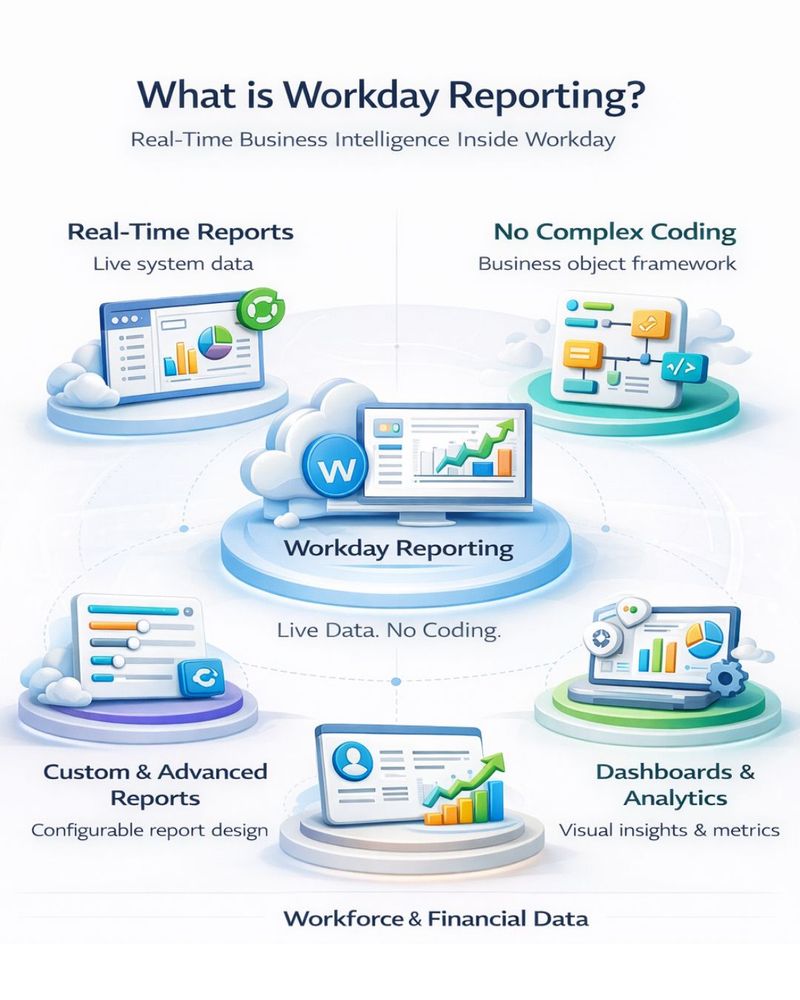
Workday provides a powerful reporting framework integrated directly into its Human Capital Management and Financial Management systems. Workday Reporting allows users to create real-time reports using live system data without external tools.
Unlike traditional reporting systems, Workday does not require complex coding. It uses business objects and data sources to generate customizable reports. Users can build reports that pull data from employee records, payroll transactions, compensation plans, or organizational structures.
Workday Reporting supports custom reports, advanced reports, calculated fields, dashboards, and analytics visualization. Because the system operates in real time, organizations gain immediate visibility into workforce trends and financial metrics.
Types of Workday Reports:
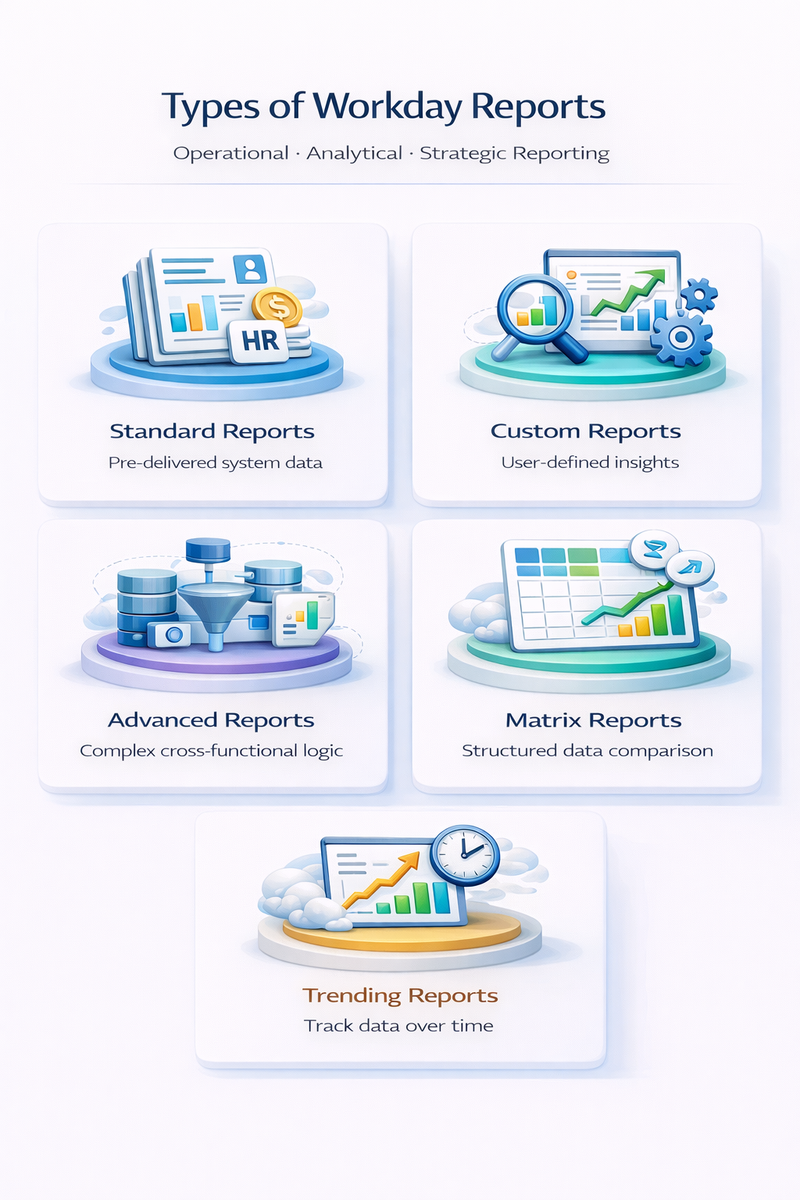
Workday offers multiple types of reports designed to support operational, analytical, and strategic business needs. Each report type serves a different purpose depending on the level of customization, complexity, and time-based analysis required.
Standard Reports- Standard Reports are pre-delivered by Workday and require little to no configuration. They provide consistent, system-controlled data for routine HR and finance tasks. These reports are ideal for quick access to commonly used information without customization.
Custom Reports-
Custom Reports are created by users to meet specific business requirements. They allow selection of data sources, filters, and calculated fields. Organizations use them to track department-specific KPIs and generate tailored insights.
Advanced Reports- Advanced Reports support complex data relationships and detailed filtering. They are used when reporting requires multi-level logic and cross-functional analysis. This type is typically handled by experienced Workday professionals.
Matrix Reports- Matrix Reports display data in a row-and-column format for structured comparison. They are useful for headcount summaries, compensation analysis, and financial comparisons across departments or locations.
Trending Reports- Trending Reports track data changes over time. They help organizations monitor workforce growth, turnover patterns, and long-term performance metrics for strategic decision-making.
Workday Pro-Reporting Certification Explained
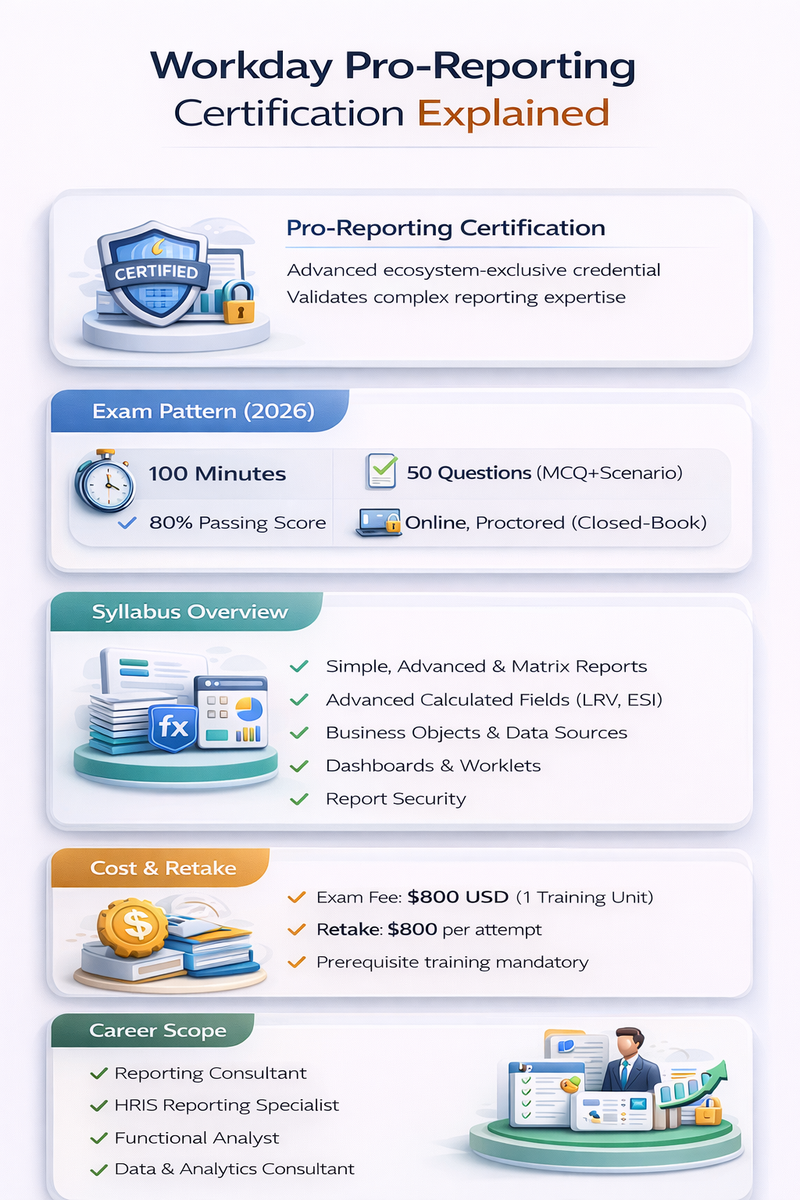
Workday, Pro Reporting Certification is an advanced, ecosystem-exclusive credential designed for professionals already working within Workday reporting projects. It validates practical expertise in building complex reports, calculated fields, dashboards, and managing report security.
Exam Pattern (2026)
- Duration: 100 minutes
- Questions: 50 (MCQs + scenario-based)
- Passing Score: 80%
- Mode: Online, proctored (closed-book)
The exam is highly practical and focuses on real implementation scenarios rather than theory.
Syllabus Overview
- Report Writer (Simple, Advanced, Matrix Reports)
- Advanced Calculated Fields (LRV, ESI, conditional logic)
- Business Objects & Data Sources
- Dashboards & Worklets
- Report Security & Data Access Control
Cost & Retake
- Exam Fee: $800 USD (1 Training Unit)
- Retake Fee: $800 per attempt
- Prerequisite training (Report Writer & Advanced Calculated Fields) is mandatory.
Career Scope
This certification strengthens your profile for roles like:
- Workday Reporting Consultant
- HRIS Reporting Specialist
- Functional Analyst
- Workday Data & Analytics Consultant
In 2026, with organizations relying heavily on real-time analytics and executive dashboards, certified reporting professionals are seen as strategic contributors in enterprise implementations
Workday Reporting Course Modules (Beginner to Advanced)
A well-designed Workday Reporting course should follow a progressive learning structure, moving from foundational concepts to advanced reporting techniques. Below is a structured breakdown of modules typically covered from beginner to advanced levels.
Beginner Level:
At the beginner stage, learners focus on understanding the core foundation of Workday reporting. This includes platform navigation to become comfortable with menus, search functionality, and report access. A strong emphasis is placed on business objects, as they form the backbone of Workday’s data architecture. Students also learn about data sources and how they determine what information can be pulled into a report. The module concludes with creating basic custom reports, enabling learners to generate simple, structured reports using standard fields and filters.
Intermediate Level:
The intermediate stage introduces more control and customization in report building. Learners work with calculated fields to derive meaningful values from existing data. They gain deeper knowledge of report filters to refine results accurately and use prompting to allow dynamic user input at runtime. This level also covers report sharing and security concepts, ensuring that reports are distributed appropriately across roles and user groups within the organization.
Advanced Level:
At the advanced stage, learners handle complex reporting scenarios. This includes building matrix reports for multi-dimensional analysis and designing dashboards that consolidate multiple reports into a visual overview. The module also introduces Workday Prism basics for integrating and transforming large datasets. Finally, learners study report performance optimization techniques to ensure reports run efficiently without impacting system performance.
Practical Skills You Will Gain
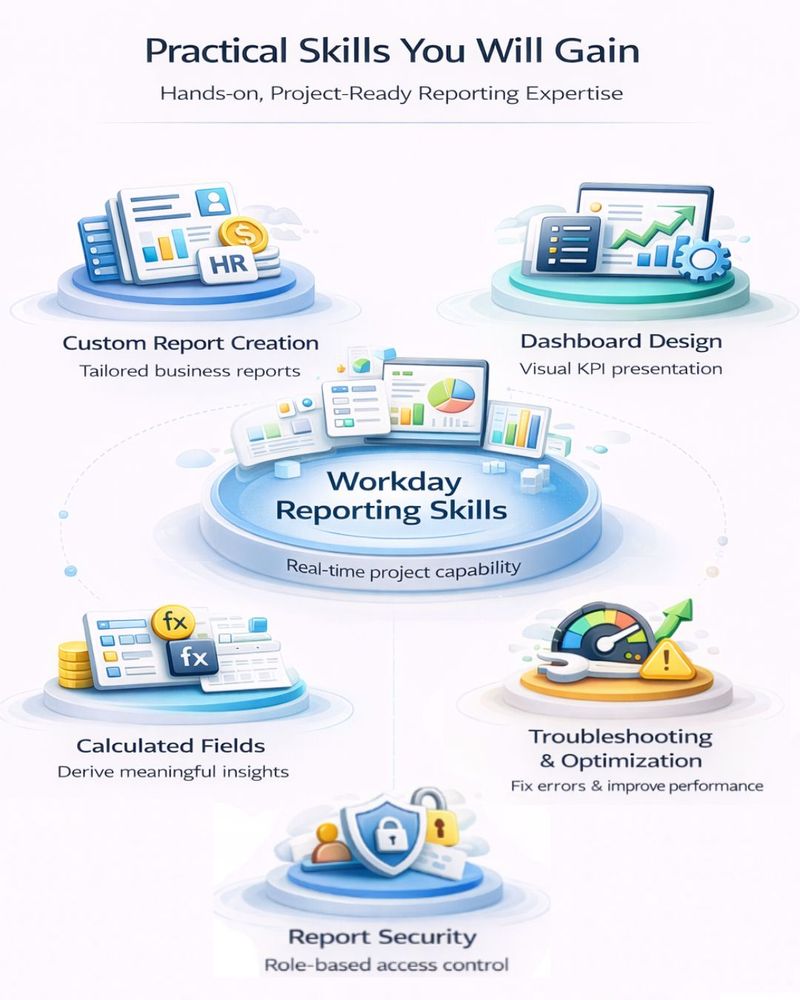
By the end of the Workday Reporting training, you will develop hands-on skills that are directly applicable in real-time project environments. You will learn how to create Workday custom reports tailored to specific business requirements, ensuring accurate and structured data output. The course will also train you in building calculated fields to derive meaningful insights from raw data and support advanced reporting needs.
In addition, you will gain expertise in designing dashboards that present key metrics in a clear and actionable format for stakeholders. You will understand how to configure report security to control user access based on roles and permissions, maintaining data confidentiality. Finally, you will develop troubleshooting skills to identify and resolve common report errors, performance issues, and data inconsistencies efficiently.
Workday Reporting Career Path
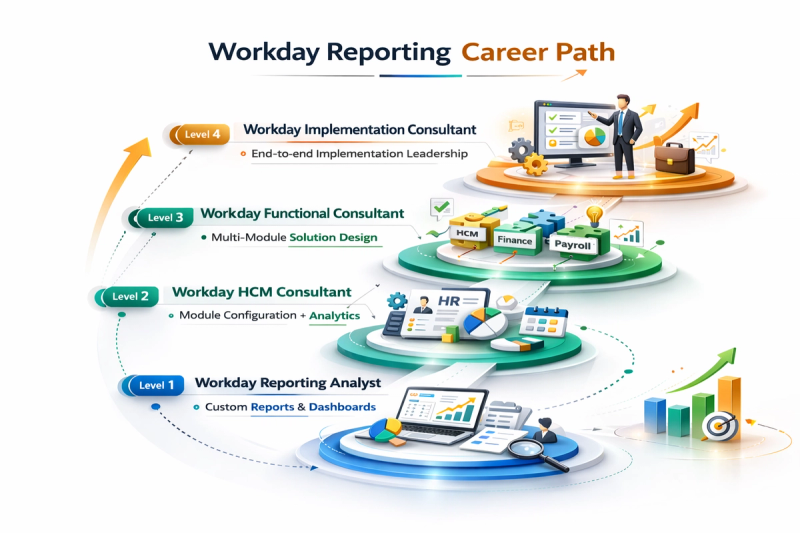
Workday Reporting is one of the most strategic skills within the Workday ecosystem. Strong reporting expertise not only opens dedicated reporting roles but also strengthens long-term career growth in functional and implementation consulting.
Workday Reporting Analyst
The typical starting role is a Workday Reporting Analyst. In this position, professionals focus on building custom reports, developing calculated fields, creating dashboards, and supporting business users with data requests. This role builds deep knowledge of business objects, data sources, and report security. It is highly practical and provides strong exposure to real-time business requirements.
Workday HCM Consultant
With experience, many professionals transition into a Workday HCM Consultant role. Here, reporting knowledge becomes a major advantage because HCM modules such as Core HR, Compensation, and Absence rely heavily on accurate reporting. Consultants who understand reporting can better configure modules, validate data, and deliver client-specific analytics.
Workday Functional Consultant
As professionals grow further, they move into broader Functional Consultant roles covering multiple modules like HCM, Finance, or Payroll. Reporting expertise enhances their ability to design end-to-end solutions. Since every client requires customized analytics and compliance reports, consultants with reporting strength are often more valuable in implementation projects.
Workday Implementation Consultant
At the senior level, professionals may become Workday Implementation Consultants, leading full lifecycle implementations. In this role, reporting knowledge is critical for data validation, testing support, post-go-live reporting setup, and executive dashboard design. Understanding reporting ensures smoother deployments and stronger client satisfaction.
Workday Reporting Salary Trends in 2026
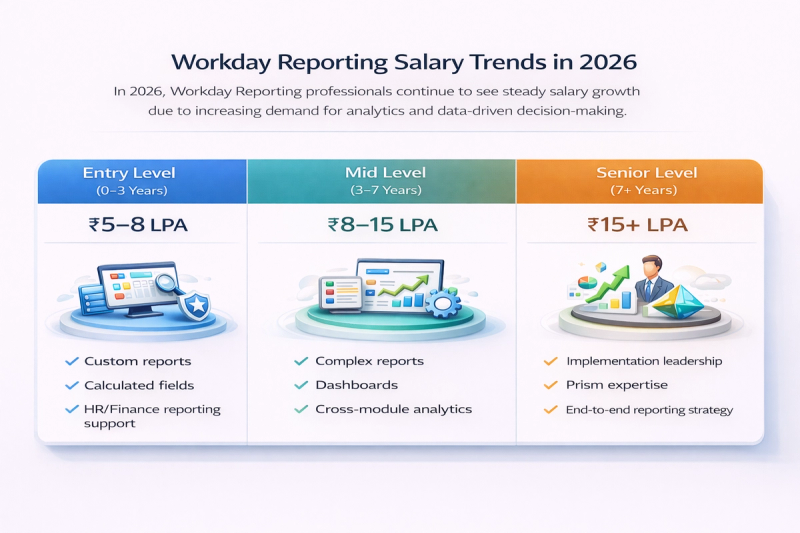
In 2026, Workday Reporting professionals continue to see steady salary growth due to increasing demand for analytics and data-driven decision-making.Entry-Level (0–3 Years): Freshers and junior Workday Reporting Analysts typically earn between ₹5–8 LPA in India. At this stage, professionals focus on building custom reports, calculated fields, and supporting HR or finance teams.
Mid-Level (3–7 Years): With strong reporting and functional exposure, salaries grow to around ₹8–15 LPA. Professionals at this level often handle complex reports, dashboards, and cross-module analytics, making them more valuable in implementation projects.
Senior-Level (7+ Years): Senior consultants, reporting leads, or implementation specialists can earn ₹15 LPA and above, depending on expertise and company size. Those with advanced reporting, Prism knowledge, and end-to-end implementation experience command higher compensation.
How to Prepare for Workday Reporting Certification
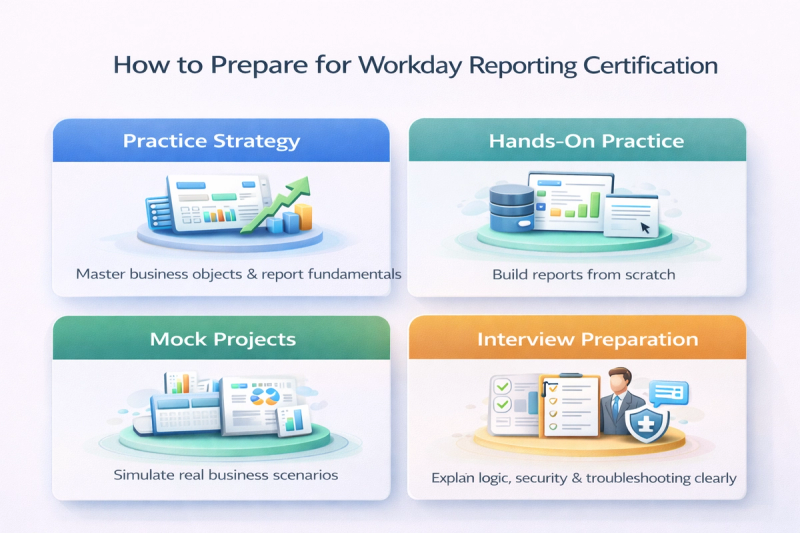
- Practice strategy- Focus on understanding business objects, data sources, custom reports, and calculated fields. Follow a structured plan starting from basic reports to advanced topics like matrix reports and dashboards.
- Hands-on approach- Practice building reports from scratch. Work with filters, calculated fields, and prompts to understand real-time reporting logic instead of memorizing steps.
- Mock projects-Create sample reports such as headcount analysis, turnover trends, or compensation summaries to simulate real business scenarios.
- Interview preparation- Prepare for scenario-based questions. Be ready to explain report types, security configuration, troubleshooting steps, and performance optimization clearly and practically.
Final Conclusion
Workday Reporting is a high-demand skill that offers strong career stability in the growing cloud ERP market. As organizations rely more on data-driven decisions, professionals who can build accurate and insightful reports become highly valuable.
With continuous cloud adoption, reporting expertise strengthens your overall Workday profile and opens long-term opportunities in functional and implementation roles. Learning through structured programs like Techpratham can help you gain practical skills and build a future-ready career in Workday.
FAQs
Q1. Is Workday Reporting difficult?
Ans. Workday Reporting is not difficult if you understand business objects and data relationships clearly. Beginners may find calculated fields and advanced reports challenging at first, but with regular hands-on practice, it becomes manageable and logical.
Q2. Do I need technical knowledge?
Ans. Basic technical understanding is helpful, but deep coding knowledge is not required. Workday Reporting is mainly functional and configuration-based. Logical thinking and data analysis skills are more important than programming.
Q3. How long does it take to prepare?
Ans. With consistent practice, most learners can become comfortable with core reporting concepts in 4–6 weeks. Advanced topics like matrix reports and dashboards may require additional practice time.
Q4. Is certification mandatory?
Ans. Certification is not mandatory to start a career, but it adds credibility and improves job opportunities. Practical skills and real-time project exposure are equally important for career growth.