Workday vs ServiceNow: Which Platform Is Better for Your Career in 2026?
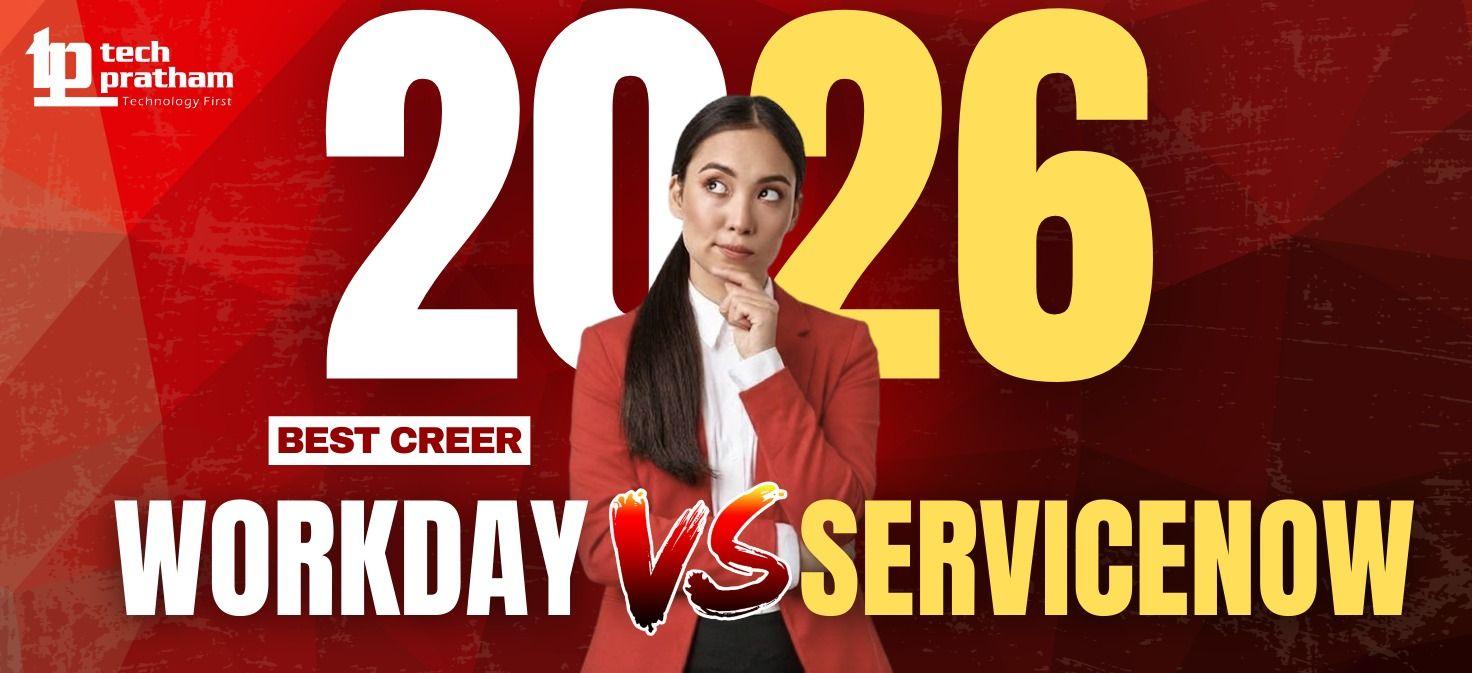
Choosing the right enterprise platform can define your long-term career growth, and in 2026, Workday vs ServiceNow is one of the most searched comparisons among IT and business professionals. Both platforms are global leaders, widely adopted by large enterprises, yet they serve very different purposes and require distinct skill sets. Workday focuses on HR, finance, and people management, while ServiceNow powers IT service management and digital workflows. This creates a common question for freshers and experienced professionals alike — which platform is better for your career in 2026?
In this blog, we provide a clear comparison of Workday vs ServiceNow based on features, career scope, salary, demand, and learning path to help you make the right decision.
What is Workday and its types of modules ?
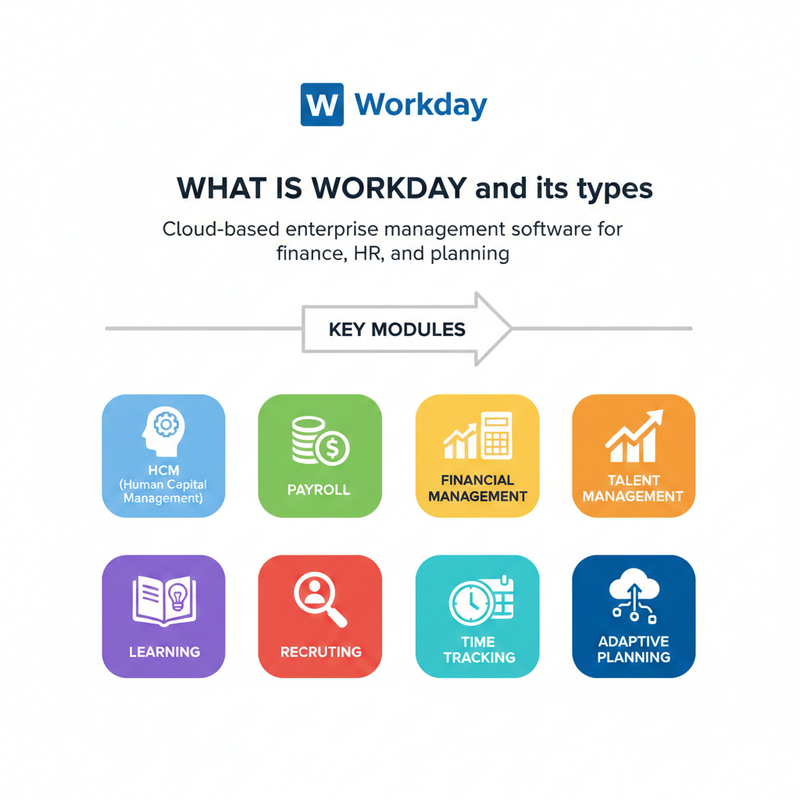
Workday is a cloud-based enterprise software platform that helps organizations manage their human resources, financial operations, and business planning in a single, unified system. It is designed to provide real-time visibility into workforce and financial data, enabling better decision-making for large and mid-size enterprises. Unlike traditional on-premise systems, Workday operates entirely on the cloud, offering high scalability, regular updates, and strong data security. Because of this, many global companies rely on Workday to modernize their HR and finance processes. Where the Workday finance course is also good option for the people who are thinking to build thier career in the finance sector .
One of the core offerings of Workday is Human Capital Management (HCM), which focuses on managing the complete employee lifecycle. Workday HCM includes modules such as Core HR, Recruiting, Talent Management, Performance Management, Learning, Time Tracking, and Payroll. These modules help HR teams handle hiring, employee development, compensation, attendance, and compliance efficiently. Workday HCM is especially popular among organizations looking to improve employee experience and workforce analytics.
Another major area of Workday is Financial Management, which supports finance teams in managing accounting, budgeting, procurement, and financial reporting. Key modules under this category include Financial Accounting, Expenses, Procurement, Revenue Management, and Financial Reporting. These modules allow organizations to track financial performance in real time, ensure regulatory compliance, and improve financial planning accuracy. Workday’s finance modules are often integrated with HCM to provide a complete view of workforce and financial data.
In addition to HCM and Finance, Workday also offers Workday Adaptive Planning and Integration solutions to support advanced business needs. Adaptive Planning helps organizations with budgeting, forecasting, and scenario planning, while Workday Integrations enable seamless data exchange with third-party systems. These modules make Workday a comprehensive enterprise platform that supports long-term digital transformation, making it a strong choice for professionals building a career in HR technology and enterprise cloud solutions.
What is ServiceNow and its types of modules ?
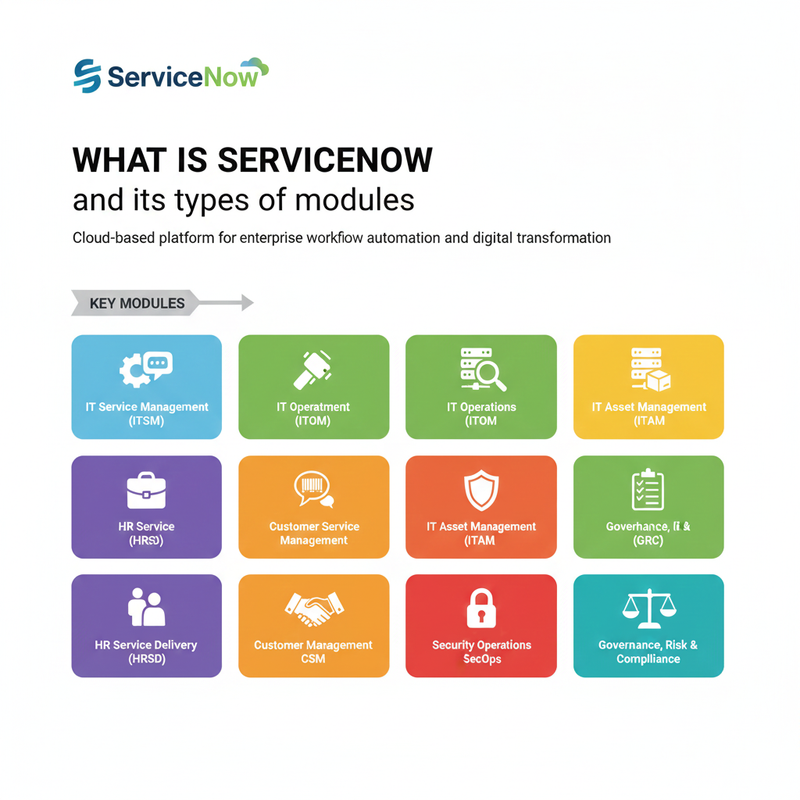
ServiceNow is a cloud-based digital workflow platform that helps organizations automate and manage their IT services, business operations, and enterprise workflows on a single system. It is widely used by enterprises to improve efficiency, reduce manual work, and deliver better service experiences across departments. Originally known for IT Service Management (ITSM), ServiceNow has evolved into a powerful platform that supports IT, HR, customer service, and security operations. Its flexibility, scalability, and strong integration capabilities make it a preferred choice for large organizations worldwide.
The most widely used ServiceNow offering is IT Service Management (ITSM), which focuses on managing and improving IT support processes. ITSM includes key modules such as Incident Management, Problem Management, Change Management, Request Management, and Service Catalog. These modules help IT teams resolve issues faster, minimize service disruptions, and maintain standardized IT processes. ITSM is often the entry point for professionals starting a career in ServiceNow.
Another important set of ServiceNow modules falls under IT Operations Management (ITOM) and IT Asset Management (ITAM). ITOM includes modules like Discovery, Service Mapping, Event Management, and Cloud Management, which provide visibility into IT infrastructure and services. ITAM focuses on managing hardware and software assets throughout their lifecycle, helping organizations control costs and ensure license compliance. These modules are critical for organizations aiming to optimize their IT infrastructure and operations.
Beyond IT, ServiceNow also offers modules for Enterprise Service Management (ESM), extending workflows to non-IT departments. This includes HR Service Delivery (HRSD), Customer Service Management (CSM), Security Operations (SecOps), and Governance, Risk, and Compliance (GRC). These modules allow organizations to standardize and automate workflows across the enterprise. With its wide range of modules and continuous innovation, ServiceNow provides strong career opportunities for professionals interested in IT automation, development, and enterprise digital transformation.
Workday vs ServiceNow – Key Differences
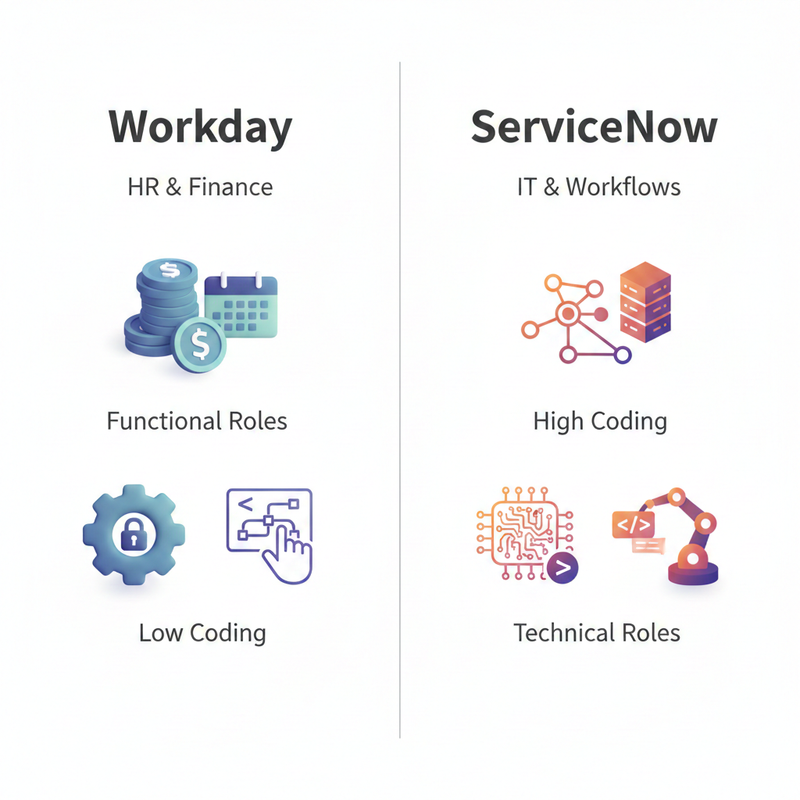
When comparing Workday vs ServiceNow, the primary difference lies in their core purpose and target users. Workday is built to manage HR, finance, and workforce-related processes, making it a preferred platform for HR and finance teams. In contrast, ServiceNow is designed to automate IT services and enterprise workflows, primarily serving IT, operations, and security teams. This fundamental difference directly influences the type of roles, skills, and career paths associated with each platform.
From a functional and technical perspective, Workday is more configuration-driven with limited customization and minimal coding requirements. Professionals working on Workday typically focus on business process configuration, reporting, and functional consulting. ServiceNow, on the other hand, offers high flexibility and extensibility, requiring skills in JavaScript, scripting, workflow automation, and integrations. This makes ServiceNow more suitable for technically inclined professionals who enjoy hands-on development work.
Another major difference is platform adoption and expansion. Workday operates as a closed ecosystem with a strong focus on stability and compliance, which is ideal for long-term HR and finance transformations. ServiceNow is a highly scalable platform that continuously expands beyond IT into areas such as HR service delivery, customer service, and security operations. This expansion has resulted in faster adoption and a broader range of job roles for ServiceNow professionals.
From a career growth and demand standpoint, Workday offers niche expertise with steady demand and less competition, especially for certified consultants. ServiceNow provides wider career opportunities, faster role progression, and higher demand across industries due to its multi-department usage. Understanding these key differences helps professionals choose between Workday vs ServiceNow based on their background, interests, and long-term career goals in 2026.
Workday vs ServiceNow Training in India – Which Should You Choose in 2026?
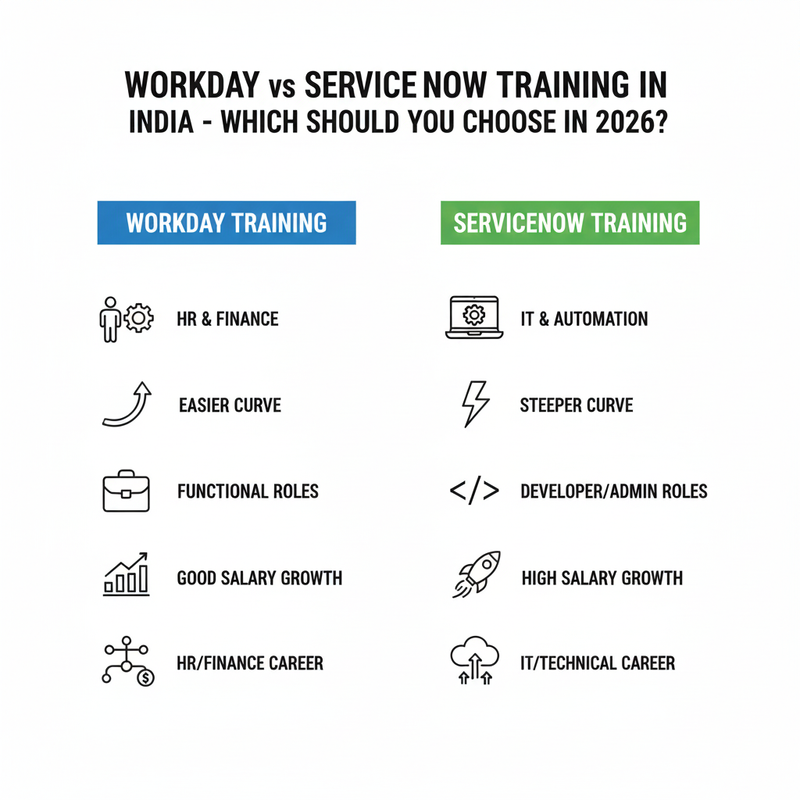
As Indian enterprises continue their rapid digital transformation, demand for enterprise cloud professionals is expected to rise sharply in 2026. Among the most popular career options, Workday and ServiceNow training in India stand out as high-value, future-ready skills. While both platforms are widely adopted by global organizations, they serve very different business functions, which makes choosing the right one critical for long-term career success.
Understanding the nature of the platform, learning effort, job roles, salary growth, and market demand will help you decide which training path is best suited for you in 2026.
Platform Focus & Industry Usage
Workday is primarily used for Human Capital Management (HCM), payroll, finance, and business planning. Indian IT service companies and multinational enterprises implement Workday to modernize HR and finance operations. As a result, Workday professionals usually work closely with HR leaders, finance managers, and business stakeholders, making it a strong option for those interested in functional consulting roles.
ServiceNow, on the other hand, is a digital workflow and automation platform used extensively by IT departments. It is deployed across industries to manage IT services, operations, security, HR service delivery, and customer service workflows. ServiceNow’s ability to expand beyond IT makes it one of the fastest-growing enterprise platforms in India, creating demand for both technical and functional professionals.
Training Approach & Learning Curve
When it comes to training, Workday and ServiceNow differ significantly in learning style and difficulty.
Workday training focuses more on:
- Understanding HR and finance business processes
- System configuration and data structures
- Reporting, security, and integrations (limited coding)
This makes Workday training ideal for non-technical professionals or those transitioning from HR, payroll, or finance roles into IT consulting.
ServiceNow training is more technical and includes:
- JavaScript scripting and workflow automation
- ITSM processes and CMDB concepts
- Platform customization and integrations
Because of this, ServiceNow training is better suited for candidates with an IT, engineering, or development background who are comfortable with coding and technical problem-solving.
Job Roles After Training in India
Completing Workday training in India can lead to roles such as:
- Workday HCM Consultant
- Workday Payroll or Finance Consultant
- Workday Integration Analyst
These roles are typically project-based and offer long-term stability with enterprise clients.
After ServiceNow training, candidates can target roles like:
- ServiceNow Developer
- ServiceNow Administrator
- ITSM or ITOM Consultant
- ServiceNow Solution Architect (with experience)
ServiceNow roles are more diverse and allow professionals to switch modules and domains as they grow, which increases career flexibility in 2026.
Salary Growth & Career Progression
From a salary perspective in India:
- Workday professionals often see steady and predictable salary growth, especially after gaining certification and project experience. Niche expertise helps reduce competition.
- ServiceNow professionals may experience faster early salary growth due to high demand and technical skill requirements, especially for developers and architects.
In the long run, both platforms offer excellent earning potential, but ServiceNow may provide quicker role changes and promotions, while Workday offers stability and specialization.
Certification Value & Market Recognition
Certifications play a crucial role in both careers:
- Workday certifications are typically available through authorized partners and are highly valued by employers, making certified professionals stand out in the job market.
- ServiceNow certifications such as CSA, CAD, and CIS modules are widely recognized and accessible, allowing candidates to build credentials step by step.
In 2026, certified professionals in either platform will have a clear advantage in hiring and salary negotiations.
Final opinion – Which Should You Choose in 2026?
👉 Choose Workday training in India if you:
- Prefer HR, finance, and business process roles
- Want a functional, consulting-oriented career
- Seek stable, long-term enterprise projects
👉 Choose ServiceNow training in India if you:
- Enjoy technical work, scripting, and automation
- Want broader job opportunities across domains
- Aim for faster career mobility and growth
Conclusion
Choosing between Workday and ServiceNow ultimately depends on your career goals, background, and interests. Workday is ideal for professionals with a focus on HR, finance, and business processes, offering long-term stability, specialized expertise, and steady growth in enterprise projects. ServiceNow, on the other hand, is perfect for technical and IT-focused professionals, providing diverse career paths, faster skill development, and opportunities in IT service management, workflow automation, and enterprise digital transformation.
Both platforms are highly valued in India and globally, and completing certified training in either can significantly boost your career. By understanding the differences in modules, learning paths, career scope, and salary potential, you can make an informed decision and choose the platform that aligns with your 2026 career aspirations. Whether you prefer functional consulting with Workday or technical development with ServiceNow training in hyderabad , both paths promise high demand, growth opportunities, and rewarding careers in the enterprise cloud ecosystem.