Start typing to search courses...

Type in the search box to find courses
workday
228 min read4 views

How Does Workday HCM Help HR Teams Manage the Employee Lifecycle?
By TechPratham TeamPublished September 2, 2026Updated September 2, 2026
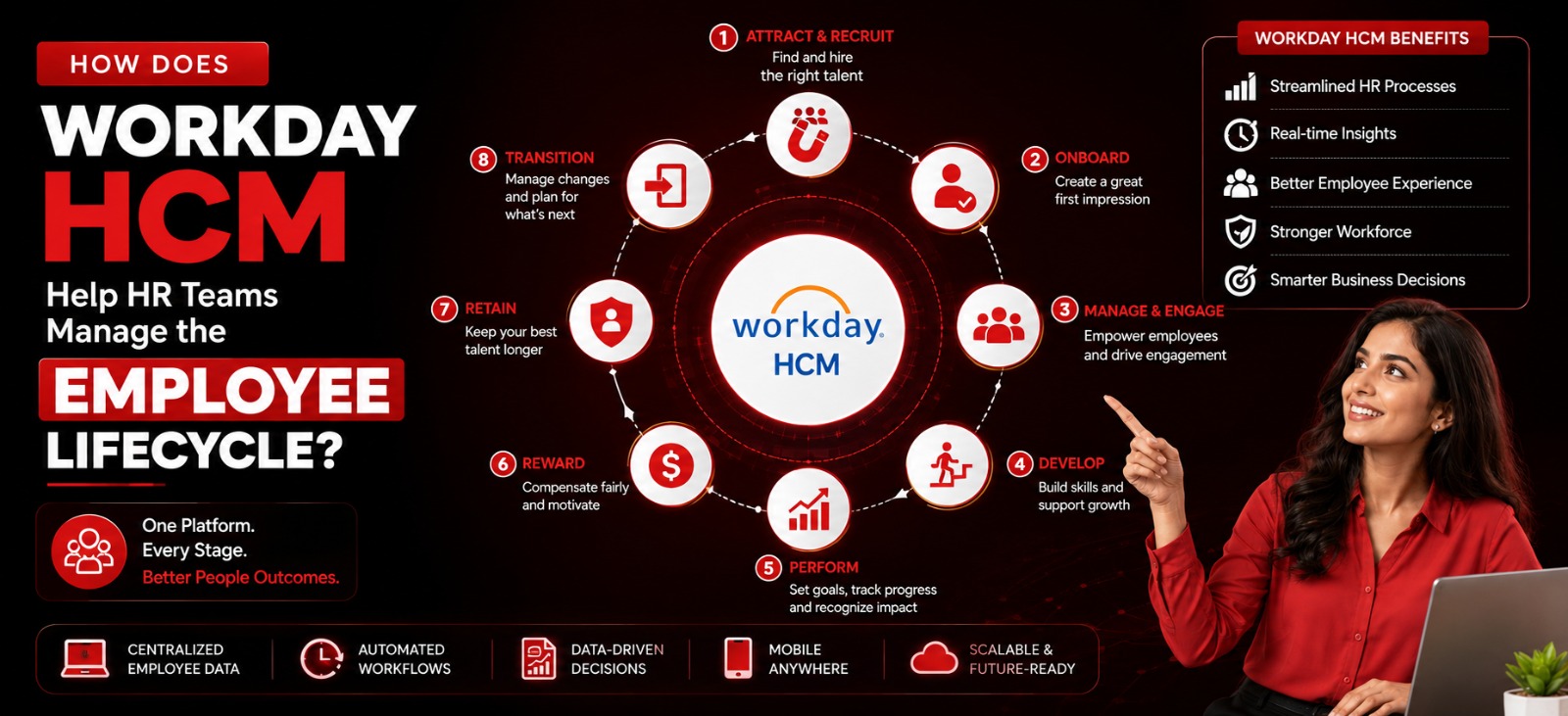
Workday HCM infographic showing how HR teams manage the employee lifecycle through recruitment, onboarding, employee management, development, performance, rewards, retention, and transitions, with benefits such as streamlined HR processes, real-time insights, and better employee experiences
Managing employees today involves much more than maintaining employee records. HR teams have to handle recruitment, onboarding, compensation, performance, learning, workforce management, employee engagement, and eventually offboarding—all while keeping employee data accurate and accessible.
Workday Human Capital Management (HCM) helps HR teams connect these activities through a unified platform, allowing organizations to manage different stages of the employee lifecycle with connected workforce data and processes. Workday describes its HCM platform as covering areas such as Core HCM, talent management, workforce management, workforce planning and analytics, and employee experience.
Instead of treating recruitment, employee records, performance, learning, and workforce planning as completely separate activities, an HCM platform can connect them so HR teams and managers have better context when making people-related decisions.
So, how does Workday HCM actually support the employee lifecycle?
Let's look at it stage by stage.

What Is the Employee Lifecycle in HR?

The employee lifecycle refers to the different stages an employee goes through during their relationship with an organization.

While the exact stages vary between organizations, the lifecycle commonly includes:

  1. Workforce planning
  2. Recruitment
  3. Hiring
  4. Onboarding
  5. Employee management
  6. Compensation and benefits
  7. Performance management
  8. Learning and development
  9. Career growth and internal mobility
  10. Workforce management
  11. Retention and engagement
  12. Offboarding
The challenge for HR teams is that these stages are connected. For example, information collected during recruitment can become important during onboarding. Skills identified during an employee's development can influence career opportunities. Performance information can contribute to talent decisions, while workforce data can help organizations plan future hiring. This is where an integrated Workday HCM environment can become valuable.

Workday HCM Employee Lifecycle: Key HR Processes and Capabilities
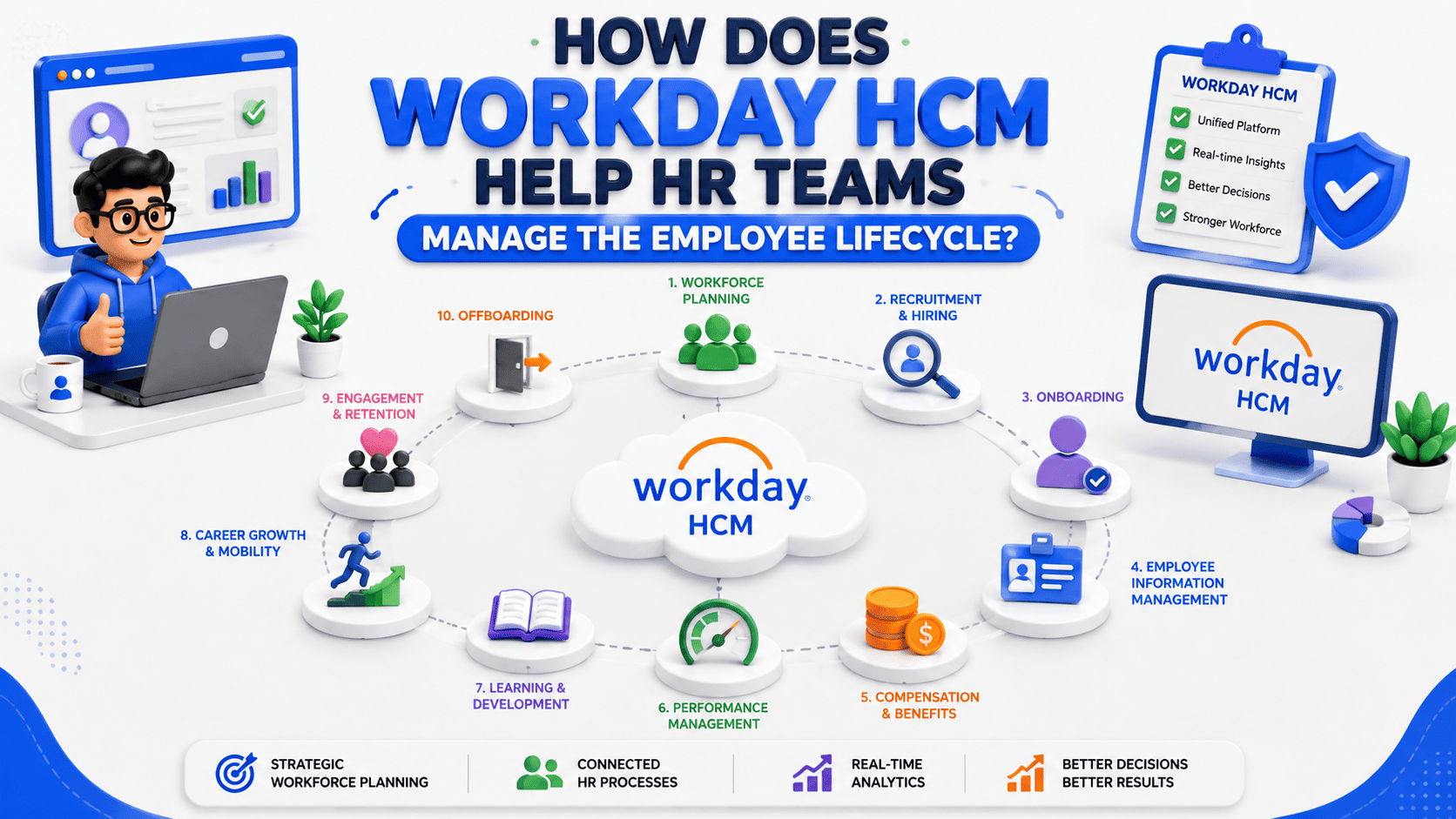
Workday HCM helps HR teams manage the employee lifecycle by connecting employee information, HR processes, talent activities, workforce management, and analytics within a unified environment.
The exact configuration depends on an organization's implementation, integrations, policies, and geographic requirements, but the overall idea is to create a connected flow of workforce information rather than maintaining isolated HR processes. Let's explore the major stages.

1. How Does Workday HCM Support Workforce Planning?

The employee lifecycle can begin before an employee is even hired. HR and business leaders need to understand questions such as:
  • How many employees will the organization need?
  • Which skills will be required?
  • Where are potential workforce gaps?
  • Which teams are growing?
  • What could future hiring or retention requirements look like?
Workday's workforce planning capabilities connect workforce considerations with business planning. Organizations can model areas such as hiring, transfers, retention and workforce costs to understand how different workforce decisions could affect business plans.
This changes workforce planning from simply estimating headcount to considering skills, costs, business priorities and future workforce requirements together.

Example
Suppose an organization plans to expand its technology operations.

Instead of simply deciding to hire 500 people, HR could evaluate:

  • required job roles
  • existing workforce skills
  • expected vacancies
  • internal mobility opportunities
  • hiring requirements
  • workforce costs
  • future skill gaps
This gives HR and business leaders a more complete view before recruitment begins.

2. How Does Workday HCM Help With Recruitment and Hiring?

Recruitment is one of the most visible stages of the employee lifecycle.
HR teams need to manage job requisitions, candidate information, hiring workflows, interviews, offers and communication while providing a good candidate experience.
Workday's talent acquisition capabilities are designed to manage recruitment and engagement workflows as part of its broader HCM environment. Workday currently highlights AI-supported recruiting and capabilities covering the talent acquisition lifecycle.
The benefit of connecting recruitment with the wider HCM environment is that hiring does not necessarily have to remain an isolated HR activity.
Candidate and job information can become part of the broader employee journey once a candidate becomes an employee.

For example:

A candidate applies for a role → completes the recruitment process → receives an offer → becomes an employee → enters onboarding.

A connected system can reduce the need to repeatedly recreate the same information at each stage.

3. How Does Workday HCM Improve Employee Onboarding?

Onboarding is where the candidate experience transitions into the employee experience.
A poorly organized onboarding process can create unnecessary administrative work for HR and confusion for new employees.
Workday supports onboarding as part of its talent management capabilities, with the broader platform connecting employee information, tasks, experiences and HR processes.

Depending on the organization's configuration, onboarding workflows can help coordinate activities such as:

  • New employee information
  • Required documentation
  • Manager tasks
  • Policy-related activities
  • Initial learning
  • Organizational information
  • Role-related tasks
  • Employee self-service
The objective is not simply to complete paperwork. A well-designed onboarding process should help employees understand where they fit within the organization, what they need to accomplish, and how they can become productive.

4. How Does Workday HCM Manage Employee Information?

Once an employee joins the organization, HR needs an accurate source of information about that person.

This can include:

  • Personal and employment information
  • Job and position details
  • Organizational structure
  • Manager relationships
  • Compensation information
  • Benefits
  • Skills
  • Career information
  • Time and absence information
Workday Core HCM is designed to manage HR information and organizational processes within a unified system. Workday emphasizes a common data foundation so HR teams can work with workforce information in the same environment as other HCM processes. This is particularly useful when organizations have complex structures, multiple locations or large workforces.
Instead of HR teams depending on disconnected spreadsheets and systems for every process, a centralized HCM environment can provide greater consistency.

5. How Does Workday HCM Support Compensation and Benefits?

Compensation and benefits are important throughout the employee lifecycle.
HR teams may need to manage:

  • Salary information
  • Compensation changes
  • Incentives
  • Benefits
  • Compensation planning
  • Pay-related processes
  • Employee eligibility
Workday includes compensation and benefits capabilities within its HCM environment, allowing these processes to be connected with employee information and organizational structures.
For example, when an employee changes roles, receives a promotion or moves to another organizational unit, HR may need to consider several related changes.
A connected HCM environment can make it easier to manage these relationships while maintaining appropriate controls and approvals.

6. How Does Workday HCM Support Performance and Talent Management?

Employee development does not stop after onboarding.

Organizations need to understand:

  • How employees are performing
  • What skills they currently have
  • Which skills they need to develop
  • What career opportunities may be available
  • Which employees could be prepared for future roles
Workday's talent management capabilities connect areas such as talent acquisition, development, learning, skills and employee growth. This is important because performance management becomes more useful when it is connected to broader talent development.
For example, an employee's performance discussion might reveal a need to develop a particular technical or leadership skill.
That information can then inform learning and career development activities.

7. How Does Workday HCM Help Employees With Learning and Skill Development?

Continuous learning has become an important part of workforce management because job requirements and skills can change over time.
Workday Learning is positioned as part of the broader HCM environment and supports learning experiences from onboarding through ongoing upskilling. Workday also highlights AI-supported learning, personalized learning experiences and skills intelligence.

HR teams can use learning programs to support areas such as:

  • New employee training
  • Compliance learning
  • Technical skills
  • Leadership development
  • Role-specific learning
  • Upskilling
  • Reskilling
  • Career development
The bigger opportunity comes when learning is connected with skills and career development rather than treated simply as a course library.
Simple example
An employee wants to move from a support role into a technical role.

A skills-based approach can help identify:

Current skills → Required skills → Learning opportunities → Potential career path

This makes employee development more closely connected to workforce planning.

8. How Does Workday HCM Support Internal Mobility?

Hiring externally is not always the only answer to a workforce requirement. Organizations may already have employees with transferable skills who could move into new roles. Workday's talent capabilities include internal mobility and skills-related functionality designed to help organizations identify opportunities for employees to develop and move within the organization.

For HR teams, this can change the question from:
“Who should we hire?”
to:
“Do we already have people who could grow into this role?”
That shift can support a more skills-oriented approach to workforce planning.

9. How Does Workday HCM Help With Time, Absence and Workforce Management?

Employee lifecycle management also includes the day-to-day operational side of employment.
Depending on the organization's configuration, workforce management can involve:

  • Time tracking
  • Absence management
  • Scheduling
  • Workforce capacity
  • Employee availability
  • Payroll-related time information
Workday describes its workforce management capabilities as covering time tracking, absence, scheduling and related workforce processes.
Connecting these activities with broader employee information can help HR and managers understand workforce availability and operational requirements more effectively. For organizations with large or distributed workforces, this connection can be particularly important.

10. How Does Workday HCM Help HR Teams Use Workforce Data?

One of the biggest advantages of an HCM platform is not simply storing data—it's being able to use that data to understand the workforce.
Workday's HCM reporting and analytics capabilities allow organizations to analyze workforce information within the same environment where HR transactions occur.

HR teams can use workforce analytics to explore questions such as:

  • Where are workforce gaps emerging?
  • Which teams are growing?
  • What skills exist within the organization?
  • Where are employees moving internally?
  • How is the workforce distributed?
  • What trends should HR leaders investigate?
This supports a move from reactive HR administration toward more data-informed workforce decisions.
However, analytics are only as useful as the underlying data, configuration and business questions. A dashboard alone does not automatically produce a good HR decision.

11. How Is AI Changing Workday HCM?

AI is becoming an increasingly important part of modern HCM platforms. Workday currently highlights AI across areas such as recruiting, skills, employee experience, workforce insights, learning and automation. Its current AI strategy also includes AI agents designed to support work across business functions.

For HR teams, the potential value of AI can be understood in several areas.
AI for recruitment

AI can assist with recruiting workflows, candidate engagement and talent-related activities.

AI for skills intelligence

AI can help organizations understand workforce skills and identify potential skills gaps.

AI for employee support

AI-powered experiences can help employees find information or complete routine HR-related activities.

AI for workforce insights

AI-supported analytics can help HR teams identify patterns that may require further investigation.

AI for learning

AI can support more personalized learning experiences and help employees discover relevant development opportunities. But responsible implementation matters. HR teams still need appropriate governance around privacy, security, access controls, data quality, human oversight and responsible AI use.
AI should support better HR decisions—not replace human judgment in sensitive employee matters.

What Are the Main Workday HCM Modules Involved in the Employee Lifecycle?

Workday HCM is broader than a single HR function. Its capabilities span multiple areas that can contribute to different stages of the employee lifecycle.
Common areas include:


Employee Lifecycle Stage
Relevant Workday HCM Capability
Workforce planning
Workforce Planning & Analytics
Recruitment
Talent Acquisition
Onboarding
Onboarding
Employee records
Core HCM
Compensation
Compensation
Benefits
Benefits
Performance
Talent Management
Learning
Workday Learning
Skills development
Skills & Talent capabilities
Time and absence
Workforce Management

Why Is an Integrated Employee Lifecycle Important?

The employee lifecycle is not a collection of unrelated HR activities. Each stage produces information that can influence another stage.


For example:


Recruitment → Onboarding → Performance → Learning → Career Growth → Internal Mobility → Retention


If these processes are disconnected, HR teams may struggle to get a complete picture of an employee. An integrated HCM approach can help create a more connected flow of information.


This can support:


  • Better employee experiences
  • More consistent HR processes
  • Improved workforce visibility
  • Reduced manual administration
  • Better manager access to relevant information
  • More informed workforce planning
  • Skills-based talent development

The goal is not simply to automate HR tasks. The larger objective is to help organizations make better people and workforce decisions using connected information.

What Skills Are Important for Workday HCM Professionals?
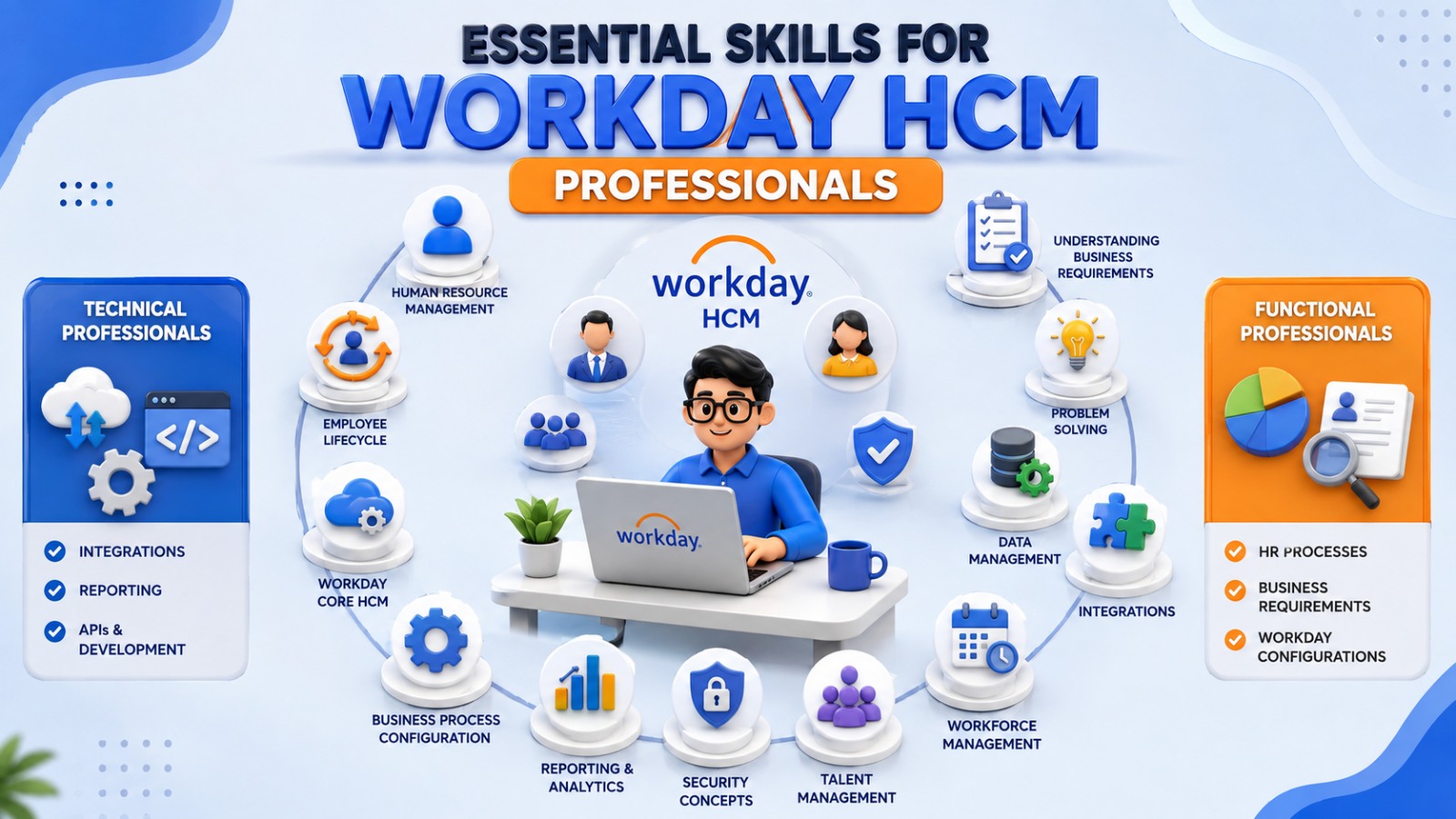
Workday HCM professionals skills including HR processes reporting security integrations and data management

As organizations use HCM platforms for increasingly connected HR processes, professionals working with Workday need more than knowledge of individual screens or transactions.


Useful areas of knowledge can include:


  • Human resource management concepts
  • Employee lifecycle processes
  • Workday Core HCM concepts
  • Business process configuration
  • Reporting and analytics
  • Security concepts
  • Talent management
  • Workforce management
  • Integrations
  • Data management
  • Problem-solving
  • Understanding business requirements

For technical professionals, areas such as integrations, reporting, APIs and development can become increasingly important. For functional professionals, understanding HR processes and translating business requirements into Workday configurations is particularly valuable.

This is why a good Workday HCM training approach should focus not only on software navigation but also on understanding the HR processes behind the system.


Can You Learn Workday HCM Online?

Yes, Workday HCM training online can be a practical option for learners who need flexibility.

However, the quality of the learning experience depends heavily on what is covered.


A useful Workday HCM course should ideally help learners understand:


  • Core HCM concepts
  • Employee lifecycle processes
  • Business processes
  • Reporting
  • Security fundamentals
  • Configuration concepts
  • Practical HR scenarios
  • Relevant Workday modules

Learners considering Workday HCM certification online should also distinguish between learning a platform and preparing for a specific certification path. Certification requirements and available programs can change, so learners should verify current requirements through official Workday channels or their authorized learning route.

Is Workday HCM Training and Placement Enough to Build a Career?

Training and placement support can be useful, particularly for beginners, but completing a Workday HCM training and placement program should not be viewed as a substitute for practical knowledge.


A stronger career foundation comes from understanding:


HR concepts + Workday processes + practical scenarios + problem-solving + relevant technical/functional skills


Placement assistance may help with interview preparation and job search, but actual employability depends on the learner's skills, experience and ability to apply what they have learned.


What Does the Future of Workday HCM Look Like?

The future of HCM is moving toward more connected, skills-based and AI-assisted workforce management.


Organizations increasingly need to understand not only who works for them, but also:


  • What skills their employees have
  • What skills they will need
  • Where workforce gaps may emerge
  • How employees can grow
  • How work can be redesigned
  • Where automation can reduce administrative effort

Workday's current product direction reflects this shift, with AI, skills intelligence, workforce analytics, employee experience and AI agents becoming increasingly connected to its HCM ecosystem. The important point is that technology alone will not transform HR. Organizations still need strong HR processes, accurate data, appropriate governance and people who understand both technology and human resource management.


Frequently Asked Questions About Workday HCM and the Employee Lifecycle

What is Workday HCM?

Workday HCM is a cloud-based human capital management platform designed to help organizations manage workforce-related processes such as core HR, talent, workforce management, planning, analytics and employee experience.

How does Workday HCM manage the employee lifecycle?

Workday HCM can connect different stages of the employee lifecycle, including workforce planning, recruitment, onboarding, employee management, compensation, performance, learning, workforce management, career development and offboarding.

What are the main Workday HCM modules?

Major areas of the Workday HCM ecosystem include Core HCM, Talent Management, Workforce Management, Workforce Planning & Analytics, and Experience & Engagement, along with related capabilities such as recruiting, learning, compensation and benefits.

How does Workday HCM help HR teams?

It can help HR teams centralize workforce information, connect HR processes, automate workflows, support employee self-service, analyze workforce data and improve visibility across different stages of the employee lifecycle.

How does AI support Workday HCM?

AI can support areas such as recruiting, employee assistance, skills intelligence, workforce insights, learning and workflow automation. Workday is also developing AI-agent capabilities across HR and other business functions.

Is Workday HCM suitable for large organizations?

Workday is designed to support complex workforce environments, including organizations operating across multiple locations and countries. However, suitability depends on an organization's requirements, implementation strategy, integrations and business processes.

Is Workday HCM useful for HR professionals?

Yes. Understanding Workday HCM can be useful for HR professionals involved in HR operations, talent management, workforce management, reporting, HR technology or digital transformation.

Can beginners learn Workday HCM?

Beginners can learn the fundamentals, but it helps to first understand basic HR concepts such as employee lifecycle management, organizational structures, recruitment, compensation and performance management.

Final Thoughts

Workday HCM helps HR teams look at the employee lifecycle as a connected journey rather than a series of isolated HR processes.

From workforce planning and recruitment to onboarding, performance, learning, career development and workforce analytics, connected HCM processes can give HR teams greater visibility into how people and work move through an organization.

The bigger opportunity is emerging as AI, skills intelligence and workforce analytics become more deeply integrated into HR technology. Instead of using technology only to record employee information, organizations can increasingly use workforce data to understand skills, identify opportunities and make more informed decisions.

For professionals interested in Workday, this also means that learning the platform should go beyond memorizing features. Understanding HR processes, employee lifecycle management, business requirements, data, analytics and practical Workday workflows can provide a stronger foundation for working with HCM technology.