
How to Become a Workday Adaptive Planning Consultant in 2026: Skills, Certification, and Career Path
_11zon.webp)
Financial planning and analysis (FP&A) is evolving rapidly as organizations move away from spreadsheets and adopt intelligent cloud-based planning platforms. Among the leading enterprise planning solutions, Workday Adaptive Planning has become a preferred choice for organizations looking to improve budgeting, forecasting, workforce planning, and financial reporting.
As businesses continue investing in digital finance transformation, the demand for skilled Workday Adaptive Planning Consultants is expected to grow significantly in 2026. Professionals with expertise in financial planning, analytics, and Workday implementation are finding opportunities across consulting firms, global enterprises, and technology companies.
What is Workday Adaptive Planning?
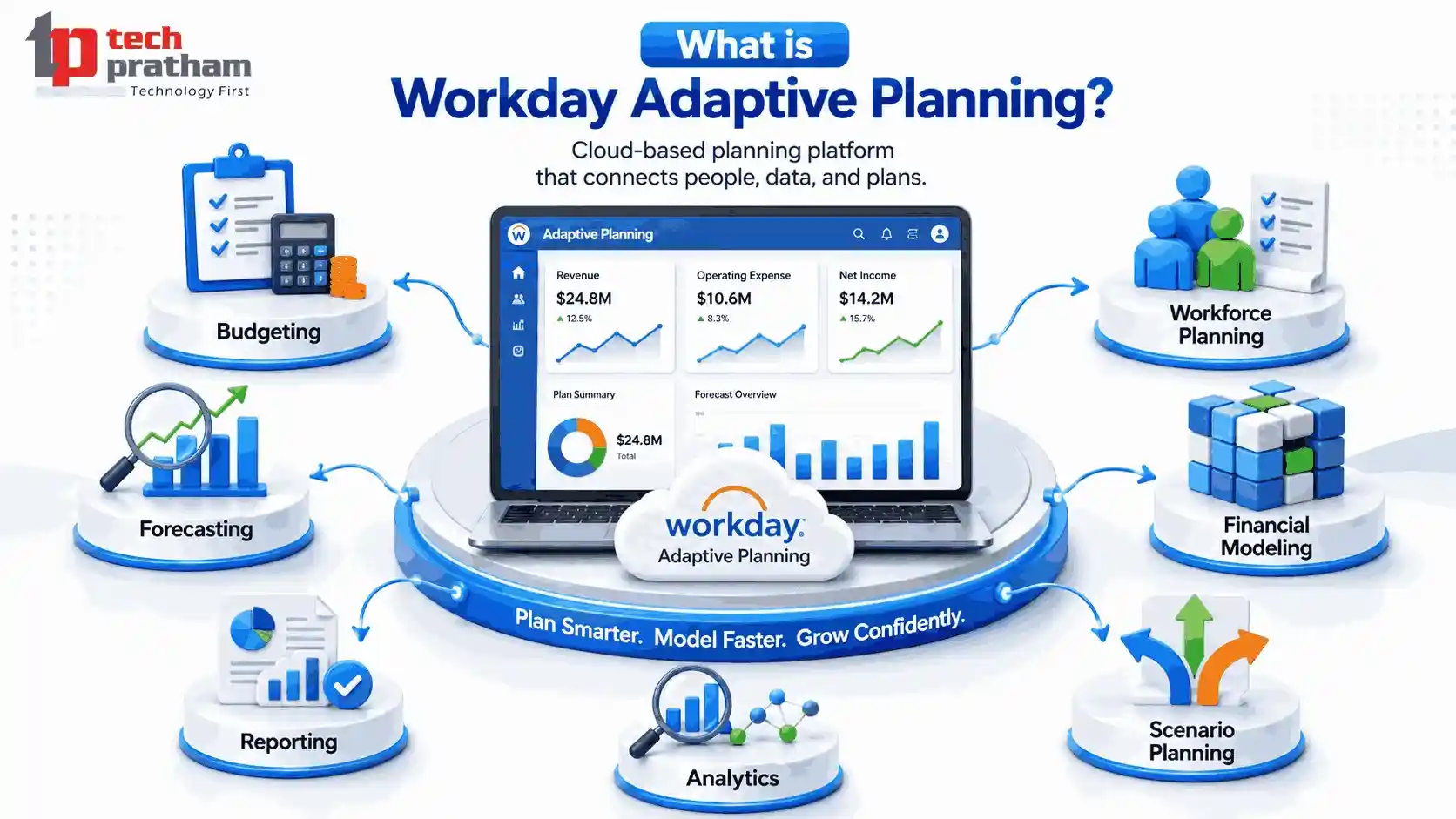
Workday Adaptive Planning is a cloud-based Enterprise Performance Management (EPM) solution that helps organizations simplify financial planning, budgeting, forecasting, workforce planning, reporting, and business analytics. It enables finance teams to collaborate in real time, automate planning processes, and make data-driven decisions using accurate, up-to-date information.
Unlike traditional spreadsheets, Workday Adaptive Planning centralizes financial data in a secure cloud environment, allowing multiple departments to work together efficiently while reducing manual errors and improving planning accuracy. It also integrates seamlessly with leading ERP, HR, and CRM systems, making it an ideal solution for modern finance teams.
Key Features of Workday Adaptive Planning
- Cloud-Based EPM: Access planning data securely from anywhere with real-time collaboration.
- Budgeting: Create and manage department-wise, project, and company-wide budgets with automated workflows.
- Forecasting: Build rolling and driver-based forecasts to quickly adapt to changing business conditions.
- Workforce Planning: Plan headcount, salaries, hiring, promotions, and employee costs effectively.
- Financial Consolidation: Consolidate financial data across multiple entities and currencies for accurate reporting.
- Reporting: Generate dynamic financial reports, variance analysis, and executive summaries with ease.
- Interactive Dashboards: Visualize KPIs and financial performance through customizable dashboards.
- Scenario Planning: Compare best-case, worst-case, and expected business scenarios for better decision-making.
- Real-Time Analytics: Monitor business performance with live insights and data-driven analytics.
- ERP Integration: Connect with Workday Financial Management, SAP, Oracle, NetSuite, Microsoft Dynamics 365, Salesforce, and other enterprise applications.
Why Workday Adaptive Planning Is One of the Fastest Growing Finance Careers in 2026
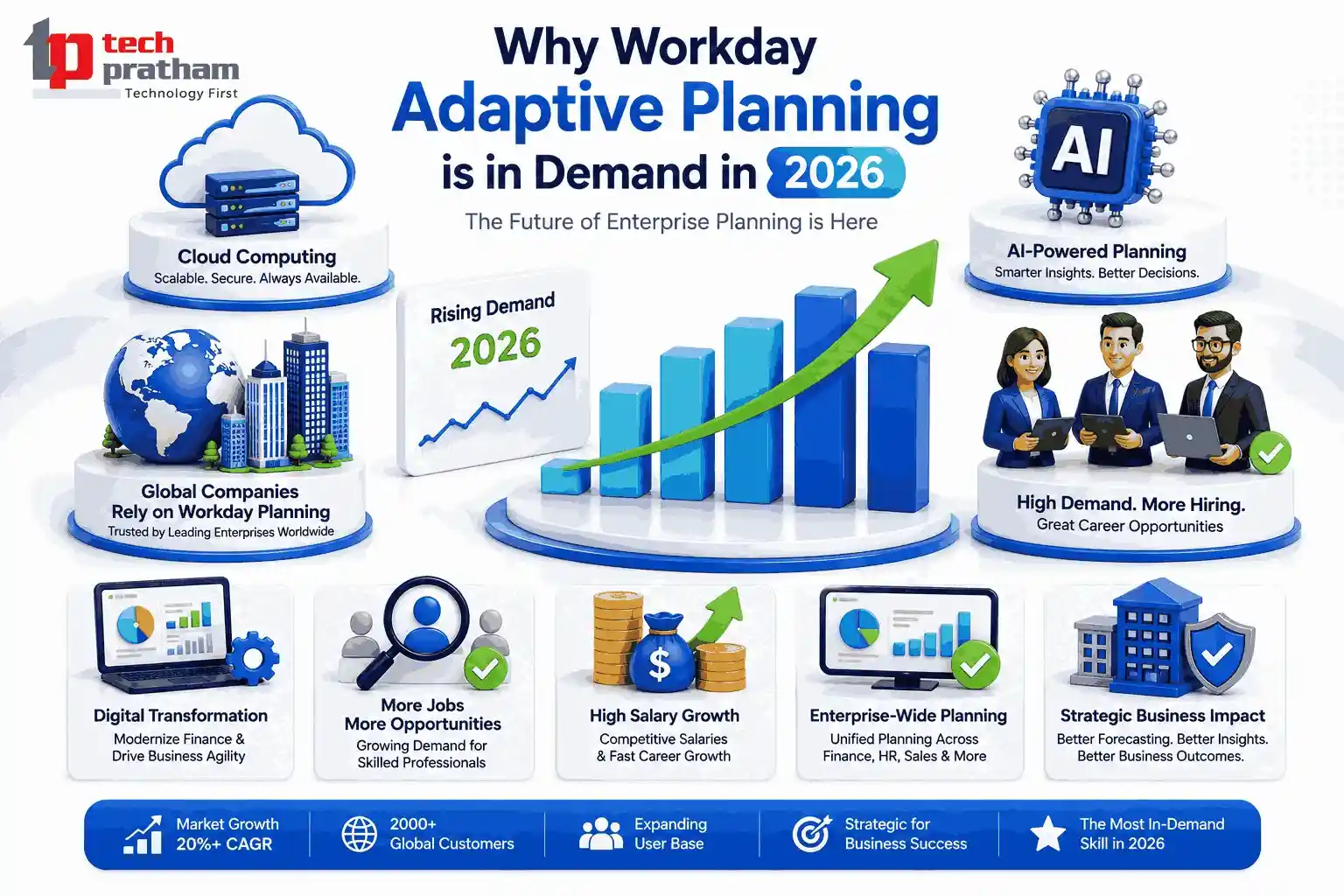
As businesses embrace digital transformation, the demand for professionals skilled in Workday Adaptive Planning is growing rapidly. Organizations are moving beyond traditional spreadsheets to cloud-based financial planning solutions that offer greater accuracy, collaboration, and real-time insights. This shift has made Workday Adaptive Planning Consultants one of the most sought-after roles in the finance and ERP industry.
Cloud Finance Transformation
Companies are replacing legacy financial systems with cloud-based Enterprise Performance Management (EPM) solutions. Workday Adaptive Planning enables finance teams to manage budgeting, forecasting, and reporting from a single platform, making cloud finance expertise highly valuable.
AI-Assisted Planning
Modern finance teams are leveraging AI-powered insights to improve budgeting and forecasting. Workday Adaptive Planning helps organizations analyze trends, automate routine tasks, and make faster, data-driven decisions.
Continuous Forecasting
Instead of relying on annual budgets, businesses now use rolling forecasts to adapt quickly to market changes. Professionals who can build and manage dynamic financial models are in high demand.
Rising Demand for FP&A Professionals
Financial Planning and Analysis (FP&A) has become a strategic business function. Organizations need consultants who can combine finance expertise with Workday Adaptive Planning to deliver accurate financial insights and improve business performance.
Digital Finance Initiatives
Many enterprises are investing in digital finance transformation to automate financial processes, reduce manual work, and improve operational efficiency. This trend continues to create new career opportunities for Workday Adaptive Planning specialists.
Growing Adoption Across Industries
Industries such as IT, healthcare, manufacturing, retail, banking, education, and consulting are increasingly adopting Workday Adaptive Planning to streamline financial planning and workforce management, expanding job opportunities across sectors.
Increased Hiring by Consulting Firms
Global consulting firms and Workday implementation partners are actively hiring professionals with Workday Adaptive Planning skills to support implementation projects, system optimization, and finance transformation initiatives.
Why Choose a Career in Workday Adaptive Planning?
- High demand across global industries
- Attractive salary packages and career growth
- Opportunities to work on cloud finance transformation projects
- Increasing adoption of AI-driven financial planning
- Strong demand for certified Workday Adaptive Planning consultants
- Excellent opportunities in consulting, implementation, and FP&A roles
Who Is a Workday Adaptive Planning Consultant?
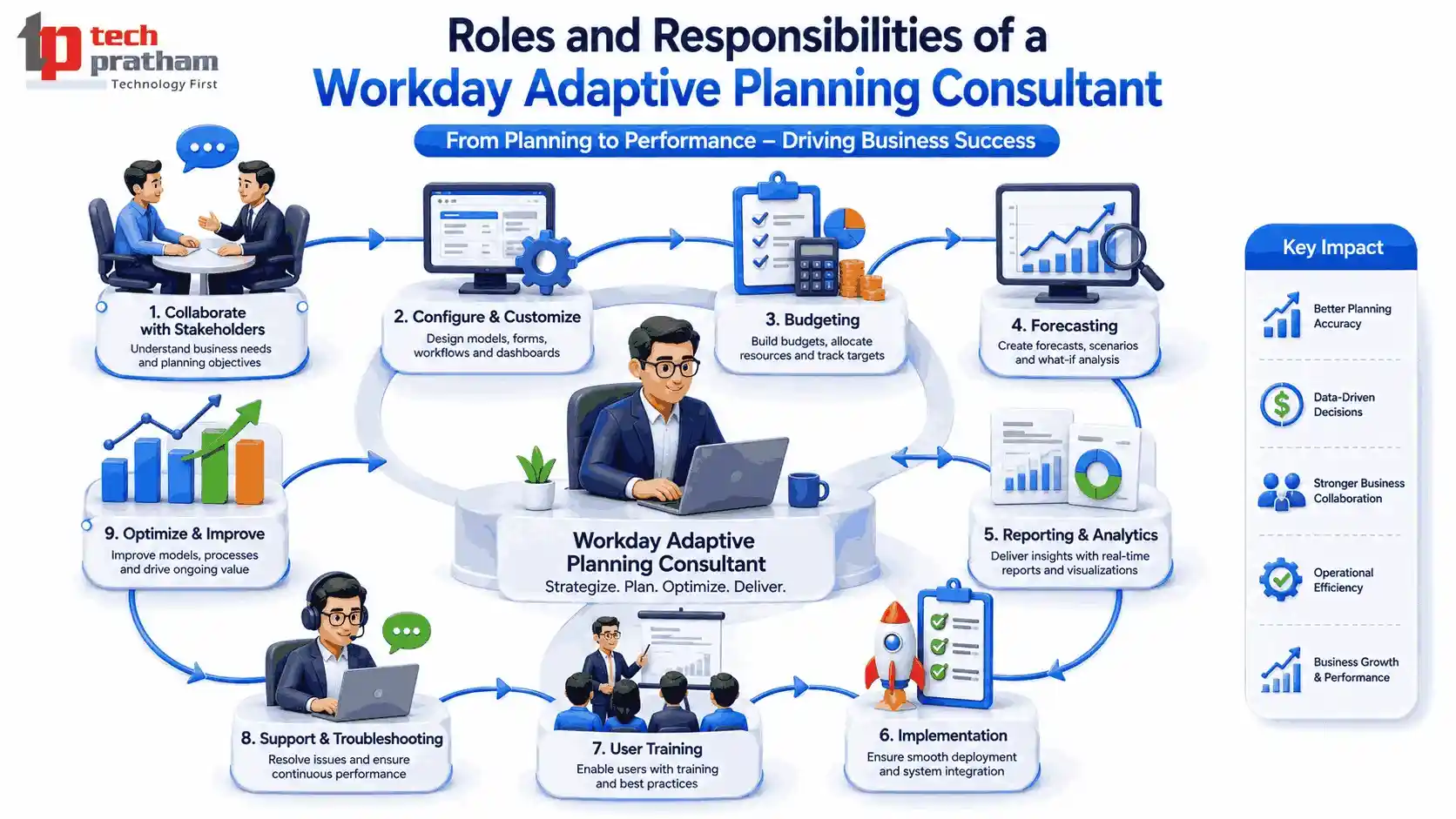
A Workday Adaptive Planning Consultant is a finance and technology professional who helps organizations implement, configure, and optimize Workday Adaptive Planning to improve budgeting, forecasting, workforce planning, and financial reporting. They work closely with finance teams and business stakeholders to understand business requirements, build planning models, and deliver customized solutions that support strategic decision-making.
From implementation to post-deployment support, a consultant ensures the platform is aligned with an organization's financial goals and business processes.
Key Responsibilities of a Workday Adaptive Planning Consultant
Requirement Gathering
Collaborate with finance teams and stakeholders to understand business processes, planning requirements, and reporting needs before designing the solution.
Financial Model Building
Develop financial planning models for budgeting, forecasting, revenue planning, and expense management based on business objectives.
Budget Setup
Configure department-wise, project-wise, and organization-wide budgets while ensuring data accuracy and streamlined approval workflows.
Workforce Planning
Create workforce planning models to manage headcount, salaries, hiring plans, employee costs, and compensation forecasting.
Dashboard Creation
Design interactive dashboards that provide executives and managers with real-time visibility into key financial KPIs and business performance.
Report Development
Build customized financial reports, variance analysis, budget vs. actual reports, and executive summaries for better decision-making.
Security Configuration
Set up role-based access controls and user permissions to ensure secure access to financial data and maintain compliance.
User Training
Train finance teams and business users on how to use Workday Adaptive Planning effectively, including budgeting, reporting, and dashboard navigation.
Implementation & Go-Live Support
Support the complete implementation lifecycle, including system configuration, testing, data migration, deployment, and go-live assistance to ensure a smooth transition.
Performance Optimization
Continuously monitor system performance, optimize planning models, improve reporting efficiency, and recommend best practices as business requirements evolve.
Skills Required for Success
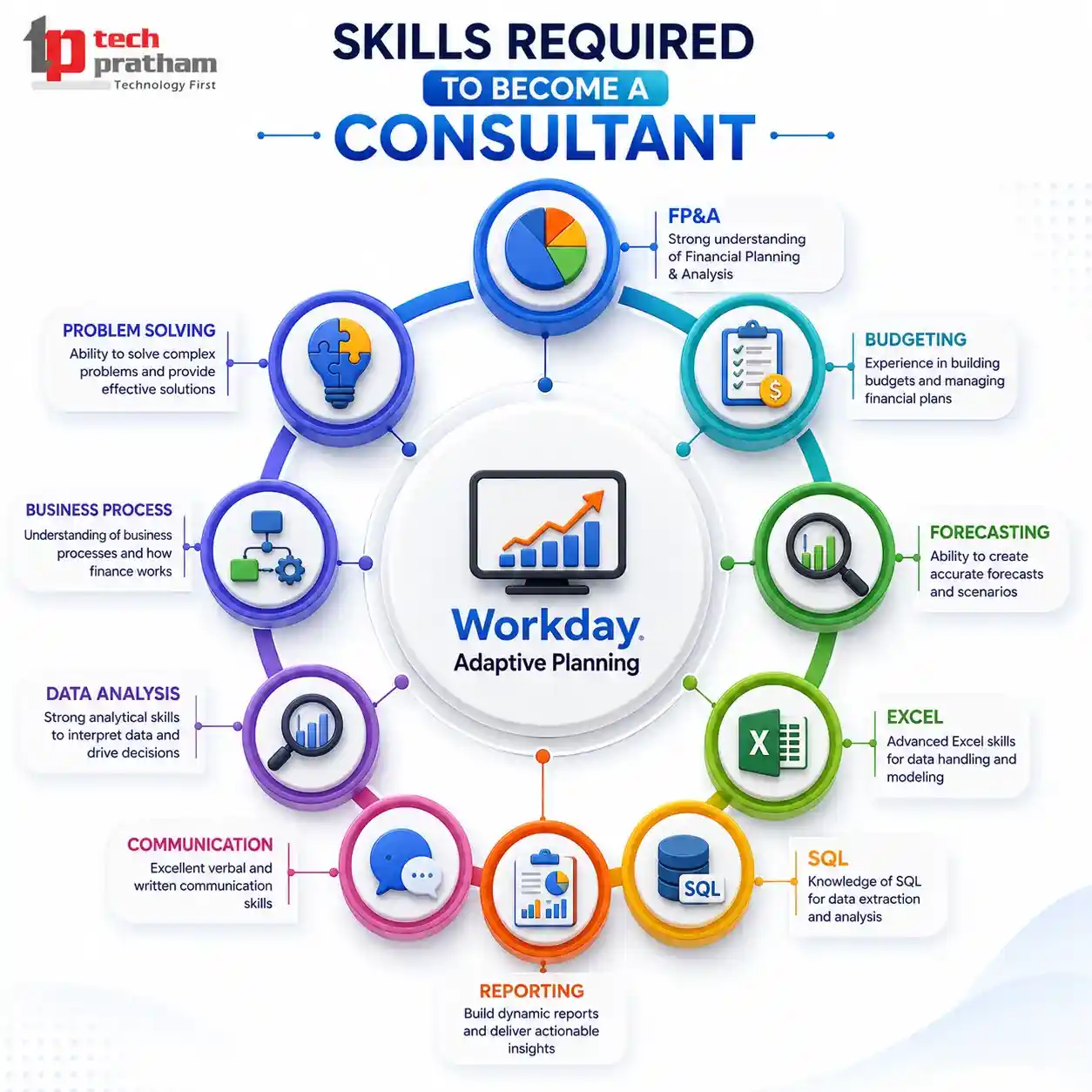
Skills Required to Become a Consultant
Finance skill
A successful Workday Adaptive Planning Consultant needs a strong foundation in finance to build accurate planning models, analyze business performance, and support strategic decision-making. These core finance skills are essential for working with Workday Adaptive Planning.
- Budgeting: Create and manage department and company-wide budgets.
- Forecasting: Develop rolling and driver-based financial forecasts.
- Variance Analysis: Compare budgeted and actual results to identify performance gaps.
- Financial Statements: Understand the Profit & Loss Statement, Balance Sheet, and Cash Flow Statement.
- Cost Centers: Allocate and monitor expenses across departments or business units.
- CAPEX: Plan and manage long-term capital investments.
- OPEX: Budget and control day-to-day operating expenses.
- Revenue Planning: Forecast sales and revenue to support business growth.
- Workforce Planning: Plan headcount, salaries, hiring, and employee costs.
- Cash Flow Planning: Forecast cash inflows and outflows to maintain financial stability.
Mastering these finance concepts, along with Workday Adaptive Planning, will help you build a successful career as a finance planning consultant.
Technical Skills
A successful Workday Adaptive Planning Consultant should have a strong understanding of both financial planning tools and supporting technologies. These technical skills help in implementing solutions, automating workflows, and delivering accurate business insights.
- Workday Adaptive Planning: Learn budgeting, forecasting, planning models, dashboards, and reporting.
- OfficeConnect: Create dynamic reports and presentations using Microsoft Excel, Word, and PowerPoint.
- Integration: Understand how to connect Workday Adaptive Planning with ERP, HR, CRM, and other business applications.
- Microsoft Excel: Build advanced spreadsheets, financial models, PivotTables, and data analysis reports.
- Power BI: Design interactive dashboards and visualize financial performance.
- SQL: Use basic SQL to retrieve, validate, and analyze business data.
- Workday Financial Management: Gain knowledge of Workday's financial modules and their integration with Adaptive Planning.
- ERP Concepts: Understand core ERP processes such as General Ledger (GL), Accounts Payable (AP), Accounts Receivable (AR), and Procurement.
- Data Modeling: Design planning models, dimensions, and calculations for accurate financial planning.
- Reporting: Create financial reports, KPI dashboards, and variance analysis for business decision-making.
Soft Skills
Technical expertise alone isn't enough to become a successful Workday Adaptive Planning Consultant. Strong soft skills help you collaborate with clients, understand business requirements, and deliver successful implementation projects.
- Communication: Clearly explain financial concepts, planning models, and technical solutions to clients and team members.
- Client Management: Build strong relationships, understand client needs, and provide effective solutions.
- Presentation Skills: Present reports, dashboards, and project updates confidently to stakeholders.
- Analytical Thinking: Analyze financial data, identify trends, and recommend data-driven solutions.
- Problem Solving: Resolve planning, reporting, and system configuration issues efficiently.
- Documentation: Prepare clear business requirement documents (BRDs), process documentation, and user guides.
- Stakeholder Management: Collaborate with finance teams, IT departments, and business leaders to ensure successful project delivery.
Educational Qualifications
There is no single degree required to become a Workday Adaptive Planning Consultant, but a background in finance, accounting, business, or technology provides a strong foundation. Employers typically look for candidates who understand financial planning, business processes, and enterprise applications.
The following educational qualifications are well-suited for this career:
- B.Com (Bachelor of Commerce): Ideal for building a strong foundation in accounting, finance, and business.
- BBA (Bachelor of Business Administration): Helps develop business management and financial planning skills.
- MBA Finance: Preferred for advanced roles in FP&A, financial consulting, and business strategy.
- CA (Chartered Accountant): Excellent for professionals with expertise in financial reporting, auditing, and compliance.
- CMA (Certified Management Accountant): Focuses on cost management, budgeting, and performance analysis.
- ACCA (Association of Chartered Certified Accountants): Provides global accounting and financial management knowledge.
- CFA (Chartered Financial Analyst): Beneficial for professionals specializing in financial analysis, investment planning, and corporate finance.
- M.Com (Master of Commerce): Enhances expertise in finance, accounting, and business management.
Workday Adaptive Planning Certification Guide
A Workday Adaptive Planning certification can help you validate your skills and improve your career prospects in finance transformation and enterprise planning. While certification alone doesn't guarantee a job, combining it with hands-on experience and strong FP&A knowledge makes you a more competitive candidate.
Why Certification Matters
Certification demonstrates your understanding of Workday Adaptive Planning concepts, implementation best practices, and financial planning processes. It also helps employers identify professionals who are committed to continuous learning and industry standards.
Understand the Workday Partner Ecosystem
Workday certifications are typically available through Workday-authorized partners and customers. If you're working with a Workday partner or implementation organization, you may have access to official training and certification programs.
Choose the Right Training Path
Select a training program that covers budgeting, forecasting, workforce planning, reporting, dashboards, integrations, and real-world business scenarios. A course with practical assignments and project-based learning will better prepare you for consulting roles.
Gain Hands-on Practice
Practical experience is essential. Build planning models, create reports and dashboards, develop budgeting scenarios, and work on sample implementation projects to strengthen your skills.
Get Implementation Exposure
Participating in real or simulated implementation projects helps you understand requirement gathering, system configuration, testing, user acceptance testing (UAT), deployment, and go-live support—skills that employers highly value.
Commit to Continuous Learning
Step-by-Step Career Roadmap to Become a Workday Adaptive Planning Consultant
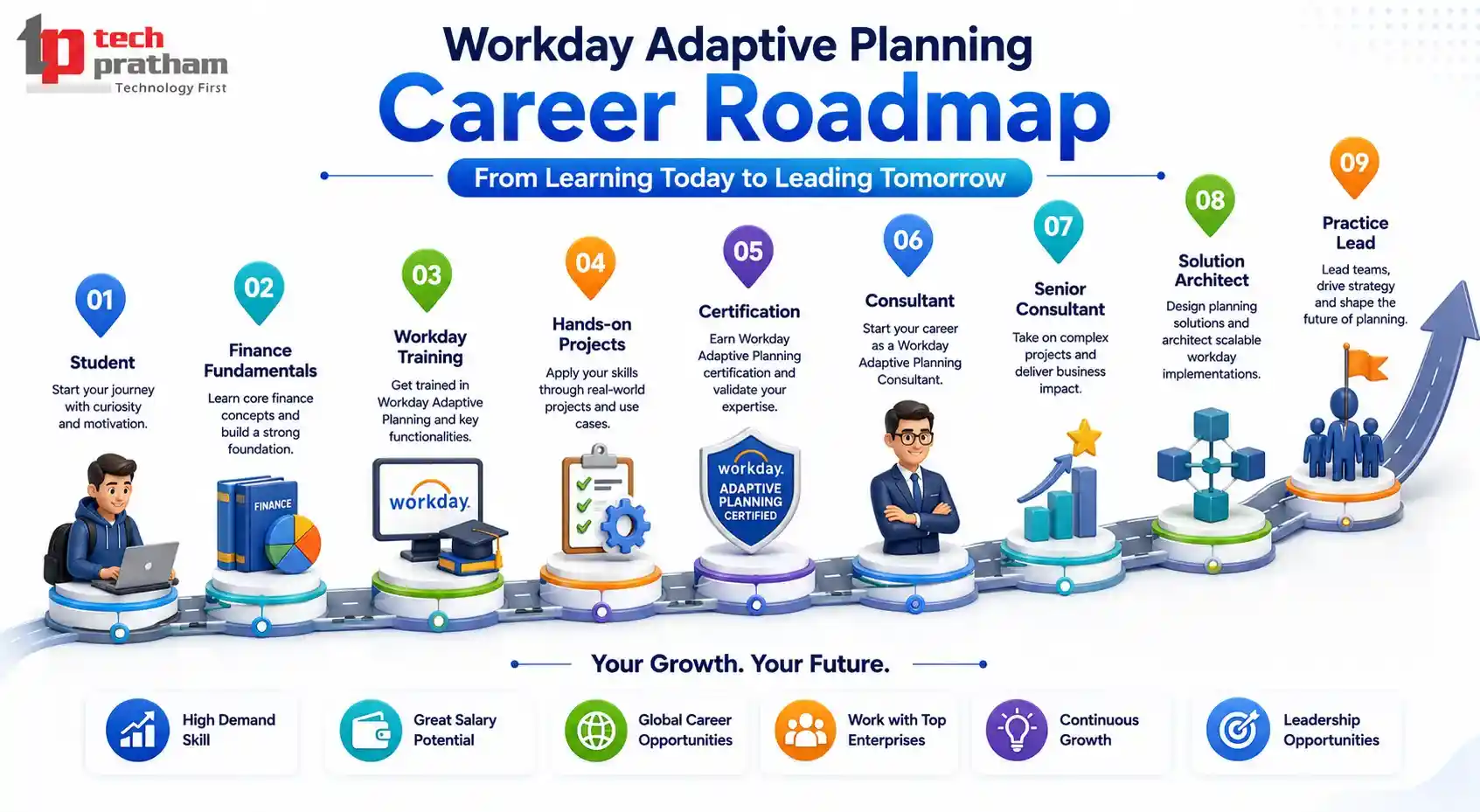
If you're planning to build a career in Workday Adaptive Planning, following a structured learning path will help you develop the right mix of finance knowledge, technical skills, and practical experience.
Step 1: Learn Accounting Fundamentals
Build a strong foundation in accounting concepts such as financial statements, journal entries, balance sheets, and profit & loss statements.
Step 2: Understand FP&A
Learn the core principles of Financial Planning & Analysis (FP&A), including budgeting, forecasting, variance analysis, and financial modeling.
Step 3: Master Microsoft Excel
Develop advanced Excel skills, including formulas, PivotTables, charts, financial models, and data analysis, as Excel remains a key tool for finance professionals.
Step 4: Learn Budgeting
Understand how organizations create, manage, and monitor operational and financial budgets across departments.
Step 5: Learn Forecasting
Study rolling forecasts, driver-based planning, and scenario analysis to predict future business performance accurately.
Step 6: Learn Financial Reporting
Gain knowledge of financial reporting, KPI tracking, variance reports, and management dashboards used by finance teams.
Step 7: Study Workday Adaptive Planning
Learn the platform's core features, including planning models, workforce planning, dashboards, reports, integrations, and security configuration.
Step 8: Practice Real-World Projects
Work on hands-on projects such as budgeting models, workforce planning, financial dashboards, and forecasting scenarios to gain practical experience.
Step 9: Build a Professional Portfolio
Create a portfolio showcasing your projects, reports, dashboards, and implementation case studies to demonstrate your expertise.
Step 10: Obtain Certification
Complete a reputable Workday Adaptive Planning training program and pursue certification opportunities available through authorized channels or partners.
Step 11: Prepare Your Resume
Highlight your finance knowledge, technical skills, certifications, and project experience with a resume tailored for Workday consulting roles.
Step 12: Crack Interviews
Prepare for technical and functional interview questions, practice business scenarios, and strengthen your communication and problem-solving skills.
Step 13: Start Your Career as a Consultant
Industries Hiring Workday Adaptive Planning Consultants
As organizations adopt cloud-based financial planning solutions, the demand for Workday Adaptive Planning Consultants continues to grow across multiple industries. Businesses rely on these professionals to improve budgeting, forecasting, workforce planning, and financial reporting.
Some of the top industries hiring Workday Adaptive Planning professionals include:
- IT Services: Financial planning for projects, resources, and business operations.
- Banking & Financial Services: Budgeting, risk management, and financial performance analysis.
- Healthcare: Workforce planning, cost management, and financial forecasting.
- Manufacturing: Production budgeting, inventory planning, and operational forecasting.
- Retail & E-commerce: Sales forecasting, demand planning, and profitability analysis.
- Telecom: Revenue planning, operational budgeting, and business analytics.
- Consulting Firms: Workday implementation, system configuration, and finance transformation projects.
- Education: Budget management, resource allocation, and financial reporting.
- Pharmaceuticals: R&D budgeting, operational planning, and compliance reporting.
- Logistics & Supply Chain: Cost optimization, transportation budgeting, and demand forecasting.
- SaaS & Technology Companies: Subscription revenue forecasting, workforce planning, and business performance management.
- Energy & Utilities: Capital planning, operational budgeting, and long-term financial forecasting.
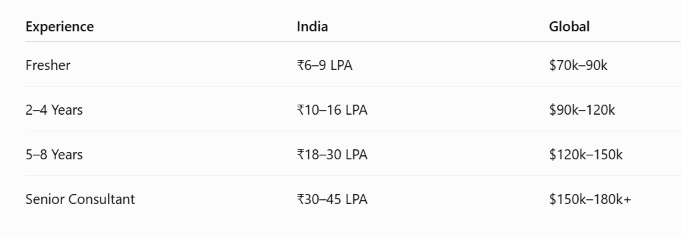
Salary of a Workday Adaptive Planning Consultant in 2026
Create a table similar to:
Career Growth in Workday Adaptive Planning
A career in Workday Adaptive Planning offers excellent long-term growth opportunities. As you gain experience in financial planning, implementation, and consulting, you can progress into senior leadership and finance transformation roles with higher responsibilities and salaries.
Career Overview
- FP&A Analyst: Supports budgeting, forecasting, and financial analysis.
- Adaptive Planning Analyst: Develops planning models, reports, and dashboards using Workday Adaptive Planning.
- Implementation Consultant: Configures and implements Workday Adaptive Planning solutions for clients.
- Senior Consultant: Leads implementation projects and mentors junior consultants.
- Solution Architect: Designs enterprise-wide planning solutions and integration strategies.
- Finance Transformation Consultant: Helps organizations modernize finance processes using cloud technologies.
- Practice Lead: Manages consulting teams, delivery standards, and business growth.
- Delivery Manager: Oversees multiple client engagements, project delivery, and customer success.
Future Scope of Workday Adaptive Planning
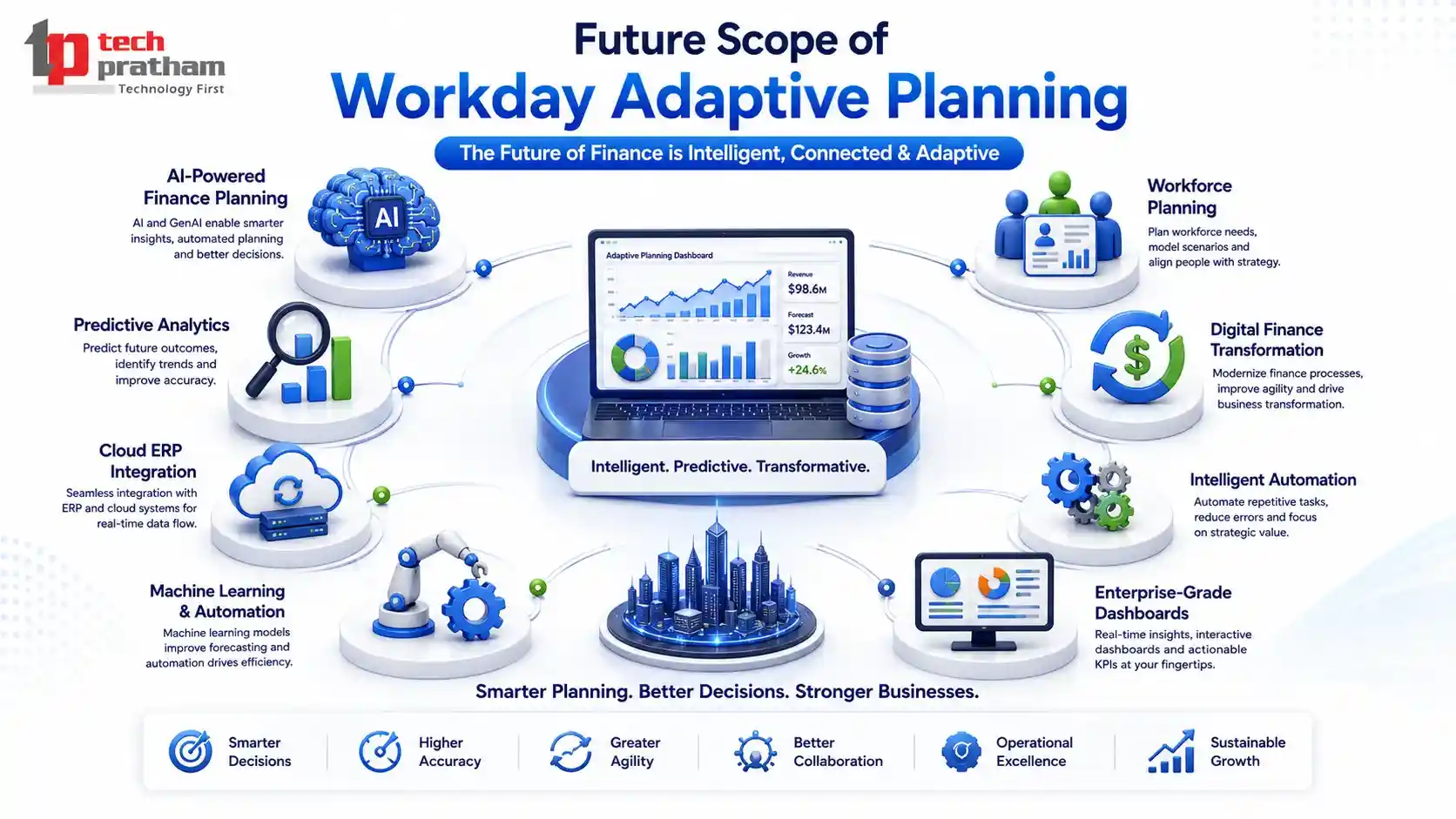
The future of Workday Adaptive Planning looks highly promising as organizations continue to invest in cloud-based financial planning and digital transformation. With the growing adoption of AI, automation, and data-driven decision-making, skilled Workday Adaptive Planning Consultants are expected to remain in high demand across industries.
AI-Powered Planning
Businesses are increasingly using AI to automate financial planning, identify trends, and generate smarter business insights, making finance teams more efficient.
Predictive Forecasting
Organizations are shifting from traditional forecasting to predictive forecasting, enabling more accurate financial projections based on historical and real-time data.
Driver-Based Planning
Companies are adopting driver-based planning to create flexible financial models that quickly adapt to changes in revenue, expenses, and market conditions.
Integrated Business Planning (IBP)
Modern enterprises are connecting finance, HR, sales, and operations through integrated business planning, improving collaboration and strategic decision-making.
Workforce Analytics
As workforce costs continue to rise, organizations rely on advanced workforce analytics to optimize hiring, compensation, and resource planning.
Enterprise Performance Management (EPM)
The demand for cloud-based Enterprise Performance Management (EPM) solutions is increasing, making Workday Adaptive Planning a critical tool for budgeting, forecasting, reporting, and business performance management.
Increasing Cloud Adoption
More organizations are replacing legacy systems and spreadsheets with cloud-based planning platforms, creating strong demand for Workday Adaptive Planning professionals.
Rising Demand for Finance Transformation Professionals
Conclusion
Frequently Asked Questions (FAQs)
1. What is Workday Adaptive Planning?
Workday Adaptive Planning is a cloud-based Enterprise Performance Management (EPM) solution that helps organizations streamline budgeting, forecasting, workforce planning, financial reporting, and business analytics. It enables finance teams to collaborate in real time and make faster, data-driven decisions.
2. Is Workday Adaptive Planning a good career in 2026?
Yes. Workday Adaptive Planning is one of the fastest-growing careers in finance and ERP consulting. As more organizations adopt cloud-based financial planning solutions, the demand for skilled consultants continues to increase, offering excellent salary packages and global career opportunities.
3. How long does it take to learn Workday Adaptive Planning?
The learning time depends on your background. Professionals with finance or ERP experience can gain a solid understanding in 2–4 months, while beginners may take 4–6 months with consistent learning and hands-on practice.
4. Do I need a finance background to learn Workday Adaptive Planning?
A finance background is helpful but not mandatory. Candidates from Computer Science, IT, or engineering can also learn Workday Adaptive Planning if they understand basic accounting, budgeting, and financial planning concepts.
5. What skills are required for a Workday Adaptive Planning Consultant?
A successful consultant should have knowledge of budgeting, forecasting, FP&A, financial reporting, Microsoft Excel, Workday Adaptive Planning, OfficeConnect, data modeling, ERP concepts, SQL, Power BI, and strong communication and problem-solving skills.
6. Is certification necessary for getting a job?
Certification is not mandatory, but it adds credibility to your profile. Employers also value hands-on project experience, finance knowledge, and practical implementation skills alongside certification.
Related Articles

How Can Non-IT Professionals Start a Career in Workday HCM?
Learn how non-IT professionals can enter Workday HCM, build relevant skills, gain practical experience, and explore suitable career opportunities.
What Are the Different Workday Modules and What Does Each One Do?
Explore Workday modules, their functions, how they work together, and which specialization may suit your skills and career goals.
How Does Workday HCM Help HR Teams Manage the Employee Lifecycle?
Learn how Workday HCM connects recruitment, onboarding, talent, learning, workforce management, analytics, and employee development.





 +91-8882178896
 +1 (343) 477-0926