
Agentic AI
179 min read728 viewsAgentic AI Architecture: Components, Workflow & Use Cases
By TechPratham TeamPublished August 22, 2026Updated August 26, 2026
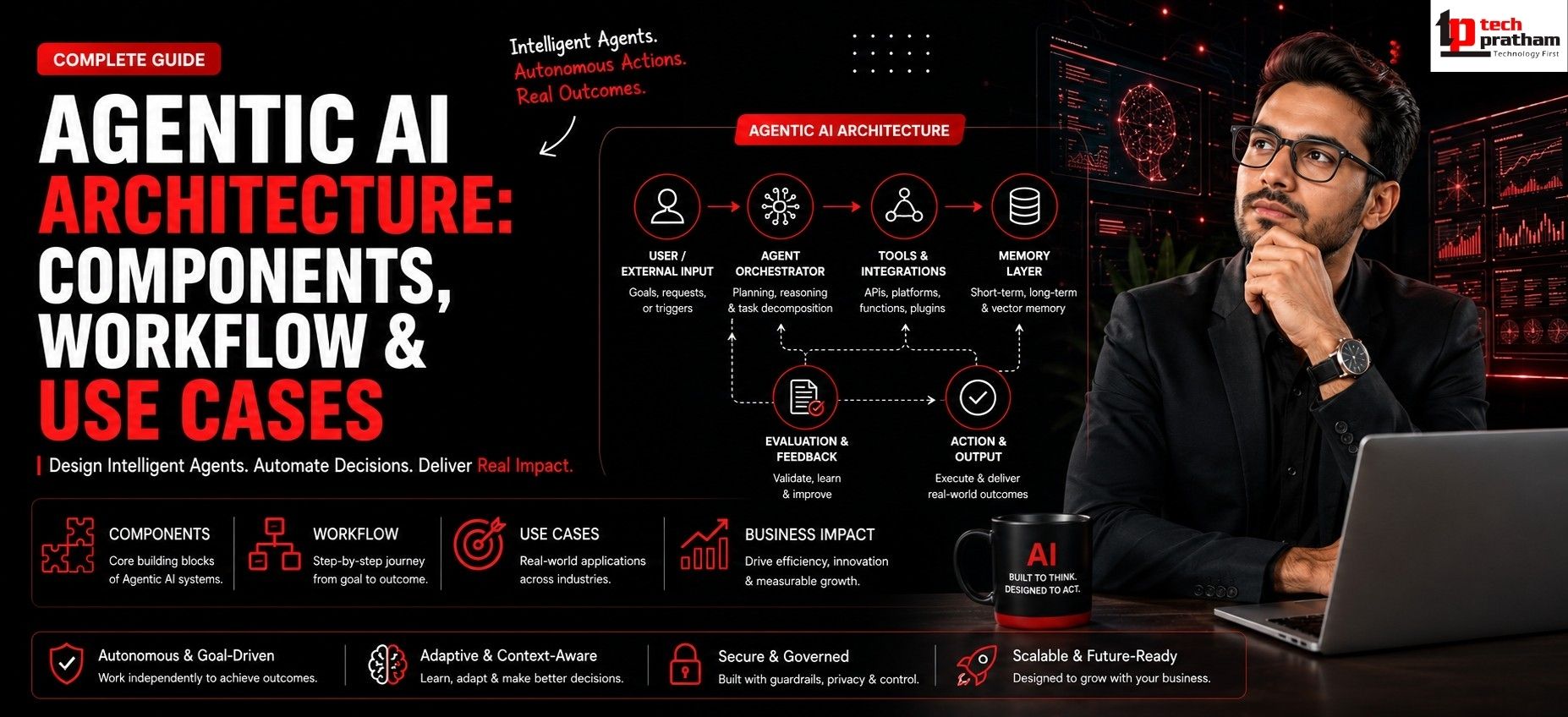
Agentic AI is changing how organizations design AI systems that can move beyond generating responses and perform multi-step tasks toward defined goals. Unlike a traditional chatbot that primarily responds to a prompt, an AI agent can interpret an objective, plan tasks, retrieve information, use tools, execute actions, and evaluate results within defined boundaries.
As organizations explore AI agents for enterprise automation, research, customer service, software development, operations, knowledge management, and other workflows, understanding Agentic AI architecture has become increasingly important.
This guide explains the major components of an AI agent architecture, how an agentic AI workflow operates, and how technologies such as RAG, memory, MCP, tools, orchestration, and multi-agent systems fit into modern agentic applications.
What Is Agentic AI Architecture?
Agentic AI architecture is the design of the components and workflows that allow an AI agent to understand a goal, reason about the required steps, access relevant information, use tools, execute actions, and evaluate the outcome.
A typical agentic AI architecture can include:
- AI models
- Planning and reasoning
- Context management
- Retrieval-Augmented Generation (RAG)
- Agent memory
- Tools and APIs
- Workflow orchestration
- Multi-agent collaboration
- Security and access control
- Evaluation
- Monitoring and observability
- Governance
- Production infrastructure
The exact architecture depends on the business problem, required level of autonomy, available data, tools, security requirements, and operational environment.
Key Components of an Agentic AI Architecture
1. AI Model Layer
The AI model provides the language and reasoning capabilities required by the agent. Depending on the application, an agent may use a large language model or another specialized model to interpret instructions, analyze context, generate plans, select tools, and produce outputs. However, the model alone is not the complete agent. A production agentic system generally requires additional components for knowledge access, memory, tool execution, orchestration, security, evaluation, and monitoring.
2. Agent Planning and Reasoning
The planning layer helps an agent break a larger objective into manageable tasks.
For example, an enterprise research agent may need to:
- Understand the research objective.
- Identify the information required.
- Retrieve relevant knowledge.
- Use approved tools.
- Analyze the collected information.
- Produce a structured result.
- Request human approval when required.
This planning-and-execution loop is one of the important characteristics of agentic workflows. For organizations building these systems, understanding the complete AI agent development lifecycle is important—from defining the objective and architecture to testing and production deployment.
3. Context Management
AI agents need the right context at the right time.
Context can include:
- User instructions
- Previous interactions
- Retrieved documents
- Business rules
- Tool results
- Workflow state
- User or organizational information
Effective context management helps an agent avoid irrelevant information while maintaining the information required to complete a task.
4. RAG and Enterprise Knowledge
Many AI agents need access to organizational information that is not available in a model's general knowledge. This is where Retrieval-Augmented Generation (RAG) becomes useful.
A RAG-based architecture can retrieve relevant information from:
- Internal documents
- Knowledge bases
- Policies
- Product information
- Databases
- Enterprise search systems
- Approved business applications
The retrieved information can then be provided as context to the agent. For enterprise systems, retrieval should also consider permissions, metadata, data access policies, and knowledge quality.
5. AI Agent Memory
Memory allows an AI agent to retain relevant information across interactions or workflow steps.
Depending on the use case, an agentic system may use:
- Short-term memory
- Long-term memory
- Persistent memory
- Conversation context
- Workflow state
For enterprise implementations, memory should not simply store everything. Organizations need to consider retention, security, access controls, data protection, and context isolation. This makes AI agent memory an architectural component rather than simply a feature added to a chatbot.
6. Tools, APIs and MCP
An agent becomes more useful when it can interact with external systems and perform controlled actions.
Tools can allow agents to:
- Query databases
- Call APIs
- Search approved information sources
- Update business systems
- Trigger workflows
- Perform calculations
- Retrieve operational information
Model Context Protocol (MCP) provides a standardized approach for connecting AI applications and agents with tools and external capabilities. In enterprise environments, tool access should be controlled through appropriate permissions and security boundaries.
7. Agent Orchestration
Orchestration determines how different tasks, tools, agents, and workflow steps work together.
An agentic workflow may contain:
- Sequential execution
- Parallel execution
- Conditional routing
- Task delegation
- Human approvals
- Event-driven actions
- Agent handoffs
For example, an enterprise operations workflow could receive a request, retrieve business information, determine an appropriate action, call an approved application, and route sensitive decisions to a human employee.
8. Multi-Agent Architecture
Some complex problems can be divided among specialized agents.
Instead of using one general-purpose agent, organizations can create specialized agents such as:
- Research Agent
- Data Analysis Agent
- Customer Service Agent
- Operations Agent
- Compliance Agent
- Reporting Agent
A supervisor or orchestration layer can coordinate these agents. Multi-agent architecture can be useful when different responsibilities require different tools, knowledge sources, workflows, or specialized capabilities. However, adding more agents also increases architectural complexity. Organizations should use multi-agent designs when the problem actually benefits from specialization and coordination.
How Does an Agentic AI Workflow Work?
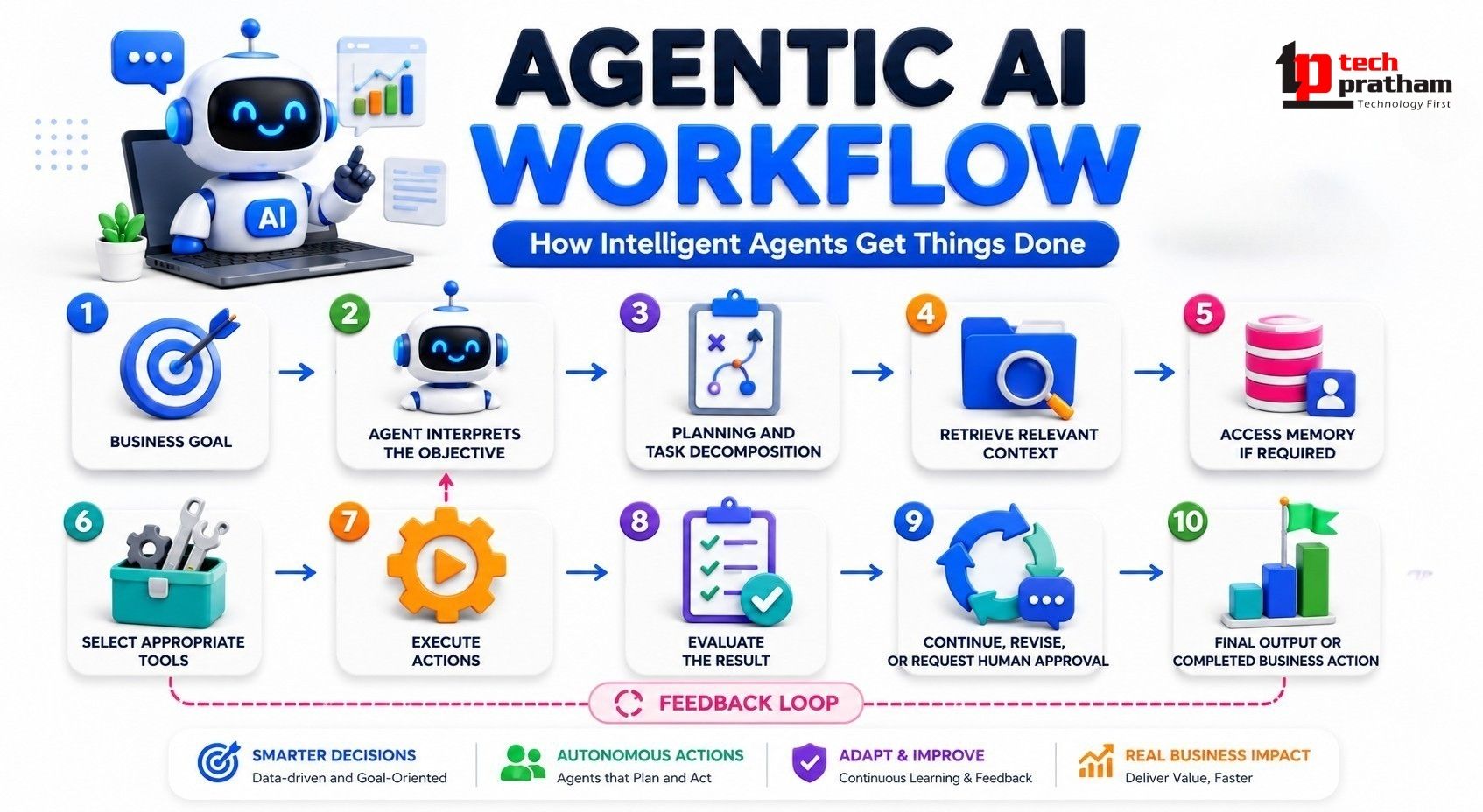
A simplified agentic AI workflow can look like this:
Business Goal
↓
Agent interprets the objective
↓
Planning and task decomposition
↓
Retrieve relevant context
↓
Access memory if required
↓
Select appropriate tools
↓
Execute actions
↓
Evaluate the result
↓
Continue, revise, or request human approval
↓
Final output or completed business action
This workflow allows AI agents to handle multi-step tasks rather than simply responding to a single prompt.
Agentic AI vs Traditional Automation
Traditional automation usually follows predefined rules and workflows.
For example:
Trigger → Rule → Action
An agentic workflow can be more adaptive:
Goal → Understand → Plan → Retrieve → Decide → Use Tools → Execute → Evaluate
This does not mean agentic AI should replace every traditional automation workflow. For deterministic and highly predictable tasks, conventional automation may still be more appropriate. Agentic AI becomes particularly useful when workflows involve changing context, multiple information sources, reasoning, tool selection, or complex decisions.
Enterprise Agentic AI Architecture
Enterprise environments introduce additional requirements.
A production enterprise AI agent may need:
A production enterprise AI agent may need:
- Identity management
- Authentication
- Authorization
- Role-based access control
- Least-privilege tool access
- Data protection
- Audit logging
- Human oversight
- AI governance
- Evaluation
- Monitoring
- Observability
- Reliability
- Cost controls
- Scalability
Security should therefore be considered during architecture design rather than added after the agent has already been developed. For example, an AI agent that can access a CRM, financial system, internal documents, and external APIs should not automatically receive unrestricted access to all of them. Each tool and data source should have clearly defined permissions. For a deeper look at enterprise-focused agentic systems, see the Enterprise AI Agents Course.
Common Enterprise Use Cases for AI Agents
Customer Service
AI agents can retrieve approved knowledge, understand customer requests, use business tools, maintain context, and escalate sensitive cases to human teams.
Enterprise Knowledge Management
Knowledge agents can retrieve relevant organizational information and provide grounded responses while respecting access permissions.
Operations Automation
Agents can interpret operational requests, retrieve information, coordinate tools, and route tasks through defined workflows.
Research and Analysis
Research agents can combine information retrieval, memory, tools, and structured workflows to support business research.
Document Workflows
AI agents can help process documents, extract information, retrieve related knowledge, and route tasks for approval.
Software and IT Operations
Agents can assist with development workflows, troubleshooting, documentation, monitoring, and controlled operational tasks.
Challenges in Building Agentic AI Systems
Despite their potential, agentic AI systems introduce new engineering and governance challenges.
Security
Agents can interact with sensitive information and external systems, so authentication, authorization, permissions, and secure tool execution are essential.
Reliability
An agent may make an incorrect decision, select an inappropriate tool, or fail during a multi-step workflow. Systems therefore need evaluation, monitoring, testing, and failure handling.
Cost and Latency
Multiple model calls, retrieval operations, tool calls, and agent interactions can increase cost and latency. Architecture should therefore consider model selection, workflow optimization, caching, and efficient orchestration.
Governance
Organizations need policies covering data usage, model behavior, agent permissions, human oversight, auditing, risk management, and compliance.
Observability
Production teams need visibility into what an agent did, which tools it used, what information it retrieved, where failures occurred, and how long each workflow step took.
Best Practices for Designing Agentic AI Architecture
When designing an agentic AI system, organizations should:
- Start with a clearly defined business problem.
- Determine whether the workflow actually requires agentic behavior.
- Define the agent's responsibilities and boundaries.
- Provide only the context and tools required for the task.
- Use RAG when agents need access to changing or private knowledge.
- Design memory according to the actual business requirement.
- Apply least-privilege access to tools and data.
- Include human approval for sensitive actions.
- Establish evaluation metrics before production deployment.
- Implement observability and monitoring.
- Test failure scenarios and unexpected tool behavior.
- Establish governance and operational controls.
- Optimize cost, latency, scalability, and reliability.
- Start with a controlled workflow before increasing autonomy.
Agentic AI Architecture: From Prototype to Production
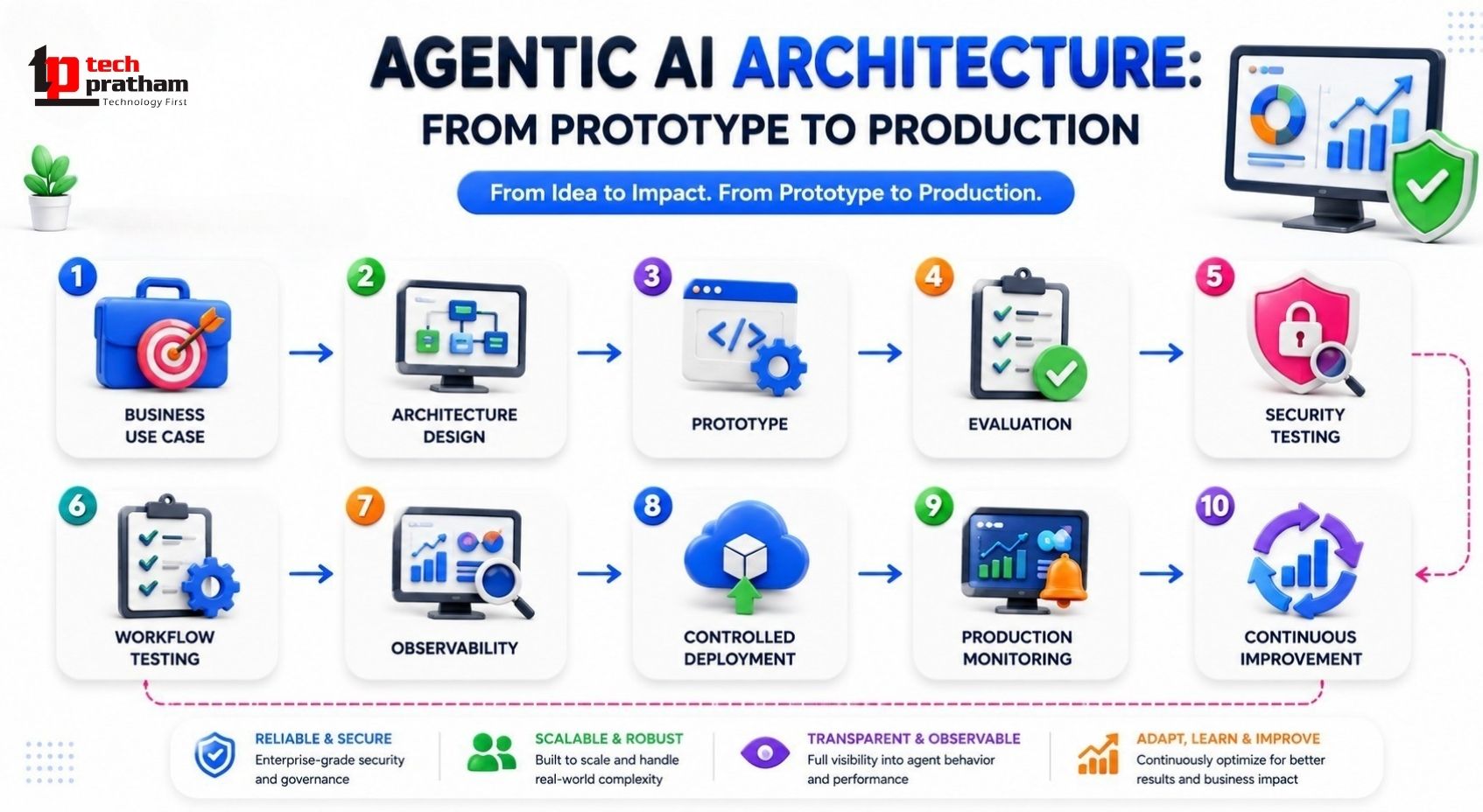
Building a prototype is only the first stage.
A production-ready AI agent requires a broader lifecycle:
Business Use Case
↓
Architecture Design
↓
Prototype
↓
Evaluation
↓
Security Testing
↓
Workflow Testing
↓
Observability
↓
Controlled Deployment
↓
Production Monitoring
↓
Continuous Improvement
This approach helps organizations move from experimental AI agents toward reliable enterprise systems.
Frequently Asked Questions
Q : What is Agentic AI architecture?
Ans : Agentic AI architecture is the design of components that enable AI agents to understand objectives, plan tasks, access context and knowledge, use tools, execute workflows, and evaluate results.
Q : What are the main components of an AI agent architecture?
Ans : Common components include AI models, planning and reasoning, context management, RAG, memory, tools and APIs, orchestration, security, evaluation, observability, and governance.
Q : What is the role of RAG in Agentic AI?
Ans : RAG allows agents to retrieve relevant information from external or organizational knowledge sources and use that information as context when completing tasks.
Q : Why is memory important for AI agents?
Ans : Memory can help agents maintain relevant context across interactions and workflows. Enterprise implementations should also consider retention, security, permissions, and data boundaries.
Q : What is MCP in Agentic AI?
Ans : MCP, or Model Context Protocol, provides a standardized approach for connecting AI applications and agents with tools and external capabilities.
Q : What is the difference between an AI agent and a chatbot?
Ans : A chatbot primarily focuses on conversational responses, while an AI agent can be designed to interpret goals, plan tasks, use tools, retrieve information, and execute multi-step workflows within defined boundaries.
Q : When should businesses use multi-agent systems?
Ans : Multi-agent systems can be useful when a complex business problem naturally divides into specialized responsibilities that require different tools, knowledge, or workflows.
Conclusion
Agentic AI architecture brings together models, reasoning, planning, context, knowledge, memory, tools, orchestration, security, evaluation, and governance to create AI systems capable of completing complex tasks.
For organizations, the goal should not simply be to make an AI agent more autonomous. The objective should be to build an agent that is useful, reliable, secure, observable, governable, and aligned with a clearly defined business workflow.
As enterprises move from AI experimentation toward production systems, understanding these architectural components becomes increasingly important for designing scalable and responsible agentic AI solutions.
Recommended Learning
If you want to build a strong foundation in agentic AI concepts and technologies, explore the Master in Agentic AI course at TechPratham.
Related Articles
Agentic AI
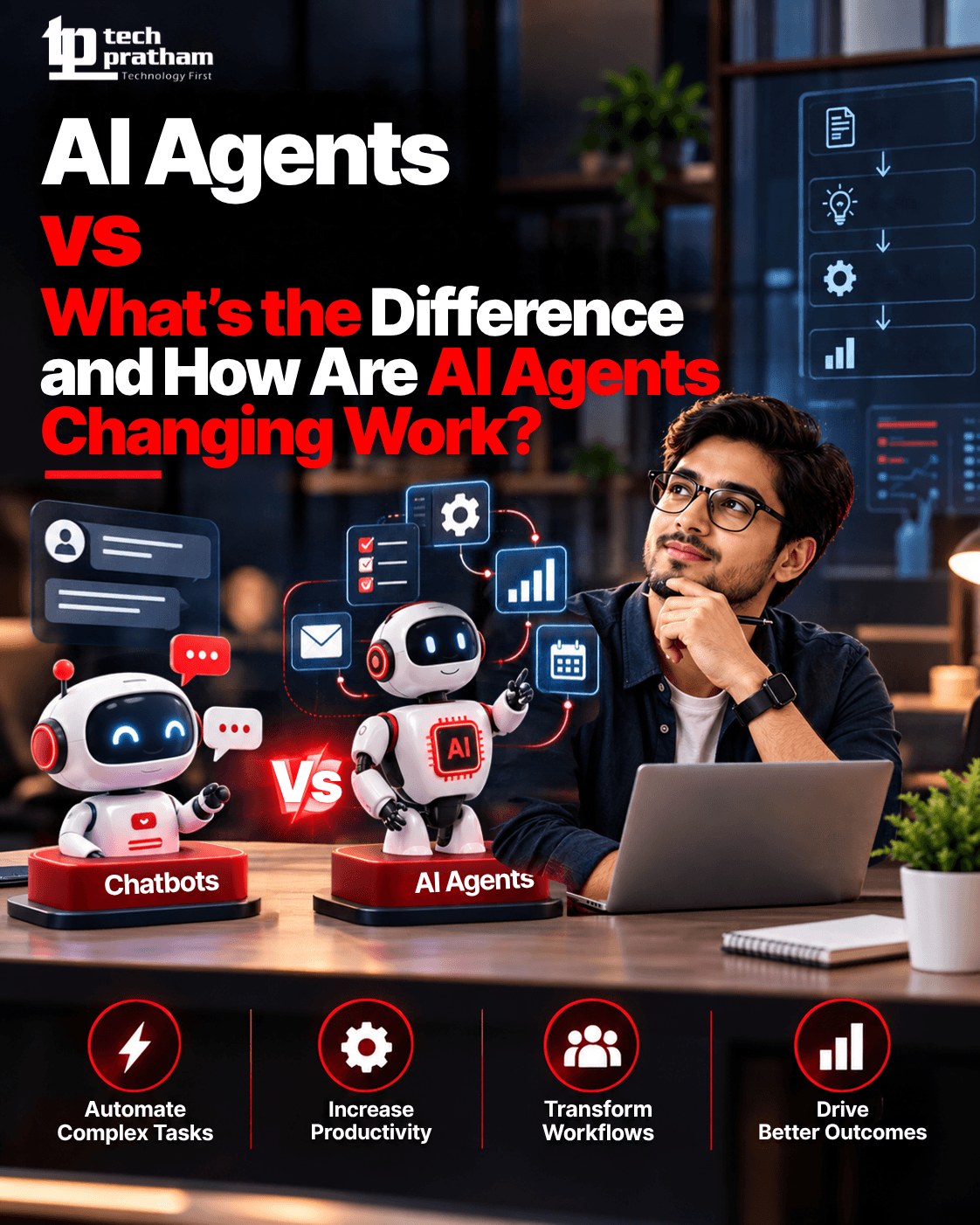
AI Agents vs Chatbots: What’s the Difference and How Are AI Agents Changing Work?
Compare AI agents and chatbots, understand how AI agents work, their business applications, required skills, career opportunities and learning roadmap

Agentic AI
How to Become an Agentic AI Expert: Complete Learning Path, Essential Skills & Career Guide
Learn Agentic AI from scratch with this complete guide covering skills, certifications, career paths, and the best Agentic AI course in India.





 +91-8882178896
 +1 (343) 477-0926