
Data Analytics vs Data Science Certification: Which Should You Choose in 2026?
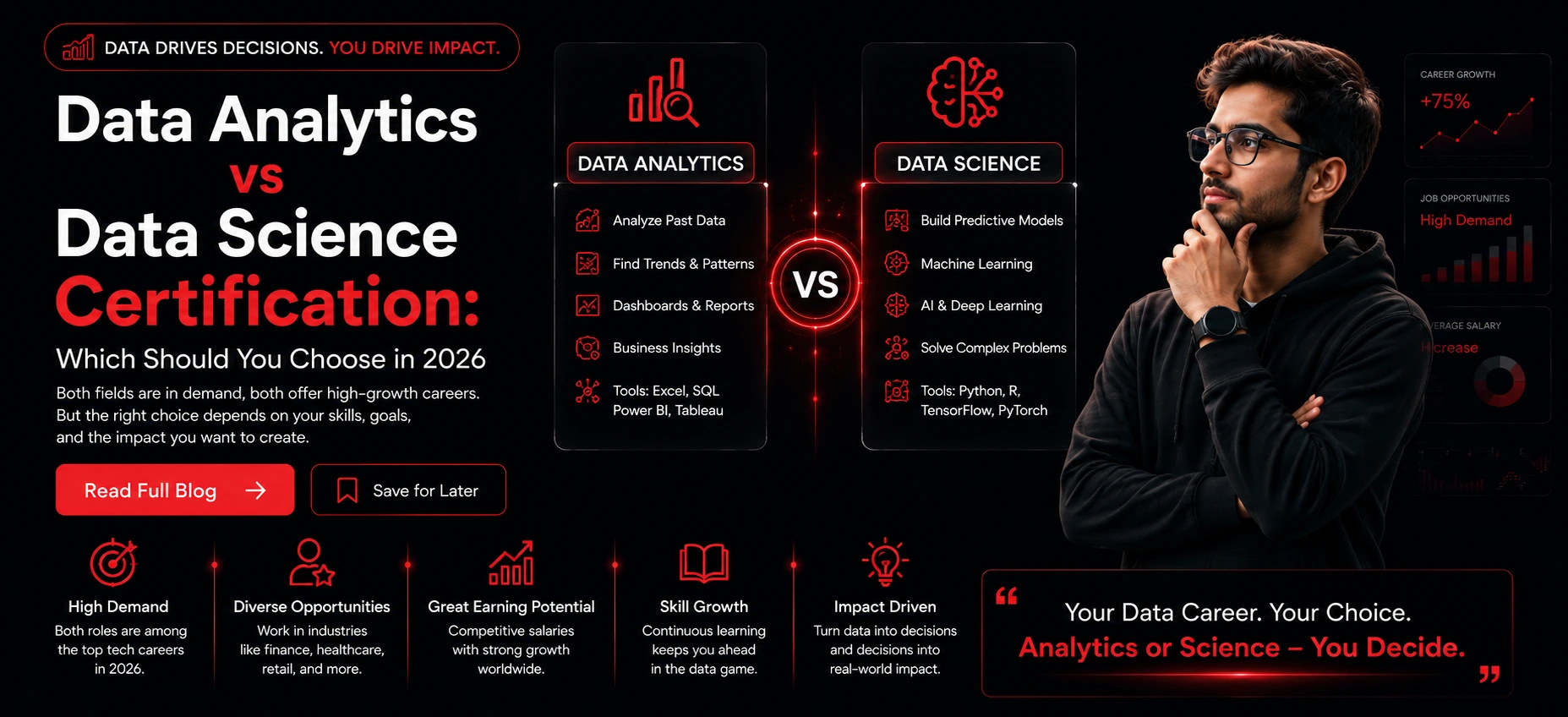
However, one question continues to appear in search results, online communities, and career forums: Which certification should you choose in 2026—Data Analytics or Data Science? For beginners and career changers, starting with a Data Analytics Course is often a practical choice because it provides a strong foundation in Excel, SQL, Power BI, data visualization, and business reporting. Many learners also prefer enrolling in Data Analytics Certification Training in India to gain structured learning, hands-on projects, and guidance from industry experts before advancing to more specialized fields like Data Science. Whether you are considering an Online Data Analytics Course, searching for the Best Data Analytics Course, or comparing career options before investing in professional training, understanding the differences between these two certifications is essential.
Data Analytics vs Data Science
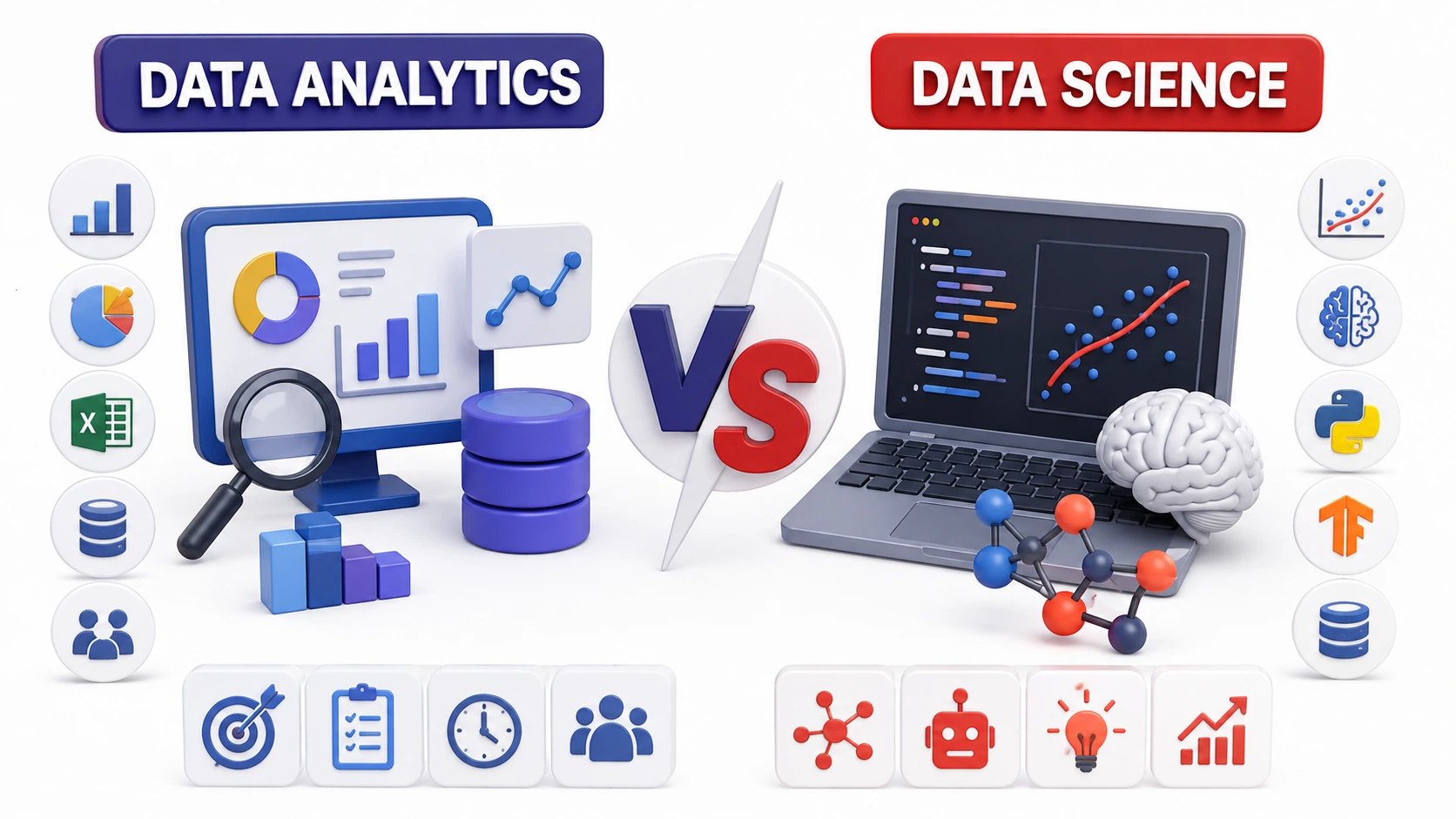
Before choosing between a Data Analytics Certification and a Data Science Certification, it is important to understand how these two fields are connected and where they differ. Many beginners assume that Data Analytics and Data Science are the same because both fields work with data. However, the purpose, tools, responsibilities, and career paths are different.
A business usually needs Data Analysts to answer questions such as:
- What happened in the business?
- Why did sales decrease?
- Which products are performing well?
- Which customer segments generate more revenue?
A Data Scientist works on more complex questions like:
- What is likely to happen in the future?
- Can we predict customer behavior?
- Can we automate decision-making using AI models?
- Can machine learning improve business processes?
Both roles are valuable, but the right choice depends on your background, career goals, and the type of work you enjoy.
What Does a Data Analyst Do?
A Data Analyst helps organizations convert raw data into meaningful information that supports business decisions. Their primary responsibility is collecting, cleaning, analyzing, and presenting data in a way that business teams can easily understand.
A typical Data Analyst works with:
- Sales data
- Customer information
- Marketing performance data
- Financial reports
- Operational data
A Data Analyst Course generally focuses on building practical skills such as:
- Advanced Excel
- SQL
- Data Cleaning
- Data Visualization
- Power BI
- Tableau
- Basic Statistics
- Dashboard Development
- Business Intelligence Concepts
These skills are highly valuable because almost every industry requires professionals who can understand and communicate data effectively.
What Does a Data Scientist Do?
A Data Scientist works on more advanced analytical problems by combining programming, statistics, mathematics, and machine learning. Instead of only analyzing past data, Data Scientists build models that can predict future trends.
A Data Scientist commonly works with:
- Python
- Machine Learning
- Artificial Intelligence
- Deep Learning
- Statistical Modeling
- Big Data Technologies
- Predictive Analytics
Because of the advanced mathematical and programming requirements, Data Science usually requires a stronger technical foundation compared to Data Analytics.
Key Difference Between Data Analytics and Data Science
After gaining experience in analytics, professionals can gradually move toward Data Science by learning Python, machine learning, and advanced statistics. On the other hand, students with strong programming backgrounds, mathematics knowledge, and interest in artificial intelligence may directly explore Data Science.
Data Analytics vs Data Science: Which One Has Better Career
Choosing between Data Analytics and Data Science is not only about learning tools and technologies; it is also about understanding career opportunities, industry demand, and long-term growth. In 2026, organizations across industries are becoming increasingly data-driven, creating opportunities for professionals who can convert raw information into valuable business insights.
Career Opportunities After Data Analytics Certification
A Data Analyst works as a bridge between raw data and business teams. They help organizations understand performance, identify opportunities, and improve processes through data-driven insights. After completing a professional Data Analytics Certification Training in India, learners can explore multiple career opportunities such as:
- Data Analyst
- Business Intelligence Analyst
- Reporting Analyst
- Marketing Analyst
- Operations Analyst
The biggest advantage of Data Analytics is that it allows professionals from different educational backgrounds to enter the field. With the right skills, even non-technical professionals can transition into analytics careers.
Career Opportunities After Data Science Certification
- Data Scientist
- Machine Learning Engineer
- Artificial Intelligence Engineer
- Data Science Consultant
Because of these requirements, Data Science is often considered a more advanced career path compared to Data Analytics.
Data Analytics vs Data Science Salary Comparison in India
Salary depends on multiple factors, including experience, location, technical skills, industry, and company size.
Data Analyst Salary Range
A Data Analyst in India can earn an average salary of around ₹4 LPA to ₹10 LPA at the entry and mid-level stages. Freshers with skills in SQL, Excel, Power BI, Python, and data visualization tools can start with competitive packages, while experienced professionals can earn higher salaries based on their expertise.
- Fresher Data Analyst: ₹5 LPA – ₹8 LPA
- Senior Data Analyst: ₹8 LPA – ₹15 LPA
- Business Intelligence Developer: ₹7 LPA – ₹16 LPA
- Analytics Consultant: ₹10 LPA – ₹20 LPA
- Analytics Manager: ₹15 LPA – ₹30 LPA
Data Scientist Salary Range
Data Scientists generally command higher salaries because the role requires advanced skills in machine learning, AI, and programming. However, reaching these positions usually requires:
- Entry-Level Data Scientist: ₹8 LPA – ₹15 LPA
- Data Scientist: ₹12 LPA – ₹25 LPA
- Senior Data Scientist: ₹20 LPA – ₹40 LPA
- Machine Learning Engineer / AI Specialist: ₹15 LPA – ₹50 LPA+
Which Career Path Is More Suitable for Freshers?
A well-designed Online Data Analytics Course can help beginners learn essential tools, complete practical projects, and develop confidence before applying for jobs. For fresh graduates and career switchers, Data Analytics is often the better entry point because:
- Learning requirements are more beginner-friendly
- More entry-level roles are available
- Skills can be developed faster
- Business knowledge is highly valued
- Portfolio projects can demonstrate capability
Professionals who enjoy mathematics, programming, and solving complex technical problems can gradually move from analytics into Data Science after building a strong foundation
Data Analytics vs Data Science: Learning Roadmap
Many learners follow this roadmap through a structured Data Analytics Course in India because guided learning helps them practice industry-based projects instead of only learning theory. Understanding the learning journey makes it easier to choose the right path.
Data Analytics Learning Roadmap
A beginner-friendly Data Analytics roadmap generally includes:
Step 1: Excel Fundamentals
- Advanced formulas
- Data cleaning
- Pivot tables
- Reporting
Step 2: SQL
- Queries
- Joins
- Database concepts
Step 3: Statistics Basics
- Data interpretation
- Business metrics
Step 4: Data Visualization
- Power BI
- Dashboard creation
- Data storytelling
Step 5: Real-World Projects
- Sales analysis
- Customer analytics
- Financial dashboards
- Business reports
Data Science Learning Roadmap
A typical Data Science roadmap includes:
Step 1: Programming Fundamentals
- Python
- Data structures
- Programming logic
Step 2: Statistics and Mathematics
- Probability
- Statistical methods
- Mathematical concepts
Step 3: Data Processing
- Data cleaning
- Feature engineering
- Data preparation
Step 4: Machine Learning
- Supervised learning
- Unsupervised learning
- Model evaluation
Step 5: Advanced Projects
- Predictive models
- AI applications
- Machine learning solutions
Which Career Has Better Long-Term Growth
Both careers have excellent future potential.
Future of Data Analytics
The demand for Data Analysts will continue growing because businesses will always need professionals who can understand performance, analyze trends, and support decision-making. Future Data Analysts will increasingly work with:
- Artificial Intelligence tools
- Automated reporting
- Advanced visualization platforms
- Business intelligence systems
Future of Data Science
Companies investing in AI solutions will require professionals who can develop and maintain intelligent systems. Data Science will continue expanding due to advancements in:
- Artificial Intelligence
- Machine Learning
- Automation
- Predictive analytics
However, Data Science careers will continue to require deeper technical skills and continuous learning.
Frequently Asked Questions
Is Data Analytics easier to learn compared to Data Science?
Data Analytics is generally considered easier for beginners because it requires less programming and focuses more on data analysis, visualization, and business decision-making. Data Science involves advanced concepts such as machine learning, artificial intelligence, statistics, and programming, which require more technical depth.
Does completing a Data Analytics Certification guarantee a job?
A certification alone does not guarantee employment, but it can significantly improve your career opportunities when combined with practical skills and real-world projects. Employers look for candidates who can solve business problems, create dashboards, analyze data, and communicate insights effectively.
Is Python required for Data Analytics or Data Science?
Python is useful for both fields, but the requirement level is different. Data Scientists generally need strong Python skills because they use it for machine learning, automation, and model development. Data Analysts can start their careers with Excel, SQL, and Power BI, while learning Python later for advanced analytics.
Can I switch my career to Data Analytics after working in another field?
Yes, professionals from different backgrounds can transition into Data Analytics. Many career switchers use their existing industry knowledge along with analytics skills to create new opportunities.
What tools are covered in a Data Analytics Certification Training program?
A professional Data Analytics Certification Training program usually covers tools required in real business environments, including Excel, SQL, Power BI, Tableau, statistics, data visualization, and sometimes Python. The goal is not only to learn tools but also to understand how they are applied to solve business problems through dashboards, reports, and analytical projects.
Conclusion
Both Data Analytics and Data Science offer excellent career opportunities in 2026, but the right choice depends on your skills, interests, and career goals. Data Analytics is often a better starting point for beginners and career switchers as it focuses on practical skills like SQL, Excel, Power BI, data visualization, and business insights. A structured Data Analytics Certification Training in India can help learners gain industry-relevant knowledge, work on real-world projects, and prepare for roles such as Data Analyst and Business Intelligence Analyst. Data Science, on the other hand, is ideal for those interested in programming, machine learning, and artificial intelligence.
Related Articles
How to Switch Your Career to Data Science: A Pathway to a New Career
Learn how to switch your career to Data Science with the right skills, projects, AI knowledge, portfolio and career guidance.
Is Data Science a Good Career? A Complete Guide for Beginners
Is Data Science a good career? Explore career opportunities, skills, roadmap, AI impact, and practical guidance for beginners.

Best Data Science Courses in India: A Complete Guide
Explore the Best Data Science Courses in India and build in-demand skills with industry-focused training and certification.





 +91-8882178896
 +1 (343) 477-0926